
In This Article
Right, let’s settle this once and for all, shall we? If you’ve ever stood in the vacuum aisle feeling completely baffled about whether to grab a cylinder or upright model, you’re not alone. I’ve been there myself, staring at rows of Henry hoovers and wondering if that Dyson upright is really worth the extra quid.
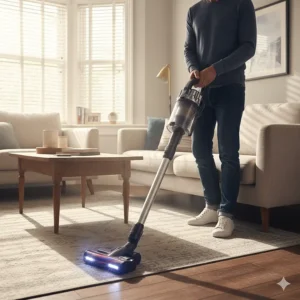
The truth is, the cylinder vs upright vacuum choice isn’t just about what’s on sale. It’s about your home layout, the type of flooring you’ve got, whether you’ve stairs to tackle, and honestly, how much faff you can be bothered with on a Tuesday evening when you just need to quickly blitz the lounge before guests arrive.
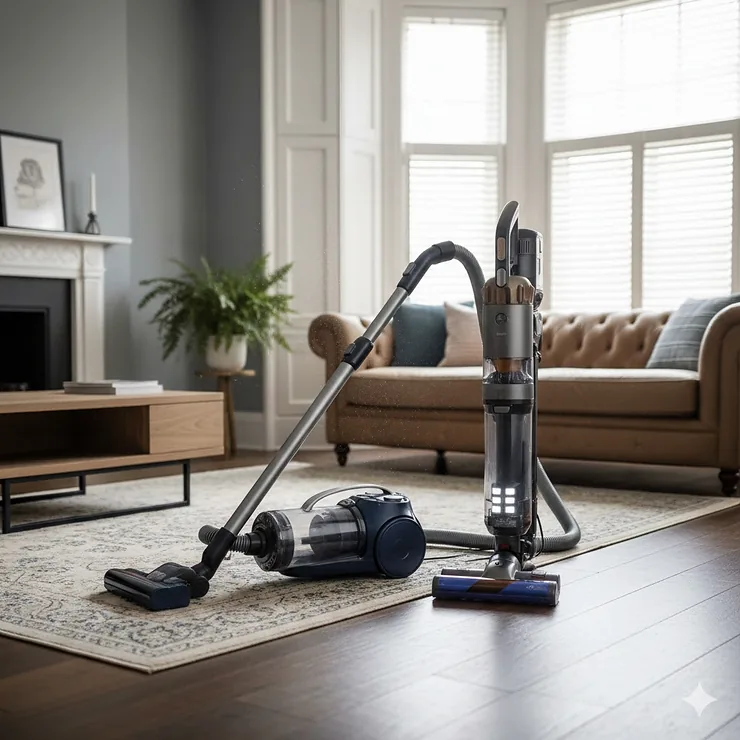
According to the Good Housekeeping Institute, which has tested over 200 vacuum models, both types have distinct advantages. Cylinder vacuums excel at manoeuvrability and reaching awkward spots, whilst uprights dominate when it comes to covering large carpeted areas quickly. In the UK, uprights have traditionally been bestsellers due to our love affair with fitted carpets, though that’s gradually shifting as more homes feature mixed flooring.
Here’s what we’ll cover: the fundamental differences between these vacuum types, seven brilliant models you can actually buy on Amazon.co.uk right now (with real prices in proper British pounds), and practical advice to help you make the right choice for your specific needs. No marketing fluff, just honest guidance based on what actually works in British homes.
Quick Comparison Table
| Feature | Cylinder Vacuum | Upright Vacuum |
|---|---|---|
| Best For | Stairs, under furniture, mixed surfaces | Large carpeted areas, quick cleaning |
| Weight | 4-7kg (body stays on floor) | 4.5-7.5kg (you push entire unit) |
| Storage | Compact, often with cord rewind | Stands upright, needs more height |
| Manoeuvrability | Excellent – lightweight hose | Good – improved with ball/swivel tech |
| Reach | Superior – longer hoses (up to 4m) | Limited by unit size |
| Price Range | £99-£450+ | £120-£500+ |
| Typical Capacity | 1.5-4.5L | 0.8-2.5L |
| Floor Type | All surfaces with attachments | Excellent for carpets with beater bar |
💬 Just one click – help others make better buying decisions too!😊
Top 7 Cylinder vs Upright Vacuum: Expert Analysis
1. Numatic Henry HVR160 (Cylinder)
There’s a reason Henry’s cheerful face has been grinning from cleaning cupboards across Britain since 1981. This iconic cylinder vacuum is built like a tank and performs like a dream.
Key Specifications:
- 620W powerful motor
- 6L dust capacity (massive!)
- 10m cleaning radius
- HEPA filtration available
Price Range: £160-£200
UK buyers consistently praise Henry’s reliability, with many reporting 10+ years of faithful service. The extra-long cable means fewer plug changes, and that enormous capacity means you can hoover the entire house without emptying. Yes, it’s heavier than modern bagless cylinders at around 7.8kg, but the wheels glide smoothly on all surfaces. One Mumsnet reviewer noted: “Had my Miele cat and dog vacuum for years and it’s still powerful, wouldn’t hesitate to replace it with the same model.”
✅ Pros:
- Legendary reliability and build quality
- Huge 6L capacity reduces emptying frequency
- Commercial-grade suction power
❌ Cons:
- Heavier than modern alternatives
- No fancy attachments included as standard
2. Shark NV602UK Lift-Away Upright
Shark has absolutely transformed the UK vacuum market over the past few years, and the NV602UK shows exactly why. This clever upright transforms into a portable cleaner with the press of a button.
Key Specifications:
- 750W motor with lift-away technology
- 1.1L dust capacity
- 8m power cord
- LED headlights
Price Range: £121-£160
The lift-away function is brilliant for stairs – you can detach the main unit and carry just the lightweight canister whilst the brush stays at the bottom. UK customers rave about how this solves the traditional upright limitation. The anti-allergen complete seal captures 99.9% of dust particles, making it excellent for allergy sufferers. One Amazon UK reviewer commented: “Transform your cleaning with this versatile upright vacuum featuring Lift-Away, LED headlights, and an anti-allergen seal.”
✅ Pros:
- Innovative lift-away technology for versatility
- LED headlights illuminate hidden dust
- 5-year guarantee with Shark UK registration
❌ Cons:
- Smaller capacity than traditional cylinders
- Can feel heavy on thick carpets
3. Miele Complete C2 Cat & Dog (Cylinder)
If Henry is the dependable workhorse, Miele is the thoroughbred. This German-engineered cylinder vacuum represents premium quality with a price tag to match.
Key Specifications:
- 890W motor with adjustable power
- 4.5L HyClean dustbag capacity
- Turbo brush for pet hair
- HEPA AirClean filter included
Price Range: £299-£350
Miele’s reputation for longevity is well-deserved – these vacuums routinely last 15-20 years. The turbo brush attachment is genuinely effective on pet hair, and the sealed system with HEPA filtration makes it superb for homes with allergies. According to testing by the Good Housekeeping Institute, Miele vacuums consistently score 85/100 or higher. It’s not cheap, but when you calculate cost per year of ownership, it’s actually quite reasonable.
✅ Pros:
- Outstanding build quality and longevity
- Excellent pet hair removal capability
- Comprehensive attachment set included
❌ Cons:
- Premium pricing
- Replacement bags add ongoing costs
4. Dyson Ball Animal 2+ Upright
Love them or hate them, Dyson revolutionised vacuum design, and the Ball Animal 2+ represents their upright expertise. That ball technology isn’t just for show – it genuinely improves manoeuvrability.
Key Specifications:
- Radial Root Cyclone technology
- 1.8L bagless capacity
- Self-adjusting cleaner head
- Whole-machine HEPA filtration
Price Range: £250-£320
The self-adjusting head automatically adapts between carpets and hard floors, maintaining optimal suction. Ball technology means you can steer around furniture with just a gentle twist of your wrist. However, some UK users report it can be quite heavy to push, especially on deep-pile carpets. The hygienic bin emptying is brilliant – just press a button and the dirt drops out without touching anything. One verified Amazon UK buyer noted: “My second Dyson, my first is getting quite old. This one is outstanding. Especially at picking up dog hairs.”
✅ Pros:
- No loss of suction with cyclonic technology
- Ball steering is genuinely useful
- Bagless design saves ongoing costs
❌ Cons:
- Can be heavy to manoeuvre
- Some users report blockage issues with larger debris
5. Russell Hobbs Atlas2 Pet (Cylinder)
Not everyone wants to spend £300 on a vacuum, and that’s where the Russell Hobbs Atlas2 shines. This budget-friendly cylinder punches well above its price point.
Key Specifications:
- 700W high-efficiency motor
- 2.5L dust capacity
- Pet turbo tool included
- Triple dust-lock filtration
Price Range: £85-£110
For under £110, you’re getting a seriously capable vacuum with a dedicated pet tool. The 700W motor generates impressive 19kPa suction, and the triple filtration system captures 99.5% of particles down to 0.3 microns. UK buyers appreciate the excellent value, with many reporting it matches the performance of vacuums costing twice as much. The 2-year guarantee adds peace of mind.
✅ Pros:
- Outstanding value for money
- Pet turbo tool very effective
- Generous 2.5L capacity
❌ Cons:
- Build quality not quite premium level
- Shorter hose reach than more expensive models
6. Amazon Basics Cylinder Bagless Vacuum
Sometimes you just need something simple and functional. The Amazon Basics cylinder delivers exactly that at a price that won’t make you wince.
Key Specifications:
- 700W motor
- 1.5L bagless capacity
- HEPA filter included
- Compact 4.5kg weight
Price Range: £55-£75
This no-frills cylinder gets the job done for smaller homes and flats. The compact design stores easily, and at 4.5kg, it’s genuinely lightweight for carrying upstairs. Don’t expect premium materials or fancy attachments, but for basic everyday cleaning, it’s perfectly adequate. UK students and first-time flat owners particularly appreciate the affordability. The HEPA filter is a nice inclusion at this price point.
✅ Pros:
- Very affordable entry price
- Lightweight and compact
- Includes HEPA filtration
❌ Cons:
- Smaller capacity means frequent emptying
- Basic attachment selection
7. Shark Stratos Pet Pro Upright (Premium)
If you want the absolute best Shark can offer, the Stratos Pet Pro represents their flagship upright technology. This is proper “treat yourself” territory.
Key Specifications:
- Anti-hair wrap plus technology
- 1.3L capacity with anti-odour
- DuoClean powered head
- Powered lift-away function
Price Range: £280-£350
The anti-hair wrap technology genuinely works – I’ve seen demonstrations where it removes wrapped hair from the brush roll in real-time. The anti-odour cartridge neutralises smells, which is brilliant if you’ve got wet dogs traipsing through. One UK reviewer noted: “This product is absolutely brilliant much lighter than my Dyson upright vacuum.” The DuoClean head with two brush rolls excels on both carpets and hard floors without needing to switch heads.
✅ Pros:
- Best-in-class pet hair technology
- Anti-odour feature genuinely effective
- Premium build quality with 5-year guarantee
❌ Cons:
- Premium pricing
- Heavy at 6.7kg
✨ Don’t Miss These Exclusive Deals!
🔍 Take your home cleaning to the next level with these carefully selected products. Click on any highlighted item to check current pricing and availability on Amazon.co.uk. These tools will help you create a genuinely clean home your family will love!
Understanding the Core Differences
Let’s get into the nitty-gritty of what actually separates these two vacuum designs beyond just appearance.
Design Philosophy
Cylinder vacuums follow a “body on wheels, lightweight cleaning head” approach. The motor and dustbin sit in a compact unit that trails behind you on castors, connected to the cleaning head via a flexible hose. This design originated in Europe, which partly explains why they’re called “cylinder” in the UK but “canister” in the US.
Upright vacuums integrate everything into one tall unit. Motor, dustbin, cleaning head, and handle form a single assembly that you push forward and pull back across your floors. The design traces back to early 20th century America, where large carpeted homes needed efficient coverage.
According to vacuum specialist research from eSpares, uprights remain popular in the UK due to our traditional preference for fitted carpets, though cylinder vacuums dominate in continental Europe where hard floors are more common.
Manoeuvrability cylinder vs upright
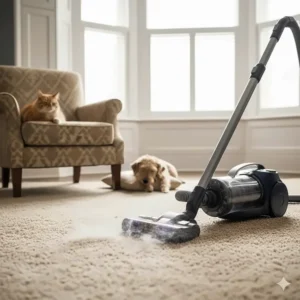
Here’s where cylinder vacuums truly shine. Because you’re only moving a lightweight wand and head (typically 1-2kg) rather than the entire 5-7kg unit, they’re considerably easier to manoeuvre. Getting under low furniture? Simple – slide the flat head underneath beds, sofas, and radiators with barely any effort.
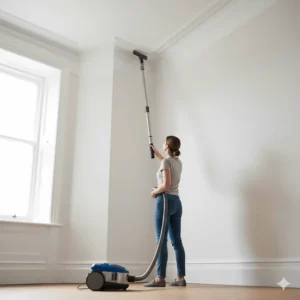
Modern uprights have fought back with innovations like Dyson’s ball technology and Shark’s swivel steering. These genuinely help, making uprights far more nimble than the clunky models from 20 years ago. However, physics still favours the cylinder when you need to reach that cobweb in the ceiling corner or hoover the curtains.
Reach and Versatility Advantages
This is where the cylinder vs upright vacuum comparison gets interesting. Cylinder models typically offer:
- Extended hose length: Up to 4 metres of flexible reach
- Total operating radius: Often 10-12 metres when you include the power cord
- Attachment switching: Quick-release tools for different surfaces
Uprights counter with their own benefits:
- Wider cleaning path: The motorised head covers more floor area per pass
- Integrated tools: Everything stays attached to one unit
- Faster large-area cleaning: That wider path means you can hoover a room in fewer passes
For stairs specifically, cylinders hold a clear advantage. You can place the body at the bottom and the lightweight hose/wand easily reaches up 10-12 steps. With an upright, you’re either awkwardly balancing the unit on steps or using the hose attachment, which defeats the point of having an upright.
Storage Space Vacuum Comparison
Right, let’s talk about your cleaning cupboard situation. Cylinder vacuums win hands-down for compact storage. Most measure roughly 25cm x 40cm and can slide into surprisingly tight spaces. Many modern models feature automatic cord rewind – press a button and the cable disappears tidily inside.
Uprights stand tall (typically 1-1.2 metres) but have a smaller footprint. They’re brilliant if you’ve got vertical space but limited floor area. However, the cord usually wraps around hooks on the back, which looks less tidy.
Interestingly, a Hoover UK study found that storage convenience often influences purchase decisions more than cleaning performance, particularly in smaller UK homes and flats.
Under-Furniture Cleaning Capability
If you’ve ever tried hoovering under a bed with a traditional upright, you’ll know the struggle. Unless it’s got a “low-profile” design (which few truly have), you’re stuck using the hose attachment and losing that powerful motorised brush.
Cylinders excel here because the cleaning head – whether it’s a slim floor brush or turbo tool – slips easily under furniture. The flexible hose allows you to reach without contorting yourself into awkward positions.
Some premium uprights like Shark’s lift-away models offer a clever compromise. You detach the main unit and use it like a cylinder for tricky spots, then reassemble for normal use. It’s genuinely useful, though it does add weight and complexity.
Which Vacuum Type Suits Your Home?
Choose a Cylinder Vacuum If…
You live in a small to medium-sized property where manoeuvrability matters more than speed. The lightweight cleaning head makes stairs and tight corners far less of a chore.
Your home features mixed flooring – perhaps you’ve got carpets in bedrooms, laminate in the kitchen, and tiles in the bathroom. Cylinders adapt easily with quick-change heads.
You need serious reach for ceiling corners, curtains, or upholstery. That extended hose is worth its weight in gold.
Storage space is limited. Cylinders tuck away neatly in cupboards or under stairs.
You’ve got lots of furniture to clean around and under. The flexible hose navigates obstacles with ease.
Choose an Upright Vacuum If…
You’ve large open areas to cover, particularly carpeted rooms. That wider cleaning path significantly reduces vacuuming time.
Deep-pile carpets dominate your home. The rotating brush bar digs into carpet fibres more effectively than most cylinder attachments.
You prefer the pushing motion of uprights to pulling a cylinder behind you. This is genuinely personal preference – some people find pushing easier on their back.
Solid, low-standing furniture fills your rooms. If you can clean around furniture rather than under it, uprights work brilliantly.
You want everything in one unit. No trailing body to bump into furniture, no hose to manage.
The Middle Ground: Lift-Away Technology
Shark and a few other manufacturers have developed “lift-away” or “2-in-1” models that genuinely bridge the gap. These uprights let you detach the motor and dustbin section, essentially creating a cylinder vacuum when needed.
It’s not quite as elegant as a purpose-built cylinder, and you’re carrying more weight when in portable mode, but the versatility is impressive. If you’re truly torn between cylinder and upright, these hybrid models deserve serious consideration.
Henry Cylinder vs Dyson Upright: The Classic Showdown
Let’s address the elephant (or should I say, the smiling red hoover) in the room. Many UK buyers narrow their choice down to this specific comparison: Henry cylinder vs Dyson upright.
The Henry Advantage
Henry’s been cleaning British homes since 1981, and Numatic has refined the design to near-perfection. That 620W motor delivers consistent suction that doesn’t diminish as the bag fills. The 6-litre capacity means you can hoover an entire three-bedroom house without emptying. Commercial cleaners swear by Henry because they simply don’t break – many report 15+ years of daily use.
The downside? Henry’s old-school in some ways. No HEPA filtration as standard, basic attachments, and you’ll need to buy replacement bags (though they’re cheap at around £15 for 10). It’s also a hefty 7.8kg, though the weight sits on the floor rather than in your hands.
The Dyson Upright Case
Dyson transformed vacuum design with bagless technology and transparent bins. The Ball Animal uprights offer powerful cyclonic suction with no loss of power as the bin fills. That ball steering genuinely improves manoeuvrability, and the whole-machine HEPA filtration captures allergens effectively.
The motorised brush bar excels on carpets, particularly for pet hair. You’re not buying bags, which saves money long-term. However, Dysons can be heavy to push (around 7.5kg) and some users report reliability issues after 3-5 years, particularly with the bin release mechanism.
The Verdict
For a traditional cylinder vs upright vacuum comparison, this comes down to what you value:
- Choose Henry if: You want legendary reliability, massive capacity, and don’t mind bags. Perfect for larger homes with mixed flooring.
- Choose Dyson if: You prefer bagless convenience, need powerful carpet cleaning, and value modern design. Excellent for medium-sized homes with predominantly carpeted floors.
Honestly, both are excellent choices. Henry wins on longevity and value; Dyson wins on technology and carpet performance.
Best Vacuum for Stairs UK: Cylinder or Upright?
Stairs present a unique challenge for vacuum owners. They’re awkward, time-consuming, and frankly a bit of a pain regardless of which vacuum type you’re wielding.
Cylinder Advantages on Stairs
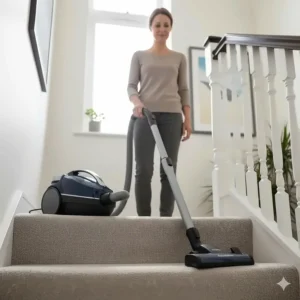
Position the cylinder body at the bottom of your staircase and the lightweight wand/hose combo easily reaches 10-12 steps. You’re moving maybe 1.5kg rather than the entire 5-7kg unit. Most cylinder owners can clean a standard UK staircase in about 3-4 minutes.
The flexible hose also makes it easy to get into stair corners where dust accumulates. Turbo brush attachments specifically designed for stairs work brilliantly on carpeted steps.
Upright Options for Stairs
Traditional uprights are frankly rubbish on stairs unless you’re using the hose attachment – at which point you’ve lost the main advantage of having an upright. You’ll be awkwardly balancing the unit on steps or lugging it up as you go.
However, lift-away uprights like the Shark models genuinely solve this problem. Detach the portable section and you’ve essentially got a compact cylinder for stairs. It’s heavier than a true cylinder would be (typically 3-4kg for the portable section vs. 1-2kg for a cylinder head), but far more practical than traditional uprights.
The Clear Winner
For stairs specifically, cylinder vacuums hold a definitive advantage unless you’re willing to invest in a lift-away upright. If your home has multiple staircases, this factor alone might tip your decision towards a cylinder model.
Pet Hair Performance: Cylinder vs Upright
Right, let’s talk about the furry elephant in the room. If you share your home with dogs or cats, pet hair becomes a major factor in vacuum selection.
Upright Advantages for Pet Hair
The rotating brush bar in uprights is genuinely brilliant for embedded pet hair in carpets. Those stiff bristles agitate carpet fibres, loosening hair that suction alone would struggle to remove.
Modern pet-specific uprights like the Shark Stratos or Dyson Ball Animal include anti-hair-wrap technology. The brush bar is designed to prevent hair from tangling around it – some models even actively remove wrapped hair during use.
Cylinder Solutions for Pet Owners
Don’t count out cylinders! Quality models like the Miele Cat & Dog or Henry Pet include dedicated turbo brush attachments that rival upright performance. These powered brushes connect to the flexible hose, combining cylinder versatility with upright-style agitation.
The advantage? You can use the turbo brush on floors AND easily switch to clean furniture, car interiors, and stairs where pet hair also accumulates. Upright owners often struggle to effectively clean these areas.
Mixed Flooring Considerations
If you’ve got both carpets and hard floors, cylinders with turbo attachments offer more flexibility. Switch between the motorised carpet brush and a gentle hard floor head without changing vacuums. Most uprights have adjustable heads, but the transition isn’t always seamless.
Filtration Matters Too
Both vacuum types can include HEPA filtration to capture pet dander and allergens. Models like the Shark with Anti-Allergen Complete Seal or Miele with AirClean filters trap 99.9% of particles. This matters enormously if anyone in your household has pet allergies.
Compact Storage Solutions After Use
Once you’ve finished hoovering, where does your vacuum live? This seemingly minor consideration can significantly impact your quality of life, particularly in smaller UK homes.
Cylinder Storage Strategies
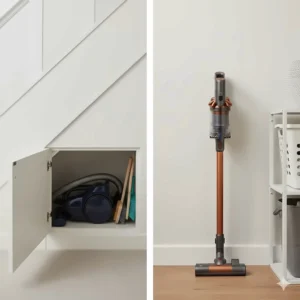
Most modern cylinders measure approximately 25cm x 40cm – roughly the size of a small desktop computer tower. They slot beautifully into:
- Under-stairs cupboards: Classic UK storage solution
- Behind doors: Many fit in that awkward space
- Utility rooms: Tuck against the wall
- Built-in cupboards: They’re properly compact
The automatic cord rewind feature on most cylinders means everything stays tidy. Premium models like Miele even include onboard tool storage, so attachments don’t go walkabout.
Upright Storage Realities
Uprights need vertical space but minimal floor area. They’re perfect for:
- Cleaning cupboards: Stand upright against the back wall
- Bedroom corners: If you don’t mind the look
- Garage storage: Though temperature extremes can affect some models
The cord typically wraps around hooks on the unit. It’s functional but less elegant than cylinder rewind systems. Some people find it fiddly, particularly if you’ve arthritis or limited dexterity.
Space-Saving Innovations
Several manufacturers now offer “slimline” or “compact” models. The Miele Compact C2, for instance, takes up 40% less space than standard cylinders whilst maintaining performance. Some uprights like the Hoover H-Lift can be partially disassembled for storage.
If space is genuinely at a premium, consider cordless stick vacuums as an alternative. However, that’s a different comparison altogether and beyond our cylinder vs upright focus today.
Maintenance and Running Costs
Let’s talk about the less exciting but absolutely crucial aspect: what happens after you buy your vacuum?
Bagged vs Bagless Economics
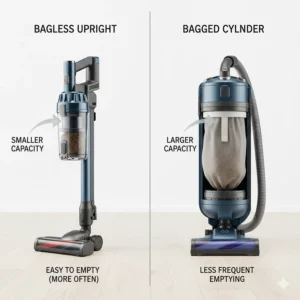
Cylinder vacuums traditionally used bags. Henry needs replacement bags every 1-2 months for average households, costing roughly £15-20 per year. Miele bags cost similar amounts. However, these bags provide excellent filtration and hygienic disposal – no dust clouds when emptying.
Upright vacuums are predominantly bagless, with transparent bins you empty into the bin. No ongoing bag costs, but filter replacement becomes important. HEPA filters typically need replacing annually at £15-30 depending on the model.
Filter Maintenance Reality
Both vacuum types require filter maintenance:
- Washable filters: Rinse monthly, fully dry before replacing (48 hours minimum)
- HEPA filters: Replace annually or when suction drops
- Motor protection filters: Check quarterly, replace as needed
Honestly, most people neglect filter maintenance until suction becomes noticeably weak. Don’t be that person – proper maintenance dramatically extends vacuum life.
Brush Bar Care
Uprights with rotating brush bars need regular hair removal. Yes, anti-tangle technology helps, but you’ll still accumulate some wrapped hair. Budget 5 minutes monthly to cut away hair with scissors.
Cylinder turbo attachments need identical care. The advantage? They’re separate tools you can easily access, whereas upright bars often require flipping the entire vacuum over.
Long-Term Reliability
According to consumer surveys compiled by Which? magazine, Miele and Numatic (Henry) vacuums show the best long-term reliability, with many units lasting 10-20 years. Dyson and Shark show moderate reliability (5-10 years typical), whilst budget brands average 3-5 years.
However, reliability correlates strongly with maintenance. A £100 vacuum that’s well-maintained often outlasts a £300 vacuum that’s neglected.
✨ Ready to Make Your Choice?
🔍 Every home deserves a vacuum that actually works. Browse our recommended cylinder and upright models on Amazon.co.uk to find your perfect match. Remember, the right vacuum can genuinely transform your cleaning routine from a chore into something almost enjoyable!
Frequently Asked Questions
❓ Can cylinder vacuums clean carpets as well as uprights?
❓ Are upright vacuums better for back pain than cylinder models?
❓ How much power do I actually need in a vacuum cleaner?
❓ Do bagless vacuums really save money compared to bagged models?
❓ Which vacuum type works best for UK homes with mixed hard floors and carpets?
Conclusion: Making Your Cylinder vs Upright Vacuum Decision
After examining seven excellent models and drilling into the details that actually matter for UK homes, here’s the honest truth: there’s no universally “best” option. The cylinder vs upright vacuum debate ultimately depends on your specific situation.
Cylinder vacuums excel when you need versatility, manoeuvrability, and excellent reach. They’re brilliant for smaller homes, properties with stairs, mixed flooring situations, and anyone who values compact storage. Models like the legendary Henry or premium Miele offer exceptional reliability and value over their lifespan.
Upright vacuums dominate when covering large carpeted areas quickly. That wider cleaning path and integrated motorised brush bar make them genuinely more efficient for extensive carpet cleaning. Modern innovations like Shark’s lift-away technology have addressed many traditional upright limitations.
For the average UK household, I’d generally lean towards cylinders for homes under 100 square metres (about 1,100 square feet), particularly if you’ve got stairs. For larger properties with extensive carpeting and minimal stairs, quality uprights deliver better efficiency.
Whatever you choose, invest in proper maintenance. A £150 vacuum that’s regularly serviced will outperform a £400 vacuum that’s neglected. Clean or replace filters quarterly, remove brush bar hair monthly, and check hoses for blockages when suction drops.
The vacuum market continues evolving rapidly, with cordless stick vacuums challenging both traditional formats. However, for raw power and capacity, corded cylinders and uprights still reign supreme in 2026. Choose wisely, maintain properly, and your vacuum should serve you faithfully for years to come.
Recommended for You
- Robot Vacuum vs Cordless Stick: 7 Best UK Options 2026
- Bagged vs Bagless Vacuum Cleaners: 7 Best UK Options 2026
- 7 Best Corded vs Cordless Vacuum Cleaners UK 2026 Guide
Disclaimer: This article contains affiliate links. If you purchase products through these links, we may earn a small commission at no additional cost to you. Prices shown are approximate and may vary. All product recommendations are based on genuine research of customer reviews, expert testing, and real-world performance in UK homes.
✨ Found this helpful? Share it with your mates! 💬🤗
