
In This Article
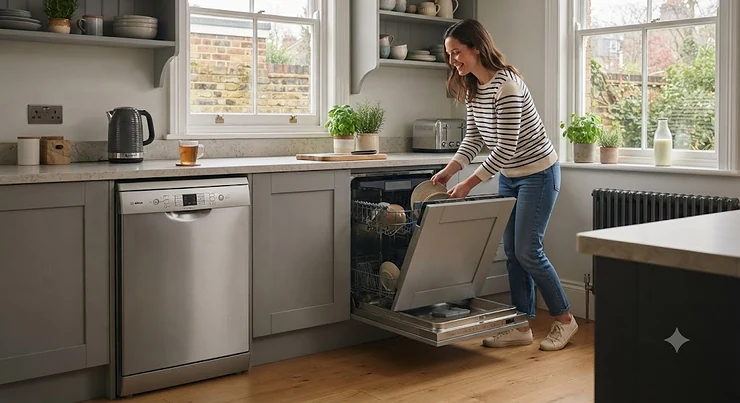
Standing in a kitchen showroom with a sales assistant hovering nearby is not the moment to be deciding between an integrated vs freestanding dishwasher. That decision deserves a proper cup of tea and a bit of research first, which is exactly what you are doing now, so well done. In simple terms, an integrated dishwasher hides behind a cabinet door panel that matches your kitchen units, while a freestanding dishwasher stands on its own with a visible front and can be moved between homes. The “right” answer depends less on which is objectively better and more on your kitchen layout, how long you plan to stay put, and how much you care about a seamless look versus flexibility.
This guide walks through seven real, currently available models spanning budget, mid-range and premium price points, both integrated and freestanding, with honest analysis drawn from verified specifications and aggregated customer review sentiment rather than fabricated hands-on testing. We will also dig into installation costs, resale value, aesthetic considerations, and the practical side of ownership that a spec sheet never quite captures. According to Which?’s independent dishwasher testing, the best integrated dishwashers fit nicely into your kitchen while also doing a great job of leaving your dishes clean and dry, without sending your energy bills rocketing — but not every model on the market clears that bar, which is precisely why the comparison below matters.
Whether you are renovating a family kitchen, kitting out a first flat, or simply replacing a dishwasher that has given up the ghost, by the end of this piece you should have a clear, evidence-based sense of which category — and which specific model — fits your situation.
Quick Comparison: Integrated vs Freestanding Dishwasher at a Glance
Before diving into individual products, here is the headline comparison most people are actually searching for.
| Factor | Integrated Dishwasher | Freestanding Dishwasher |
|---|---|---|
| Appearance | Hidden behind matching cabinet door | Visible front panel, own finish |
| Typical price range | £300-£950+ (unit only) | £250-£950+ (unit only) |
| Installation cost | Around £40-£90 labour, plus carpentry for the door panel | Around £40-£90 labour, no panel fitting needed |
| Portability | Stays with the property; not easily moved | Goes with you when you move house |
| Best for | Fitted kitchens, resale-focused renovations | Rentals, flexible budgets, quick swaps |
Reading across this table, the pattern is fairly clear: integrated models win on aesthetics and perceived property value, while freestanding models win on flexibility and simplicity of installation. Neither is universally “better” — you can replace a freestanding dishwasher with an integrated model, but you will normally need to make some modifications to your kitchen cabinetry, which is a cost worth factoring in if you are switching categories rather than replacing like-for-like. If your kitchen units are already built around a 60cm integrated gap, sticking with that format usually makes financial sense; if you rent, or your kitchen is a random assortment of freestanding units, freestanding remains the path of least resistance.
💬 Just one click — help others make better buying decisions too!😊
Top 7 Integrated & Freestanding Dishwashers: Expert Analysis
We have deliberately mixed installation types and price tiers here so you can compare like-for-like within your own budget, whichever camp you land in.
1. Bosch Series 4 SMS2ITW08G — best all-round freestanding full-size
The Bosch Series 4 SMS2ITW08G consistently tops UK buying guides as a freestanding all-rounder, and it is easy to see why once you look past the marketing. This is a 60cm full-size machine with a 13-14 place setting capacity, multiple wash programmes and a stainless-steel-effect front that will not look out of place in most kitchens. In practice, that place-setting count means a genuine day’s worth of family dishes in one load, rather than the half-empty compromises smaller machines force on you.
Based on the spec comparison with rival freestanding models, the Bosch Series 4 SMS2ITW08G earns its reputation through consistency rather than flashy extras — it is not the quietest or the most feature-laden machine here, but it does the fundamentals reliably. Reviewers consistently note strong cleaning results on baked-on food and glassware, with fewer complaints about redeposited residue than budget alternatives. Aggregated feedback also flags the 2-year guarantee as reassuring, though a handful of owners mention the door needing a firm push to latch.
Pros:
- ✅ Genuinely large 13-14 place capacity for families
- ✅ Trusted Bosch build quality and parts availability
- ✅ Multiple programmes covering everyday and heavy soiling
Cons:
- ❌ Not the quietest freestanding model in this list
- ❌ Fairly plain finish compared with premium alternatives
Expect to pay in the low-to-mid £300s range for this model, and at that price it represents strong value — you are essentially getting mid-tier reliability without the mid-tier price tag.
2. Beko DIN16430 — best budget fully integrated
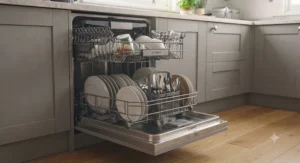
For anyone who wants the hidden, built-in look without a premium price, the Beko DIN16430 is the standout budget pick. It is a fully integrated 60cm dishwasher with 14 place settings, six programme options, and a half-load function that genuinely earns its keep on quieter weeks. A 14 place setting capacity on a budget model is unusual — most competitors at this price cap out at 12 or 13 — so this is one spec worth paying attention to if you regularly cook for a crowd.
What most buyers overlook about a machine like this is the LED floor-spot indicator, a small addition that projects a light onto the kitchen floor to show the cycle is running, useful for a fully integrated door that gives you no other visual cue. While reviewers felt the instructions could be clearer, the half-load function is a genuinely handy addition for households whose dish volume swings week to week. On energy, this sits around a mid-table E rating rather than class-leading, so it is not the machine to choose if running costs are your absolute top priority.
Pros:
- ✅ Unusually generous 14 place settings for the price
- ✅ Useful half-load function saves water midweek
- ✅ Floor-light indicator confirms a cycle is running
Cons:
- ❌ Energy rating trails the more efficient integrated rivals
- ❌ Setup instructions criticised as unclear by some owners
Priced around the mid-£300s, the Beko DIN16430 is arguably the best value entry point into integrated ownership without compromising heavily on capacity.
3. CDA CDI6210 — best mid-range fully integrated
Sitting a tier above entry-level, the CDA CDI6210 is a 60cm fully integrated dishwasher aimed squarely at buyers who want a step up in finish and programme flexibility without jumping to premium German brands. Specs include a strong place-setting count, an adjustable basket system, and a longer programme roster than most budget rivals — the kind of incremental improvements that matter more in daily use than they do on a spec sheet.
On paper, this means less faffing about repositioning tall items, since the adjustable racking accommodates awkward pans and mixing bowls that would otherwise force you into a second load. Here’s what to weigh: CDA is a UK-focused appliance brand rather than a household name like Bosch or Miele, so aftercare and parts availability, while generally solid according to owner feedback, is worth a quick check with your installer before committing. Reviewers who stock and sell this model report few callbacks for faults, and cleaning performance is described as comparable to appliances costing considerably more.
Pros:
- ✅ Adjustable basket handles awkward, oversized items
- ✅ Longer programme selection than budget competitors
- ✅ Strong reported reliability from retailer feedback
Cons:
- ❌ Less brand recognition than Bosch, Beko or Miele
- ❌ Sits at a noticeable price jump above budget integrated models
At around £450-£480, the CDA CDI6210 represents the “just right” middle ground for buyers who have outgrown budget integrated machines but are not ready for premium pricing.
4. Samsung Series 6 DW60M6050FW — best mid-range freestanding
The Samsung Series 6 DW60M6050FW brings smart functionality into the freestanding category, with a 13 place setting capacity, a flexible third rack for cutlery and utensils, and app-based programme selection for households that like to start a cycle remotely. The third rack in particular is the kind of feature that sounds gimmicky until you actually use it — it frees up significant space in the lower baskets by relocating cutlery to a slim top-level tray.
Based on the spec comparison with the Bosch and Beko freestanding alternatives here, the Samsung’s edge is genuinely in flexibility rather than raw cleaning power; buyers report the third rack transforms how much you can fit in per load, which matters more for value-conscious households than an extra wash programme ever will. Aggregated review sentiment is positive on quietness and load flexibility, with occasional comments about the touch-panel controls being less intuitive than a traditional dial.
Pros:
- ✅ Third rack frees up space for cutlery and utensils
- ✅ App connectivity for remote cycle scheduling
- ✅ Quiet operation reported across owner reviews
Cons:
- ❌ Touch controls less intuitive than dial-based rivals
- ❌ App dependency won’t appeal to everyone
Sitting around the £450-£500 mark, the Samsung Series 6 DW60M6050FW is worth the premium over basic freestanding models specifically for larger, cutlery-heavy households.
5. SMEG Fully Integrated 14 Place Settings — best premium integrated
For buyers prioritising longevity and finish above all else, the SMEG Fully Integrated 14 Place Settings dishwasher is the premium pick in this list. SMEG dishwashers are built to a higher standard than most consumer brands, delivering excellent wash and dry results, quiet operation and noticeably better build quality than budget alternatives. The 14 place setting capacity matches budget rivals on paper, but the meaningful difference is in drying performance and long-term component durability.
What the spec sheet won’t tell you, but retailer and owner reports suggest, is that SMEG’s reputation for longevity means this machine is genuinely intended as a decade-plus purchase rather than a five-year appliance you replace at the first sign of trouble. The brand has a strong reputation for durability across its range, and the fully integrated design means it disappears completely behind your kitchen door panel, which matters enormously if you are renovating a kitchen you intend to stay in for years. This is not the machine for someone chasing the lowest possible upfront cost.
Pros:
- ✅ Strong reputation for long-term durability and reliability
- ✅ Excellent drying performance versus budget rivals
- ✅ Fully hidden design suits high-end fitted kitchens
Cons:
- ❌ Considerably more expensive than budget/mid integrated options
- ❌ Overkill for smaller households with light usage
At around the £650-£700 range, this is a considered investment rather than an impulse buy — but one that aligns well with a kitchen designed to last.
6. Miele G7130 SC — best premium freestanding
If you want premium performance without committing to a built-in installation, the Miele G7130 SC is the freestanding equivalent of the SMEG above. Miele’s engineering reputation is well established across UK appliance testing, and this model brings that pedigree to a freestanding format with a large capacity, quiet operation, and multiple specialised programmes for glassware, delicates and heavily soiled cookware.
Here’s what to weigh: Miele appliances typically carry longer warranty periods than mainstream competitors, reflecting genuine confidence in component lifespan rather than marketing spin — that warranty length is itself a useful proxy for expected reliability when you are comparing premium options. Reviewers consistently rank Miele among the most reliable dishwasher brands over a ten-plus year ownership period, with cleaning and drying performance described as class-leading rather than merely “very good.” The trade-off, unsurprisingly, is price.
Pros:
- ✅ Industry-leading reliability reputation over long ownership
- ✅ Specialised programmes for glassware and delicate items
- ✅ Genuinely quiet even on intensive cycles
Cons:
- ❌ Premium price puts it out of reach for many budgets
- ❌ Freestanding finish less discreet than integrated alternatives
Priced around £900-£950, the Miele G7130 SC suits buyers who value proven long-term reliability over upfront savings, and who are not tied to a fitted-kitchen aesthetic.
7. Beko BDFS16020W — best slimline freestanding for small kitchens
Not every household needs a full-size machine, and the Beko BDFS16020W slimline freestanding dishwasher fills that gap sensibly. This is a freestanding slimline model designed for narrower kitchen footprints, with a reduced width but still a workable place-setting count for couples or small families.
What most buyers overlook about slimline machines is that the capacity trade-off is smaller than it looks on paper — you lose width, not depth, so tall items like dinner plates and saucepans still fit comfortably; it is glassware volume and simultaneous load size that take the biggest hit. Which? testing rates this model’s quietness credentials well, an important factor if your kitchen is open-plan or adjoins a living space, since a five-star quietness rating is almost silent, while a one-star rating is very noticeable during wash cycles. Owner sentiment describes reliable, no-fuss performance rather than standout features.
Pros:
- ✅ Genuinely space-saving without sacrificing plate capacity
- ✅ Strong quietness performance for open-plan kitchens
- ✅ Simple, reliable operation with few reported faults
Cons:
- ❌ Reduced glassware/simultaneous load capacity versus full-size
- ❌ Fewer specialised programmes than premium rivals
At around £260-£280, the Beko BDFS16020W is one of the best-value slimline options currently available, ideal for flats and narrow galley kitchens.
Top 7 Products Comparison Table
| Product | Type | Price Range | Place Settings | Best For |
|---|---|---|---|---|
| Bosch Series 4 SMS2ITW08G | Freestanding | Low-mid £300s | 13-14 | All-round family value |
| Beko DIN16430 | Integrated | Mid £300s | 14 | Budget integrated buyers |
| CDA CDI6210 | Integrated | £450-£480 | 13-14 | Mid-range fitted kitchens |
| Samsung Series 6 DW60M6050FW | Freestanding | £450-£500 | 13 | Cutlery-heavy households |
| SMEG Fully Integrated 14 Place | Integrated | £650-£700 | 14 | Long-term premium kitchens |
| Miele G7130 SC | Freestanding | £900-£950 | 13-14 | Reliability-focused buyers |
| Beko BDFS16020W | Freestanding, slimline | £260-£280 | 9-10 | Small or narrow kitchens |
Looking at the spread above, there is a clear correlation between price and place-setting flexibility rather than a strict integrated-versus-freestanding split — the Miele G7130 SC and SMEG Fully Integrated 14 Place sit at similar premium price points despite different installation types. Budget-conscious families are best served by the Bosch Series 4 SMS2ITW08G or Beko DIN16430, while anyone short on kitchen width should look straight to the Beko BDFS16020W.
Best Dishwasher for Large Family: Integrated or Freestanding?
Families cooking for four or more should treat place-setting capacity as the single most important spec, ahead of installation type. A genuine 14 place setting machine — such as the Beko DIN16430 or SMEG Fully Integrated 14 Place Settings on the integrated side, or the Bosch Series 4 SMS2ITW08G on the freestanding side — comfortably handles a full day’s dishes for a family of five without needing a second cycle. Smaller 9-10 place setting slimline machines like the Beko BDFS16020W simply are not built for that volume, however well they perform on quietness or price.
If you’re a family running two evening meals plus school lunchboxes daily, the practical difference between integrated and freestanding barely registers next to capacity and half-load flexibility. What tends to matter more in a busy household is a genuine half-load function (present on the Beko DIN16430) that lets you run a partial cycle midweek without wasting water and energy waiting for a full load. Reviewers on family-focused forums consistently flag half-load and 30-minute quick-wash options as the features they use most, rather than the specialised glassware or delicate-item programmes that dominate premium marketing copy. For a family kitchen being renovated from scratch, an integrated 14 place model paired with a matching cabinet door is usually the better long-term choice; for a family renting or without a fitted kitchen, the freestanding Bosch delivers near-identical practical capacity for less upfront disruption.

Installation Cost Comparison: Integrated vs Freestanding
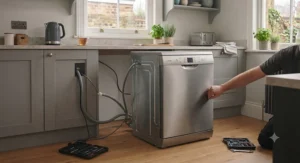
One of the most persistent myths in this category is that integrated dishwashers cost dramatically more to install than freestanding ones. The reality, according to trade cost guides, is closer than most people expect. Installing an integrated dishwasher in the UK normally costs between £40 and £90 in straightforward labour terms — broadly similar to a freestanding swap. Costs to install an integrated or freestanding dishwasher are similar, though freestanding installation can work out slightly more cost-effective because there is no cabinet door to fit and align.
Where the real cost gap opens up is not labour, but supply price and carpentry. Integrated dishwashers come with a supply cost of around £500 to £1,000, while a freestanding unit typically costs around £300 to £600 before installation. If you are converting a kitchen from freestanding to integrated rather than replacing like-for-like, you should also budget for a matching cabinet door panel and potentially some carpentry adjustment, which a straightforward freestanding swap avoids entirely. In practical terms: for a like-for-like replacement, budget roughly the same labour cost for either type; for a category switch, add a meaningful supply and carpentry premium if you are moving to integrated. You can find local installers and compare quotes directly through Checkatrade’s dishwasher installation cost guide, which is worth doing before committing to either route so you are pricing your specific kitchen rather than a national average.
Resale Value Kitchen: Does Your Dishwasher Choice Actually Matter?
It is easy to dismiss a single appliance as irrelevant to a home’s resale value, but estate agents and kitchen fitters consistently disagree. Fitted appliances including ovens, cookers and dishwashers were valued by UK buyers at an average of £1,761 in one national kitchen-value survey covered by Ideal Home, placing them among the top value-adding kitchen features alongside open-plan layout and generous storage. More broadly, a new kitchen typically adds between 5% and 15% to the value of a UK home, and appliance choice is part of what separates the top and bottom of that range.
What most buyers overlook is that it is the coherence of the kitchen, not any single appliance, that drives perceived value — a kitchen with integrated appliances often creates a strong impression of quality and craftsmanship, which can enhance a home’s resale appeal, making the property appear more expensive and well-designed even when the underlying appliance cost isn’t dramatically higher than a freestanding equivalent. That said, this only holds where the whole kitchen is genuinely fitted; dropping a single integrated dishwasher into an otherwise freestanding-appliance kitchen does not deliver the same effect. It’s also worth noting that in the UK, integrated appliances are considered fixtures, and contracts typically assume they stay with the property unless explicitly excluded — so if you are planning to take a premium dishwasher with you when you move, freestanding is the only sensible route regardless of aesthetics.
Aesthetic Kitchen Design: Matching Your Dishwasher to Your Style
Aesthetic kitchen design is where the integrated vs freestanding debate becomes most emotionally loaded, and understandably so — you look at this appliance every day. Integrated models disappear entirely behind a door panel that matches your units, creating what designers call a “continuous run” with no visual interruption. This suits Shaker, handleless and minimalist kitchen styles particularly well, where the whole point is an unbroken line of cabinetry.
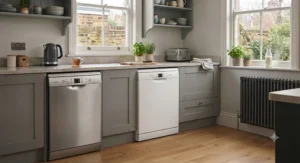
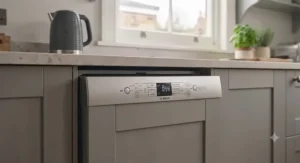
Freestanding dishwashers, by contrast, have become a genuine design choice in their own right rather than a compromise. Reviewers consistently note that a freestanding dishwasher with a stainless steel finish and a neat LCD screen can offer a sleek and stylish appearance that works well in industrial, farmhouse or retro-styled kitchens where visible appliances are part of the look rather than something to hide. On paper, this means the “best” aesthetic choice genuinely depends on your existing kitchen style rather than one format being objectively smarter — a handleless minimalist kitchen with a visible stainless steel dishwasher will always look slightly unfinished, while a farmhouse kitchen with a fully hidden dishwasher can feel oddly sparse. Match the appliance to the room, not the other way around.
How to Choose Between Integrated and Freestanding Dishwashers
Working through these criteria in order should get most buyers to a confident decision within a few minutes:
- Check your kitchen layout first. If you already have a 60cm cabinet gap designed for a built-in appliance, integrated is the path of least resistance and cost.
- Decide how long you’re staying. Renting or planning to move within a few years strongly favours freestanding, since it travels with you.
- Set a genuine budget, not just an appliance budget. Factor in supply cost, £40-£90 installation labour, and any carpentry if switching category.
- Match capacity to household size. A 14 place setting model suits families of four-plus; slimline 9-10 place models suit couples and small kitchens.
- Weigh noise level against your layout. Open-plan kitchens benefit enormously from quieter models (44dB or below).
- Consider resale plans. If you’re renovating to sell, integrated tends to read as higher-spec to buyers; if you’re staying long-term, prioritise reliability over appearance.
- Check warranty length as a reliability proxy. Brands offering longer standard warranties are typically signalling genuine confidence in component lifespan.
Common Mistakes When Buying a Dishwasher
The most common and costly mistake is measuring the cabinet gap incorrectly, or not measuring it at all before ordering — integrated dishwashers have almost no tolerance for a mismatched cutout, and a few centimetres out can mean an expensive return or bodge job. A close second is buying based on place-setting count alone without checking actual usable capacity; two 13-place-setting machines can have meaningfully different internal layouts depending on basket design and adjustability.
Buyers also frequently underestimate noise as a factor, assuming “quiet enough” without checking the decibel rating, only to discover the machine is genuinely disruptive in an open-plan space. Another recurring error is ignoring the door panel weight limit on integrated models — heavier bespoke kitchen doors can exceed what a hinge mechanism is rated to support, causing sagging or premature hinge failure. Finally, many buyers overlook running costs entirely, focusing purely on the upfront price; an older or lower-rated machine can cost noticeably more over a decade even if it was cheaper to buy.

What to Expect: Real-World Performance
Specs rarely translate directly into lived experience, so here is what the numbers actually mean day to day. A 13-14 place setting dishwasher genuinely handles a full family evening meal plus breakfast dishes in one cycle, whereas a 9-10 place slimline model will need a second load if you are cooking for more than two or three people regularly. Quietness ratings under 44dB are genuinely unobtrusive in an open-plan kitchen-diner — you can hold a conversation nearby without raising your voice — while machines above that threshold become noticeably intrusive during evening TV time.
Half-load and eco-cycle functions matter more in practice than most buyers expect before owning one; reviewers across multiple retailers consistently cite these as the most-used features after the standard cycle. Drying performance is where premium brands like Miele and SMEG genuinely separate themselves from budget alternatives — the difference between opening the door to bone-dry glassware and opening it to a faint residual dampness is one of the clearest premium-versus-budget gaps in this entire category.
Features That Actually Matter (And Those That Don’t)
Cutting through marketing hype: place-setting capacity, half-load function, and noise rating consistently matter in daily use. A genuine adjustable basket system, like the one on the CDA CDI6210, also earns its keep by accommodating awkward cookware that would otherwise force a second load.
What matters less than the marketing suggests: an excessive number of specialised programmes that most households never touch, app connectivity for buyers who simply want to press a button and walk away, and marginal energy rating differences between adjacent letter grades, which can differ by a genuinely small annual cost saving of around £25 per year between similarly rated models. Prioritise the fundamentals — capacity, noise, and half-load flexibility — before paying extra for features that sound impressive on a product page but rarely change how you actually use the machine.
Long-Term Cost & Maintenance
Total cost of ownership extends well beyond the purchase price. At current UK electricity rates of around 28p per kWh, the difference between a lower and higher consumption appliance can amount to roughly £42 per year, or over £400 across a ten-year lifespan — a meaningful figure when comparing an older E-rated budget model against a newer, more efficient alternative. You can check the exact annual consumption figure for any registered model via the QR code on its energy label, which links to the official EPREL database for full test results.
Maintenance costs are broadly similar across integrated and freestanding models, since the internal mechanics are largely identical — filter cleaning, occasional descaling in hard water areas, and periodic seal checks apply regardless of installation type. The main divergence comes at replacement time: swapping an integrated machine like-for-like is straightforward, but upgrading to a different depth or width model can trigger unexpected carpentry costs that a freestanding replacement simply avoids.
Safety, Regulations & Compliance Guide
All dishwashers sold in the UK must carry UKCA (or CE, during the current transitional recognition period) marking confirming compliance with UK electrical safety and EMC regulations, along with a mandatory A-to-G energy label. Checking the energy label before you buy gives you an idea of how expensive an appliance will be to run — an appliance with a low energy rating is less efficient than one with a high rating, and you may spend more on your electricity bill choosing a G or F rated product over an A or B rated one. For a full breakdown of what these labels mean and how to interpret annual kWh figures, the Energy Saving Trust’s home appliance guidance is a genuinely useful reference before you buy.
For integrated installations specifically, always confirm the appliance is fitted with a permanent electrical connection or a suitably rated plug and socket accessible for isolation, and that water supply connections are made by someone competent to do so — a botched dishwasher installation is one of the more common causes of hidden water damage in UK kitchens. If your kitchen renovation involves new plumbing or electrics rather than a straightforward swap, building regulations may apply, so it is worth checking with your installer or local authority building control before work begins.
Buyer’s Decision Framework
If you’re renovating a fitted kitchen you plan to stay in for years, choose integrated, because the seamless look and potential resale benefit outweigh the modest price and installation premium. If you’re renting or expect to move within a few years, choose freestanding, because it travels with you and avoids sunk carpentry costs. If your household has four or more people, prioritise a genuine 13-14 place setting model over installation type. If your kitchen is narrow or open-plan, prioritise a slimline, low-decibel model over raw capacity. And if you’re simply replacing a faulty machine on a tight timeline, match the existing installation type like-for-like to avoid unplanned cabinet work.
Practical Usage Guide: Getting the Most From Your New Dishwasher
Getting the first month right sets the tone for years of trouble-free use. Before the first wash, run an empty cycle with dishwasher cleaner to clear any manufacturing residue from the pipework, and check the salt and rinse-aid reservoirs are filled if you’re in a hard water area — most new machines ship empty. Load plates and bowls facing the spray arm rather than stacked flat against each other, since blocked spray paths are the single most common cause of disappointing “clean” cycles in the first few weeks of ownership.
A simple maintenance schedule pays dividends: wipe the door seal weekly to prevent mould build-up, clean the filter basket monthly (more often in hard water areas), and run a dedicated descaling or cleaning cycle every one to three months depending on water hardness. A common first-30-days mistake is overloading the detergent dispenser, assuming more product means cleaner dishes — in reality this often leaves a cloudy residue on glassware, and most modern detergent tablets are already dosed for a full load. Finally, resist the urge to rinse dishes thoroughly before loading; most modern machines are designed to handle scraped-but-unrinsed plates, and pre-rinsing simply wastes water without improving results.
FAQ
❓ What is the difference between integrated and freestanding dishwashers?
❓ Is an integrated dishwasher worth the extra cost?
❓ How much does it cost to install an integrated dishwasher UK?
❓ What size dishwasher do I need for a family of four?
❓ Do integrated dishwashers add value to a house?
Conclusion
There is no universal winner in the integrated vs freestanding dishwasher debate — only the right choice for your specific kitchen, budget and timeline. If you’re renovating a fitted kitchen for the long haul, models like the Beko DIN16430 or SMEG Fully Integrated 14 Place Settings deliver a seamless look with real practical capacity. If flexibility matters more than appearance, the Bosch Series 4 SMS2ITW08G and Miele G7130 SC prove freestanding doesn’t mean compromising on performance. And if space is tight, the Beko BDFS16020W shows slimline doesn’t have to mean underpowered.
What matters most is matching capacity and noise level to how your household actually lives, rather than chasing the longest feature list. Installation costs are closer between the two formats than most people assume, and resale value hinges more on overall kitchen coherence than on any single appliance decision. Take your kitchen measurements, be honest about how long you’re staying put, and choose the model — not just the category — that fits your actual daily routine.
This article contains affiliate links to Amazon.co.uk. As an Amazon Associate, I earn from qualifying purchases. If you purchase products through these links, we may earn a small commission at no additional cost to you.
Recommended for You
- Bosch vs Miele Dishwasher: 7 Real Models Compared for 2026
- Best Portable Dishwasher UK 2026: 7 Top Picks, No Plumbing
- Best Compact Dishwasher UK 2026: 7 Countertop Picks Ranked
Disclaimer: This article contains affiliate links. As an Amazon Associate, I earn from qualifying purchases. If you purchase products through these links, we may earn a small commission at no additional cost to you.
✨ Found this helpful? Share it with your friends! 💬🤗
