
In This Article
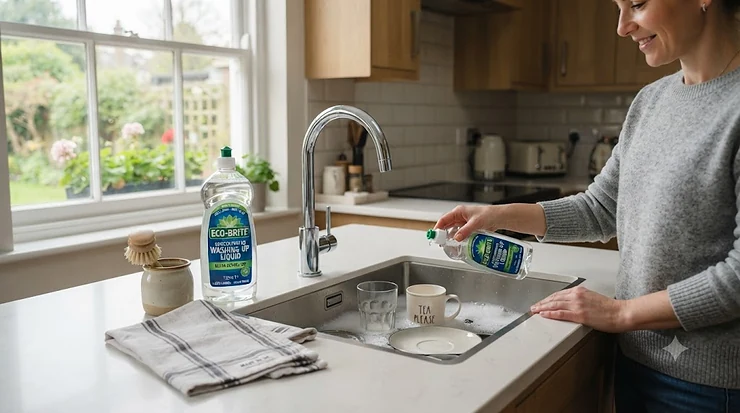
Nobody ever got misty-eyed over a bottle of washing-up liquid. Yet it’s one of the most repeated purchases in a British kitchen, and one of the easiest to get wrong. Buy on shelf-price alone and you end up paying a premium for water. Buy on hype and you pay for a fragrance you’ll stop noticing by Tuesday.
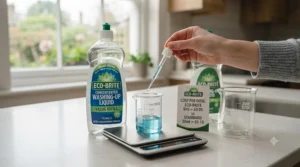
Concentrated washing-up liquid value comes down to three things: how much cleaning each millilitre does, how many bowls a bottle gets you through, and what you pay per wash rather than per bottle. Get those three right and the maths starts working in your favour. That is what this guide is about.
Fair warning: the savings are real but modest. Detergent is not where your kitchen budget bleeds. Hot water is. Still, small wins on a weekly repeat purchase add up, and bulk buying has knock-on benefits in plastic, storage and fewer trips to the shop. Prices below are indicative ranges gathered at the time of research from brand sites, trade suppliers and UK round-ups. Pack sizes, sellers and offers on Amazon UK change often, so check the current listing before you buy.
What Is Concentrated Washing-Up Liquid Value?
Concentrated washing-up liquid value is the real cost of cleaning one bowl of dishes with a high-strength formula, worked out per wash rather than per bottle. A concentrate contains less water and more surfactant, so you use less each time. The best value is the lowest cost per wash that still cleans properly. For background on what these products contain, see this overview of washing-up liquid.
Quick Comparison: The 7 Picks at a Glance
Here is the shortlist before we get into the detail. Unit prices are approximate ranges per 100ml.
| Product | Pack | Approx. cost per 100ml | Best For |
|---|---|---|---|
| Janstar Wash-Up Wonder Double Concentrate | 5L | Roughly 20-25p | Lowest-cost bulk buying |
| Bright Earth Washing-Up Liquid | 5L | Roughly 25-30p | Trying a lesser-known refill |
| Persil Pro Formula Zest | 5L | Roughly 35-40p | Greasy, heavy-use kitchens |
| Fairy Professional Washing-Up Liquid | 5L | Roughly 35-40p | Fairy loyalists wanting refill economy |
| Bio-D Fragrance Free Washing Up Liquid | 5L | Roughly 25-35p | Sensitive skin, no perfume |
| Faith in Nature Lemon Concentrated Washing Up Liquid | 5L refill | Roughly 45-65p | Plastic-light eco households |
| Fairy Platinum Quickwash Original | 520ml | Roughly 35-40p | Convenience and small kitchens |
Looking at the table, the two budget 5L options undercut everything else on unit price, while the eco refill costs roughly double. That premium buys you formulation values and packaging choices, not extra cleaning power. If your priority is pure value bulk washing-up liquid, the first two rows are where to start. If you have sensitive skin, the Bio-D Fragrance Free Washing Up Liquid sits in a sweet spot between price and gentleness.
💬 Just one click — help others make better buying decisions too!😊
Top 7 Concentrated Washing-Up Liquid Value Picks: Expert Analysis
1. Janstar Wash-Up Wonder Double Concentrate — cheapest per wash in this round-up
The headline here is the “double concentrate” claim: the same cleaning action in a formula designed to be used sparingly. It comes in a 5L container, which is where the unit-price magic happens. Trade listings during research put it at roughly £9-£17 for 5L depending on seller, which works out at around 20-25p per 100ml at the lower end.
In practice, a cheap concentrate only pays off if you actually dose it lightly. Squirt it like a standard bottle and you’ve thrown away half the advantage. Based on the spec, this suits busy households, houseshares and anyone who washes up more than once a day. Review evidence is thin: the trade listing I found showed five-star scores, but from only a handful of reviews, which is too small a sample to trust. Treat it as promising rather than proven.
Expect a functional, no-frills clean, not a luxury sensory experience. Check availability, because this one appeared as out of stock at one supplier.
Pros:
- ✅ Lowest unit cost of the seven
- ✅ Double concentrate lets you dose lightly
- ✅ 5L means fewer reorders
Cons:
- ❌ Very small pool of independent reviews
- ❌ Stock can be patchy
Value verdict: under £20 for 5L, this is the budget benchmark.
2. Bright Earth Washing-Up Liquid — solid 5L for cautious budget shoppers
The Bright Earth Washing-Up Liquid appears in both a 500ml and a 5L size, and the 5L is where the value lives. Comparing the two on the same supplier’s listing shows how bulk buying works: the small bottle costs several times more per millilitre. That single comparison teaches more about unit pricing than a dozen blog posts.
Sitting in the mid-teens of pounds for 5L, it lands at roughly 25-30p per 100ml. That is a slightly higher unit cost than the cheapest concentrate, in exchange for a more established-looking range. It is a sensible pick if you want a big container without gambling on the very cheapest option.
Review data is again limited: the listing I found showed strong star ratings across a few dozen votes at best, so read that as mildly encouraging, not conclusive. Buyers who want to test it can start with the small bottle, then step up.
Pros:
- ✅ Available in both 500ml and 5L
- ✅ Unit cost well below standard bottles
- ✅ Low-risk way to try bulk buying
Cons:
- ❌ Limited independent review evidence
- ❌ Slightly pricier per 100ml than Janstar
Value verdict: around £13-£15 for 5L, good middle-of-the-road value.
3. Persil Pro Formula Zest — the heavy-duty grease fighter
Persil’s professional-style washing-up liquid is aimed at busy kitchens, and the 5L pack is the sensible way to buy it. One UK round-up listed the 5L at roughly £18 and gave it top marks for cleaning tough grime, working out at around 36p per 100ml. Those scores are that site’s own, not a lab test, so weigh them accordingly.
Why does that matter? Grease is where cheap formulas stall. If you regularly deal with roasting trays, frying pans and cooking oil, a stronger surfactant load can mean fewer squirts and fewer second washes. The spec logic favours it for keen cooks and larger families.
The trade-off is the price per 100ml, which is above the budget concentrates. You are paying for punch, so it only makes sense if your washing-up is genuinely greasy. If your dishes are mostly cereal bowls and mugs, you are overbuying.
Pros:
- ✅ Rated strongly for tough grime
- ✅ 5L format suits heavy use
- ✅ Recognisable, trusted brand
Cons:
- ❌ Higher unit cost than budget concentrates
- ❌ Overkill for light households
Value verdict: around £15-£20 for 5L, worth it for greasy kitchens only.
4. Fairy Professional Washing-Up Liquid — familiar formula, refill economy
If you love the Fairy performance but hate the bottle churn, the Fairy Professional Washing-Up Liquid in 5L is the obvious bridge. One trade supplier listed it in the high-teens for 5L including VAT, around 38p per 100ml. Compare that with standard Fairy bottles bought one at a time and the refill route is the cheaper habit, although promotions on everyday bottles can narrow the gap.
What most buyers overlook is that Fairy’s strength is also its cost. This is a premium brand priced accordingly, so the saving comes from pack size, not from a bargain formula. The advantage is familiarity: no adjustment period, no wondering whether it will cut through grease.
Independent review evidence for this specific professional size was minimal in my research, so I can’t tell you what buyers think of it beyond the brand’s general reputation. That reputation is, of course, a strong one.
Pros:
- ✅ Familiar Fairy cleaning performance
- ✅ 5L cuts reorder frequency
- ✅ Cheaper per millilitre than small bottles
Cons:
- ❌ Not the cheapest 5L option
- ❌ Few independent reviews for this size
Value verdict: roughly £16-£20 for 5L, fair but not cheap.
5. Bio-D Fragrance Free Washing Up Liquid — gentle, plain and very economical
Bio-D’s fragrance-free formula is the quiet achiever of this list. It’s vegan, cruelty-free and sold in a 5L container, and it was named a Best Buy in Ethical Consumer’s eco washing-up guide. That guide, now a few years old, put Bio-D at roughly £2.49 a litre against about £3.06 for Fairy at Tesco at the time, so the value story predates the current price mess.
Reviewers on the brand’s own site consistently mention that it goes a long way, with one commenting that the price is trivial next to how long it lasts. A recurring note is few bubbles, which trips up people who equate foam with cleaning. That is a perception issue rather than a performance flaw.
Who is it for? Anyone with sensitive hands, anyone who dislikes perfume lingering on plates, and anyone happy to trade suds for economy. The 5L was listed as out of stock at one point, so availability needs checking.
Pros:
- ✅ Fragrance-free and gentle on skin
- ✅ Reviewers say it goes a long way
- ✅ Strong ethical credentials
Cons:
- ❌ Low suds can feel underwhelming
- ❌ 5L stock can be inconsistent
Value verdict: around £13-£18 for 5L, excellent value for gentle cleaning.

6. Faith in Nature Lemon Concentrated Washing Up Liquid — the plastic-light refill pick
This is the premium end of the list. The Faith in Nature Lemon Concentrated Washing Up Liquid is sold as a refill, up to 5L, with a reusable dispenser approach. On the brand’s own site, list prices for 5L run from the low £20s to the low £30s, with a stated per-100ml figure of roughly 46p at the best-value size.
Customer reviews on that site are notably positive: an average of about 4.7 from several hundred votes at the time of research. Reviewers describe it as more concentrated than previous brands, with one squirt per washing-up bowl being enough. That is aggregated brand-site feedback, so it carries the usual bias of reviews on a seller’s own page.
Analytically, this is the one to buy if you’re motivated by fewer single-use bottles rather than pure cost. You pay roughly double the budget concentrates, but you buy a formulation and packaging philosophy along with the soap.
Pros:
- ✅ Strong, consistently positive brand-site reviews
- ✅ Refill format cuts plastic
- ✅ Very concentrated, light dosing
Cons:
- ❌ Highest cost per 100ml in this round-up
- ❌ Sold direct, so Amazon listings vary
Value verdict: roughly £20-£33 for 5L, best for values-driven buyers.
7. Fairy Platinum Quickwash Original — convenient everyday bottle for small kitchens
Not every household wants a 5L drum in the cupboard. The Fairy Platinum Quickwash Original in a 520ml bottle is the convenience choice, at roughly 38p per 100ml in one UK round-up. That round-up rated it highly for speed and reported a 4.6 average from more than 2,800 reviews, which is a substantial sample even if I can’t independently verify it.
The honest take is that this is not a concentrated washing-up liquid value champion in the bulk sense. You pay more per millilitre than any 5L pick here. But a small bottle makes sense for flats, tiny cupboards, people with limited strength for lifting heavy containers, and anyone who simply wants a well-known formula without decanting.
Think of it as the control in this experiment: the price you pay for convenience. It is a good benchmark against which to judge the savings from the bigger packs.
Pros:
- ✅ Large, positive review base
- ✅ Easy to store and pour
- ✅ Fast-rinse formula saves time
Cons:
- ❌ Higher unit cost than 5L options
- ❌ More plastic per litre
Value verdict: roughly £2 a bottle, fine for convenience, poor for savings.
How to Choose Concentrated Washing-Up Liquid Value
Picking the right bottle is a six-step job. Here is the sequence I’d follow.
- Work out your unit price. Divide the price by the volume in millilitres and multiply by 100. Ignore the headline price and the big, bold “SAVE” banner.
- Check the dilution or dose guidance. A true concentrate should tell you to use less. If it doesn’t, you may be paying a concentrate price for a standard formula.
- Decide what matters more: grease, skin or plastic. Heavy grease points towards the Persil Pro Formula Zest, sensitive skin towards Bio-D Fragrance Free Washing Up Liquid, and plastic reduction towards the Faith in Nature Lemon Concentrated Washing Up Liquid.
- Match pack size to storage. A 5L container is brilliant value and awkward under a small sink. Be honest about your cupboard.
- Read reviews with sample size in mind. Six five-star reviews are not the same as 2,800. Weight evidence accordingly.
- Consider the brand’s wider credentials. The Ethical Consumer guide to washing-up liquid notes that washing-up liquid is mostly water and that some brands strip water out to reduce packaging and transport weight. That is a useful lens for thinking about what you’re really buying.
Cost Per Wash Washing-Up Liquid: The Maths Behind the Bottle
Time for numbers. To compare products fairly, I’ll use an illustrative assumption: one bowl of washing-up uses about 5ml of detergent. That is a modelling figure, not a manufacturer dose, so measure your own habit and adjust.
| Product | Pack | Approx. cost per 100ml | Illustrative cost per bowl | Best For |
|---|---|---|---|---|
| Janstar Wash-Up Wonder Double Concentrate | 5L | 20-25p | About 1p | Maximum savings |
| Bio-D Fragrance Free Washing Up Liquid | 5L | 25-35p | About 1.5p | Gentle economy |
| Persil Pro Formula Zest | 5L | 35-40p | About 2p | Greasy dishes |
| Fairy Platinum Quickwash Original | 520ml | 35-40p | About 2p | Convenience |
| Faith in Nature Lemon Concentrated Washing Up Liquid | 5L | 45-65p | About 2.5-3p | Eco-minded buyers |
The striking thing is how small the gaps are. Even the priciest pick costs only a couple of pence more per bowl than the cheapest. Over a year of one bowl a day, that difference is well under £10 in most cases. So the sensible conclusion is that cost per wash washing-up liquid comparisons matter, but they shouldn’t override skin comfort, dosing habits or packaging preferences.
The place where value bulk washing-up liquid really wins is behavioural: a big container sitting in the cupboard means you never pay convenience-store prices for an emergency bottle.

Value Bulk Washing-Up Liquid vs Standard Supermarket Bottles
Here is the head-to-head, because the “bulk versus bottle” question deserves more than a hunch.
| Factor | 5L concentrated refill | Standard 500-900ml bottle | Best For |
|---|---|---|---|
| Unit cost | Usually lowest | Usually higher, offers aside | Refill for savings |
| Storage | Needs cupboard space | Fits anywhere | Bottle for small kitchens |
| Plastic per litre | Lower | Higher | Refill for sustainability |
| Convenience | Needs decanting | Grab and go | Bottle for simplicity |
| Dosing control | Easy to over-pour if careless | Easier to judge | Bottle for beginners |
The table shows a real trade-off. Refills win on cost and plastic, bottles win on ease. The catch is that a 5L container is only good value if you use it. It’s a strong choice for households of three or more, or anyone who washes up daily.
Supermarket own-brand bottles, meanwhile, can beat concentrates on raw price when heavily discounted. One UK comparison found own-brand washing-up liquids priced well under branded competitors per litre, although that piece is several years old. So if your local shop runs a good offer, don’t dismiss it. The concentrated advantage shows up mainly when you dose carefully and buy large.
Long-Lasting Washing-Up Liquid: What Actually Makes a Bottle Last
“Long-lasting washing-up liquid” is a phrase that sounds like marketing, but there is real logic behind it. Three factors decide how long a container survives.
Formulation strength. Concentrates need less per bowl. That is the point of them. The more surfactant per millilitre, the less you use, so the bottle stretches further.
Dosing habit. This is the big one, and it’s entirely in your hands. A pump dispenser or a measured squirt beats a free-pour every time. Reviewers of the Faith in Nature Lemon Concentrated Washing Up Liquid specifically mention one squirt being enough for a bowl, which is exactly the behaviour that makes a concentrate last.
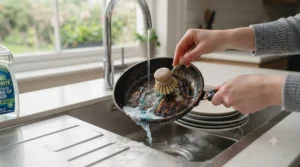
Water temperature and hardness. Hot water helps surfactants work harder on grease, so you may use less. In hard-water areas, suds can vanish quickly, tempting you to add more. Adding more is usually wasted detergent.
Low-suds formulas are also a longevity issue of perception. Bio-D buyers frequently note that eco formulas produce fewer bubbles, yet still clean. If you judge success by foam, you will over-pour. Judge it by plates instead.
Household Budgeting With Washing-Up Liquid: A Practical Framework
Household budgeting is rarely about one big decision. It’s about the small, repeated ones. Here is a framework for making washing-up liquid a solved problem.
Step 1: Measure your baseline. Note how long your current bottle lasts. If a 500ml bottle disappears in two weeks, you use around 35ml a day, and that’s your starting point.
Step 2: Set a per-month cap. Decide what you’re willing to spend, then work backwards to a unit price. If your monthly detergent budget is small, a 5L concentrate makes that cap easy to hit.
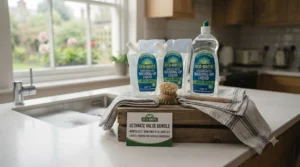
Step 3: Buy once, dose carefully. Bulk buying is a budgeting tool because it front-loads the spend and removes the weekly impulse purchase.
Step 4: Track the real win. Your washing-up liquid saving might only be a few pounds a year. The much bigger lever is hot water, which I’ll come back to. Treat detergent savings as a bonus, not the main event.
If you’re wondering where washing-up liquid sits in the wider picture, think of it as the cheapest input in your kitchen cleaning routine and the easiest to optimise without any sacrifice in results.
Practical Usage Guide: Decanting, Dosing and Storing a 5L Refill
A 5L container is brilliant until you try pouring it. Here’s how to use it without mess or waste.
Decant into a smaller dispenser. A pump bottle or a reusable dispenser makes dosing easy and stops the big container getting sticky. Keep the original container sealed and stored away from heat and sunlight.
Label everything. Write the product name and date on your decanted bottle. It saves confusion and helps you track how long it lasts.
Test your dose. Start with a smaller squirt than usual and add more only if grease isn’t lifting. Most people overdose out of habit.
Never mix products. Don’t top up a half-empty bottle with a different brand, and don’t combine washing-up liquid with bleach or other cleaners. Keep the original label handy for ingredient and safety information.
Keep it out of reach of children. Washing-up liquid is a household chemical. Store it up high and away from food.
First 30 days mistakes to avoid. Over-pouring, forgetting to rinse the pump, and leaving the cap loose are the classic errors. Get those three right and your refill will last exactly as long as it should.
Real-World Scenarios: Three Households, Three Best Picks
Let’s match products to real lives, using budget, environment and frequency of use.
The student houseshare (four people, daily washing-up, tight budget). Greasy pans, shared costs and no storage worries. The Janstar Wash-Up Wonder Double Concentrate is the logical choice: lowest unit cost, big container, and low expectations for luxury. Split the cost four ways and it barely registers.
The family of five (heavy cooking, big pots, constant use). Here, grease-cutting matters more than pennies. The Persil Pro Formula Zest earns its higher unit price by tackling roasting trays and baked-on residue with fewer repeat washes. The Fairy Professional Washing-Up Liquid is the alternative if you want that familiar Fairy feel.
The sensitive-skin single household (light use, gentle preference). A person washing up once a day doesn’t need a drum of industrial cleaner. The Bio-D Fragrance Free Washing Up Liquid suits skin that dislikes fragrance and lasts a long time at low usage. If plastic reduction is the goal, the Faith in Nature Lemon Concentrated Washing Up Liquid is the alternative.
The takeaway: concentrated washing-up liquid value depends less on the product and more on who is using it.
Problem → Solution Guide for Concentrated Formulas
Concentrates can be a little different to live with. Here are the usual snags and what to do about them.
“It doesn’t make many bubbles.” Low suds is normal for many eco formulas, including Bio-D Fragrance Free Washing Up Liquid. Judge by clean plates, not foam.
“It’s running out too fast.” You’re probably over-dosing. Switch to a pump or measure a fixed amount for a week.
“The grease is still there.” Use hotter water and consider stepping up to a stronger formula like the Persil Pro Formula Zest.
“The 5L is too heavy to pour.” Decant into a smaller dispenser once, then top up from the big container only when needed. Use two hands and a funnel.
“My hands are dry or irritated.” Try a fragrance-free option and wear gloves. Sensitive skin often reacts to perfume rather than the cleaning agents themselves.
“The bottle leaks or the pump clogs.” Rinse the pump with warm water occasionally and keep the cap tight.
✨ Ready to stop overpaying for water?
🔍 Compare the options above, check current pricing and availability on Amazon UK, and pick the pack that matches your household. A little planning now means fewer trips to the shop later!
Bulk Buying Without the Regret: Common Mistakes
Bulk buying only works if you avoid the classic traps.
Mistake 1: Buying too much for your storage. A 5L container that lives on the kitchen floor is a trip hazard, not a bargain. Measure your cupboard first.
Mistake 2: Chasing the lowest price on an unknown brand. Cheap is fine, but with very few independent reviews, as with Janstar Wash-Up Wonder Double Concentrate and Bright Earth Washing-Up Liquid, consider trying a smaller size first if you can.
Mistake 3: Ignoring the unit price. Bulk isn’t automatically cheaper. Always compare per 100ml, because a promotion on a small bottle can sometimes beat a poorly priced large pack.
Mistake 4: Forgetting availability. Several of these products appeared as out of stock at individual suppliers. Have a backup in mind.
Mistake 5: Not switching habits. If you pour a concentrate like a standard formula, you lose the value. The saving comes from dosing less.
The best approach to bulk buying is trial, then commit. Start with a small pack if you’re unsure, then scale up once you know your dose, your preferences and your skin’s reaction.
Cost Efficiency Over a Year: Where the Real Savings Are
Let’s put washing-up liquid in proportion. Assuming one bowl a day and my 5ml illustrative dose, the difference between the cheapest and priciest concentrate here is a few pounds a year. Useful, but hardly life-changing.
The much bigger cost is hot water. One Saga analysis of hand washing versus a dishwasher cites a Which? estimate of around 15p to heat a bowl of water using a 3kW immersion heater, adding up to hundreds of pounds a year for a heavy washing-up routine. Set that against the pennies you spend on detergent and the lesson is plain: real cost efficiency comes from using less hot water, not just cheaper soap.
So how do you get the best of both? Fill the bowl once, wash in batches, rinse sparingly and dose the detergent properly. A concentrate helps because you use less per wash, but your habits matter more than the brand.
If you use a dishwasher, hand washing detergent is still handy for pans, glassware and awkward items, so a big refill rarely goes to waste. Over a year, the smart route is a mid-priced concentrate in a large pack, dosed carefully, with hot-water use kept in check.
Frequently Asked Questions
❓ Is concentrated washing-up liquid really cheaper than a standard bottle?
❓ How much concentrated washing-up liquid should I use per bowl?
❓ Is 5L washing-up liquid worth it for a small household?
❓ Does concentrated washing-up liquid go off over time?
❓ Can I dilute concentrated washing-up liquid myself?
Conclusion
Concentrated washing-up liquid value is really a story about small margins and good habits. The cheapest per wash in this round-up is the Janstar Wash-Up Wonder Double Concentrate, with the Bright Earth Washing-Up Liquid close behind. For grease, the Persil Pro Formula Zest and Fairy Professional Washing-Up Liquid earn their higher unit prices. For gentle, long-lasting washing-up liquid, the Bio-D Fragrance Free Washing Up Liquid is a standout. For plastic-light living, the Faith in Nature Lemon Concentrated Washing Up Liquid is the pick, and the Fairy Platinum Quickwash Original remains the simple convenience option.
The honest truth is that cost per wash washing-up liquid differences are measured in pennies. The bigger prize is a system: buy in bulk, decant, dose carefully and watch your hot water. That’s household budgeting at its most painless.
Recommended for You
- Pet-Safe Oven Cleaner: 7 Trusted Non-Toxic UK Picks (2026)
- Washing-Up Liquid For Sensitive Skin: 7 Best Picks (2026)
- Eco-Friendly Washing-Up Liquid: 7 Best Plastic-Free Picks (2026)
Disclaimer: This article contains affiliate links. As an Amazon Associate, I earn from qualifying purchases. If you purchase products through these links, we may earn a small commission at no additional cost to you.
✨ Found this helpful? Share it with your friends! 💬🤗
