
In This Article
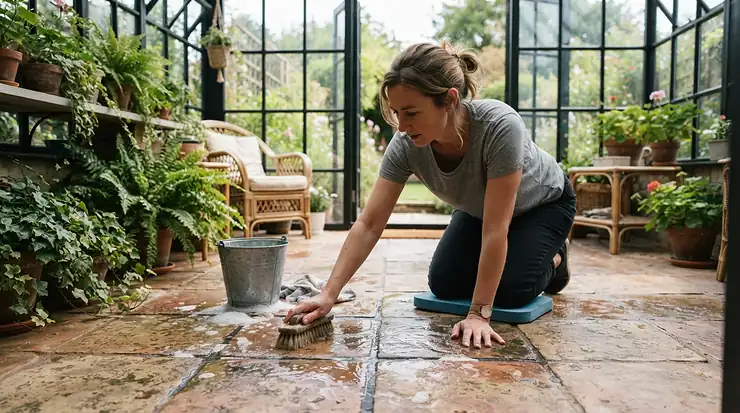
A stiff grout brush for tile joints is a compact scrubbing tool with firm nylon or polypropylene bristles, shaped to fit the narrow recessed lines between tiles. Its rigid fibres lift soap scum, mould, grease and ground-in dirt from porous grout that mops and sponges simply glide over.
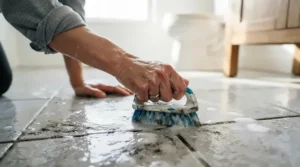
Grout is the sponge of your bathroom. It is cement-based, sold in sanded and unsanded varieties, and full of tiny pores that drink in shower gel, kitchen grease and damp. Wipe the tile face as often as you like and the joint stays grey. Only a stiff grout brush for tile joints reaches into the channel and physically dislodges what’s living there.
Here’s the catch: not every brush sold for the job is any good at it. Some heads are too fat for a 2mm joint. Some bristles are so soft they merely stroke the dirt. Others are so aggressive they’d take the glaze off a tile.
So I’ve compared seven real products by their specifications and by the patterns in aggregated customer reviews. I haven’t scrubbed a single tile with them, and I won’t pretend otherwise. What you’ll get is honest analysis of what each design means in practice: bristle material (nylon bristles versus the alternatives), angled bristles, narrow heads for tight lines, and handled options for bigger jobs. Prices are shown as ranges only, so check current price and availability on amazon.co.uk before you buy.
Quick Comparison: Stiff Grout Brush for Tile Joints at a Glance
| Product | Type | Standout feature | Price range* | Best For |
|---|---|---|---|---|
| SXhyf Crevice Cleaning Brush 3-Pack | Handheld, 3 brushes | Narrow L-shaped head | Under £10 | Shower corners and tight lines |
| SPARTA Grout Brush | Handheld | Stiff crimped nylon, angled handle | Under £10 | Tough, stained grout on a budget |
| OXO Good Grips Deep Clean Grout Cleaning Brushes | Handheld, 2 brushes | Thumb pad plus crevice wiper | Around £10 | Comfort and UK availability |
| Libman Scrub Brush Kit | Handheld, 3 brushes | Narrow grout head, recycled fibres | £10-£20 | Mixed household cleaning |
| MR.SIGA Heavy Duty Grout Scrub Brush | Long handle | 50-inch pole, swivel head | £15-£25 | Floors without kneeling |
| Foxtrot Living Long Handle and Crevice Set | Telescopic | 30-57 inch reach, bonus crevice brush | £15-£25 | Showers and floors with one tool |
| Unger Swivel Grout Brush 5.5 Inch | Pole head | Swivel head, tapered bristles | Head under £15, pole extra | Large or mosaic floors |
*Indicative bands based on listings at the time of research. Prices vary, so check current price.
Looking at the comparison above, the SXhyf pack and SPARTA deliver stiff-bristle punch for the least money, while MR.SIGA is the buy if your problem is acreage rather than corners. OXO earns its slightly higher price through comfort and confirmed UK retail availability. Unger is the specialist’s pick, but it arrives without a pole, so factor in that extra cost.
💬 Just one click — help others make better buying decisions too!😊
Top 7 Stiff Grout Brush for Tile Joints: Expert Analysis
Each pick below is judged on what its design does for you, not on what the box promises. Review sentiment comes from aggregated Amazon listings and retailer pages. Where I couldn’t verify UK-specific numbers, I say so.
1. SXhyf Crevice Cleaning Brush 3-Pack — best all-round handheld for tight corners
The headline is the narrow L-shaped head, which tilts the angled bristles into spots a flat-faced brush can only wave at.
The pack pairs stiff bristles with a non-slip handle and a hanging hole. The L-shape lets the tips meet the joint at a natural scrubbing angle, so your wrist isn’t contorted in the corner where wall tile meets bath. Three brushes also means one lives by the shower, one by the sink and one gets sacrificed to the toilet base.
On analysis, this suits anyone wanting a narrow grout cleaning brush for tight lines without paying for a premium name. The likely weak spot is joint width. The head is slim, not needle-fine, so joints of about 1.5mm or less may still be a squeeze.
Across the US review data summarised in a 2026 buying roundup, reviewers praise stiff bristles that actually fit narrow joints. The most common complaint is bristles loosening after months of heavy use. I couldn’t verify equivalent amazon.co.uk review counts, so treat that as a pattern, not a UK score.
Pros:
- ✅ Narrow L-shaped head reaches inside corners
- ✅ Three brushes for different rooms
- ✅ Non-slip handle with hanging hole
Cons:
- ❌ Bristles may loosen after heavy use
- ❌ Possibly wide for ultra-fine joints
Price range: under £10 at the time of research (check current price). Verdict: superb value for corners and wall tile, though not a floor-scrubbing solution.
2. SPARTA Grout Brush — best budget brush with pro-style stiff nylon
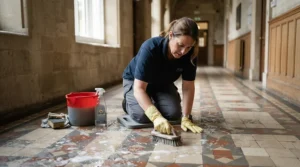
Its standout trait is crimped nylon bristles, which are wavy rather than straight and give you far more gripping surface per stroke.
The brush has a compact face of roughly 2.75 inches (about 7cm), an angled handle and chemical-resistant bristles. In practice, the narrow face keeps each pass on one or two joints instead of smearing across tile faces. The angled handle keeps your wrist neutral during longer sessions, and chemical resistance means oxygen bleach won’t turn the bristles to spaghetti.
Based on the spec comparison, this is the brush for ground-in grime on a tight budget. It’s also a kneeling tool: the overall length is about 8 inches (around 20cm), so floors will test your knees. The stiffness that makes it effective is also a hazard around silicone sealant, which it can chew up if you stray.
Reviewers on US listings rate it very highly across several thousand reviews. They commonly describe pairing it with peroxide or baking soda to revive dingy joints. Because it’s a US-popular model, check amazon.co.uk stock before planning around it.
Pros:
- ✅ Crimped nylon bristles grab and lift grime
- ✅ Chemical-resistant for stronger cleaners
- ✅ Angled handle reduces wrist fatigue
Cons:
- ❌ Short handle means kneeling for floors
- ❌ Too stiff near silicone sealant
Price range: under £10 (check current price). Verdict: the best stiff-bristle performance per pound if you can source it.
3. OXO Good Grips Deep Clean Grout Cleaning Brushes — most comfortable pair with a crevice wiper
The two-brush set pairs a thumb-pad scrubber with a small brush that has a built-in wiper blade.
The large brush is about 17cm long and the small one about 16cm. The thumb pad sits on the back of the big brush, letting you push harder without your fingers cramping. The little wiper blade on the small brush scrapes loosened gunk out of crevices rather than just shifting it around.
My read: this is the most considered ergonomic design of the seven, and it has the clearest UK retail footprint. A UK retailer listing was live at the time of research with a respectable review count. It’s a detail tool, not a floor tool, so don’t plan on doing an entire kitchen with it.
Retailer reviewers mention bristles that keep their shape and stiffness over repeated use and reach grooves a toothbrush can’t. I’d rate that a believable pattern rather than a guarantee.
Pros:
- ✅ Thumb pad delivers comfortable scrubbing force
- ✅ Wiper blade clears crevice debris
- ✅ Two sizes for varied joints
Cons:
- ❌ Not practical for whole-floor jobs
- ❌ Costs more than basic multipacks
Price range: around £10 at the time of research (check current price). Verdict: pay slightly more for comfort and dependable UK availability.
4. Libman Scrub Brush Kit — best three-in-one household kit
It’s three purpose-shaped brushes in a single kit, including an extra-narrow tile and grout head.
The kit combines a narrow grout brush, a curved power-scrub brush for flat surfaces, and a softer detail brush for fixtures. The bristles use recycled PET fibres, and the roundup I read describes them as genuinely firm. Hanging holes let all three share one hook.
Here’s what to weigh: you’re buying versatility, not a pure stiff grout brush for tile joints. The detail brush is deliberately softer, so don’t expect three hard-bristle weapons. If you want one set for grout, taps and the tub rim, that suits you well.
Aggregated US reviews are strongly positive across thousands of ratings, with buyers praising value for the three-tool bundle. Amazon UK availability and review counts weren’t verifiable during research, so confirm stock before ordering.
Pros:
- ✅ Narrow grout head fits tight joints
- ✅ Three brushes cover several jobs
- ✅ Made from recycled PET fibres
Cons:
- ❌ Detail brush is much softer
- ❌ Not suited to large floors
Price range: £10-£20 (check current price). Verdict: great for varied cleaning, less ideal if grout is your only mission.
5. MR.SIGA Heavy Duty Grout Scrub Brush — best hard bristle grout scrubber with handle for floors
The reach advantage is a 50-inch adjustable steel pole with a swivelling head and stiff V-shaped polypropylene bristles.
The V-shape puts longer bristles in the centre to drive into the joint while shorter flanking bristles work the tile face. The swivel head means you can angle it across a joint instead of dragging it lengthwise. A foam top grip keeps your palms happier on long sessions.
On paper this is the answer to “my hallway has four hundred joints and I have two knees”. It’s a bad idea on delicate surfaces: the very stiff bristles can mark polished or glossy tile. The reported weak point is rust at the pole joints, so dry it after shower-floor use.
Reviewers on US listings call it a back-saver, with thousands of reviews. The common complaints are rusting joints and a pulling-stroke technique that takes adjustment.
Pros:
- ✅ Long pole means no kneeling
- ✅ Swivel head reaches corners and edges
- ✅ V-shaped stiff bristles dig into joints
Cons:
- ❌ Pole joints may rust over time
- ❌ Very stiff on delicate tile
Price range: £15-£25 (check current price). Verdict: the strongest value for big floors if you dry it after use.
6. Foxtrot Living Long Handle Grout Brush and Crevice Set — best telescopic option with a bonus detail brush
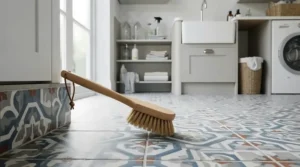
You get a telescopic handle from about 30 to 57 inches plus a handheld crevice brush.
The 120-degree pivoting head with V-shaped bristles splits the difference between a fixed head and a full swivel. The short 30-inch setting suits a shower cubicle, where a full-length pole bangs the ceiling. The bonus brush covers toilet bases and drain surrounds.
The honest analysis: telescoping means joints, and joints loosen. Reviewers report that the lock sometimes needs re-tightening during heavy scrubbing. If you clean grout once a season, that’s trivial. If it’s weekly, the MR.SIGA fixed pole is sturdier.
US sentiment is solid but slightly less glowing than the big names, and the brand is less established. That’s a fair trade for versatility.
Pros:
- ✅ Handle adjusts for showers and floors
- ✅ Includes a handheld crevice brush
- ✅ Pivot head handles awkward angles
Cons:
- ❌ Telescopic lock may loosen
- ❌ Less established brand reputation
Price range: £15-£25 (check current price). Verdict: the sensible one-tool answer for a mixed bathroom-and-hallway household.
7. Unger Swivel Grout Brush 5.5 Inch — best swivel head for large and mosaic floors
It’s a swivel head with tapered bristles that stays flat as you change direction.
The head screws onto a universal pole, which is both its strength and its catch. If you already own a compatible pole, you save money and choose your own length. If you don’t, add the cost, and check thread compatibility first. The tapered bristles track along the joint rather than wandering onto the tile.
For hexagonal or mosaic floors, with hundreds of joints per square metre, this is the closest thing to a push-broom for grout. It isn’t a gentle domestic gadget, and bristles wear down after big restoration jobs.
Reviewers on US listings describe it as a knee-saver, though the pole requirement is the standard complaint.
Pros:
- ✅ Swivel head keeps full bristle contact
- ✅ Tapered bristles track joints precisely
- ✅ Fits universal poles
Cons:
- ❌ Pole isn’t included
- ❌ Bristles wear after large jobs
Price range: head under £15, pole extra (check current price). Verdict: superb for big floors if you own or will buy a compatible pole.
| Product | Bristle and head | Reach | Standout spec | Best For |
|---|---|---|---|---|
| SXhyf | Stiff, L-shaped | Handheld | 3-pack | Corners |
| SPARTA | Crimped nylon bristles | Handheld, about 20cm | 2.75-inch face | Heavy staining |
| OXO | Stiff bristles plus wiper | Handheld, 16-17cm | Thumb pad | Comfort |
| Libman | Narrow grout head | Handheld | Recycled PET | Mixed jobs |
| MR.SIGA | V-shaped polypropylene | 50-inch pole | 180° swivel | Large floors |
| Foxtrot Living | V-shaped | 30-57 inches | 120° pivot | Versatility |
| Unger | Tapered | Pole-dependent | Swivel head | Mosaic floors |
Reading the table, the handheld group wins on precision and price, while the pole group wins on stamina. If your tile is mostly walls, the SXhyf, SPARTA or OXO will do everything you need. If it’s mostly floor, the MR.SIGA or Unger will save your joints, and I mean your knees.
✨ Don’t Miss These Exclusive Deals!
🔍 Take your tile joint cleaning to the next level with these carefully selected brushes. Click on any highlighted product to check current pricing and availability. These tools will help you create the bright, hygienic grout lines your whole household will notice!
How to Choose a Stiff Grout Brush for Tile Joints
- Measure your joint. Walls often have joints around 2-3mm, so a narrow head matters more than raw stiffness. If the head is wider than the joint, the bristles splay instead of penetrating.
- Match bristle material to your tile. Nylon bristles suit most ceramic and porcelain; avoid wire on glossy or soft stone.
- Pick the head shape. L-shaped and angled bristles are for corners; V-shaped heads are for flat floor runs.
- Decide on reach. Under about 5 square metres, handheld is fine. Beyond that, a pole saves your back.
- Check the grip. A non-slip handle matters more than it sounds when everything is wet and soapy.
- Think about storage. A hanging hole keeps bristles dry and shaped for longer.
- Buy for the worst joint, not the average one. One neglected shower floor will punish a brush that’s too soft.
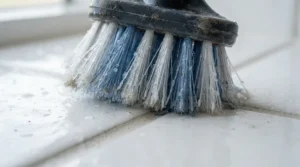
Nylon Bristles: Why They’re the Safe Default
Nylon bristles are the workhorse of the grout world for a simple reason: they’re stiff enough to dislodge soap scum and mildew but forgiving enough not to scratch ceramic or porcelain. Crimped nylon, as used on the SPARTA, adds waviness that grips dirt rather than skating over it.
Polypropylene, used on the MR.SIGA, behaves similarly and is often chosen for chemical resistance. That matters if you use bleach-based products. Wire is the aggressive outlier. It cuts through baked-on residue, but it scratches glaze, painted tile and soft stone like marble, so reserve it for cement joints on hard tile, and only with care.
There’s also the question of the grout itself. Sanded grout is rougher and tougher, so it copes well with a stiff brush. Unsanded grout is finer and more delicate, so use lighter pressure and test an unobtrusive spot first. In short, stiff nylon bristles are the right answer for most UK bathrooms, but pressure is a choice you still have to make.
Angled Bristles: Getting Into Corners
Angled bristles are the secret behind every brush that actually fits where you need it. The SXhyf L-shaped head tilts the tips into corners. V-shaped bristles on the MR.SIGA, Foxtrot Living and Unger do something different: the longer centre fibres run along the joint while shorter outer fibres scrub the tile face.
Which is better? Angled heads win in corners, around taps and along the wall-to-bath junction. V-shaped heads win on open stretches, because the geometry keeps the brush tracking along the joint without wandering. If you do a lot of both, owning one of each is more sensible than finding a compromise.
The swivel and pivot features on the pole brushes extend the same idea. They keep the bristle angle correct as you change direction, so each stroke stays productive instead of wasted on tile face.
Narrow Grout Cleaning Brush for Tight Lines
A narrow grout cleaning brush for tight lines is a different beast from a general scrub brush. The width of the head, not the length of the bristles, decides whether you clean the joint or just paint cleaner across it.
For fine subway-tile joints, look for the slimmest heads: the OXO small brush and the SXhyf L-shape are the obvious candidates, with the Libman narrow grout head close behind. For slightly wider floor joints, the SPARTA 2.75-inch face is a sensible compromise.
Here’s a practical test. Press the dry brush into a joint. If bristles splay sideways and ride up over the tile edges, the head is too wide. If they sink in with a slight squeak, you’re in business. And if the joint is ultra-fine, a stiff old toothbrush is a legitimate backup, though it won’t last.
A narrow grout cleaning brush for tight lines also lets you work out of your cleaner faster, because you’re not wasting chemistry on the surrounding tile face.
Hard Bristle Grout Scrubber with Handle: When Reach Matters
A hard bristle grout scrubber with handle is the answer when the surface area is larger than your patience. Standing upright, you can apply body weight through the pole, which is far more effective than wrist power while kneeling.
The MR.SIGA offers the sturdy fixed 50-inch pole. The Foxtrot Living offers adjustable 30-57 inch reach. The Unger gives you the head and lets you pick the pole. Each has a trade-off: rust at joints, loosening locks, or the extra pole purchase.
My rule of thumb: if the tile is more than about 5 square metres of floor, a hard bristle grout scrubber with handle repays itself the first weekend. Below that, a handheld brush is quicker to grab and easier to store. Remember to pair either with a handheld detail brush, because poles can’t reach behind toilets and under taps.
Tile Joint Cleaning: A Practical Step-by-Step Guide
Good tile joint cleaning is about sequence more than muscle. Here’s an order that makes the stiff grout brush for tile joints do its best work.
- Clear loose dirt. Vacuum or sweep first, so grit isn’t ground into the joint.
- Start mild. A tested comparison from Woman & Home found baking soda and white vinegar worked best among household options, with stronger products only if needed. Avoid vinegar on natural stone.
- Let it dwell. Give any cleaner 5-10 minutes so chemistry does the heavy lifting.
- Scrub in sections. Work about a metre at a time, along the joint rather than across it.
- Rinse thoroughly. Wipe or mop away loosened residue before it redries.
- Dry and consider sealing. Once the grout is completely dry, a sealer slows future staining.
Common first-month mistakes: pushing too hard (which etches grout), using one brush on mouldy shower joints and then the kitchen, and storing wet brushes face-down. Rinse, shake and hang.
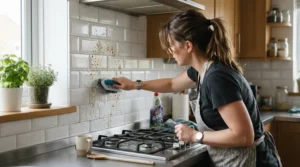
Real-World Scenarios: Which Brush for Which Home?
The renter with a subway-tile shower. Budget is tight, joints are fine and the landlord will inspect. Frequency: monthly. The SXhyf pack or OXO set is the sensible choice, using angled bristles for the corners and the narrow head for the joints.
The family with a hexagonal kitchen floor. About 12 square metres, grease and spills, cleaned every six weeks. Here a hard bristle grout scrubber with handle makes sense. The MR.SIGA is the straightforward pick, with a SPARTA or OXO for the awkward spots by the cooker.
The homeowner with sore knees. Showers and hallway, occasional deep clean. The Foxtrot Living telescopic set covers both, though the lock may need a twist now and then.
The tiling enthusiast with a mosaic floor. Hundreds of tiny joints and plenty of patience. The Unger swivel head on a good pole is built for exactly this.
Common Mistakes When Buying a Stiff Grout Brush for Tile Joints
The first mistake is buying on stiffness alone. A brush that’s rock-hard but wider than your joint is just an expensive arm workout.
The second is reaching for wire. Wire cleans stubborn residue, but it scratches glaze and soft stone, and the damage is permanent. If you’re unsure, start with nylon bristles.
The third is ignoring handle length. Many shoppers underestimate how much kneeling a floor involves until the second hour.
The fourth is skipping dwell time and scrubbing dry. Cleaner needs a few minutes to loosen grime, and the brush finishes the job.
The fifth is mixing chemicals. Never combine bleach with ammonia or vinegar, and never improvise a cocktail in a closed bathroom.
Finally, don’t use the stiffest brush on silicone sealant. It will fray the bead, and a damaged seal is a bigger problem than dingy grout.
Stiff Grout Brush vs Alternatives: Which Wins?
| Option | Strengths | Weaknesses | Best For |
|---|---|---|---|
| Stiff grout brush | Precise, cheap, controllable | Manual effort | Regular joint cleaning |
| Old toothbrush | Free, ultra-fine access | Soft bristles wear out quickly | Occasional touch-ups |
| Electric spin scrubber | Less effort on big areas | Noise, splatter, battery limits | Large flat walls |
| Regrouting | Resets badly damaged joints | Time, mess, cost | Cracked or crumbling grout |
A stiff brush wins on cost and control for nearly every household. Electric scrubbers help on large areas but struggle in corners and around fixtures. Regrouting is the nuclear option, only needed when joints are damaged beyond cleaning.
Long-Term Cost & Maintenance
A brush costing under £10 and lasting two years of monthly use works out at roughly 40p per clean, which is a better deal than most sprays. Pole brushes cost more upfront but spread that cost across years of floor cleans.
To extend life, rinse after every use, shake out water and hang the brush by its hole so bristles dry upright. Check for splayed bristles, and replace the brush when they stop springing back. Dry pole joints to avoid rust, and re-tighten telescopic locks regularly.
Think of a good stiff grout brush for tile joints as a consumable with a long life, not a lifetime purchase. Replace it when it stops doing the job, and you’ll avoid the false economy of scrubbing harder with a worn-out tool.
Safety, Ventilation and Damp: What UK Homes Should Know
Scrubbing is only half the story. Wear gloves, ventilate the room, and check cleaner labels for hazard warnings. Keep bleach away from other products.
Persistent black mould returning to grout lines can signal a damp or ventilation problem rather than a cleaning problem. The government’s damp and mould guidance for rented housing, summarised on a local council’s .gov.uk page, makes clear that landlords are responsible for addressing the underlying causes, and that tenants shouldn’t be blamed for them. If you rent and the mould keeps returning, document it with photos and report it.
A brush cleans the surface. It cannot fix a leaking seal, poor extraction or a cold, damp wall. Treat recurring mould as information, not just an annoyance.

FAQ
❓ Can a stiff grout brush damage my grout?
❓ How often should I scrub tile joints?
❓ Is an L-shaped or V-shaped head better?
❓ Can I use nylon bristles on natural stone tile?
❓ Should I seal grout after cleaning?
Conclusion
The best stiff grout brush for tile joints is the one whose head fits your joint and whose reach fits your floor. For corners and shower walls, the SXhyf pack delivers angled bristles and a narrow head for the least money, and SPARTA adds crimped nylon muscle if you can source it. If comfort and verified UK availability matter, the OXO set is the confident, slightly pricier choice, and the Libman kit suits mixed household chores.
If your tile is mostly floor, the MR.SIGA is the straightforward hard bristle grout scrubber with handle, the Foxtrot Living is the flexible all-rounder, and the Unger swivel head is the specialist’s weapon for mosaics and big runs.
Whichever you pick, start mild, give cleaner time to work, rinse, dry and consider sealing. Keep stiff bristles off silicone, wire off glossy tile, and treat recurring mould as a damp problem rather than a scrubbing challenge.
Recommended for You
- Electric Grout Cleaner For Dark Grout Lines: 7 Best Picks (2026)
- Toilet Brush Set That Does Not Drip On Floor: 7 Smart Picks (2026)
- Wall Mounted Toilet Brush For Small Cloakroom: 7 Smart Picks (2026)
Disclaimer: This article contains affiliate links. As an Amazon Associate, I earn from qualifying purchases. If you purchase products through these links, we may earn a small commission at no additional cost to you.
✨ Found this helpful? Share it with your friends! 💬🤗
