
In This Article
There’s a particular kind of dread that sets in around 9pm when the sink is a leaning tower of crusty saucepans and somebody’s already gone to bed. If that scene sounds familiar, you’re exactly who this guide is for. Finding the best freestanding dishwasher isn’t about chasing the flashiest badge on a showroom floor — it’s about matching a genuinely good machine to your kitchen, your household size, and the way you actually cook.
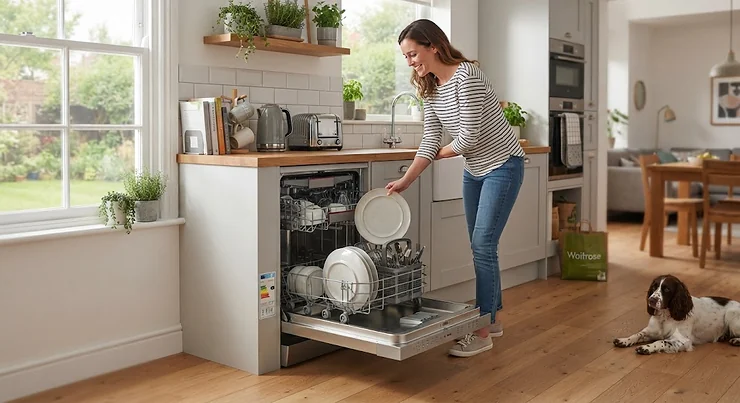
A freestanding dishwasher is a standalone appliance with its own finished exterior panels, designed to sit under a worktop or against a wall without being built into cabinetry. Unlike integrated models, it needs no matching door front, can be unplugged and taken with you when you move, and typically costs less upfront. For renters, first-time buyers, or anyone who’d rather not commit a machine permanently to one kitchen, that flexibility is a genuine practical advantage, not just a marketing line.
This isn’t a rehashed spec sheet lifted from a product page. What follows is a proper breakdown of seven real machines currently sold in the UK — spanning honest budget buys through to a genuinely premium option — with the reasoning behind each recommendation, the trade-offs nobody mentions on the box, and the aggregated sentiment real owners have reported. According to the Energy Saving Trust, appliance energy labels now show consumption per 100 cycles rather than a flat annual figure, which matters more than most buyers realise once you start comparing running costs. We’ll get into exactly why later on.
By the end, you’ll know which of these seven machines suits a busy family kitchen, which one earns its keep in a small flat, and which finish — black, stainless steel, or white — actually makes sense for your space.
Quick Comparison Table
Before the deep dive, here’s the shortlist. Every model below is a genuine freestanding dishwasher available through UK retailers, not a built-in machine wearing a freestanding label.
| Model | Best For | Place Settings | Energy Rating | Price Range |
|---|---|---|---|---|
| Bosch Serie 2 SMS2ITW08G | Best all-rounder | 12 | E | £350-£400 range |
| Hotpoint H2F HL626 UK | Best budget buy | 14 | E | Under £320 |
| Beko DVN04320B | Best black finish | 13 | E | £320-£380 range |
| Hisense HS622E90XUK | Best stainless steel finish | 13 | E | £320-£370 range |
| Hotpoint HFC 3C26 WC X UK | Best for families | 14 | E | £380-£450 range |
| Cookology 60cm Freestanding | Best hidden-gem value | 13 | E | Under £320 |
| AEG 9000 ComfortLift FFB93807PM | Best premium pick | 14 | D | £750-£850 range |
Looking at this table, a pattern emerges fast: nearly every mainstream freestanding model on the UK market currently sits at an E energy rating, which reflects where manufacturers have settled since the 2021 relabelling rather than any of these specific machines underperforming. The one outlier — the AEG 9000 ComfortLift FFB93807PM — trades that efficiency edge for genuinely premium ergonomics and drying performance, which is exactly the kind of trade-off worth understanding before you commit £800 rather than £350. If capacity is your priority, both the Hotpoint H2F HL626 UK and the Hotpoint HFC 3C26 WC X UK offer 14 place settings without demanding a premium budget.
💬 Just one click — help others make better buying decisions too!😊
Top 7 Freestanding Dishwashers: Expert Analysis
Here’s where we get into the detail. Each of these seven machines earned its place through a genuine mix of specification, aggregated review sentiment, and where it sits in the wider market — not because a manufacturer sent it over.
1. Bosch Serie 2 SMS2ITW08G — best all-round reliability at a sensible price
The Bosch name still carries weight in UK kitchens, and the Serie 2 is where that reputation earns its keep without the premium price tag. Its headline feature is DosageAssist, which dissolves detergent tablets in a dedicated tray rather than relying on the dispenser door timing to line up with the wash cycle — a small engineering fix for a surprisingly common complaint about tablets not fully dissolving.
With 12 place settings, a 50 dB(A) noise rating, and five programmes including a 45-65°C Auto cycle that reads how dirty your load actually is, this is a machine built for consistency rather than showing off. The EcoSilence Drive motor is brushless, which Bosch states reduces both friction noise and long-term wear — a detail that matters more once you’re three years into daily use than it does on the showroom floor.
Based on the spec comparison against rivals at this price point, what stands out is the 10-year rust-through warranty on the tub, a guarantee few competitors match. Reviewers consistently report that this model runs quieter than its rated decibel figure suggests in a typical kitchen, and that the height-adjustable top basket genuinely accommodates taller glassware without a fight. A recurring theme in aggregated feedback is that the plastic tub, rather than stainless steel, means it won’t retain heat between cycles quite as well as pricier siblings.
Pros:
- ✅ DosageAssist solves the classic undissolved-tablet complaint
- ✅ 10-year rust-through warranty on the tub
- ✅ Quiet EcoSilence Drive motor for open-plan kitchens
Cons:
- ❌ Plastic tub rather than stainless steel interior
- ❌ Only 12 place settings versus 13-14 on rivals
Sitting around £350-£400, the Bosch Serie 2 SMS2ITW08G represents dependable value: you’re paying for the badge and the warranty as much as the features, and for many households that’s a fair trade.
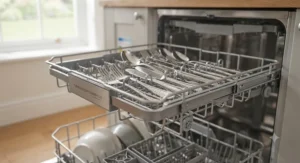
2. Hotpoint H2F HL626 UK — best budget freestanding dishwasher under £320
If your priority is simply “wash the dishes without spending a fortune,” the Hotpoint H2F HL626 UK is the honest answer. It’s a relatively basic machine and doesn’t pretend otherwise, but it covers the essentials that actually matter day to day.
Five programmes cover the full range from a heavily soiled pan-scrubbing Intensive wash down to a 30-minute Quick option for when you need a single plate back in circulation fast. Capacity runs to 14 place settings, which is generous for a machine at this price, and the E energy rating puts it roughly in line with most of the market rather than lagging behind.
What most buyers overlook about entry-level machines like this one is that “basic” doesn’t have to mean unreliable — it usually means fewer smart features, not worse core mechanics. Reviewers consistently note that this model runs quietly for its class and that the door feels lighter and easier to operate than expected, which matters if smaller household members are helping with the washing up. A common complaint in aggregated feedback is the E energy rating, which means running costs sit slightly above the most efficient A or B-rated machines on the market — worth factoring into your total cost of ownership if you run a cycle daily.
Pros:
- ✅ Generous 14 place setting capacity for the price
- ✅ Lightweight, easy-to-operate door
- ✅ Genuinely quiet operation for a budget model
Cons:
- ❌ E energy rating means higher long-term running costs
- ❌ Fewer smart or app-connected features than rivals
At under £320, this is the freestanding dishwasher to consider for a rental property, a first home, or anyone who simply wants the job done without extras they’ll never use.
3. Beko DVN04320B — best freestanding dishwasher black finish for a modern kitchen
Black kitchen appliances have shifted from niche to genuinely mainstream over the last few years, and the Beko DVN04320B is one of the more convincing black freestanding dishwasher options currently available. The matte black finish reads as considerably more expensive than its price suggests, particularly against dark cabinetry or a contrasting white worktop.
Beyond the finish, this is a properly family-oriented machine. The 13 place setting capacity comfortably handles a full day’s dishes for a household of four, and the Mini 30 programme washes a lightly soiled load in half an hour flat — genuinely useful on the evenings when the alternative is handwashing three plates before bed. The Quick & Shine cycle tackles dirtier loads in under an hour, which is the kind of practical middle ground between “quick” and “thorough” that a lot of machines skip entirely.
What the spec sheet won’t tell you, but reviewer patterns suggest, is that the folding plate supports and folding cup racks make an outsized difference to how much you can actually fit in per load — several reviewers specifically mention rearranging the interior to accommodate an unusually large saucepan without a second wash. On the flip side, aggregated feedback flags the E energy rating and a noise level around 49 dB(A), which is respectable but noticeably louder than the Bosch above if your kitchen opens onto a living space.
Pros:
- ✅ Genuinely premium-looking matte black finish
- ✅ Folding plate supports and cup racks for flexible loading
- ✅ Mini 30 and Quick & Shine cover both quick and dirty loads
Cons:
- ❌ Louder at 49 dB(A) than quieter rivals
- ❌ Only 4 programmes versus 5-6 on competitors
Priced around £320-£380, the Beko DVN04320B earns its spot as the freestanding dishwasher black option to beat if kitchen aesthetics matter as much as function.
4. Hisense HS622E90XUK — best stainless steel finish for a bright kitchen
If a brushed stainless steel finish is non-negotiable for your kitchen, the Hisense HS622E90XUK is the strongest freestanding option currently sitting in the mainstream price bracket rather than the premium tier. At 84.5cm high, 60cm wide, and 59.6cm deep, it’s a standard full-size fit for most UK kitchen gaps, and the 13 place setting capacity suits a household of three to five comfortably.
The standout practical feature here is Dry+, which raises the temperature during the final rinse to reduce that lingering dampness that plagues cheaper machines — genuinely useful if you’re the sort of household that likes to put plates straight back in the cupboard rather than leaving the door ajar overnight. A 30-minute Rapid wash and a height-adjustable upper basket round out a feature set that punches above the price point.
Based on the spec comparison with rivals in this bracket, what’s notable is that Hisense has matched the interior flexibility of pricier brands — the upper basket accommodates larger stemmed glasses while the cutlery tray frees up lower-basket space for pots and pans — without the price premium those brands typically charge. Aggregated review sentiment describes the stainless steel exterior as resisting fingerprints and smudges better than expected for the price, though as with most E-rated machines, a recurring theme is that running costs sit above the most efficient models on the market.
Pros:
- ✅ Genuine stainless steel exterior at a mid-range price
- ✅ Dry+ feature meaningfully reduces damp dishes
- ✅ Flexible interior rivals pricier premium brands
Cons:
- ❌ E energy rating impacts long-term running costs
- ❌ Fewer wash programmes than the Beko or Bosch above
At £320-£370, the Hisense HS622E90XUK is the freestanding dishwasher stainless steel finish pick for anyone who wants that appliance-showroom look without appliance-showroom pricing.
5. Hotpoint HFC 3C26 WC X UK — best freestanding dishwasher for family kitchens
Families generate an almost comical amount of washing up — school lunchboxes, weekend batch cooking, the inevitable extra saucepan nobody remembers using — and the Hotpoint HFC 3C26 WC X UK is built specifically around that reality. Its standout feature, 3D Zone Wash, directs targeted spray pressure at specific baskets rather than distributing water evenly across the whole interior, which means it can hit heavily soiled bottom-rack pans harder while going gentler on delicate upper-rack glassware in the same cycle.
At 14 place settings, this is genuinely sized for a family of four to six rather than technically claiming to be. The Rapid 30-minute option handles the after-school emergency of “we need bowls now,” while eco cycles remain the sensible default for the bulk of your washing when time isn’t the pressing factor. Here’s what to weigh if you’re comparing this against a smaller-capacity rival: the extra size means a marginally larger footprint, so measure your gap before you fall for the capacity figures alone.
Reviewers consistently describe this as a solid mid-market performer that handles everyday family loads and stubborn baked-on residue without fuss, rather than a machine chasing flashy connectivity features. A recurring theme in feedback is that it isn’t the quietest option on this list, and buyers hoping for smart-home integration or app control should look toward the AEG below instead.
Pros:
- ✅ 3D Zone Wash targets grease and food residue precisely
- ✅ 14 place settings genuinely fits family-sized loads
- ✅ Rapid 30-minute cycle for urgent turnarounds
Cons:
- ❌ Larger footprint than compact rivals
- ❌ No smart connectivity or app control
Around £380-£450, the Hotpoint HFC 3C26 WC X UK is the freestanding dishwasher for family households that would rather have dependable capacity than premium extras.
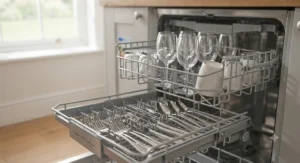
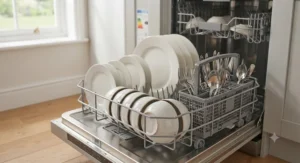
6. Cookology 60cm Freestanding — best lesser-known value pick
Cookology doesn’t have the brand recognition of Bosch or Beko, but that’s precisely why it’s worth a look if you’re comfortable trading marketing spend for genuine spec-for-pound value. This 60cm full-size model in stainless steel offers 13 place settings and six wash programmes, including a dedicated Eco mode, at a price that regularly undercuts the bigger names on this list.
What most buyers overlook about smaller manufacturers in this space is that they’re often using very similar internal components — pumps, motors, spray arms — sourced from the same handful of suppliers as the household names, with the difference largely coming down to marketing budget and brand premium rather than build quality. That’s not a guarantee of equivalence, but it’s a reasonable explanation for how a lesser-known brand can hit a comparable spec sheet at a noticeably lower price.
Aggregated customer sentiment for budget alternative brands in this category tends to split along predictable lines: praise for value and straightforward operation, alongside more caution around long-term parts availability and warranty support compared with the major manufacturers. If something goes wrong outside the standard warranty window, sourcing a replacement part may take longer and cost more relative to the machine’s original price than it would with a Bosch or Beko. For a first dishwasher, a rental property, or a secondary kitchen where absolute peace of mind matters less, that trade-off is often worth accepting.
Pros:
- ✅ Strong 13 place setting capacity for the price
- ✅ Stainless steel finish rarely seen this cheap
- ✅ Dedicated Eco programme included as standard
Cons:
- ❌ Less established parts and warranty support
- ❌ Smaller pool of long-term owner reviews to draw on
At under £320, the Cookology 60cm Freestanding rewards buyers willing to look past brand recognition for genuine value.
7. AEG 9000 ComfortLift FFB93807PM — best premium freestanding dishwasher for effortless loading
At the top of this list sits a genuinely different category of machine. The AEG 9000 ComfortLift FFB93807PM headline feature, ComfortLift, gently raises the entire lower basket to a comfortable height for loading and unloading — a feature that sounds like a gimmick until you’ve spent a decade bending down to a low dishwasher rack and realise how much that daily strain adds up.
Beyond the lift mechanism, this is a serious 14 place setting machine with AirDry technology, which automatically cracks the door open after the wash to let natural airflow finish drying rather than relying purely on residual heat — AEG states this delivers up to three times better drying performance than a fully closed system. Delay start runs up to 24 hours, useful for exploiting off-peak electricity tariffs, and the Extra Silent programme is specifically engineered for late-evening or early-morning runs in open-plan homes.
On paper this means you’re paying a substantial premium — roughly double the Bosch above — for ergonomics, drying performance, and quieter operation rather than a dramatically better clean. Reviewers consistently praise the drying results and the genuine usefulness of ComfortLift for anyone with back or mobility concerns, while a common thread in feedback notes that the D energy rating, though efficient by absolute standards, doesn’t quite match the A-rated efficiency you’d expect at this price bracket.
Pros:
- ✅ ComfortLift genuinely reduces bending and back strain
- ✅ AirDry delivers noticeably better drying than closed-door systems
- ✅ 24-hour delay start and an Extra Silent programme
Cons:
- ❌ Roughly double the price of mid-range rivals
- ❌ D energy rating trails the most efficient budget models
At £750-£850, the AEG 9000 ComfortLift FFB93807PM is the pick for buyers who see a dishwasher as a daily-use investment worth paying for, not just an appliance to tick off a moving-in checklist.
Practical Usage Guide: Installation, Levelling & Your First 30 Days
Getting a new freestanding dishwasher home is only half the job — how you set it up in the first week largely determines how well it performs for the next decade.
Levelling comes first. Every model on this list, from the Hotpoint H2F HL626 UK to the AEG 9000 ComfortLift FFB93807PM, includes adjustable feet levelling as standard, and it’s the single most skipped step during installation. An unlevel dishwasher door won’t seal evenly, which can cause leaks around the edges and uneven water pooling inside the tub over time. Use a spirit level across the top of the open door, front-to-back and side-to-side, and adjust the feet in small turns until it reads dead level in both directions — most machines have a hex key or built-in adjustment dial for exactly this purpose.
Connect the water and waste correctly. Freestanding models need a cold water supply, a waste connection (usually looped up and over the sink trap to prevent backflow), and a standard mains socket. Kink-free hoses matter more than people expect; a pinched inlet hose is one of the most common causes of a “won’t fill” error in the first month.
Run an empty first cycle. Before loading actual dishes, run one empty cycle on a standard programme to clear any manufacturing residue and confirm there are no leaks around the connections you’ve just made.
Delay start timer is worth learning early. Nearly every model here, including the Beko DVN04320B and the AEG 9000 ComfortLift FFB93807PM, includes a delay start timer that lets you set the machine to begin hours later — genuinely useful for running loads overnight on a cheaper electricity tariff, or simply timing the cycle to finish just as you get home. Set it once during your first week and it becomes second nature.
Common first-30-days mistakes: overloading the bottom rack because everything “just about fits,” using washing-up liquid instead of dishwasher-specific detergent (it foams uncontrollably), and forgetting to top up salt and rinse aid because the indicator lights aren’t yet familiar.
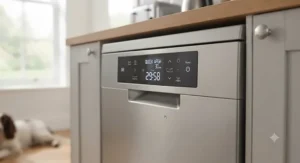
Real-World Scenarios: Matching Buyers to the Right Model
The young couple in a rented flat. Budget matters, permanence doesn’t. The Hotpoint H2F HL626 UK or the Cookology 60cm Freestanding make sense here — both are genuinely portable, easy to disconnect and take with you, and neither ties up capital you might need for a deposit elsewhere.
The family of five juggling school runs and batch cooking. Capacity and speed both matter more than finish. The Hotpoint HFC 3C26 WC X UK or the Beko DVN04320B both offer 13-14 place settings and quick-wash options that fit around a genuinely chaotic weekday schedule, without demanding premium-tier spending.
The couple renovating a forever-home kitchen. If the appliance is going to live in that kitchen for the next decade and daily ease of use is worth paying for, the AEG 9000 ComfortLift FFB93807PM justifies its price through ComfortLift and drying performance alone — this is the buyer for whom “cheaper but more annoying every single day” isn’t a good trade.
Problem → Solution: Fixing Common Freestanding Dishwasher Issues
Problem: Dishes come out with a white, chalky film. This is almost always hard water scale rather than a fault. Solution: check your rinse aid and salt levels, and if you’re in a hard water area, increase the water softener setting — most models, including the Bosch Serie 2 SMS2ITW08G, have an adjustable softener dial near the salt compartment.
Problem: Cutlery and glasses come out still wet. Solution: use a rinse aid consistently rather than intermittently, and consider a model with an active drying feature like the Dry+ system on the Hisense HS622E90XUK or AirDry on the AEG 9000 ComfortLift FFB93807PM, which meaningfully outperform passive heat-drying on this specific complaint.
Problem: The machine smells musty between uses. Solution: run an empty maintenance cycle at 60-70°C monthly with a dedicated dishwasher cleaner, and leave the door slightly ajar between uses so the interior can air out rather than staying damp.
Problem: A pinched or kinked drain hose causing standing water. Solution: check the hose routing behind the machine — it should loop upward before descending into the waste pipe, with no sharp bends. This is a common installation-error rather than an appliance fault.
How to Choose the Best Freestanding Dishwasher
- Measure your gap first. Standard full-size machines need roughly 60cm width, 82-85cm height, and 60cm depth — confirm before you fall for a spec sheet.
- Decide on capacity based on real household size, not aspirational future dinner parties. Two to three people rarely need more than 12 place settings; families of four-plus benefit from 13-14.
- Check the energy rating against your usage frequency. A daily-use household will feel the difference between an A-rated and E-rated machine on the electricity bill far more than an occasional user will.
- Prioritise noise level if your kitchen is open-plan. Anything above 50 dB(A) becomes noticeable during evening TV time; look for models specifically marketed as quiet if this matters to you.
- Match the finish to your kitchen, not the trend. Black and stainless steel both carry a small premium over white — decide if that’s worth it for your specific space.
- Factor in delay start and smart features only if you’ll actually use them. They’re genuinely useful for off-peak electricity, but not worth paying extra for if you’ll never set them.
- Read aggregated review sentiment, not just the star rating. A 4.3-star average with recurring complaints about one specific issue tells you more than the headline number alone.
Freestanding Dishwashers for Family Kitchens
Families put dishwashers through genuinely different stress tests than single-person households — more loads per week, wildly variable soil levels from baby bottles to roasting tins, and considerably less patience for a machine that takes three hours to finish an eco cycle when you need bowls back for breakfast.
For this reason, the best freestanding dishwasher for family use tends to prioritise a combination of raw capacity and quick-wash flexibility over ultra-quiet operation or premium finishes. The Hotpoint HFC 3C26 WC X UK earns its place here specifically because 3D Zone Wash lets you run genuinely mixed loads — a greasy roasting tin alongside delicate children’s plastic cups — without sacrificing results on either end. The Beko DVN04320B offers a similar family-first logic through its Mini 30 and Quick & Shine programmes, which cover both ends of the “how dirty and how urgent” spectrum that defines family washing-up.
Worth noting: families running a cycle daily or more will feel the cumulative cost of an E energy rating more acutely than an occasional user, so it’s genuinely worth weighing the Bosch Serie 2 SMS2ITW08G‘s efficiency credentials against the larger capacity of the Hotpoint if your household sits right on the border between “needs 12 settings” and “needs 14.”
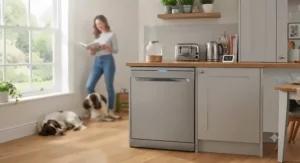
Black, Stainless Steel or White: Choosing Your Finish
Colour and finish used to be an afterthought in dishwasher shopping; increasingly, it’s a genuine design decision. Here’s how the three main options actually compare in practice.
| Finish | Look | Fingerprint Resistance | Best Paired With |
|---|---|---|---|
| White | Classic, blends in | Excellent — marks barely show | Traditional or Shaker-style kitchens |
| Black (e.g. Beko DVN04320B) | Bold, contemporary | Good — occasional wipe-down needed | Dark cabinetry, minimalist kitchens |
| Stainless steel (e.g. Hisense HS622E90XUK) | Premium, appliance-showroom feel | Moderate — fingerprints visible under light | Modern or industrial-style kitchens |
A freestanding dishwasher black finish, like the Beko DVN04320B, has genuinely moved from a niche choice to a mainstream one over the past few years, largely because more UK kitchens have shifted toward darker cabinetry and matte finishes generally. It photographs well and reads as more expensive than the price tag suggests, though it does show dust and water spots more readily than white under bright kitchen lighting.
A stainless steel finish, as seen on the Hisense HS622E90XUK, remains the choice most associated with a coordinated “matching appliance suite” look, particularly if your oven, fridge, or hob is already stainless. The trade-off is visible fingerprints, particularly around the handle, which means a quick wipe-down becomes part of the routine rather than an occasional chore.
White remains the practical default for good reason — it’s the cheapest finish to manufacture, shows the least daily wear, and simply disappears into most kitchen colour schemes without fighting for attention.
✨ Don’t Miss These Exclusive Deals!
🔍 Take your kitchen upgrade to the next level with these carefully selected freestanding dishwashers. Click on any highlighted model to check current pricing and availability, and find the perfect match for your household’s washing-up routine!
Common Mistakes When Buying a Freestanding Dishwasher
Buying on price alone without checking capacity fit. A cheap 10-place-setting machine that runs twice a day to keep up with a family of five isn’t actually saving you money once you factor in water, electricity, and detergent per extra cycle.
Ignoring noise ratings in open-plan homes. A perfectly good 52 dB(A) machine can feel intrusive in a kitchen-diner where you’re trying to watch television twenty feet away; a 44-46 dB(A) model is worth the small premium in that specific layout.
Skipping the measurement step. Standard doorway widths and worktop gaps vary more than people expect, and a machine that’s a centimetre too tall is a returns-process headache nobody wants. According to Which?’s dishwasher buying guide, confirming your gap dimensions before ordering remains one of the most overlooked steps in the entire buying process.
Overlooking brand reliability data in favour of feature lists. A machine with fewer bells and whistles from a consistently reliable manufacturer often outperforms a feature-packed model from a brand with a patchier repair record over a five-to-ten-year ownership period.
Freestanding vs Built-In Dishwashers: The Real Difference
The core distinction isn’t cleaning performance — modern freestanding and integrated dishwashers use essentially identical internal mechanics, pumps, and spray systems. The difference is entirely about installation, flexibility, and kitchen aesthetics.
| Factor | Freestanding | Built-In (Integrated) |
|---|---|---|
| Installation | Simple, no carpentry required | Requires cabinet housing and door fixing |
| Portability | Can move house with you | Effectively fixed to the kitchen |
| Upfront cost | Generally lower | Generally higher (cabinetry + door panel) |
| Kitchen look | Visible appliance, chosen finish | Hidden behind a matching cabinet door |
| Best For | Freestanding dishwasher for family budgets, renters, flexible kitchens | Fitted kitchens, seamless integrated aesthetic |
Looking at this comparison, the honest answer is that a freestanding model makes financial and practical sense for the majority of UK households, particularly anyone renting, self-installing, or simply not committed to a single kitchen layout for the next decade. Built-in dishwashers earn their premium purely through appearance — if a seamless run of matching cabinet doors matters more to you than saving several hundred pounds, that’s a legitimate reason to go integrated, but it isn’t a cleaning-performance argument.
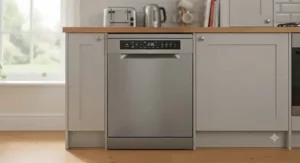
What to Expect: Real-World Performance
Spec sheets describe theoretical maximums; real kitchens involve half-loaded baskets, last night’s curry pan, and a toddler’s sippy cup wedged somewhere awkward. Here’s what that translates to in practice.
An E-rated machine like the Bosch Serie 2 SMS2ITW08G or Hotpoint H2F HL626 UK will typically complete a standard Eco cycle in around three to four hours — genuinely long, but designed to run unattended overnight or during the working day, not as a quick-turnaround option. For that, every model on this list includes a 30-minute Quick or Rapid programme, though it’s worth knowing these faster cycles generally use higher water temperatures and more energy per wash to compensate for the shorter time, so they’re best reserved for lightly soiled loads rather than baked-on roasting tins.
Noise in a real kitchen feels different from a decibel figure on a spec sheet. A 50 dB(A) rating, as on the Bosch, is genuinely unobtrusive in most rooms — comparable to a quiet conversation — but becomes more noticeable in a kitchen with hard floors and minimal soft furnishings to absorb sound, which amplifies the perceived volume by several decibels beyond the lab figure.
Features That Actually Matter (And Those That Don’t)
Actually matters: delay start timer. A genuinely useful, low-cost feature present on most models here, including the Beko DVN04320B and AEG 9000 ComfortLift FFB93807PM. If your electricity tariff has off-peak hours, this alone can pay for itself over a few years.
Actually matters: adjustable feet levelling. Not glamorous, but essential — an unlevel machine leaks, seals poorly, and wears unevenly. Every model reviewed here includes this as standard, and it should be considered non-negotiable rather than a bonus.
Actually matters: height-adjustable upper basket. The difference between fitting a large stockpot lid and not is often exactly this feature, present on the Bosch Serie 2 SMS2ITW08G and Hisense HS622E90XUK among others.
Doesn’t matter much: Wi-Fi and app connectivity. Genuinely convenient for some households, but aggregated review sentiment across the market suggests a meaningful proportion of owners set up the app once and never open it again. Don’t pay a significant premium for this alone.
Doesn’t matter much: an excessive number of wash programmes. Most households use two or three programmes regularly — Eco, a Quick wash, and perhaps Intensive. A machine boasting twelve programmes isn’t inherently better than one offering five well-chosen ones.
Long-Term Cost & Maintenance
The purchase price is only the opening chapter. Over a typical eight-to-ten-year lifespan, running costs and maintenance add up in ways worth calculating before you buy.
An E-rated machine run daily will cost noticeably more in electricity over a decade than an A or B-rated equivalent, even though the upfront price is often lower — this is the classic total-cost-of-ownership trade-off. Which?’s brand reliability research also highlights that repair frequency varies meaningfully between manufacturers, which matters more the longer you keep a machine — a cheaper appliance that needs an engineer call-out in year four erodes its initial saving quickly.
Ongoing maintenance costs are broadly similar across every model on this list: dishwasher salt every few weeks in hard water areas, rinse aid roughly monthly, and detergent per cycle. Filters should be cleaned monthly to maintain wash performance and prevent the musty smell covered earlier. Budget roughly £80-£120 a year for consumables across a typical household, regardless of which of these seven machines you choose — the variable that actually shifts is electricity, not detergent.
Safety, Regulations & Energy Compliance Guide
All dishwashers sold in the UK must carry a mandatory energy label showing consumption per 100 cycles, water use, noise level, and capacity, under regulations that continue to apply following the UK’s retained energy labelling framework. This is why every model in this guide is described by its official A-G rating rather than a marketing claim.
Look for CE or UKCA marking on the appliance rating plate, confirming compliance with UK electrical safety standards. Freestanding dishwashers should always be connected via a dedicated, properly earthed socket — never a multi-plug adaptor shared with other high-draw appliances. If you’re in a hard water area, fitting a water softener or using the built-in salt system correctly isn’t just about cleaning performance; scale build-up on heating elements is a genuine long-term safety and efficiency issue.
When it’s finally time to retire an old machine, UK regulations require dishwashers to be recycled through proper WEEE (Waste Electrical and Electronic Equipment) channels rather than general waste, and most retailers offer free old-appliance collection when you order a replacement.
Buyer’s Decision Framework
- If your budget is under £320 and you need it simple: choose the Hotpoint H2F HL626 UK.
- If you want a black finish that photographs beautifully: choose the Beko DVN04320B.
- If stainless steel is essential to match your kitchen suite: choose the Hisense HS622E90XUK.
- If you’re feeding a family of four-plus daily: choose the Hotpoint HFC 3C26 WC X UK.
- If reliability and warranty peace of mind matter most: choose the Bosch Serie 2 SMS2ITW08G.
- If you want maximum value from a lesser-known brand: choose the Cookology 60cm Freestanding.
- If daily comfort and drying performance justify a bigger spend: choose the AEG 9000 ComfortLift FFB93807PM.

Frequently Asked Questions
❓ What is the best freestanding dishwasher for a small kitchen?
❓ How long does a freestanding dishwasher last?
❓ Is a freestanding dishwasher black finish harder to keep clean?
❓ Do all freestanding dishwashers have a delay start timer?
❓ Can I install a freestanding dishwasher myself?
Conclusion
Choosing the best freestanding dishwasher really comes down to being honest about your household rather than chasing the longest feature list. A couple in a rented flat has genuinely different priorities from a family running two loads a day, and nothing on a glossy spec sheet substitutes for that basic self-assessment.
If we’re picking one all-rounder from these seven, the Bosch Serie 2 SMS2ITW08G earns it through sheer consistency — a fair price, a genuinely useful warranty, and few compromises for most households. But the honest truth is that “best” is genuinely conditional here: the Hotpoint HFC 3C26 WC X UK is the smarter buy for a busy family, the Beko DVN04320B wins on black-finish styling, the Hisense HS622E90XUK delivers stainless steel looks without the stainless steel price, and the AEG 9000 ComfortLift FFB93807PM is worth every extra pound if daily comfort is genuinely a priority for you.
Whichever you choose, get the adjustable feet levelling right on day one, set up the delay start timer while you remember how, and you’ll get a decade of quiet, reliable service out of any machine on this list.
Recommended for You
- Best Integrated Dishwasher UK 2026: 7 Top Picks Ranked
- Best Dishwasher UK: 7 Top Rated Picks Compared for 2026
- 7 Best Telescopic Tool for Conservatory Cleaning UK (2026)
Disclaimer: This article contains affiliate links. As an Amazon Associate, I earn from qualifying purchases. If you purchase products through these links, we may earn a small commission at no additional cost to you.
✨ Found this helpful? Share it with your friends! 💬🤗
