
In This Article
You unload the dishwasher, reach for a wine glass, and hold it up to the light. Cloudy. Streaky. Faintly chalky, like it’s been sandblasted. Welcome to life in a hard water postcode.
If that sounds familiar, the culprit probably isn’t your machine. It’s the water. Roughly 60 per cent of England has hard or very hard supply, with London and the South East among the worst-affected areas, while most of Scotland and Wales enjoy softer water. That mineral load, mainly calcium and magnesium, fights your detergent, leaves white film on glassware and slowly crusts your heating element.
Choosing the right dishwasher tablets for hard water is the cheapest fix you can make. The best ones pack detergent, rinse aid and a salt-function component into one tablet. This guide compares seven real products using manufacturer specs, retailer information and independent testing from Which?. It also explains what the maths of water hardness means for your kitchen.
You’ll also find setup advice, a problem-solving guide, buyer scenarios and honest answers on when tablets alone aren’t enough. Read on before you buy another 100-pack.
Quick Comparison: Dishwasher Tablets for Hard Water at a Glance
| Product | Salt/Softening Claim | Standout Trait | Price Range (per pack) | Best For |
|---|---|---|---|---|
| Fairy Platinum Plus Lemon | All-in-one with salt-function component | Strong brand track record, tested by Which? | £15–£30 | Everyday households |
| Finish Ultimate Infinity Shine | Built-in salt effective up to 26°e (21°dH) | Glass and silverware protection | £25–£35 (80–100 pack) | Glassware lovers |
| Finish Powerball Ultimate Plus Lemon | All-in-one, tested by Which? | Multi-action cleaning without pre-rinsing | £15–£30 | Heavily soiled loads |
| Finish Powerball Ultimate Infinity | Integrated salt action and rinse aid per retailer listing | Streak-free finish | £15–£25 (55 pack) | Hard water regions |
| Ecover All In One Power | All-in-one, tested by Which? | Eco-minded brand | £8–£18 | Eco-conscious buyers |
| Ocean Saver Pearl 5in1 Power | 5-in-1 formula, tested by Which? | Plastic-free positioning | £8–£18 | Low-waste households |
| Fairy Platinum All In One Lemon | All-in-one, tested by Which? | Simpler, cheaper Fairy option | £10–£25 | Budget-minded families |
Prices vary by retailer and pack size, so check current prices before buying. The table shows a clear split. The two Finish Ultimate Infinity Shine and Finish Powerball Ultimate Infinity options publish the most specific hard water claims, while the eco brands trade a little certainty for sustainability credentials.
If limescale is your main enemy, start with the Finish pair. If you’re watching the budget, Fairy Platinum All In One Lemon is the safer entry point, then top up with salt if your machine needs it.
💬 Just one click — help others make better buying decisions too!😊
Top 7 Dishwasher Tablets for Hard Water: Expert Analysis
1. Fairy Platinum Plus Lemon — the dependable all-rounder
Fairy’s Platinum Plus line has a loyal following, and it earned a place in Which?’s April 2026 round of dishwasher tablet testing. A “30 Minute Miracle” variant also exists for short cycles, which suits busy households.
On paper, this is a standard all-in-one: detergent, rinse aid and a salt-function component in one water-soluble tablet. That category-wide salt function does real work, but it isn’t a replacement for properly topped-up dishwasher salt, as one UK appliance-advice site points out. Here’s what to weigh: if your water sits in the “hard” band rather than “very hard,” this tablet probably handles things alone.
The aggregated picture is hard to verify. Independent review scores here are paywalled, and I couldn’t confirm star ratings across retailers. One UK white-goods advice site does call Fairy Platinum the strongest it has tried, but treat that as one opinion rather than consensus.
Pros:
- ✅ Widely stocked, easy to repurchase
- ✅ Independently tested by Which? in 2026
- ✅ Short-cycle variant available
Cons:
- ❌ Premium pricing versus supermarket tablets
- ❌ May need extra salt in very hard water
Expect a price in the mid-range for a branded tablet, roughly £15–£30 per large pack. It’s good value if you value consistency over chasing the cheapest option.
2. Finish Ultimate Infinity Shine — best for protecting glassware
This is the tablet to try if cloudy glasses are the main complaint. Finish says its “Protector Shield” guards glass, dish décor and silverware wash after wash.
The hard water claim is the most useful spec on the pack. The built-in salt function works in soft, medium and hard water up to 26°e (21°dH). Converted, that’s roughly 370mg/l of calcium carbonate, which covers most of the UK. Some of the hardest towns reportedly top 340 ppm, so a few postcodes sit right at the limit. Finish advises adding its salt if your water is harder, and recommends rinse aid for best drying.
Retailer reviews are decidedly mixed. Listings for different pack sizes show averages ranging from the high 2s to the low 4s out of 5. That spread suggests experiences depend heavily on water, machine and expectations, so don’t assume “premium” means “perfect.”
Pros:
- ✅ Clear published hardness limit
- ✅ Dedicated glass and silverware protection
- ✅ No unwrapping needed, dissolves fully
Cons:
- ❌ Mixed retailer ratings across pack sizes
- ❌ Still needs salt in the hardest areas
Bulk packs sit in the £25–£35 range, which works out cheaper per wash. Decent value if glassware is your priority.
3. Finish Powerball Ultimate Plus Lemon — tough on baked-on mess
Tested by Which? in April 2026, this one targets the heavily soiled end of the market. The cleaning claim is multi-action chemistry that tackles burnt-on stains without pre-rinsing.
In practice, that matters for hard water because limescale and food residue compound each other. A tablet that cleans harder can help, but it isn’t a descaler. The Finish range’s shared salt function suggests similar hardness coverage to its sister products, though I couldn’t verify the exact limit for this specific formula.
On reviews, the single comment I found on a similar Finish Ultimate Plus product said it works fine but isn’t noticeably better than cheaper Finish tablets, and was too expensive for them. One comment isn’t a trend, but it hints at a value question worth asking: do you need the top tier?
Pros:
- ✅ Independently tested by Which? in 2026
- ✅ Built for tough, dried-on food
- ✅ Dissolvable film, no unwrapping
Cons:
- ❌ Premium tier pricing
- ❌ Hardness limit not verified for this version
Expect the £15–£30 range depending on pack size. Choose it if you rarely pre-rinse and cook greasy, starchy food.
4. Finish Powerball Ultimate Infinity — hard water focus in a compact pack
Retailer listings describe this tablet as especially effective in hard water areas thanks to integrated salt action and a built-in rinse aid function. It also includes a glass protection element aimed at preventing etching.
That combination is worth understanding. The salt function helps the detergent dissolve and work, while the rinse aid element reduces water spotting. For small households, the 55-tablet pack is a manageable size that won’t sit in a cupboard going stale.
I couldn’t find verified customer review data for this specific listing, so I won’t characterise sentiment. What the spec sheet won’t tell you is how it behaves in your machine, so buy a small pack first.
Pros:
- ✅ Integrated salt action and rinse aid
- ✅ Glass protection element
- ✅ Practical 55-tablet pack size
Cons:
- ❌ Review data hard to verify
- ❌ Smaller pack means higher per-wash cost
Prices run in the £15–£25 range for the standard pack. Good value for a trial, less so as a long-term bulk buy.
5. Ecover All In One Power — the eco-minded option
For households that want less chemical guilt, Ecover All In One Power was part of Which?’s April 2026 testing, and Which? now scores sustainability as well as cleaning.
Here’s the honest trade-off. Eco formulas can perform well, but hard water is the toughest test for them, because mineral-heavy water punishes weaker chemistry. If you live in a very hard water region, plan on pairing this with dishwasher salt and a rinse aid rather than relying on the tablet alone. That’s sensible advice for any all-in-one in those conditions.
I couldn’t verify aggregated review sentiment across retailers, so I’ll stay neutral. Check recent reviews on the pack you intend to buy, particularly from people in your area.
Pros:
- ✅ Eco-focused brand positioning
- ✅ Independently tested by Which? in 2026
- ✅ Often cheaper than premium Finish
Cons:
- ❌ May struggle in very hard water alone
- ❌ Review sentiment hard to verify
It typically sits in the £8–£18 range. Solid value if environmental credentials matter and your water is moderate.

6. Ocean Saver Pearl 5in1 Power — plastic-free, low-waste
Ocean Saver pitches itself as the plastic-free choice, and the Pearl 5in1 Power version appeared in Which?’s April 2026 round. A separate Ocean Saver Plastic Free Eco range was also tested.
The “5-in-1” label means the tablet bundles several functions, typically detergent, rinse aid and salt-type action. Whether that translates into limescale prevention depends on your water. In hard water regions I’d treat it as a fine everyday tablet that benefits from salt in the reservoir.
I found no reliable aggregated reviews to summarise, so I’m leaving sentiment out rather than guessing. If you want packaging with a smaller footprint, this is a legitimate candidate, but verify performance claims through current Which? results.
Pros:
- ✅ Plastic-free packaging approach
- ✅ Independently tested by Which? in 2026
- ✅ Competitive pricing
Cons:
- ❌ No verified hard water limit published
- ❌ Limited reviewer data available
Budget around £8–£18 per pack. Worth it for low-waste households, with a salt top-up as insurance.
7. Fairy Platinum All In One Lemon — the budget Fairy
This is the simpler sibling of the Plus range, and Which? tested it in April 2026 as well. It’s the sensible pick when you want a known brand without paying for extra features.
The value logic is straightforward. Hard water performance is driven as much by your machine’s softener and salt setting as by the tablet itself. Pair a mid-range tablet with correctly set softening and you often beat a premium tablet used with an empty salt reservoir.
On reviews, the same single white-goods site praised Fairy Platinum generally, but I can’t claim wider consensus. Treat it as a solid, unremarkable performer and judge it on your own glassware after a month.
Pros:
- ✅ Cheaper than the Plus version
- ✅ Familiar, widely available brand
- ✅ Independently tested by Which? in 2026
Cons:
- ❌ Fewer premium glass-care claims
- ❌ Salt top-up likely in very hard areas
Expect the £10–£25 range. Best value if you want reliability without fuss.
Top 7 Comparison: Which Tablet Suits Which Kitchen?
| Product | Hard Water Strength | Eco Angle | Price Range | Best For |
|---|---|---|---|---|
| Fairy Platinum Plus Lemon | Good (category-standard) | Moderate | £15–£30 | Reliable all-rounders |
| Finish Ultimate Infinity Shine | Strong (published to 26°e) | Moderate | £25–£35 | Glassware care |
| Finish Powerball Ultimate Plus Lemon | Good | Moderate | £15–£30 | Baked-on food |
| Finish Powerball Ultimate Infinity | Strong (listing claim) | Moderate | £15–£25 | Trial packs |
| Ecover All In One Power | Moderate | High | £8–£18 | Eco buyers |
| Ocean Saver Pearl 5in1 Power | Moderate | High | £8–£18 | Low-waste homes |
| Fairy Platinum All In One Lemon | Moderate | Moderate | £10–£25 | Budget families |
The strongest hard water claims belong to the two Finish Infinity products, mainly because they publish measurable limits. If you’re in a very hard area, the Finish Ultimate Infinity Shine gives you the clearest reassurance. The eco options cost less, but the “moderate” rating reflects missing published data rather than proven weakness.
Note that I couldn’t view Which?’s paywalled score columns. Cross-check any Best Buy status, which requires a score of 70 per cent or higher, on their site before you commit.

What Are Dishwasher Tablets for Hard Water?
Dishwasher tablets for hard water are all-in-one detergent tablets that combine cleaning agents, rinse aid and a salt-function component to counter mineral build-up. They help detergent dissolve properly in mineral-rich water, reduce spotting on glass and limit limescale build-up inside the machine. In very hard areas they work best alongside dishwasher salt.
The science is simple. Hard water carries dissolved calcium and magnesium, which bind to detergent and form limescale when heated. Dishwasher tablets with built-in salt don’t regenerate your machine’s softener resin the way proper salt does. Instead, they offer a lighter chemical response inside the wash.
That distinction matters. Think of it as tablets doing the daily admin, while the salt reservoir does the heavy lifting.
How to Choose Dishwasher Tablets for Hard Water
- Check your water hardness first. Search your water supplier’s postcode checker. Below about 200mg/l, most all-in-ones cope. Above 300mg/l, you’ll want separate salt and rinse aid.
- Look for a published hardness limit. Finish’s 26°e (21°dH) claim is useful because it’s measurable.
- Confirm built-in salt and rinse aid. Dishwasher tablets with built-in salt save money only if both functions are genuinely included.
- Match the tablet to your load. Greasy, baked-on cooking needs stronger chemistry than light daily washes.
- Consider your cycle. If you run short cycles, check that the tablet is designed to dissolve quickly.
- Weigh price per wash, not per pack. Divide pack cost by tablet count before deciding.
- Read independent tests. Which? scores cleaning, glass cloudiness, water marks and sustainability.
Features That Actually Matter (And Those That Don’t)
Marketing language around tablets is thick with numbers and acronyms. Here’s how to filter it.
What matters: a published hardness range, a genuine salt function, a rinse aid element and a water-soluble film. These directly address limescale and spotting.
What matters less: fancy tablet colours, scent descriptions and “5X power” style claims. They’re hard to verify and rarely change results.
Fragrance deserves a special mention. Lemon scent masks odour in the machine but does nothing against mineral deposits.
The real difference-maker is machine-side. Your dishwasher’s softener setting and filter condition affect results more than any tablet upgrade. A premium tablet with an empty salt reservoir loses to a budget tablet in a well-configured machine.
Hard Water Regions: Where Limescale Hits Hardest
Hard water regions cluster across the South East, East of England and parts of the Midlands and North East, where water travels through chalk and limestone. Industry estimates put London and the South East above 200 ppm, with some towns such as Ipswich, Norwich and Sunderland reported above 300 ppm.
That has practical consequences. Even a thin layer of limescale can raise energy use, with British Water estimating a 7–10 per cent increase for a 1mm layer. A dishwasher’s heating element is exactly where scale loves to settle.
If you live in one of these hard water regions, plan for a three-part system: all-in-one tablets, topped-up dishwasher salt, and a correctly set softener. If you’re in Scotland or Wales, a standard all-in-one is usually plenty, and extra salt is optional.
Hard Water Dishwasher Detergent: Tablets vs Separate Products
| Approach | How It Works | Pros | Cons | Best For |
|---|---|---|---|---|
| All-in-one tablets (e.g. Fairy Platinum Plus Lemon) | Detergent, rinse aid and salt function combined | Convenient, low effort | Weaker in very hard water | Moderate hard water |
| Tablets plus dishwasher salt | Tablet cleans, salt softens incoming water | Best limescale protection | Extra product to buy | Very hard regions |
| Powder or gel hard water dishwasher detergent | Adjustable dose, separate rinse aid | Flexible dosing | Messier, more steps | Experimenters |
| Full separate system | Salt, rinse aid, detergent all separate | Maximum control | Most expensive, most effort | Hardest water |
The data says tablets plus salt is the sweet spot. Convenience matters, but in hard water the softener’s salt does work no tablet can replicate. If you only change one habit, make it keeping that reservoir full.
Pure detergent systems offer control but demand discipline. Most households will do better with a quality tablet and a regular salt top-up.
Practical Usage Guide: Setting Up Your Dishwasher for Hard Water
Getting results is as much about setup as product choice. Follow this routine.
First, find your hardness. Use your water supplier’s postcode checker, or test strips for an exact reading. Manufacturers such as Bosch provide conversion tables showing which softener setting matches your reading.
Second, set the softener. The harder the water, the higher the setting. Too low, and scale reaches the heating element.
Third, fill the salt reservoir. On first use, add water to the reservoir before pouring in salt. Use only dishwasher salt, never table salt, which can damage the machine.
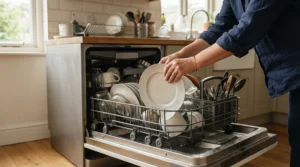
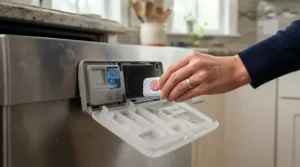
Fourth, load properly. Scrape, don’t rinse. Place tablets in the dry dispenser, not the cutlery basket. For short cycles, Finish suggests placing its tablet on the floor of the machine near the filter.
Fifth, avoid first-month mistakes. Don’t double up tablets, don’t ignore the salt indicator, and don’t skip filter cleaning.
Do this once and you’ll notice the difference within a few washes.
Problem → Solution Guide: Fixing Common Hard Water Dishwasher Issues
Problem: Cloudy glasses. This is usually limescale deposits, insufficient rinse aid, or too-cool final rinse water. Solution: check the salt level, top up rinse aid, and try a glass-focused tablet such as Finish Ultimate Infinity Shine.
Problem: White film on dishes. Solution: raise the softener setting and confirm you’re using proper dishwasher salt.
Problem: Powdery residue after cycles. Solution: make sure the tablet is in the dry dispenser and that spray arms aren’t blocked.
Problem: Visible limescale on the interior. Solution: run a hot cycle monthly, as Which? advises, and use a dishwasher cleaner.
Problem: Tablets not dissolving. Solution: check the dispenser isn’t damp and switch to a fast-dissolving or short-cycle formula such as the Fairy Platinum Plus Lemon 30 Minute Miracle.
Real-World Scenarios: Matching Tablets to Households
Scenario 1: A family of five in Ipswich. Very hard water, daily cycles, mixed loads. Recommended: Finish Ultimate Infinity Shine plus Finish-style dishwasher salt. The family runs the machine around 300 times a year, so a bulk pack and a regularly checked reservoir are the sensible combination.
Scenario 2: A couple in a flat in Norwich who entertain often. Lots of wine glasses and a limited budget. Recommended: Finish Powerball Ultimate Infinity in a compact pack, plus a rinse aid for sparkling glassware.
Scenario 3: A single eco-conscious professional in Cardiff. Soft water, small loads, low waste preferred. Recommended: Ocean Saver Pearl 5in1 Power or Ecover All In One Power. Soft water means the tablet needs to do very little limescale-fighting.
The pattern is clear. Match the tablet to your water first, then to your lifestyle.
Common Mistakes When Buying Dishwasher Tablets for Hard Water
The first mistake is trusting the “salt” label too literally. Tablets with a built-in salt function help, but dedicated salt does a different job, regenerating the softener resin. Don’t treat them as interchangeable.
The second is ignoring your machine’s hardness setting. It’s usually buried in a menu, and the default may be set for soft water.
The third is overspending. A pricier tablet can disappoint if the underlying problem is an empty salt reservoir.
The fourth is using too many tablets. More detergent doesn’t beat limescale, and it can leave residue.
The fifth is buying giant packs of an untested product. Start with a small pack, assess your glassware after a few washes, and then commit.
Finally, remember that limescale build-up is cumulative. A tablet can slow it, but it can’t reverse years of existing deposits.
Long-Term Cost & Dishwasher Maintenance
Let’s talk money. Per wash, tablets sit at roughly 25p–40p for branded options in bulk, less for budget alternatives. Add salt and rinse aid and your total rises modestly, but it’s tiny compared with the cost of replacing a scaled-up heating element.
Dishwasher maintenance is where the real savings sit. Clean the filter weekly, wipe door seals, check spray arms for blockages and run a hot cycle monthly. Beko’s guidance also stresses frequently checking salt levels in hard water areas, since neglected softeners let limescale into pipes and valves.
Tablets for limescale prevention work best as part of this routine, not as a replacement for it. Treat the tablet as your weekly shampoo, and the hot cycle and filter clean as your monthly deep conditioning.
Budget roughly one salt refill every few weeks in hard water, depending on the setting and how often you run the machine.
Value Analysis: Premium Tablets vs Supermarket Own-Brands
Which? has highlighted that some of the best-performing tablets are among the cheapest, and its April 2026 testing included supermarket own-brands such as Aldi Magnum Premium, Tesco Ultra and Lidl W5 alongside the big names. That doesn’t mean they’re best for you, but it does mean price isn’t a reliable proxy for quality.
| Tier | Example | Typical Range | Best For |
|---|---|---|---|
| Premium | Finish Ultimate Infinity Shine | £25–£35 | Glassware, hardest water |
| Mid-range | Fairy Platinum Plus Lemon | £15–£30 | Everyday reliability |
| Budget | Fairy Platinum All In One Lemon | £10–£25 | Cost-conscious families |
| Eco | Ecover All In One Power | £8–£18 | Sustainability priorities |
Looking at the tiers, the premium option makes most sense when glass clarity matters or your water is at the upper end of the scale. For most households, mid-range plus correctly managed salt delivers 90 per cent of the benefit at a lower cost. Don’t pay for a premium tablet if your softener isn’t set properly.

FAQ
❓ Do I still need salt if I use dishwasher tablets with built-in salt?
❓ How many tablets should I use per wash in a hard water area?
❓ Which hard water dishwasher detergent is best for cloudy glasses?
❓ How often should I descale to stop limescale build-up?
❓ Are tablets for limescale prevention worth paying extra for?
Conclusion
The best dishwasher tablets for hard water do two things well: they clean thoroughly, and they work alongside your machine’s softener instead of pretending to replace it. If your water is very hard, pick a tablet with a clear hardness claim, such as Finish Ultimate Infinity Shine, and keep the salt reservoir full.
For everyday households, Fairy Platinum Plus Lemon and Fairy Platinum All In One Lemon offer dependable performance at sensible prices. For sustainability-minded buyers, Ecover All In One Power and Ocean Saver Pearl 5in1 Power are worth testing, ideally with a salt top-up in hard water regions.
Remember the three-part system: a good tablet, regular salt, and monthly dishwasher maintenance. Get those right and the cloudy-glass days are behind you.
✨ Ready to give your dishwasher a fighting chance?
🔍 Choose a tablet that matches your water, check current pricing and availability, and enjoy sparkling results with far less effort!
Recommended for You
- Dishwasher Tablets: 7 Best Picks For Sparkling Glasses (2026)
- Refillable Washing-Up Liquid: 7 Best Picks For UK Homes (2026)
- Washing-Up Liquid For Greasy Dishes: 7 Proven Picks (2026)
Disclaimer: This article contains affiliate links. As an Amazon Associate, I earn from qualifying purchases. If you purchase products through these links, we may earn a small commission at no additional cost to you.
✨ Found this helpful? Share it with your friends! 💬🤗
