In This Article
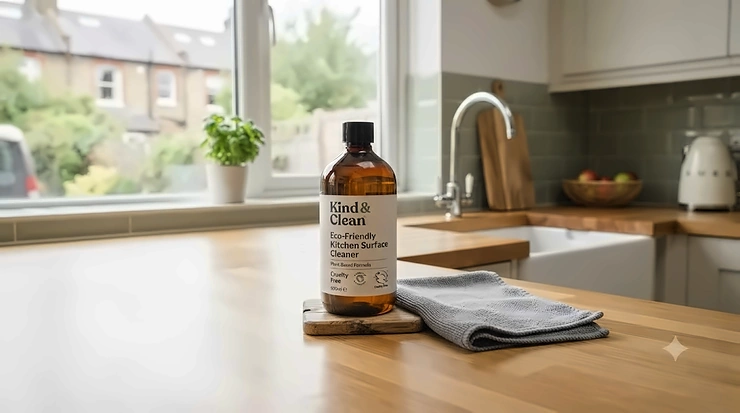
There’s a particular kind of guilt that comes from squirting a conventional spray across your worktop, watching the foam do its thing, and then glancing at the bottle in the bin and thinking: well, that’s not going anywhere for four hundred years. If you’ve found yourself standing in the cleaning aisle wondering whether an eco-friendly kitchen surface cleaner is actually better, or just better marketed, you’re asking exactly the right question. This guide cuts through the “green” noise with real products, real specs and honest reasoning about what actually happens when a plant-based formula meets a genuinely greasy hob.

We’ve dug into seven real products sold in the UK — spanning refill drops, concentrate tablets and supermarket-shelf sprays — comparing what’s in the bottle, what’s in the packaging, and what actual customers say once the novelty wears off. Because here’s the thing: an eco-friendly kitchen surface cleaner only earns that label if it performs as well as the bleach-heavy stuff it’s replacing. Anything less is just expensive water with good branding. By the end, you’ll know which pick suits a renter with one worktop, which suits a family kitchen that sees three meals a day, and which is worth the slightly higher price tag because the packaging genuinely disappears from your bin.
Quick Comparison Table
Before the deep dive, here’s the shape of the market at a glance. These five categories cover the decision most people are actually trying to make — not “which cleaner is objectively best” but “which cleaner is best for me.”
| Category | Product | Format | Best For |
|---|---|---|---|
| Best plastic-free overall | OceanSaver Kitchen Degreaser EcoDrop | Dissolvable refill pod | Zero-plastic starters |
| Best bulk value | Miniml Multi Surface Cleaner 5L Refill | 5L liquid refill | Large households |
| Best antibacterial | Delphis Eco Antibacterial Kitchen Surface Cleaner | Spray + concentrate | Food safety focus |
| Best known brand | Ecover All Purpose Cleaner Refill | 5L/15L refill | Easy nationwide availability |
| Best supermarket pick | Method Kitchen Cleaner | 828ml spray | Convenience shoppers |
Looking at this spread, the pattern that jumps out is that “eco-friendly” splits into two genuinely different problems — reducing plastic packaging and reducing harsh chemical ingredients — and no single product wins at both without some trade-off. OceanSaver and Miniml lean hardest into packaging reduction, while Delphis Eco leans into ingredient safety with its EN14476 disinfection testing. If you only remember one thing from this table, make it this: match the product to the problem you actually care about most, rather than assuming “eco” is one uniform quality.
💬 Just one click — help others make better buying decisions too!😊
Top 7 Eco-Friendly Kitchen Surface Cleaners: Expert Analysis
Picking seven products from thousands of listings meant applying one hard rule: every product here had to have a verifiable trail of real customer reviews, not just a nice-looking label. Here’s what actually held up.
1. OceanSaver Kitchen Degreaser EcoDrop — genuinely plastic-free refill drops
The standout feature here isn’t the citrus-kelp scent, it’s that there’s no bottle to buy at all — you drop a small pod into your own spray bottle, add water, and it dissolves into 750ml of cleaner. That single design choice is the whole point of an eco-friendly kitchen surface cleaner category existing in the first place: it removes the plastic bottle from the equation entirely rather than just making the bottle recyclable.
Each pod is packaged in recyclable cardboard, the formula is free from SLS, SLES, palm oil and triclosan, and it’s independently tested against leading conventional brands for cleaning efficacy. In practice, that means you’re not sacrificing grease-cutting power just because there’s no plastic bottle involved — a genuine rarity in this space. Based on the spec sheet, the trade-off is convenience: you need to keep a bottle in rotation rather than grabbing a new one off the shelf.
This is best suited to renters, students and anyone starting their sustainable cleaning journey from scratch, since the barrier to entry is just one reused bottle. Reviewers consistently note the “green ethos” and ease of storage as the big wins, with aggregated sentiment sitting comfortably in the 4.5-star range across several retailers, though a minority of reviewers found the diluted formula a step down from bleach-based sprays on truly baked-on grease, and one flagged streaking on glass hobs that needed a dry-cloth buff to fully clear.
Pros:
- ✅ Zero plastic bottle waste — dissolves in your own container
- ✅ Independently tested to match leading conventional brands
- ✅ Free from SLS, SLES, palm oil and triclosan
Cons:
- ❌ A minority of reviewers found it weaker than bleach sprays on baked-on grease
- ❌ Can leave light streaking on glass hobs without a dry-cloth finish
Priced in the low single figures per refill drop, OceanSaver sits firmly in the budget-to-mid range and represents strong value if you’re buying the wider starter kit rather than single pods — check current price for the bundle versus individual refills.
2. Miniml Multi Surface Cleaner 5L Refill — best bulk value for large households
The standout here is scale: a 5L refill of blood-orange scented, plant-based cleaner that’s designed to top up your existing spray bottles dozens of times over, made in Yorkshire rather than shipped across a continent. For a busy kitchen, that single jug can realistically outlast several bottles of a conventional supermarket spray.
The formula is vegan, cruelty-free and free from harsh chemicals, using plant-based surfactants that clean glass and worktops without leaving the soapy residue you sometimes get with concentrates that aren’t diluted quite right. What most buyers overlook about buying in this format is the cost-per-use math: spread across a 5L jug, the price per spray bottle refill works out considerably cheaper than repeatedly buying 750ml bottles, even accounting for the higher upfront spend.
This is the pick for families or shared houses where kitchen surfaces get wiped down multiple times a day and a small 500ml bottle would need replacing weekly. Aggregated Amazon review sentiment sits at 4.7 out of 5 from several hundred UK ratings, with reviewers repeatedly highlighting value for money and how “a little goes a long way.” The main friction point reported is scent strength — some find the citrus notes overpowering in a small kitchen — and a handful mention a faint residue if the dilution ratio isn’t followed precisely.
Pros:
- ✅ 5L refill drastically cuts cost-per-use for busy kitchens
- ✅ Made in Yorkshire, UK — a shorter supply chain
- ✅ Vegan, cruelty-free, plant-based surfactant formula
Cons:
- ❌ Scent can feel strong in smaller or poorly ventilated kitchens
- ❌ A few reviewers noted residue if not diluted exactly as directed
At around the mid-teens to low-twenties in pounds for the 5L format, Miniml represents excellent long-term value once you factor in how many standard bottles that single refill replaces — worth checking the current price against smaller formats before committing.
3. Delphis Eco Antibacterial Kitchen Surface Cleaner — best for verified antibacterial performance
The standout advantage is certification: this cleaner is tested to the EN14476 European standard for viral disinfection and claims to kill 99.999% of bacteria and viruses, which puts it in a different performance bracket to a general-purpose eco spray that simply “cleans.” For households genuinely worried about food-safety on chopping boards and worktops, that distinction matters.
It’s Woolsafe approved (meaning it’s also safe on wool carpets and rugs, a nod to its multi-surface versatility), phosphate and phosphonate free, and 100% manufactured in the UK. Here’s what the spec sheet won’t tell you outright: the fragrance-free formulation is a genuine selling point for anyone who’s sensitive to the heavily perfumed “clean” scent most kitchen sprays chase, because it leaves surfaces odourless rather than masking grease with citrus.
This suits households prioritising hygiene above all else — new parents, anyone who’s recently had a Covid-era habit of disinfecting everything, or people running a home catering or holiday-let business who need a defensible food-safety standard. Reviewers consistently praise the streak-free finish on worktops like Corian, and the 700ml spray holds a 4.6-star aggregate from over 70 UK ratings. The concentrate refill format draws slightly more mixed feedback, with a few reviewers noting the dilution process is “slightly messy” compared to a ready-to-use spray, and at least one delivery reported packaging leaks in transit.
Pros:
- ✅ EN14476-tested, kills 99.999% of bacteria and viruses
- ✅ Fragrance-free — ideal around food and sensitive noses
- ✅ Woolsafe approved and 100% made in the UK
Cons:
- ❌ Concentrate refill requires careful dilution, which some find fiddly
- ❌ Occasional reports of packaging leaking during delivery
Standard 700ml sprays sit in the low single-figure price bracket, while the 5L concentrate refill lands in the £350-£450 pence-per-litre range once diluted out — genuinely cost-effective if you’re willing to do the measuring.
4. Ecover All Purpose Cleaner Refill — the household name with plant-based credentials
Ecover is the standout for sheer availability — you’ll find this on supermarket shelves across the country, which matters enormously if your eco-friendly kitchen surface cleaner needs to be a “grab it while doing the weekly shop” purchase rather than a specialist online order. The Lemongrass & Ginger formula is now 14% more concentrated than its previous version, meaning less water is being transported per dose and less plastic used per clean.
The ingredient list leans on biosurfactants and mineral ingredients rather than harsh petrochemical detergents, and the brand’s Diamond Model sustainability framework has been independently validated for reduced environmental impact across the product’s full lifecycle. On paper this means fewer of the ingredients that regulators flag as environmentally persistent, though — in the honest interest of full disclosure — the fragrance does contain allergens like limonene and linalool, clearly listed on pack, which is worth knowing if anyone in your household has fragrance sensitivities.
This is the safe, no-fuss pick for anyone who wants “eco” without having to research a niche brand — the kind of buyer who wants one bottle that does floors, tiles and worktops without a cupboard full of specialists. It’s worth noting that Amazon-specific reviews for this particular refill format are a smaller sample (low double digits) compared with the brand’s decades-long reputation more broadly, so treat the online star rating as a supplement to, not a replacement for, Ecover’s long track record.
Pros:
- ✅ Widely available in UK supermarkets, not just online
- ✅ 14% more concentrated formula, less transported water
- ✅ Independently validated sustainability framework (Diamond Model)
Cons:
- ❌ Fragrance contains listed allergens (limonene, linalool)
- ❌ Amazon-specific review sample for this refill size is relatively small
The 5L refill typically sits around the £350-£450 range on a pence-per-litre basis, while the bulk 15L option pushes the value further down for larger households — always worth checking the current price before assuming which size wins on cost.
5. Method Kitchen Cleaner — best for convenience without leaving the supermarket aisle
The standout feature of Method is that it’s the eco option that doesn’t feel like a compromise on shelf presence — it sits right next to the conventional brands in most major UK supermarkets, in an 828ml spray with a genuinely pleasant, non-clinical scent. For anyone easing into sustainable cleaning without wanting to hunt down a specialist retailer, that visibility counts for a lot.
The formula avoids parabens, phosphates, phthalates, chlorine bleach and triclosan, and the brand holds Leaping Bunny certification confirming it isn’t tested on animals anywhere in its supply chain. Here’s what most buyers overlook, though: independent ingredient reviews have pointed out that while Method leans on plant-derived surfactants like decyl glucoside and lauryl glucoside, the formulation still includes some synthetic and semi-synthetic ingredients — so “naturally derived” is a more accurate description than “all-natural,” and it’s worth reading that distinction honestly rather than assuming the marketing is the full picture.
This is the pick for households that want meaningfully reduced chemical exposure and cruelty-free credentials without changing their shopping habits at all. Reviewers repeatedly describe the grease-cutting performance as on par with conventional sprays, with several long-term users specifically praising the reliable trigger mechanism over years of daily use, though a portion of reviews mention the fragrance can be divisive for scent-sensitive households.
Pros:
- ✅ Leaping Bunny certified — genuinely cruelty-free supply chain
- ✅ Avoids parabens, phosphates, phthalates, bleach and triclosan
- ✅ Sold in major UK supermarkets for easy top-ups
Cons:
- ❌ Formula includes some synthetic surfactants despite “naturally derived” framing
- ❌ Fragrance intensity is divisive among scent-sensitive users
Method’s kitchen spray typically retails under £5, making it one of the most accessible entry points into eco-friendly kitchen surface cleaner territory — check current price for refill pouches, which usually undercut the bottled version per millilitre.

6. Ecozone Anti Bacterial Multi Surface Cleaner — budget-friendly bacterial protection
The standout advantage of Ecozone is that it delivers genuine antibacterial claims — killing 99.9% of bacteria including MRSA and E. coli according to manufacturer testing — at a genuinely budget-friendly price point, made entirely in Britain. For households wanting hygiene assurance without paying a premium for it, that combination is hard to beat.
The formula is completely plant-based using essential oils rather than petrochemical-derived cleaning agents, and it’s vegan certified with no animal testing anywhere in development. Reviewers consistently note the aloe and cucumber scent as fresh rather than clinical, which matters because a lot of antibacterial sprays lean hard into a “hospital” smell that lingers on food-prep surfaces. What the spec sheet won’t tell you outright is that the ingredient list still includes preservatives like benzisothiazolinone — a common, low-risk preservative, but worth knowing if you’re specifically trying to avoid all synthetic ingredients rather than just harsh ones.
This suits budget-conscious buyers who still want a defensible hygiene standard — students, first flats, anyone stocking a kitchen for the first time who doesn’t want to spend on a premium refill system yet. The 500ml spray holds a strong 4.4-star aggregate across more than 500 UK ratings, one of the larger review samples in this list, which gives its sentiment more statistical weight than some smaller-batch competitors.
Pros:
- ✅ Kills 99.9% of bacteria including MRSA and E. coli (manufacturer tested)
- ✅ Genuinely budget-friendly price point
- ✅ Made in Britain, plant-based essential oil formula
Cons:
- ❌ Contains synthetic preservatives despite plant-based marketing
- ❌ 500ml bottle size means more frequent repurchasing than bulk refills
At typically under £6 for the 500ml spray, Ecozone is one of the cheapest genuinely antibacterial options on this list — worth checking current price against the larger refill formats if you go through it quickly.
7. Forest & Co Multi-Surface Concentrate — plastic-free tablets with a probiotic twist
The standout feature is the format itself: sixteen compact, plastic-free concentrate tablets that dissolve into your own spray bottle, built around what the brand describes as natural woodland probiotics rather than conventional surfactants. It’s one of the more genuinely novel approaches to an eco-friendly kitchen surface cleaner on this list, storage-wise as much as chemically.
Each tablet is non-toxic, pet-safe and formulated to leave a streak-free finish, with a woodland pine and citrus scent that reviewers describe as subtle rather than overpowering. Based on the spec comparison with liquid refills, the tablet format’s real advantage is shipping efficiency — sixteen tablets weigh a fraction of the equivalent liquid volume, which meaningfully reduces the carbon cost of getting the product to your door, something a heavy 5L jug simply can’t match.
This is best suited to anyone tight on storage space, or buyers who like the ritual of “just add water” cleaning and want to minimise clutter under the sink. Reviewers consistently rate it highly, at 4.7 out of 5 from around 94 UK ratings, with repeated praise for the concept and cost-effectiveness. The most common criticism, echoed by more than one reviewer, is that the tablets can take a noticeably long time to fully dissolve, occasionally requiring a shake or two more than expected.
Pros:
- ✅ Genuinely plastic-free tablet format, minimal shipping weight
- ✅ Non-toxic, pet-safe, streak-free plant and probiotic formula
- ✅ Strong aggregated review score from a solid UK sample size
Cons:
- ❌ Tablets can take a while to fully dissolve
- ❌ No dedicated antibacterial claim, so not a disinfectant substitute
The 16-tablet pack typically sits around under £15, working out competitively per bottle once you factor in how many refills a single pack provides — check current price, as multipack bundles often improve the per-tablet cost further.
Top 7 Products: Specs & Value Comparison
| Product | Format | Key Claim | Price Range | Best For | |—|—|—|—| | OceanSaver Kitchen Degreaser EcoDrop | Dissolvable pod | Zero plastic bottle | Under £10 (starter kit) | Plastic-free beginners | | Miniml Multi Surface Cleaner 5L Refill | 5L liquid refill | UK-made, high dilution | £350-£450 range (per litre pricing) | Large households | | Delphis Eco Antibacterial Kitchen Surface Cleaner | Spray + 5L concentrate | EN14476 tested | Under £5 (700ml) | Hygiene-focused buyers | | Ecover All Purpose Cleaner Refill | 5L/15L refill | Independently validated eco model | £350-£450 range (per litre pricing) | Supermarket convenience | | Method Kitchen Cleaner | 828ml spray | Leaping Bunny certified | Under £5 | Everyday shoppers | | Ecozone Anti Bacterial Multi Surface Cleaner | 500ml spray | Kills 99.9% bacteria | Under £6 | Budget hygiene | | Forest & Co Multi-Surface Concentrate | 16 tablets | Plastic-free, probiotic formula | Under £15 (16-pack) | Storage-conscious buyers |
Read across this table and a clear split emerges between products optimised for packaging reduction — OceanSaver and Forest & Co — and those optimised for ingredient or hygiene credentials, like Delphis Eco and Ecozone. If your council’s recycling is patchy, prioritise the plastic-free formats regardless of price; if your household includes anyone immunocompromised or you run a food business from home, the EN14476-tested option is worth the modest premium over a general “eco” spray.

Practical Usage Guide: Getting the Most From Your Eco-Friendly Kitchen Surface Cleaner
Switching to a refill or concentrate format is where most people trip up, not because the products are inferior, but because habits built around ready-to-use sprays don’t transfer automatically. First, keep one dedicated, clearly labelled spray bottle per cleaner rather than rinsing and reusing across brands — cross-contamination between concentrate types can dull effectiveness and occasionally cause unwanted reactions between ingredients.
Dilution ratios matter more than they seem to. A capful too much concentrate doesn’t just waste product, it can leave the streaky residue several reviewers mentioned above; too little, and you’re essentially wiping surfaces with scented water. Follow the ratio printed on the pack exactly for the first few refills until it becomes muscle memory. For tablet formats like Forest & Co, use lukewarm rather than cold water — reviewers who reported slow dissolving were often working with cold tap water, and warmth speeds the process considerably.
In the first thirty days, the most common mistake is over-spraying out of habit built from thinner conventional formulas — most eco concentrates need less product per wipe-down than you’d expect. Finally, set a simple maintenance rhythm: rinse your reusable spray trigger monthly with warm water to prevent the nozzle clogging with concentrate residue, a small step that meaningfully extends the working life of your refill system.
Real-World Scenarios: Matching the Cleaner to Your Kitchen
Consider three quite different households making this same decision. A student in a shared flat with minimal storage and a tight budget is best served by Ecozone or a starter OceanSaver kit — low upfront cost, no need for bulk storage, and genuine antibacterial or plastic-free credentials without committing to a subscription-style refill habit.
A family of four with a busy kitchen seeing three meals a day and constant wipe-downs gets the most value from Miniml’s 5L refill or Ecover’s 15L option — the cost-per-use collapses dramatically at that volume, and the reduced frequency of reordering matters when there’s simply less time to think about it. A home baker or small catering operation, meanwhile, has a genuinely different requirement: food-contact hygiene that can be defended to environmental health inspectors, which points firmly toward Delphis Eco’s EN14476-tested formula over a general-purpose plant spray.
None of these scenarios is “wrong” for choosing differently — the point of walking through them is that an eco-friendly kitchen surface cleaner decision is really a household-shape decision wearing green branding.
Problem → Solution: Fixing Common Eco Cleaning Frustrations
Streaky worktops after switching to a plant-based spray are almost always a dilution issue rather than a product failing — try halving your usual number of sprays per wipe and buffing with a dry microfibre cloth rather than assuming the formula is weaker. Lingering grease on hob surfaces, particularly baked-on residue, responds better to a short dwell time; leave the spray sitting for thirty to sixty seconds before wiping rather than spraying and wiping in one motion, since many plant-based surfactants need a beat longer to break down fats than harsher petrochemical ones.
If a refill bottle’s trigger starts sticking, it’s usually mineral build-up rather than a fault — a quick soak in warm water with a splash of white vinegar clears it in minutes. For anyone finding a particular scent overpowering, most brands including Miniml and OceanSaver offer fragrance-light or unscented alternatives within their range, so switching variants within the same brand is often simpler than abandoning the eco switch entirely. Finally, if concentrate tablets seem slow to dissolve, crushing them lightly before adding warm water speeds things up considerably without affecting the finished cleaning strength.
What Is an Eco-Friendly Kitchen Surface Cleaner?
An eco-friendly kitchen surface cleaner is a cleaning product formulated with biodegradable, typically plant-derived ingredients and packaged to minimise single-use plastic, designed to clean and often disinfect hard kitchen surfaces without the persistent environmental impact of conventional petrochemical-based sprays. The term isn’t legally regulated in the UK, so genuine eco credentials depend on verifiable ingredients, third-party certification and real packaging reduction rather than marketing language alone.
That last point matters more than most shoppers realise. The UK’s Green Claims Code sets out exactly what businesses need to substantiate before calling a product “green” or “eco-friendly” — claims must be truthful, backed by evidence, and consider the product’s full lifecycle rather than just one flattering detail on the front label. Knowing this exists is genuinely useful leverage as a shopper: if a brand can’t point to a certification or a clear ingredient list, treat the “eco” label with healthy scepticism.
How to Choose an Eco-Friendly Kitchen Surface Cleaner
- Check for third-party certification first. Look for EU Ecolabel, Leaping Bunny or Vegan Society marks rather than taking “natural” at face value — these require independent verification, unlike self-applied green language.
- Decide whether packaging or ingredients matter more to you. Refill drops and tablets solve plastic waste; disinfectant-grade formulas like Delphis Eco solve hygiene concerns — few products excel equally at both.
- Read the full ingredient list, not just the front label. Products marketed as “naturally derived” can still contain synthetic surfactants; that’s not automatically a problem, but it should be an informed choice.
- Match the format to your storage space and habits. Bulky 5L refills are only good value if you have somewhere to store them and the discipline to dilute correctly each time.
- Factor in your council’s recycling capability. A recyclable plastic bottle is only genuinely eco if your local authority actually processes that plastic type — check before assuming.
- Weigh cost-per-use over sticker price. A £20 bulk refill that lasts six months usually beats six £4 bottles bought one at a time, both financially and in packaging terms.
- Test scent tolerance before committing to a large format. Buy a small bottle first if you’re unsure — a 5L jug of a scent you dislike is an expensive mistake to make once.
Refillable Surface Cleaner vs Traditional Bottled Spray
The case for switching to a refillable surface cleaner over a traditional bottled spray comes down to a fairly blunt piece of maths: every standard 750ml trigger bottle you buy new is another moulded plastic container, cap and often a plastic trigger mechanism heading into the recycling stream — or worse, general waste, since triggers are frequently made from mixed materials that recycling facilities can’t easily separate. A refill system like Miniml’s or Delphis Eco’s concentrate reuses that same trigger bottle indefinitely, meaning only the concentrate itself needs replacing.
The trade-off traditional sprays still win on is pure convenience — no dilution step, no waiting for a tablet to dissolve, straight off the shelf and into use. For households that value speed above all else, that’s a legitimate reason to stick with ready-to-use formats, though several brands on this list, including Ecozone and Method, offer ready-to-use eco sprays that split the difference: better-for-the-planet ingredients without the extra dilution step. Long-term cost also favours refills consistently, since you’re not paying for a new bottle and trigger mechanism with every purchase, only the liquid or tablets inside it.
| Factor | Refillable Surface Cleaner | Traditional Bottled Spray |
|---|---|---|
| Plastic waste per use | Low — one bottle, many refills | High — new bottle each purchase |
| Convenience | Requires dilution/mixing step | Ready to use immediately |
| Cost per use (long-term) | Lower | Higher |
| Best For | Miniml, Delphis Eco, Forest & Co users | Fast, no-fuss cleaning |
Plastic-Free Kitchen Spray & Eco Packaging: What Actually Counts
A genuinely plastic-free kitchen spray, like the OceanSaver EcoDrop or Forest & Co tablets, removes plastic from the equation at the point of purchase rather than just promising to recycle it afterwards — you’re buying a cardboard-packaged concentrate and supplying your own reusable bottle, which sidesteps the recycling system altogether rather than relying on it working correctly.
Eco packaging claims deserve real scrutiny, because “recyclable” and “actually recycled” are very different things in practice — UK household plastic recycling rates vary enormously by local authority, and mixed-material trigger sprayers are notoriously hard to process even where facilities exist. What most buyers overlook is that a product boasting “100% recyclable packaging” still depends entirely on your council’s infrastructure to follow through; a plastic-free format sidesteps that uncertainty completely by never generating the packaging in the first place. If reducing your bin’s plastic content is your primary goal, prioritise the dissolvable pod and tablet formats on this list over refill jugs, which — while better than single-use bottles — are still moulded plastic containers themselves.
Natural Ingredient Kitchen Cleaner: Reading the Label Properly
Calling something a natural ingredient kitchen cleaner is one of the loosest claims in this entire category, because there’s no legal threshold for how “natural” a formula needs to be before using the word. The most useful shortcut is checking for plant-derived surfactants by name — coconut or sugar-based alkyl polyglucosides, like those used in Miniml and Ecover’s formulas, are genuinely biodegradable and gentler than petrochemical alternatives, and they’ll usually be named plainly on the ingredient list rather than hidden behind vague “cleaning agents” language.
Here’s what most buyers overlook: even the most credible natural ingredient kitchen cleaners typically still include a small percentage of preservative to prevent bacterial growth in the bottle itself — this is standard practice and not a red flag on its own, but it does mean “100% natural” is rarely literally accurate for any liquid cleaner with a meaningful shelf life. The Which? investigation into green cleaning brands found that even well-regarded eco brands often sit somewhere between fully natural and conventional, which is a useful reality check before assuming any single product is perfect on every metric simultaneously.
Sustainable Cleaning: Habits That Matter More Than the Bottle
Sustainable cleaning isn’t really about any single purchase — it’s a set of habits the product either supports or undermines. Buying the greenest possible spray but replacing it every three weeks because you’re over-spraying erodes most of the environmental benefit compared to buying a slightly less “eco” concentrate and genuinely making it last. Storage matters too: keeping refills somewhere they won’t degrade in direct sunlight or extreme heat preserves the active ingredients longer, meaning you use less product per clean over the bottle’s lifespan.
The most overlooked sustainable cleaning habit is simply using less. Most kitchen surface cleaners, eco or otherwise, are designed with a generous margin — a light mist and a thirty-second dwell time cleans as effectively as a heavy-handed drench for the vast majority of everyday spills, and using half the product per wipe effectively doubles the working life of whatever bottle you’ve chosen.
Refill Stations: The Next Step Beyond Bottled Products
Refill stations — the walk-in shops or in-store dispensers where you bring your own container and pay by weight or volume — represent the logical extension of everything a refillable surface cleaner is trying to achieve, cutting out packaging almost entirely rather than just reducing it. The UK’s broader refill movement has grown from a water-refill initiative into a wider network of shops offering exactly this kind of zero-packaging top-up for household cleaning products, groceries and toiletries.
If you live near one, refill stations typically beat even the best bulk refill jug on plastic reduction, since you’re not buying a new container at all — just topping up the same bottle indefinitely. The practical catch is availability: refill stations remain concentrated in cities and larger towns, which is exactly why the delivered refill and concentrate formats reviewed earlier in this guide exist as the next-best option for anyone without one nearby. Treat a local refill station as the gold standard to work towards, and a good delivered refill system as the realistic, accessible alternative most households will actually use week to week.
Common Mistakes When Buying an Eco-Friendly Kitchen Surface Cleaner
The single most common mistake is assuming price correlates with genuine eco credentials — some of the priciest “premium eco” sprays on supermarket shelves have thinner sustainability claims than budget options like Ecozone, which simply doesn’t spend as much on branding. A close second is buying a large format before testing the scent, which explains why so many half-used 5L jugs end up abandoned under sinks nationwide.
Buyers also frequently overlook their own council’s recycling capability when choosing “recyclable” packaging, effectively buying a product that will end up in general waste regardless of what the label promises. Finally, treating “antibacterial” and “eco-friendly” as automatically compatible claims trips people up — some genuinely eco-conscious formulas, including several reviewed above, deliberately skip antibacterial claims because the compounds required for EN14476-level disinfection are a different chemistry entirely from a general plant-based degreaser, so check specifically for that claim if hygiene is your priority rather than assuming any eco spray covers it.
Safety, Regulations & Compliance Guide
UK cleaning product manufacturers making environmental claims are bound by the Competition and Markets Authority’s Green Claims Code, which requires claims to be truthful, unambiguous, and substantiated across the full product lifecycle rather than cherry-picking one green detail. This is genuinely useful protection for shoppers, since it means a brand caught making misleading “eco-friendly” claims without evidence can face regulatory action, giving you some recourse beyond just personal scepticism.
On the ingredients side, look for products explicitly stating they’re phosphate-free, since phosphates remain one of the more well-documented causes of waterway eutrophication when washed down the drain at scale. For food-contact surfaces specifically, only formulas with an explicit antibacterial or disinfectant claim — ideally backed by a recognised standard like EN14476 or EN1276 — should be relied upon where genuine pathogen risk exists, such as after handling raw meat; a general-purpose eco spray, however pleasant, isn’t a substitute for that specific claim.
Frequently Asked Questions
❓ Is an eco-friendly kitchen surface cleaner as effective as bleach-based sprays?
❓ Are refillable surface cleaners actually cheaper long-term?
❓ What does plastic-free kitchen spray actually mean?
❓ Can I trust 'natural ingredient' claims on kitchen cleaners?
❓ Where can I find refill stations near me for cleaning products?
Conclusion
Choosing an eco-friendly kitchen surface cleaner isn’t really about finding one perfect product — it’s about being honest with yourself about which trade-off matters most in your kitchen. If plastic waste is what keeps you up at night, OceanSaver or Forest & Co solve that directly. If it’s hygiene and food safety, Delphis Eco’s disinfection testing earns its place. If it’s simply wanting to do better without overhauling your shopping habits, Ecover or Method sit right there on the supermarket shelf waiting for you.
What all seven genuinely share is real, verifiable substance behind the claims — proper certifications, honest ingredient lists, and aggregated customer sentiment that backs up the marketing rather than contradicting it. That’s the real test for any eco-friendly kitchen surface cleaner: not how green the bottle looks, but whether it still cuts through last night’s frying-pan grease on a Tuesday morning. Pick the one that matches your household’s actual habits, give it a proper trial run with the correct dilution, and you’ll likely find the switch is far less of a compromise than the cleaning aisle marketing ever suggested.
Recommended for You
- Kitchen Spray for Granite Worktops: 7 Best UK Picks (2026)
- Multi-Surface Cleaner for Kitchens: 7 That Actually Work (2026)
- Kitchen Degreaser: 7 Best UK Picks That Actually Cut Grease (2026)
Disclaimer: This article contains affiliate links. As an Amazon Associate, I earn from qualifying purchases. If you purchase products through these links, we may earn a small commission at no additional cost to you.
✨ Found this helpful? Share it with your friends! 💬🤗
