In This Article
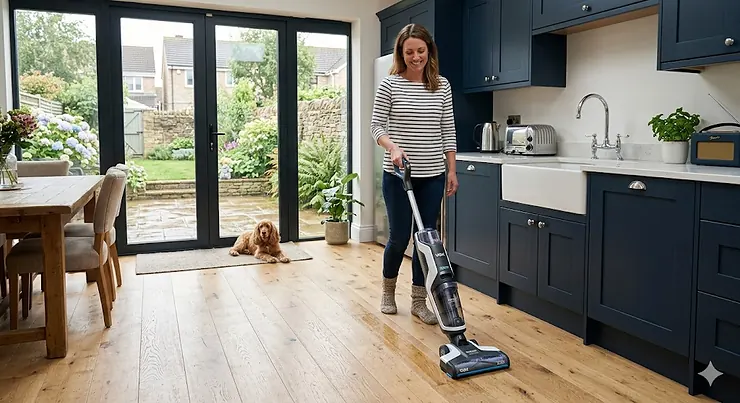
Let’s be honest. The traditional mop-and-bucket setup has had a good run — it saw us through decades of kitchen spills, muddy boot prints, and the occasional mystery puddle — but it’s time we had a frank conversation about it. A soggy mop just redistributes dirt. It doesn’t lift it. And in a country where wet shoes and damp coats are basically a national uniform from October through March, Britain’s hard floors take a serious beating.
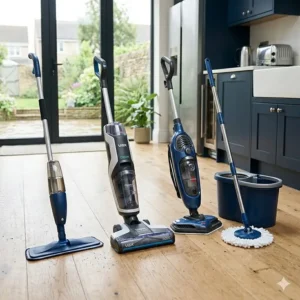
Whether you’ve got porcelain tiles in the kitchen, engineered oak in the living room, vinyl in the bathroom, or laminate running the length of a Victorian terrace hallway, knowing how to choose hard floor cleaner properly is genuinely one of the more useful things you can learn as a homeowner. Get it right and your floors will look cared-for, last longer, and stop being the first thing guests silently judge. Get it wrong — buying the wrong machine for the wrong surface, or dosing a sealed hardwood floor with an overly wet mop — and you’re looking at warped boards and a very expensive lesson.
This guide is here to do the heavy lifting. We’ve researched seven real products available on Amazon.co.uk, dug into the specs that actually matter (and explained what they mean in practice), and added the kind of commentary you won’t find on any product listing page. From tight budgets to luxury splurges, from tile to delicate hardwood, there’s a right answer for every British home here.
Quick Comparison Table: 7 Best Hard Floor Cleaners on Amazon.co.uk
| Product | Type | Tank Capacity | Runtime | Best For | Price Range (GBP) |
|---|---|---|---|---|---|
| Dyson WashG1 | Cordless wet/dry | 1L clean / 0.8L dirty | ~34 min | Large homes, premium users | £500–£550 |
| Dyson PencilWash | Cordless wet mop | N/A | ~35 min | Flat-dwellers, minimalists | £290–£330 |
| Bissell CrossWave OmniForce Edge | Corded wet/dry vac | 0.8L | Unlimited (corded) | Families, mixed floors | £350–£400 |
| Shark HydroVac Cordless WD210 | Cordless 3-in-1 | 0.5L | ~30 min | Everyday cleaning, mid-budget | £199–£230 |
| Kärcher FC 7 Cordless | Cordless 4-roller | 400ml fresh / 200ml dirty | ~45 min | Tiles, stone, laminate | £200–£260 |
| Tineco Floor ONE S7 Pro | Cordless smart wet/dry | Adjustable auto | ~40 min | Tech-savvy users, pet owners | £250–£350 |
| Beldray All-in-One Floor Cleaner | Cordless wet/dry | Compact | ~25 min | Budget buyers, smaller homes | £130–£160 |
The table above tells a clear story: cordless dominates the 2026 market, and for good reason. Britain’s homes — particularly older terraces and semis with awkward layouts — simply don’t always have a convenient socket nearby. That said, if you’ve got a large kitchen-diner with accessible sockets and genuinely grimy floors, the Bissell CrossWave’s unlimited corded runtime is a genuine advantage that cordless alternatives can’t match. Budget buyers should note that the Beldray’s 25-minute runtime is adequate for a one-bed flat but will leave owners of a four-bedroom house planning their cleaning in careful shifts.
💬 Just one click — help others make better buying decisions too! 😊
✨ Don’t Miss These Exclusive Deals!
🔍 Take your floor cleaning to the next level with these carefully selected products. Click any highlighted item to check current pricing and availability on Amazon.co.uk — these picks will help you find exactly what you need!
Top 7 Hard Floor Cleaners: Expert Analysis
1. Dyson WashG1 Wet Floor Cleaner
The WashG1 is Dyson’s flagship answer to a very British problem: floors that are perpetually in need of proper cleaning but never quite get it. Rather than relying on vacuum suction alone, it uses dual motorised rollers to scrub and lift simultaneously — wet messes, dried cereal, toast crumbs, all of it in a single pass. The 1-litre fresh water tank is generous enough for most UK living rooms and open-plan kitchen-diners without a mid-clean refill, and the clever jar-shaped dirty water container makes post-clean emptying far less grim than you’d expect.
At 4.9kg, it’s not exactly something you’d call nimble — this is a machine you use with purpose, not to nip around a studio flat. But if you have solid hard floor coverage across a reasonably sized British home, the WashG1 earns its keep. UK reviewers consistently highlight the ease of the self-cleaning cycle and praise its performance on the kinds of thick, ground-in dirt that accumulates near back doors during autumn and winter.
Pros: Exceptional cleaning performance; easy maintenance; premium build quality
Cons: Heavy at 4.9kg; premium price point
💷 Around £500–£550 on Amazon.co.uk — expensive, but arguably the best-performing hard floor cleaner currently available in the UK.
2. Dyson PencilWash Wet Floor Cleaner
First reviewed in April 2026, the PencilWash is a different beast from its WashG1 sibling — slimmer, lighter, and built for a more specific purpose. It is, essentially, a motorised electric mop: no vacuum function, no dry debris collection, just beautifully precise wet cleaning on sealed hard floors. The ultra-slim profile (hence the name) slides under low-clearance furniture — a sofa with stubby feet, a freestanding kitchen island — far more easily than any rival we’ve tested.
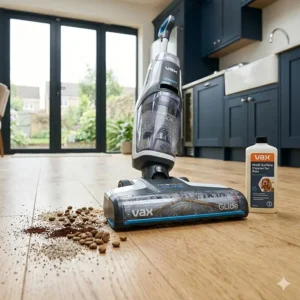
Where most reviewers get caught out is the price. At around £299–£330, the PencilWash costs almost as much as the Shark HydroVac or Kärcher FC 7, both of which do more. For a flat with no carpet, no rugs, and mostly sealed tile or engineered wood, it makes good sense. For anyone else, it’s a hard sell. Think of it as a scalpel: brilliant at one thing, but you don’t use a scalpel when you need a Swiss army knife.
Pros: Supremely lightweight; excellent under-furniture reach; whisper-quiet
Cons: Wet-only (no vacuuming); pricey given limited functionality
💷 Around £290–£330 on Amazon.co.uk — Prime-eligible, typically dispatched within 1–2 days.
3. Bissell CrossWave OmniForce Edge
The Bissell CrossWave has been a fixture in British homes for years, and the OmniForce Edge is the most refined version yet. It’s corded — which some people instinctively recoil from — but that’s actually a feature, not a flaw, for anyone with a large open-plan kitchen or a hallway running the length of a Victorian terrace. No battery anxiety, no 30-minute windows, just clean until you’re done.
What makes the OmniForce Edge stand out from the pack is its dedicated dry cleaning mode: it separates wet and dry debris into distinct chambers rather than mixing them into one grimly fragrant slurry. This matters more than the spec sheet suggests. On British floors — particularly near back doors where muddy dog paws and wet leaves do their worst — you frequently encounter a combination of dry soil and damp mud in the same pass. The OmniForce Edge handles this without complaint. The LCD display provides real-time feedback on hydration levels, tank status, and battery, keeping you informed rather than guessing.
UK buyers with mixed homes (hard floors plus area rugs) will particularly appreciate this model — it switches between surfaces without tool changes.
Pros: Unlimited corded runtime; superior wet/dry separation; switches to rugs seamlessly
Cons: Corded means limited mobility; heavier than cordless rivals
💷 In the £350–£400 range on Amazon.co.uk — excellent long-term value given its versatility.
4. Shark HydroVac Cordless Hard Floor Cleaner WD210
Shark has carved out a loyal following among British homeowners who want something genuinely capable without spending Dyson money, and the HydroVac WD210 is arguably the brand’s sweet spot. At around 3.95kg, it’s one of the lightest full-function hard floor cleaners on the market — meaningful when you’re navigating a narrow hallway or carrying it up a flight of stairs in a terraced house. The three-in-one function (vacuum, mop, self-clean) covers all the bases for everyday use, and the LED display provides clear real-time feedback on battery life, surface mode, and solution level.
The self-cleaning base is a quietly brilliant feature. Rather than requiring you to manually rinse the roller under a tap (which is, let’s be honest, faintly revolting), it uses water from the device’s own tank to flush through the brush roll, collecting the dirty water back into the dirty tank. It also doubles as the charging dock — so the machine sits, charges, and stays ready, without dripping onto your floor in the meantime.
UK reviewers rate it highly for everyday spills and general maintenance cleaning, though those with heavily trafficked floors — a family with primary-school-age children, a dog that views every walk as a mud safari — may find the 30-minute runtime restricts them to one room at a time.
Pros: Lightweight; self-cleaning dock is genuinely clever; odour-neutralising technology
Cons: Modest runtime (~30 min); smaller tank than premium rivals
💷 Around £199–£230 on Amazon.co.uk — strong mid-range value; Prime next-day delivery typically available.
5. Kärcher FC 7 Cordless Hard Floor Cleaner
Kärcher is a German brand with a long, serious reputation in the professional cleaning world, and the FC 7 Cordless brings that engineering heritage into the domestic sphere. Its four-roller system — two front, two rear — cleans in a single pass without the need to vacuum first, removing both wet and dry debris simultaneously. On tiles and stone floors in particular, the results are visibly impressive; the counter-rotating rollers get into the texture of grouted tile surfaces in a way that a flat mop simply cannot match.
The two-tank system keeps fresh water separate from dirty water at all times — a detail that sounds obvious but which many cheaper machines handle badly, essentially mopping with increasingly filthy water. The 45-minute runtime is also one of the best in its price bracket, comfortably covering a medium-sized UK home on a single charge. Accessories (replacement rollers, cleaning solution) are readily available via Kärcher’s UK distribution network and on Amazon.co.uk — an important consideration that buyers often overlook until they need a replacement part eighteen months down the line.
Not ideal for homes with area rugs or carpet patches, as the FC 7 is a hard-floor specialist rather than an all-rounder.
Pros: Excellent 45-minute runtime; genuine professional heritage; true two-tank separation
Cons: Hard-floor only; tank capacity on the modest side
💷 In the £200–£260 range on Amazon.co.uk — well priced given the engineering quality.
6. Tineco Floor ONE S7 Pro Smart Cordless Floor Cleaner
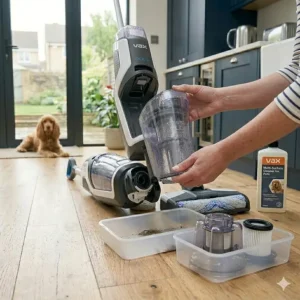
The Tineco S7 Pro sits in a slightly different category from the other machines here: it’s a self-adjusting, sensor-driven device that modifies its water flow and suction power in real time based on how dirty the floor actually is. The iLoop Smart Sensor detects mess levels and responds accordingly — which sounds like marketing fluff until you realise it genuinely extends the battery and reduces unnecessary water usage on already-clean sections of floor. Up to 40 minutes of runtime, dual-sided edge cleaning that reaches to within about 1cm of skirting boards, and a centrifugal drying function that spins the roller dry after the self-clean cycle (reducing odours and mildew — relevant in British homes where damp is a near-constant ambient condition).
UK pet owners respond particularly well to the S7 Pro. Dog and cat hair, the bane of every roller brush in existence, is handled more cleanly here than on most rivals thanks to the anti-tangle design. The app connectivity is optional — you don’t need a smartphone to run the machine — but it does offer useful cleaning history and filter maintenance reminders if you’re that way inclined.
Pros: Smart auto-adjustment genuinely useful; excellent for pet hair; centrifugal drying reduces odour
Cons: Higher price than its spec sheet alone justifies; replacement parts proprietary
💷 Around £250–£350 on Amazon.co.uk — check for Amazon Prime Day deals, as Tineco regularly discounts this model significantly.
7. Beldray All-in-One Multi-Surface Floor Cleaner
The Beldray is the honest, unpretentious option — the one that does what it says without drama or fanfare. At around £130–£160, it’s the most affordable machine on this list by a meaningful margin, and it does the core job of vacuuming, mopping, and drying in a single pass on wood, vinyl, and tiles without requiring a degree in appliance maintenance. The self-cleaning function works, the machine is lightweight and genuinely easy to assemble, and the floors come out nearly dry within seconds — particularly good for households with children who treat every freshly mopped surface as an immediate skidding opportunity.
The limitations are real but honest. Twenty-five minutes of runtime means you’re cleaning one room at a time if you’ve got a larger property. Ground-in dirt — the kind that accumulates on kitchen tiles near a busy back door — may need an extra pass. And the swivel flexibility isn’t as fluid as pricier rivals.
But here’s the thing: not everyone needs a £500 floor cleaner. For a one-bedroom flat, a two-bed terrace, or anyone doing weekly maintenance cleaning on generally well-kept floors, the Beldray delivers excellent value. It’s the Renault Clio of hard floor cleaners — slightly unglamorous, entirely reliable, and outselling the Ferraris for good reason.
Pros: Outstanding value; lightweight; effective self-cleaning function
Cons: Short runtime (25 min); struggles with heavy soiling
💷 Around £130–£160 on Amazon.co.uk — available at Argos and Currys as well; often Prime-eligible.
How to Choose Hard Floor Cleaner: 7 Key Criteria for UK Buyers
This is the section the comparison table can’t give you. Specs are easy to read; knowing which spec actually matters for your home is a different skill entirely.
1. Identify your floor type first — everything flows from this. Sealed hardwood and engineered wood require careful moisture control; too much water causes swelling and warping. Porcelain and ceramic tiles can handle a more aggressive wet clean. Laminate sits somewhere in between — technically sealed, but the edges are vulnerable. The Wood Flooring Association publishes genuinely useful maintenance guidance for UK homeowners navigating this, and it’s worth a read before committing to any machine.
2. Corded vs cordless: be honest about your home’s layout. Cordless is convenient, but runtime is a real constraint in larger homes. A 30-minute battery won’t cover a four-bedroom detached house in one pass. Corded machines eliminate that anxiety entirely — the trade-off is being tethered to a socket.
3. Tank size relative to your floor area. A 400ml fresh water tank is fine for a galley kitchen. For an open-plan ground floor, you’ll be refilling constantly. Match the tank to the space, not to the product photography.
4. Wet-only vs wet-and-dry. Wet-only machines (like the PencilWash) assume you’ve already vacuumed. Wet-and-dry combos do both simultaneously. For busy households — children, pets, general chaos — the combo option is almost always the more practical choice.
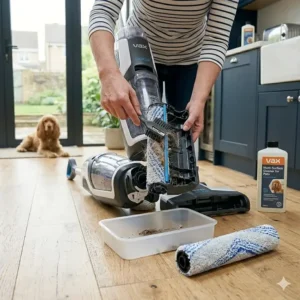
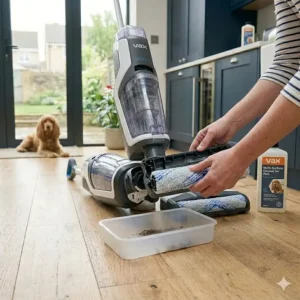
5. Self-cleaning capability. This isn’t a luxury. A machine without self-cleaning requires manual roller maintenance after every use, which is unpleasant enough that most people stop doing it promptly, leading to a bacteria-laden roller spreading rather than cleaning your floors. Prioritise self-cleaning.
6. Weight and storage. British homes are small. Terraced houses don’t have American-style utility rooms. A machine that weighs more than 5kg and requires dedicated storage space is going to get used less often than one that slots neatly behind a door. The Shark HydroVac’s dock-and-charge design is genuinely well thought out for compact living.
7. Replacement parts and UK availability. This one catches buyers out repeatedly. Check that replacement rollers, brushes, and cleaning solution are available on Amazon.co.uk before committing to a machine. Kärcher and Shark have strong UK distribution; some lesser-known Chinese brands ship rollers from overseas with a six-week wait.
Real-World Scenarios: Which Machine for Which UK Home?
Profile 1: The London Flat-Dweller
Scenario: Third-floor one-bed, mixed engineered wood and bathroom tile, no storage space, neighbours below who’d rather not hear a vacuum at 9pm.
The Dyson PencilWash is actually a sensible choice here — slim, quiet, and fits in a coat cupboard. If budget is tight, the Beldray All-in-One does the job adequately with less financial pain.
Profile 2: The Family in a Semi-Detached in Birmingham
Scenario: Open-plan kitchen-diner with porcelain tiles, laminate upstairs, two dogs, two children under ten. A back door that sees more mud than Glastonbury.
The Bissell CrossWave OmniForce Edge earns its place here. Unlimited corded runtime, wet/dry separation that handles actual mud rather than just surface damp, and a switch to rugs when the living room carpet needs attention. The Tineco S7 Pro is an equally strong contender if you prefer cordless and can tolerate recharging between floors.
Profile 3: The Retired Couple in a Cotswolds Stone Cottage
Scenario: Original flagstone floors, some areas of terracotta tile, heritage hardwood in the sitting room. Cleaning needs to be thorough without risking moisture damage to old materials.
The Kärcher FC 7 Cordless is the standout here — its precise dual-tank system applies minimal moisture while delivering proper clean results, and its performance on stone and tile is genuinely excellent. The 45-minute runtime covers most ground floor layouts without interruption.
Profile 4: The Tech-Enthusiast in Manchester with Two Cats
Scenario: All-vinyl throughout, significant cat hair issue, wants app connectivity and adaptive cleaning.
The Tineco Floor ONE S7 Pro was practically designed for this person. The iLoop sensor, anti-tangle roller design, and centrifugal post-clean drying hit every requirement on this list.
Common Mistakes When Buying a Hard Floor Cleaner in the UK
Using a steam cleaner on unsealed wood. Steam mops are seductive — the idea of chemical-free, steam-powered cleaning has an obvious appeal. But steam and real wood floors are a terrible combination. According to guidance from Which?, steam mops should only be used on fully sealed surfaces; unsealed wood, older hardwood boards, and laminate with compromised edges can absorb moisture and warp. Check your floor type before reaching for any wet cleaning machine.
Buying a machine without checking replacement roller availability. This is perhaps the most common and most expensive mistake. Several budget machines from lesser-known brands perform well on day one and become boat anchors six months later when the original roller wears out and replacements either don’t exist or ship from a warehouse in Shenzhen. Always confirm UK-based spares availability before purchase.
Ignoring the dirty water tank size. The clean water tank gets all the attention in product listings; the dirty water tank is the one that dictates how often you stop to empty it. A 200ml dirty tank on a Kärcher FC 7 fills up quickly on heavily soiled floors. Know your floors, and factor in emptying frequency accordingly.
Assuming “multi-surface” means carpet-compatible. Several machines on this list will tolerate a light pass over a thin rug. None of them replace a proper carpet cleaner for deep-pile or heavily soiled carpet. “Multi-surface” in hard floor cleaner marketing language means “various types of hard floor.”
Underestimating the impact of British weather. From late autumn through spring, British floors near entrances — hallways, kitchen back doors, utility rooms — see a constant stream of damp, grit-coated footwear. A machine with a modest-sized dirty tank will need emptying every single session during the muddy months. Build this into your expectations before you buy.
Features That Actually Matter (And Ones That Don’t)
Not everything on a spec sheet deserves your attention.
Matters: True two-tank separation. Clean water stays clean until it hits your floor. Dirty water goes directly to the waste tank. If a machine mixes them — which cheaper models sometimes do — you’re redistributing grime, not removing it.
Matters: Self-cleaning cycle quality. Specifically, does the roller actually dry after self-cleaning? A damp roller left between uses is a bacterial growth environment. Centrifugal or heat-based drying (as seen on the Tineco S7 Pro) is meaningfully better than a roller that simply gets rinsed and then left wet.
Matters: Edge cleaning reach. Skirting boards accumulate grime at a disproportionate rate. A machine that cleans to within 1–2cm of edges substantially reduces the amount of hand-wiping you’ll do afterwards.
Doesn’t particularly matter: App connectivity. Convenient for cleaning history and filter reminders, but not worth paying a significant premium for. The floor doesn’t care how many megabytes are in your cleaning algorithm.
Doesn’t particularly matter: Colour options. Every floor cleaner arrives in variations of white, grey, and black. The marketing images are aspirational. Your floors are not that kitchen.
Matters more than you’d think: Machine weight. Across a typical UK cleaning session — 30–45 minutes — the difference between a 3.9kg machine and a 5kg machine is noticeable in your back and wrist. Lighter is better for regular use.
Long-Term Cost and Maintenance in the UK
The purchase price is only part of the calculation. The machines on this list have ongoing running costs that vary considerably.
Replacement rollers range from around £10–£15 for Beldray-compatible options to £20–£35 for Dyson and Kärcher branded rollers. Most manufacturers recommend replacing rollers every three to six months with regular use — call it two roller replacements per year.
Cleaning solution is typically available in 500ml–2L bottles on Amazon.co.uk. Most machines on this list use proprietary or semi-proprietary formulations, though third-party compatible solutions exist for popular models. Budget roughly £10–£20 per year depending on frequency of use.
Filters (where applicable) run from around £8–£20 per unit; most manufacturers recommend annual replacement.
Total annual running cost for a mid-range machine: roughly £40–£70 per year beyond the initial purchase. That’s less than two visits from a professional cleaning service, and your floors will look dramatically better on a weekly basis. The NHS guidance on home hygiene underscores the importance of clean indoor environments — hard floors harbour far less dust mite habitat than carpet, but only if they’re actually being maintained properly rather than shuffled-dirt-around regularly.
For UK buyers, it’s also worth noting that all prices on Amazon.co.uk include 20% VAT, unlike US prices which exclude local sales tax. What looks like a modest premium versus American listings often isn’t, once tax is factored in.
UK Regulations, Floor Safety Standards, and What to Look For
Hard floor cleaners don’t require UKCA marking in the way that, say, an electrical socket would — but the electrical components of any mains-powered machine sold in the UK should comply with UK low voltage and electromagnetic compatibility regulations post-Brexit. For cordless machines, battery safety is the relevant concern; reputable brands (Dyson, Shark, Bissell, Kärcher, Tineco) all comply with UK battery regulations.
From a floor safety perspective, the British Standards Institution (BSI) publishes guidance on flooring standards, including slip resistance — relevant if you’re choosing a cleaning solution as much as a machine. Over-waxing or using the wrong cleaning solution on certain floor types can reduce slip resistance to genuinely dangerous levels, particularly in bathrooms and kitchens.
Under the Consumer Rights Act 2015, any machine that develops a fault within 30 days can be returned for a full refund. Between 30 days and six months, the retailer must attempt repair or replacement before a refund is required. When buying on Amazon.co.uk, these rights sit alongside Amazon’s own returns policy, giving UK consumers rather robust protection. Prime members typically receive next-day delivery across most of mainland UK, with some same-day availability in larger postcodes.
FAQ
❓ What is the best type of hard floor cleaner for a UK home?
❓ Can I use a hard floor cleaner on real wood floors?
❓ Are hard floor cleaners available with free UK delivery on Amazon.co.uk?
❓ How often should I replace the roller brush on a hard floor cleaner?
❓ Do hard floor cleaners work on laminate flooring?
Conclusion: Buy Once, Buy Right
The British instinct is to wait, compare, and then buy something slightly cheaper than you originally planned. For most things in life, this is perfectly sensible. For a hard floor cleaner that you’ll use every week for the next five years, it’s worth pausing on the “slightly cheaper” part.
The Shark HydroVac WD210 remains the strongest all-round recommendation for the majority of UK buyers — lightweight, genuinely effective, with a clever self-cleaning dock and a price point that doesn’t require a convincing conversation with yourself. Step up to the Bissell CrossWave OmniForce Edge if you have heavy-traffic floors and want unlimited runtime. Go for the Dyson WashG1 if you want the best machine money can buy and have the floors to justify it. Keep it simple with the Beldray if you live in a smaller home and want clean floors without the complexity.
Whatever you choose: check the tank capacity against your floor area, confirm replacement rollers are available in the UK, and treat the self-cleaning function as a non-negotiable rather than a luxury. Your floors — and your back — will thank you for it.
✨ Ready to Upgrade Your Floor Cleaning Routine?
🔍 Browse all seven recommended products on Amazon.co.uk and check current pricing and availability. These carefully selected picks cover every budget and floor type — click any highlighted product name to find exactly what your home needs.
Recommended for You
- Electric Mop vs Steam Mop: 7 Best UK Picks 2026 Revealed
- Best Disposable Floor Wipes UK 2026: 7 Expert-Tested Picks for Spotless Floors
- Best Outdoor Broom UK 2026: 7 Expert-Tested Picks
Disclaimer: This article contains affiliate links. As an Amazon Associate, I earn from qualifying purchases. If you purchase products through these links, we may earn a small commission at no additional cost to you.
✨ Found this helpful? Share it with your mates! 💬🤗
