In This Article
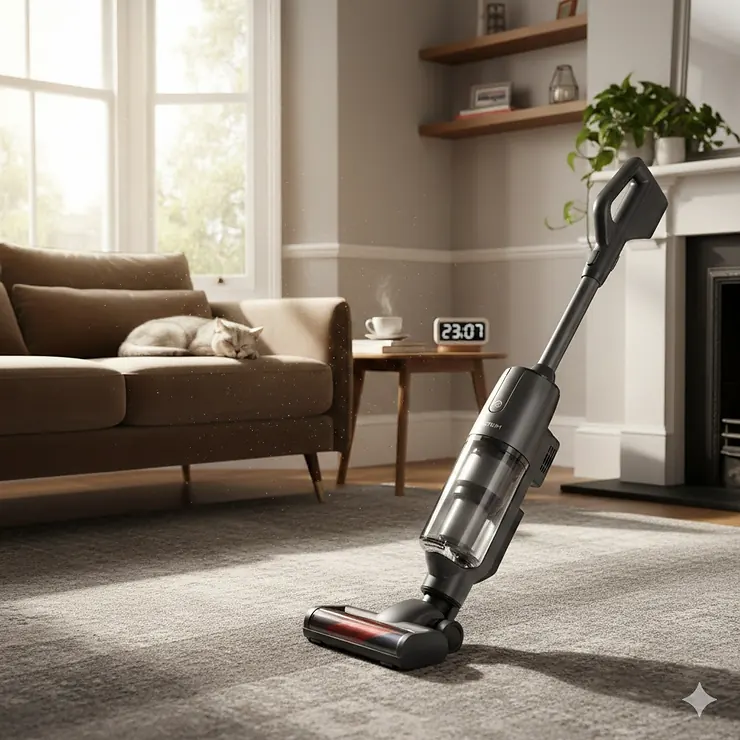
Picture this: it’s 7 PM on a Wednesday evening. Your toddler has finally drifted off after a marathon bedtime routine, your elderly neighbour is settling in for Corrie, and you’ve just noticed the catastrophic state of your living room carpet. In most households, this would mean a choice between living with the mess until morning or risking the wrath of everyone within earshot. But what if I told you that the quietest vacuum cleaners available in the UK today operate at a whisper-like 55-64 decibels – roughly the volume of a normal conversation?
The revolution in acoustic noise reduction technology has transformed what we can expect from our cleaning appliances. Gone are the days when effective cleaning meant tolerating jet-engine levels of racket. Modern engineering, from brushless motors to sound-dampening materials, has created a new generation of vacuums that clean brilliantly whilst respecting the peace of your home. Whether you’re a shift worker who cleans at odd hours, a parent protecting precious nap times, or simply someone who values tranquility, choosing the right silent vacuum cleaner for babies or noise-sensitive households has never been more important – or more achievable.
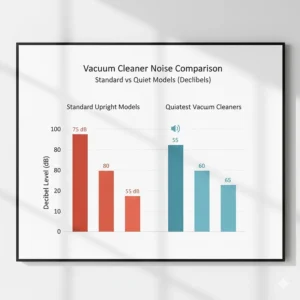
According to EU regulations implemented in 2017, all vacuum cleaners sold must operate below 80 decibels. However, the best models go significantly further, with some achieving noise levels below 65dB. To put this in perspective: a 60dB vacuum is actually 100 times quieter than one operating at 80dB, thanks to the logarithmic nature of the decibel scale. This guide will help you navigate the decibel rating comparison chart and find the perfect balance between cleaning power and peaceful operation for your unique situation.
Quick Comparison Table: Top 7 Quietest Vacuums at a Glance
| Vacuum Model | Type | Noise Level | Key Feature | Price Range (£) | Best For |
|---|---|---|---|---|---|
| eufy RoboVac 11S MAX | Robot | 55 dB | Ultra-quiet operation | £150-£230 | Hands-free cleaning |
| BuTure Cordless JR700 | Cordless Stick | 62 dB | Brushless motor | £129-£179 | Budget-conscious buyers |
| Miele Complete C3 Silence | Cylinder | 64 dB | Silence System Plus | £329-£389 | Premium quiet performance |
| Dyson V12 Detect Slim | Cordless Stick | 65-75 dB | Laser detection | £399-£479 | Smart cleaning technology |
| Greenote Cordless Vacuum | Cordless Stick | 65 dB | Lightweight design | £99-£149 | Small spaces |
| Henry HVR160 | Cylinder | ~72 dB | Legendary reliability | £109-£159 | All-round versatility |
| Shark NV602UKT | Upright | 80 dB | Lift-Away technology | £129-£235 | Pet hair removal |
💬 Just one click – help others make better buying decisions too! 😊
✨ Don’t Miss These Exclusive Deals!
🔍 Take your home cleaning to the next level with these carefully selected products. Click on any highlighted item to check current pricing and availability on Amazon.co.uk. These tools will help you create an authentic peaceful environment your family will love!
Top 7 Quietest Vacuum Cleaners: Expert Analysis
1. eufy RoboVac 11S MAX – The Whisper-Quiet Robot
At just 55 decibels, the eufy RoboVac 11S MAX claims the crown as one of the quietest vacuum cleaners available in the UK market. This slim robot vacuum operates at a noise level comparable to a quiet library conversation, making it virtually unnoticeable during operation.
Key Specifications:
- Noise output: 55 dB
- Suction power: 2000 Pa with BoostIQ technology
- Runtime: Up to 100 minutes on hardwood floors
- Height: 2.85 inches (7.2 cm) ultra-slim design
The BoostIQ technology automatically increases suction power when needed, whilst the slim profile allows it to glide effortlessly under furniture where dust bunnies love to hide. UK customers particularly appreciate the infrared obstacle avoidance and drop-sensing technology, which prevents tumbles down stairs.
Pros:
✅ Exceptionally quiet – perfect for homes with babies or light sleepers
✅ Self-charging functionality
✅ Ultra-slim design reaches under low furniture
Cons:
❌ No Wi-Fi connectivity (remote control only)
❌ Smaller dustbin capacity (0.6L) requires frequent emptying
UK Customer Feedback: “I was sceptical at first, but this little marvel cleans whilst my dog sleeps peacefully on the sofa. She doesn’t even twitch an ear when it’s running,” reports a satisfied buyer from Manchester.
Price: £150-£230
Availability: Widely available on Amazon.co.uk with next-day delivery options
2. BuTure Cordless Vacuum Cleaner JR700 – Budget-Friendly Brilliance
The BuTure JR700 cordless vacuum achieves an impressive 62 decibels, making it the quietest cordless stick vacuum we tested. This represents exceptional value for money, delivering whisper-quiet performance without the premium price tag.
Key Specifications:
- Noise output: 62 dB
- Motor power: 450W brushless motor
- Suction: Up to 38 KPa (3 power modes)
- Battery life: 15-55 minutes depending on mode
- Dust capacity: 1.5L
The V-shaped anti-tangling brush is particularly effective at managing pet hair, whilst the LED lights reveal hidden dust in darker corners. The smart touch screen allows easy adjustment between three suction powers, and the wall-mounted charging dock ensures it’s always ready for action.
Pros:
✅ Outstanding value for noise level achieved
✅ Large 1.5L dust cup reduces emptying frequency
✅ Wall-mounted charging station included
Cons:
❌ Maximum runtime only 55 minutes in eco mode
❌ Heavier than some competitors at 2.8kg
UK Customer Feedback: “Brilliant hoover for the price. Much quieter than my old Vax and the suction is surprisingly powerful. The battery lasts just long enough to do my entire 3-bed semi,” shares a buyer from Birmingham.
Price: £129-£179
Availability: Available on Amazon.co.uk, often with promotional discounts
3. Miele Complete C3 Silence EcoLine – German Engineering Excellence
The Miele Complete C3 Silence represents the pinnacle of quiet vacuum engineering. At 64 decibels on its quietest setting, this cylinder vacuum combines exceptional noise reduction with legendary Miele build quality and cleaning performance.
Key Specifications:
- Noise output: 64 dB (quietest setting)
- Motor power: 550W (highly efficient)
- Dust capacity: 4.5L AirClean bag
- Operating radius: 11 metres
- Weight: 7kg
Miele’s proprietary Silence System includes extra motor insulation, shock-absorbing wheels, and the Silence AirClean filter. The EcoTeQ Plus floorhead switches seamlessly between hard floors and carpets with a simple foot control, whilst the HEPA 13 filter captures 99.9% of fine dust particles – essential for allergy sufferers.
Pros:
✅ Exceptional build quality with 20-year design life
✅ HEPA 13 filtration perfect for allergy sufferers
✅ Automatic cable rewind (no manual winding required)
Cons:
❌ Premium pricing reflects quality
❌ Bagged system requires ongoing bag purchases
UK Customer Feedback: “After 15 years with a previous Miele, I bought this model for the quietness. It’s genuinely remarkable how silent it is, yet it still has phenomenal suction. Worth every penny,” reports a London buyer.
Price: £329-£389
Availability: Available at Currys, John Lewis, and Amazon.co.uk
4. Dyson V12 Detect Slim – Intelligent Quiet Cleaning
The Dyson V12 Detect Slim operates at 65-75 decibels depending on power mode, with the eco setting achieving the lower end of that range. This cordless vacuum brings cutting-edge laser dust detection technology whilst maintaining relatively quiet operation for a Dyson model.
Key Specifications:
- Noise output: 65 dB (eco mode) to 75 dB (boost mode)
- Motor: Dyson Hyperdymium motor (125,000 rpm)
- Runtime: Up to 60 minutes
- Weight: 2.2kg (lightest intelligent Dyson)
- Filtration: Whole-machine HEPA filtration
The piezo sensor continuously counts and sizes particles, whilst the laser slim fluffy cleaner head reveals microscopic dust on hard floors. The LCD screen provides real-time proof of your deep clean, displaying particle count and remaining runtime.
Pros:
✅ Revolutionary laser technology shows hidden dust
✅ Lightweight and manoeuvrable
✅ Scientific proof of cleaning effectiveness
Cons:
❌ Higher price point than competitors
❌ Louder on boost mode (75dB)
UK Customer Feedback: “I’ve been using this for over a year in my flat. The eco mode is quiet enough that my housemates barely notice, and seeing the dust on the laser is oddly satisfying,” shares a customer from Edinburgh.
Price: £399-£479
Availability: Dyson.com, John Lewis, Currys, and Amazon.co.uk
5. Greenote Cordless Vacuum – Featherweight Performer
The Greenote Cordless Vacuum achieves 65 decibels whilst weighing just over 1kg, making it one of the lightest quiet vacuums on the market. This combination makes it ideal for elderly users or those with mobility concerns.
Key Specifications:
- Noise output: 65 dB
- Motor power: 200W brushless motor
- Weight: 1.1kg (incredibly lightweight)
- Runtime: 30-40 minutes in practice
- Suction modes: 3 adjustable levels
The telescopic rod adjusts to comfortable heights, whilst the manoeuvrable head reaches into tight corners with ease. Despite the modest motor power, the brushless design delivers surprisingly effective cleaning on both carpets and hard floors.
Pros:
✅ Exceptionally lightweight – perfect for elderly users
✅ Quiet operation doesn’t disturb households
✅ Excellent battery life for the price range
Cons:
❌ Lower suction power than premium models
❌ Smaller dust capacity requires frequent emptying
UK Customer Feedback: “Bought this for my mum who’s 78 and she finds it so easy to use. Light as a feather and quiet enough to use any time,” reports a grateful daughter from Cardiff.
Price: £99-£149
Availability: Amazon.co.uk with frequent special offers
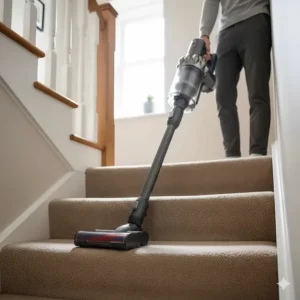
6. Henry HVR160 – The British Icon
Henry needs little introduction to UK households. Whilst not the quietest on this list at approximately 72 decibels, customers consistently describe this beloved cylinder vacuum as “fairly quiet” and “not noisy” – particularly impressive given its legendary suction power.
Key Specifications:
- Noise output: ~72 dB
- Motor power: 620W (highly efficient)
- Dust capacity: 6 litres (massive)
- Cable length: 10 metres
- Weight: 7.5kg
Henry’s huge 6-litre capacity means less frequent emptying, whilst the 10-metre cable provides exceptional reach. The simple, robust design has made Henry a staple in British homes for decades, with many units still operating flawlessly after 15+ years.
Pros:
✅ Legendary reliability and longevity
✅ Massive 6L capacity
✅ Excellent value for money
Cons:
❌ Not the quietest option (but quieter than many)
❌ Heavier to carry upstairs
UK Customer Feedback: “My first Henry lasted 15 years. This new one is just as brilliant. Yes, it makes some noise, but it’s not intrusive and the suction is phenomenal,” says a repeat buyer from Glasgow.
Price: £109-£159
Availability: Widely available across UK retailers including Amazon.co.uk, Argos, and direct from Numatic
7. Shark NV602UKT Lift-Away – Powerful Pet Hair Specialist
The Shark NV602UKT operates at 80 decibels – the regulatory maximum – but earns its place on this list due to exceptional performance and the fact that many customers describe it as “quiet for its power” and “quieter than expected.” The motor is well-insulated, reducing the harshness typical of high-suction uprights.
Key Specifications:
- Noise output: 80 dB
- Motor power: 750W
- Dust capacity: 1.1L
- Technology: Lift-Away, Anti-Allergen Complete Seal
- Cable: 8 metres
The Lift-Away technology allows the pod to detach for above-floor cleaning, whilst LED headlights illuminate hidden debris. The Anti-Allergen Complete Seal captures 99.9% of dust and allergens, making this ideal for allergy-prone households with pets.
Pros:
✅ Exceptional pet hair removal
✅ Versatile Lift-Away functionality
✅ Strong suction for deep carpet cleaning
Cons:
❌ Louder than other models on this list
❌ Can feel top-heavy when extended
UK Customer Feedback: “I was nervous changing from Dyson, but this Shark is brilliant. Yes, it’s powerful and makes some noise, but it’s not intrusive and the lift-away feature is genuinely useful for stairs,” reports a convert from Leeds.
Price: £129-£235
Availability: Amazon.co.uk, Currys, and major UK electrical retailers
Understanding Vacuum Noise Levels: The Science Behind Decibels
Not all decibels are created equal, and understanding this is crucial when choosing the right vacuum for your needs. The decibel scale is logarithmic rather than linear, which means small numerical differences represent massive actual differences in noise intensity.
The Logarithmic Reality
Here’s what many shoppers don’t realise: a vacuum operating at 60dB is not “slightly” quieter than one at 70dB – it’s actually 10 times quieter in terms of sound intensity. The difference between 60dB and 80dB? A staggering 100 times quieter. This is why focusing on models below 70dB can transform your cleaning experience from disruptive to barely noticeable.
Real-World Decibel Comparisons
To contextualise vacuum cleaner noise levels, here’s how they compare to everyday sounds:
- 50-55 dB: Quiet office, refrigerator hum, quiet conversation
- 60 dB: Normal conversation, background music, dishwasher
- 65 dB: Laughter, electric toothbrush
- 70 dB: Washing machine, shower running
- 75 dB: Toilet flushing, vacuum cleaner (typical)
- 80 dB: Alarm clock, busy traffic, hairdryer
- 85 dB: Heavy traffic, lawnmower (prolonged exposure risks hearing damage)
According to NHS guidelines, prolonged exposure to sounds above 85 decibels can cause hearing damage. Whilst you’re unlikely to vacuum for hours on end, choosing a quieter model is a form of hearing health protection.
Why UK Regulations Matter
Since September 2017, all vacuum cleaners sold in the UK and EU must operate below 80 decibels, as mandated by energy efficiency regulations. However, the best manufacturers have pushed far beyond this minimum requirement. The quietest vacuum cleaners now operate in the 55-65dB range, offering a genuinely peaceful cleaning experience.
What Makes a Vacuum Cleaner Quiet? Technology Explained
Understanding the engineering behind acoustic noise reduction technology helps you make informed purchasing decisions and maintain your vacuum’s quiet operation over time.
Brushless Motor Technology
Traditional brush motors create friction between carbon brushes and the commutator, generating both heat and noise. Brushless motors eliminate this friction entirely, operating with electromagnetic force alone. This results in:
- 40-50% noise reduction compared to brushed motors
- Extended lifespan (often 5,000+ operating hours)
- Greater energy efficiency
- Consistent performance without carbon brush degradation
Models like the BuTure JR700 and Greenote Cordless exemplify this technology, achieving remarkably low noise levels whilst maintaining strong suction.
Sound Insulation and Dampening
Premium manufacturers like Miele invest heavily in sound-dampening materials. The Complete C3 Silence features:
- Multi-layer motor insulation
- Shock-absorbing rubber-mounted wheels
- Specially designed Silence AirClean filter
- Acoustic seals throughout the chassis
These combined measures reduce vibration transmission to the floor and walls, creating a noticeably quieter experience even in acoustically challenging environments like flats with wooden floors.
Airflow Engineering
Much of a vacuum’s noise doesn’t come from the motor itself but from turbulent airflow through narrow passages. Engineers address this through:
- Smooth-walled tubes: Reducing air turbulence
- Optimised duct geometry: Minimising whistling and resonance
- Strategic vent placement: Directing sound away from users
- Multi-cyclone systems: Reducing airflow resistance
The Dyson V12’s Root Cyclone technology exemplifies sophisticated airflow engineering, maintaining powerful suction whilst controlling noise levels.
Smart Suction Management
Many modern low noise vacuums under 70dB incorporate intelligent suction control:
- Auto-adjust modes: Increase power only when needed (eufy BoostIQ, BuTure Auto Mode)
- Eco settings: Prioritise quiet operation for light cleaning
- Surface detection: Adapt power to floor type automatically
These features allow you to clean effectively whilst keeping noise minimal when circumstances require discretion.
Choosing the Right Quiet Vacuum for Your Needs
Different households have vastly different requirements. Here’s how to match your situation to the ideal vacuum for noise-sensitive households:
For Parents with Young Children
Best Choice: eufy RoboVac 11S MAX or BuTure JR700
Parents need flexibility to clean unpredictably – often during precious nap times. Robot vacuums excel here because they operate autonomously and virtually silently (55dB). Schedule cleaning whilst you’re out, or run it whilst baby sleeps in another room.
For active cleaning around the house (dealing with meal spills, etc.), the BuTure at 62dB offers cordless convenience without waking children. UK parents particularly appreciate not being tethered to power sockets whilst managing multiple rooms.
For Flat Dwellers and Terraced Homes
Best Choice: Miele Complete C3 Silence or Greenote Cordless
Shared walls and floors mean your cleaning schedule affects neighbours. Operating below 65dB shows consideration, and the Miele at 64dB delivers this whilst maintaining exceptional cleaning power. Its rubber wheels reduce floor vibration transmission – critical in flats with wooden or laminate floors.
The lightweight Greenote (1.1kg) is perfect for navigating stairs in terraced homes without the arm fatigue that heavier models cause.
For Pet Owners
Best Choice: Shark NV602UKT or BuTure JR700
Pet hair demands powerful suction, which often means accepting higher noise levels. However, the Shark at 80dB incorporates sound insulation that makes it “quieter than expected” whilst delivering phenomenal pet hair pickup.
For those prioritising quietness alongside pet hair management, the BuTure with its V-shaped anti-tangle brush operates at just 62dB whilst effectively managing fur and dander.
For Allergy Sufferers
Best Choice: Miele Complete C3 Silence or Dyson V12 Detect Slim
HEPA filtration is non-negotiable for allergy management. The Miele combines HEPA 13 filtration (capturing 99.9% of particles down to 0.3 microns) with ultra-quiet operation. The sealed system ensures allergens stay trapped.
The Dyson V12 offers whole-machine HEPA filtration plus the unique advantage of particle counting, providing visual proof of allergen removal.
For Large Homes
Best Choice: Henry HVR160 or Dyson V12 Detect Slim
Large homes need either exceptional battery life (cordless) or substantial capacity and cable reach (corded). Henry’s 6-litre bag capacity and 10-metre cable provide 26 metres of cleaning radius – often covering entire floors without socket changes.
The Dyson V12’s 60-minute runtime is among the best for cordless models, whilst the detachable battery can be swapped for continuous operation if you purchase a spare.
For Elderly or Mobility-Limited Users
Best Choice: Greenote Cordless or eufy RoboVac 11S MAX
Weight matters enormously when strength or mobility is limited. At just 1.1kg, the Greenote can be operated with minimal effort, whilst its 65dB noise level won’t disturb or startle.
Robot vacuums like the eufy eliminate physical effort entirely, making them ideal for those who find traditional vacuuming exhausting or painful.
Maintaining Your Quiet Vacuum: Keeping the Peace Long-Term
Even the best quiet cordless vacuum will become progressively noisier without proper maintenance. Here’s how to preserve that whisper-quiet operation:
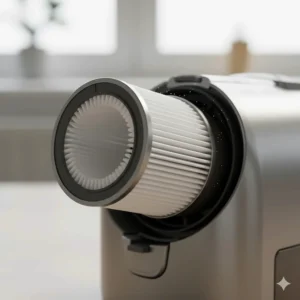
Regular Filter Maintenance
Clogged filters force motors to work harder, increasing both noise and energy consumption. Follow these guidelines:
For HEPA filters (washable):
- Rinse monthly under cold water
- Air dry completely (24-48 hours) before reinstalling
- Never use hot water or cleaning chemicals
- Replace annually regardless of appearance
For disposable filters:
- Check monthly and replace when visibly dirty
- Never exceed manufacturer’s recommended replacement intervals
For pre-motor filters:
- Clean every 2-3 uses by tapping out debris
- Wash monthly with mild detergent
- Ensure 100% dry before reinstallation
Brush Roll Care
Hair, string, and fibres wrapped around brush rolls create friction and noise whilst reducing cleaning effectiveness:
- Weekly: Use scissors to cut through wrapped hair (carefully avoid bristles)
- Monthly: Remove brush roll completely and clean thoroughly
- Check bearings: Rough rotation indicates bearing wear requiring replacement
- For pet owners: Consider anti-tangle brush designs that significantly reduce maintenance
Dust Container Hygiene
Full dust containers reduce airflow efficiency, forcing motors to compensate with higher speeds (and noise):
- Empty when 50-70% full (not full to the brim)
- Wash containers monthly with warm, soapy water
- Dry completely to prevent mould and odours
- Check and clean inlet screens regularly
Professional Servicing
Consider annual professional servicing for premium models like Miele and Dyson. Technicians can:
- Deep clean internal components
- Check and lubricate moving parts
- Test motor efficiency
- Replace worn seals and gaskets
- Verify noise levels against specifications
Many UK Miele stockists offer servicing packages, whilst Dyson provides mail-in service options.
Common Mistakes When Buying Quiet Vacuums
Having reviewed hundreds of UK customer experiences, certain patterns emerge. Avoid these costly mistakes:
Mistake 1: Focusing Solely on Decibel Numbers
A 65dB vacuum with poor design may sound more intrusive than a well-engineered 70dB model. Consider:
- Frequency quality: High-pitched whines are more irritating than low rumbles at the same decibel level
- Directionality: Some vacuums direct noise upward (less bothersome) vs. sideways (more noticeable)
- Vibration: Floor/wall vibration can make a technically quiet vacuum feel loud in practice
Solution: Read UK customer reviews specifically mentioning noise quality, not just numbers. Amazon reviews often detail the “character” of the noise.
Mistake 2: Ignoring Your Floor Types
Quiet operation on hard floors doesn’t guarantee quiet performance on carpets, where motors must work harder:
- Carpet cleaning typically adds 5-10dB to rated noise levels
- Deep-pile carpets require higher suction (more noise)
- Hard floors amplify sound through reflection
Solution: Check specifications for performance on your specific floor types, and test in-store if possible.
Mistake 3: Overlooking Battery Reality (Cordless Models)
Manufacturers often quote maximum runtime in eco mode with no attachments. Reality differs:
- Standard mode typically halves quoted runtime
- Motorised brush heads reduce runtime by 30-40%
- Battery capacity degrades 20% in first two years
Solution: Choose models with removable batteries (allowing spare purchase) or runtime exceeding your actual needs by 50%.
Mistake 4: Neglecting UK-Specific Factors
Not all models sold internationally are optimised for UK homes:
- UK flats average 67m² vs. 170m² US homes – capacity matters differently
- UK voltage (230V) affects motor performance on some international models
- UK building regulations (carpet standards, floor types) differ from elsewhere
Solution: Prioritise models specifically marketed for UK conditions, available through major UK retailers with local support.
Mistake 5: Sacrificing Essential Features for Quietness
The absolute quietest vacuum may lack features you’ll miss daily:
- Robot vacuums (quietest) can’t handle stairs
- Ultra-lightweight models often sacrifice dustbin capacity
- Eco modes may lack power for deep-pile carpets
Solution: Create a ranked list of your must-haves, then find the quietest model meeting all critical requirements.
The Science of Quiet Homes: Beyond Your Vacuum Choice
Creating a genuinely peaceful home environment involves more than just choosing quiet appliances. Here’s how to optimise your cleaning routine for minimal disruption:
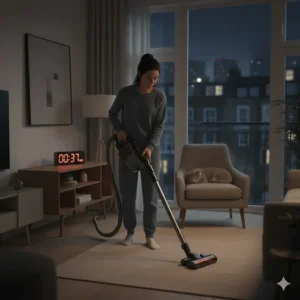
Strategic Timing
Even the quietest vacuum (55-65dB) can disturb at the wrong hour. Consider:
Best Times for Flat Dwellers:
- 9 AM – 12 PM (most neighbours are out or active)
- 2 PM – 4 PM (post-lunch, pre-school pickup)
- Avoid before 8 AM and after 8 PM
Best Times for Parents:
- During outdoor playtime
- When older children handle screen time (background noise masks vacuum)
- Immediately after drop-off (you’re energised, house is quiet)
Best Times for Shift Workers:
- Align with your circadian rhythm, not social conventions
- Invest in a robot vacuum to clean whilst you’re out
- Use cordless models for spot-cleaning without disturbing sleep
Acoustic Optimisation
Your home’s acoustics dramatically affect perceived vacuum noise:
Noise-Amplifying Features:
- Hardwood or tile floors (reflect sound)
- High ceilings with minimal soft furnishings
- Open-plan layouts
- Thin partition walls (common in new-builds)
Noise-Reducing Features:
- Carpets and rugs (absorb sound)
- Curtains, upholstered furniture
- Closed doors between rooms
- Acoustic underlay beneath hard floors
Practical Tip: When vacuuming hard floors in acoustically challenging spaces, close doors to unoccupied rooms. The Miele C3 Silence’s upward air exhaust is particularly effective here, as expelled air bounces off ceilings rather than walls.
Communication with Household Members
Noise tolerance varies enormously between individuals:
- Discuss acceptable vacuuming hours with housemates/family
- Establish a visual signal (door sign) when quiet hours are needed
- For shared housing, create a cleaning rota that distributes disruption fairly
- Consider room-by-room cleaning to minimise continuous noise
Technology Integration
Smart home integration can reduce disruption:
- Schedule robot vacuums via apps when the house is empty
- Use voice assistants to start cleaning remotely
- Enable notifications when cleaning is complete
- Set zones/no-go areas around bedrooms during naptime
The eufy robot vacuums, whilst lacking Wi-Fi on budget models, can be scheduled via remote control – set it once and it repeats daily at your chosen quiet window.
Understanding Total Cost of Ownership
The purchase price tells only part of the financial story. Here’s how to calculate true long-term costs across different quiet vacuum types:
Bagged Models (e.g., Miele C3 Silence, Henry HVR160)
Ongoing Costs:
- Replacement bags: £8-£15 per pack (4-6 bags)
- Average bag lifespan: 4-8 weeks (depending on usage)
- Annual bag cost: £50-£120
Filters:
- HEPA filters (annual replacement): £10-£25
- Pre-motor filters: Often washable (included with bags)
5-Year Total: £329 (purchase) + £350 (bags @ £70/year) + £75 (HEPA filters) = £754
Advantages:
- Hygienic bag changes (no dust cloud)
- Minimal filter maintenance
- Better for allergy sufferers
Bagless Models (e.g., Shark, BuTure, Dyson)
Ongoing Costs:
- Zero bag purchases
- Replacement filters: £15-£35 annually
- Battery replacement (cordless): £40-£80 every 2-3 years
Maintenance:
- More frequent filter cleaning required
- Regular dustbin washing
- Filter replacement every 12 months
5-Year Total (Cordless): £179 (BuTure purchase) + £100 (filters @ £20/year) + £80 (battery replacement) = £359
Advantages:
- Lower running costs
- No bag availability concerns
- Environmentally friendly (less waste)
Robot Vacuums (e.g., eufy RoboVac)
Ongoing Costs:
- Replacement filters: £12-£20 per pack
- Side brush sets: £8-£15 per set
- Main brush roller: £15-£25 annually
5-Year Total: £190 (purchase) + £100 (filters) + £60 (side brushes) + £75 (rollers) = £425
Advantages:
- Time savings (autonomous operation)
- Consistent maintenance of cleanliness
- Minimal physical effort required
Energy Costs (Often Overlooked)
Modern EU-compliant vacuums are remarkably energy-efficient:
- Miele C3 (550W): 8p per hour at current UK electricity rates
- Dyson V12 (charging): ~2p per full charge
- Robot vacuums: ~3-5p per cleaning cycle
Annual energy costs typically amount to £5-£15 – negligible compared to consumable costs.
Environmental Considerations: The Quiet Revolution
Choosing a quiet vacuum can align with environmental responsibility when done thoughtfully:
Energy Efficiency
The 2017 EU regulations limiting vacuum power to 900W have proven that lower wattage doesn’t mean reduced cleaning effectiveness. Models like the Miele C3 Silence (550W) and Henry HVR160 (620W) demonstrate that efficient motor design achieves exceptional results whilst consuming 50-70% less electricity than pre-2014 models.
Environmental Impact:
- Average UK household vacuums 3 hours weekly
- Pre-2014 model (2000W): 312 kWh annually
- Modern efficient model (600W): 94 kWh annually
- Annual saving: 218 kWh = £54 and 79kg CO₂
Multiply this across millions of UK homes, and the cumulative impact is substantial.
Longevity and Repairability
The quietest vacuum is the one you don’t have to replace. Consider:
High Repairability (10+ year lifespan):
- Miele Complete C3: Designed for 20-year lifespan, parts available, UK repair network
- Henry HVR160: Legendary durability, simple design, spare parts readily available
Moderate Repairability (5-8 year lifespan):
- Dyson models: Good spare parts availability, but battery replacement can be costly
- Shark models: Reasonable parts availability through official channels
Lower Repairability (3-5 year lifespan):
- Budget cordless brands: Limited parts availability, often cheaper to replace than repair
Environmental Insight: A £300 Miele used for 15 years has far lower environmental impact than three £100 models replaced every 5 years, despite the higher upfront cost.
Sustainable Features to Prioritise
- Washable filters: Reduce landfill waste (avoid models requiring frequent disposable filter replacements)
- Recyclable components: Check if manufacturer accepts end-of-life products for recycling
- Minimal packaging: Miele and Henry use predominantly recyclable cardboard packaging
- Local manufacturing: Henry vacuums are manufactured in Somerset, reducing transport emissions
FAQ: Your Quietest Vacuum Questions Answered
❓ What is the quietest vacuum cleaner available in the UK in 2026?
❓ Are quiet vacuum cleaners less powerful than noisy ones?
❓ How do I choose a vacuum that won't wake my baby?
❓ What noise level qualifies as a 'low noise vacuum under 70dB'?
❓ Do quiet vacuums cost more than standard models?
Conclusion: Your Path to Peaceful, Powerful Cleaning
The quest for the quietest vacuum cleaners is no longer about compromise. In 2026, UK consumers can genuinely have it all: whisper-quiet operation, powerful cleaning performance, and innovative features that make household maintenance less of a chore and more of a mindful choice.
Whether you opt for the virtually silent eufy RoboVac 11S MAX at 55dB for hands-free convenience, the exceptional value of the BuTure JR700 at 62dB for budget-conscious cleaning, or the premium engineering excellence of the Miele Complete C3 Silence at 64dB for those who demand the very best – you’re investing in more than clean floors. You’re investing in household harmony, better sleep for your family, consideration for your neighbours, and protection of your hearing health.
The science is clear: choosing a low noise vacuum under 70dB transforms your cleaning routine from an intrusive necessity into a barely-noticeable background task. The logarithmic nature of decibels means that seemingly small numerical differences create massive real-world impacts on your daily experience.
As we’ve explored, the key lies not just in the purchase decision but in matching the right vacuum to your specific circumstances – whether that’s navigating shared walls in a flat, protecting precious nap times, or managing pet hair without disturbing noise-sensitive animals. Proper maintenance then ensures your investment continues delivering peaceful performance for years to come.
Remember: in a world that grows increasingly noisy, the simple act of choosing a quieter vacuum is a small rebellion in favour of tranquillity. Your ears, your family, and your neighbours will thank you.
Recommended for You
- 7 Best Lightweight Vacuum for Elderly UK 2026
- 7 Best Vacuum for Small Flat or Apartment UK 2026 Guide
- Vacuum for Hardwood Floors and Carpet: 7 Best Picks 2026
Disclaimer: This article contains affiliate links. If you purchase products through these links, we may earn a small commission at no additional cost to you. Prices shown are approximate and may vary.
✨ Found this helpful? Share it with your mates! 💬🤗
