In This Article
If you’re still lugging around a heavy bucket and wringing out a sodden traditional mop, you’re making floor cleaning harder than it needs to be. Spray mops have revolutionised how British households tackle their daily cleaning, and for good reason. Rather than battling with litres of sloshing water and back-breaking bucket carries, you simply fill a lightweight bottle, trigger a fine mist, and wipe—done.
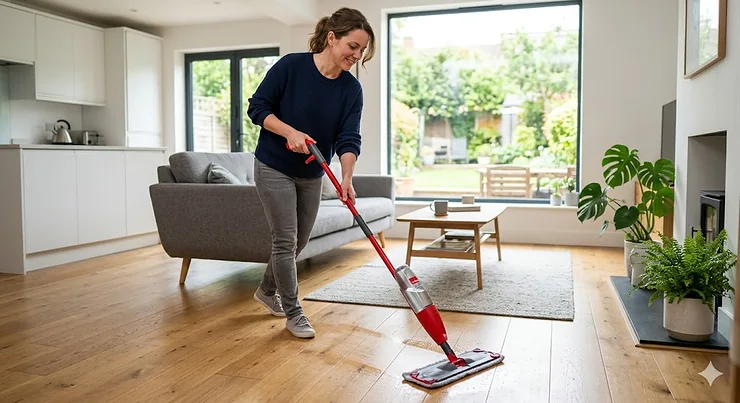
What makes spray mops particularly brilliant for UK homes is their practicality in our typically compact living spaces. Whether you’re in a London flat with limited storage or a terraced house in Manchester where every inch counts, spray mops store vertically in a cupboard without the bulk of traditional mop-and-bucket systems. They’re also kinder to our mixed flooring—laminate, engineered wood, and vinyl don’t appreciate being drenched, something our damp climate already challenges enough.
The best spray mop transforms floor cleaning from a dreaded Saturday chore into a quick five-minute task you’ll actually do more often. Modern microfibre technology means you’re not just pushing dirt around; you’re genuinely lifting grime, pet hair, and those mysterious sticky patches that appear near the kitchen bin. With refillable bottles, you control exactly what goes on your floors—essential when you’ve got kids crawling about or pets padding across freshly cleaned surfaces. This guide examines seven top-performing models available on Amazon.co.uk in 2026, comparing budget-friendly options around £15 with premium models reaching £60, helping you find the perfect match for your home’s needs without the guesswork.
Quick Comparison: Best Spray Mops at a Glance
| Model | Price Range | Best For | Key Feature | Pad Life |
|---|---|---|---|---|
| Vileda 1-2 Spray Max | £30-£40 | All-rounders | Double-sided flip pad | 100 washes |
| Bona Premium | £45-£60 | Wood floors | Professional-grade microfibre | 500 washes |
| MEXERRIS 5-Pad | £16-£20 | Budget buyers | 5 washable pads included | 200 washes |
| Vileda 1-2 Spray Standard | £20-£30 | Small flats | Slim integrated bottle | 200 washes |
| BPAWA 4-Pad | £15-£18 | First-time users | 2 bottles, 4 pads | 150 washes |
| Addis 2-in-1 | £17-£25 | UK brand loyalty | 360° mop head | 100+ washes |
| Bona Multi-Surface | £40-£55 | Mixed flooring | Streak-free formula | 500 washes |
From this comparison, the value proposition becomes clearer when you consider running costs alongside upfront price. The MEXERRIS and BPAWA models offer exceptional entry-level value under £20, perfect if you’re testing whether spray mopping suits your routine before committing serious money. However, the Bona Premium justifies its £45-£60 price tag with pads lasting 500 washes—that’s potentially five years of weekly cleaning, whereas budget pads might need replacing annually. For most UK households juggling laminate in the kitchen and engineered wood in the lounge, the Vileda 1-2 Spray Max hits the sweet spot around £35, delivering professional performance without the premium price.
💬 Just one click — help others make better buying decisions too! 😊
Top 7 Spray Mops: Expert Analysis
1. Vileda 1-2 Spray Max Mop – Best Overall Performance
The Vileda 1-2 Spray Max dominates the UK spray mop market for good reason—it’s genuinely thought through for how British homes actually work. The standout feature is the double-sided flip pad system, meaning you clean twice the floor area before needing to rinse or swap pads. When one side picks up the bulk of kitchen grime, flip it over and keep going—brilliant for larger open-plan areas that have become standard in newer UK builds.
This model addresses a common frustration with cheaper spray mops: the detachable bottle design. Rather than wrestling with a stuck-in bottle when you need a refill, the Max version clicks out with a sharp upward pull and snaps back securely. The spray mechanism delivers a proper fine mist rather than the dribbling squirts some budget models produce. At around £30-£40, it positions between throwaway cheap mops and premium options, offering the reliability you’d expect from a 100-year-old European brand that actually understands wet weather and compact storage.
UK customers consistently praise how well it handles laminate floors without leaving streaks—crucial given that laminate remains Britain’s most popular flooring choice for kitchens and dining areas. The pads are machine washable up to 100 times, and they’re widely available as replacements on Amazon.co.uk, usually arriving with Prime next-day delivery.
Pros:
✅ Double-sided pad doubles cleaning coverage
✅ No batteries needed—simple trigger spray
✅ Detachable bottle for easy refilling
Cons:
❌ Some users report spray mechanism can clog in hard water areas (solve with vinegar rinse)
❌ Pads can slip during vigorous scrubbing
Price verdict: Around £35 represents excellent value for a mop you’ll use 2-3 times weekly for years. UK delivery typically free with Prime.
2. Bona Premium Spray Mop – Best for Wood Floors
If you’ve invested in solid wood, engineered wood, or bamboo flooring—increasingly popular in eco-conscious British households—the Bona Premium is purpose-built for protecting that investment. Swedish brand Bona has spent over a century specialising in wood floor care, and this shows in the mop’s design. The microfibre pad features a patented dual-zone system: dark outer fibres break up stubborn marks while inner fibres trap and absorb, removing over 99% of bacteria without harsh chemicals.
What sets this apart for UK users is the pre-filled 850ml cartridge of Bona’s pH-neutral cleaning solution, formulated specifically for wood’s needs. Unlike generic supermarket cleaners that can gradually dull wood finishes, Bona’s formula cleans without residue, maintaining that natural lustre British homeowners pay premium prices to achieve. The extra-large mop head cleans 40% faster than standard models—meaningful when you’re tackling a ground floor of wood flooring before guests arrive.
The sustainability angle matters here too. Pads wash up to 500 times and are made from 90% recycled materials, whilst the plant-derived cleaning formula carries Safer Choice certification—reassuring when kids and pets are part of the equation. Yes, you’re looking at £45-£60 depending on Amazon.co.uk offers, but factor in that this replaces both your mop and your specialist wood floor cleaner, and the maths improves. UK reviews frequently mention it transforms routine mopping into something that actually protects rather than merely cleans wood floors.
Pros:
✅ Professional wood floor protection
✅ Pads last up to 500 washes
✅ Removes 99% bacteria with just water
Cons:
❌ Premium price point
❌ Spray bottle attachment can work loose (tighten regularly)
Price verdict: In the £45-£60 range but delivers specialist wood floor care that saves money long-term. Prime delivery standard.
3. MEXERRIS Microfibre Spray Mop (5-Pad Kit) – Best Budget Option
The MEXERRIS 5-Pad kit proves you don’t need to spend £40+ for effective spray mopping, which matters enormously in 2026’s cost-conscious UK market. For around £16-£20 on Amazon.co.uk, you receive two refillable 550ml bottles, five washable microfibre pads, and a scrubber attachment—everything needed to start spray mopping properly without the premium brand markup.
Chinese manufacturer MEXERRIS has quietly built a reputation for value-focused home cleaning tools, and this spray mop demonstrates why they’ve amassed thousands of positive UK reviews. The aluminium pole feels reassuringly sturdy rather than flimsy-cheap, whilst the 360° rotating head navigates around furniture legs and into corners that straight-only mops simply can’t reach. Having five pads included is genuinely useful—use one for the kitchen, another for bathrooms, swap mid-clean when one gets particularly grimy, and still have spares in the wash.
What impresses UK buyers is how well this performs on mixed flooring. If your home features vinyl in the kitchen, laminate in the hallway, and ceramic tiles in the bathroom (a typical British combination), this handles all three without adjustment. The fine-mist spray doesn’t oversaturate delicate laminate, whilst providing enough moisture for tiles. Yes, pad quality doesn’t match Bona’s 500-wash pads—expect around 200 washes before they lose effectiveness—but at this price point, replacing pads after two years feels perfectly acceptable.
Pros:
✅ Exceptional value under £20
✅ Five pads included (most offer 1-2)
✅ Two bottles for different cleaning solutions
Cons:
❌ Pads wear faster than premium brands
❌ Spray trigger feels less refined than Vileda
Price verdict: Around £18 offers unbeatable entry-level value. Usually despatched by Amazon with free delivery over £25.
4. Vileda 1-2 Spray (Standard Model) – Best for Compact UK Homes
The standard Vileda 1-2 Spray addresses a specific British need: proper cleaning performance in limited storage space. If you’re in a flat, terraced house, or one of those Victorian conversions where “utility cupboard” means a narrow gap behind the bathroom door, this mop’s slim integrated bottle design genuinely makes a difference. Where other spray mops have bulky detachable bottles that need separate storage, this tucks away in a 10cm-wide space.
At £20-£30, it sits nicely between budget options and the premium Spray Max variant, offering middle-ground performance. The flat mop head suits larger floor areas better than round-headed alternatives—particularly useful for the long, narrow hallways common in British housing stock. You’ll cover a typical 3-bed semi’s ground floor in under ten minutes, which feels about right for a cleaning tool that’s meant to encourage frequent use rather than being saved for deep-clean days.
British customers particularly value how this works on laminate flooring, which remains notoriously fussy about moisture levels. The fine-mist spray provides just enough solution for effective cleaning without the puddle risk that can make laminate swell at the joints—a costly mistake in our damp climate where boards already battle ambient moisture. The microfibre pad is machine washable up to 200 times and dries quickly, essential in UK homes where tumble dryer space often takes priority over mop pad drying.
Pros:
✅ Slim profile perfect for limited storage
✅ Excellent for laminate floors
✅ Trusted Vileda quality at mid-range price
Cons:
❌ Integrated bottle means more awkward refilling
❌ Single-sided pad (no flip option like Spray Max)
Price verdict: Around £25 offers solid Vileda reliability without premium features. Free UK delivery standard with Prime.
5. BPAWA Spray Mop (4-Pad Kit) – Best for First-Time Spray Mop Users
If you’re making the leap from traditional mopping to spray mopping and want to test the waters without serious investment, the BPAWA 4-Pad Kit removes the financial risk at £15-£18 on Amazon.co.uk. This Chinese brand focuses on getting newcomers into spray mopping with complete kits that include everything immediately needed: mop, two 550ml bottles, four microfibre pads, and a scrubber.
What makes this particularly suitable for first-timers is the straightforward design—no complicated mechanisms, no fussy pad attachment systems, just simple Velcro fixings and a trigger spray. Assembly takes about two minutes without needing the instruction manual, whilst operation is genuinely intuitive. Fill bottle, click in, spray, wipe. If you’ve been putting off trying spray mops because they looked complicated or you weren’t sure you’d actually use one, this eliminates those barriers.
The 360° rotating mop head proves its worth in typically cluttered British kitchens where you’re navigating around table legs, chair bases, and that permanently-there recycling box. UK reviewers frequently comment on how well it handles our mixed flooring types—the microfibre pads work effectively on vinyl, laminate, tiles, and even sealed wood without needing different attachments. Yes, build quality doesn’t match premium brands, and you might notice the spray mechanism feels less refined after six months of heavy use, but at under £20, replacement rather than repair becomes financially sensible. For renters, students, or anyone unsure whether spray mopping suits their routine, this represents minimal risk with genuine functionality.
Pros:
✅ Lowest price point without sacrificing effectiveness
✅ Complete kit—no additional purchases needed
✅ Genuinely easy for spray mop newcomers
Cons:
❌ Build quality serviceable rather than exceptional
❌ Pads lose absorbency faster than premium options
Price verdict: Around £16 is risk-free trial pricing. Sold by third-party sellers with Amazon Fulfillment—typical delivery 2-3 days.
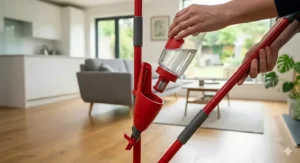
6. Addis 2-in-1 Spray Mop – Best for UK Brand Loyalty
For households that prefer supporting established British brands, the Addis 2-in-1 offers home-grown reliability at £17-£25 on Amazon.co.uk. Addis has been manufacturing household products in Britain since 1780—they genuinely pre-date the Industrial Revolution—and that longevity reflects in thoughtful design choices that suit how UK homes actually function.
The “2-in-1” designation refers to the mop’s dual-purpose capability: spray cleaning when wet, dust collection when dry. This flexibility matters in British homes where you’re often tackling different mess types throughout the week. Monday’s kitchen spills need wet cleaning, but Friday’s quick hallway dust-up before weekend guests doesn’t warrant full mopping. Having one tool handle both tasks saves storage space and reduces the temptation to skip the quick clean because fetching a separate dust mop feels like too much effort.
The 360° rotating mop head and slim profile suit Victorian terraces and 1930s semis—property types that dominate Britain’s housing stock but weren’t designed with modern cleaning equipment in mind. Addis clearly understands this, creating a mop that fits our narrow hallways and turns around furniture arrangements in compact lounges. The microfibre pad is machine washable over 100 times and attaches via Velcro rather than fiddly clips, making pad changes genuinely quick when you’re mid-clean. At around £20, it sits comfortably in the budget-friendly bracket whilst offering the reassurance of a British brand with actual UK customer service should issues arise.
Pros:
✅ Established British brand with 240+ year heritage
✅ Dry/wet versatility reduces cleaning tool clutter
✅ Designed around UK housing stock dimensions
Cons:
❌ Spray bottle capacity smaller than some competitors
❌ Pad durability good but not exceptional
Price verdict: Around £20 for British manufacturing heritage and versatile cleaning. Usually despatched from Addis Direct via Amazon.
7. Bona Multi-Surface Premium Spray Mop – Best for Mixed Flooring
British homes rarely feature single flooring types throughout—more commonly you’re juggling laminate in the kitchen, ceramic tiles in the bathroom, vinyl in the utility room, and maybe wood in the dining area. The Bona Multi-Surface model is specifically engineered for this reality, priced £40-£55 on Amazon.co.uk with a streak-free cleaning formula that genuinely works across stone, tile, laminate, and vinyl LVT/LVP without leaving different finishes on different surfaces.
What distinguishes this from Bona’s wood-specific model is the multi-surface cleaning solution that adjusts its behaviour based on surface porosity. Tiles clean without that cloudy residue some cleaners leave, laminate dries streak-free without the rainbow effect you sometimes see, and vinyl maintains its sheen rather than looking dulled. For UK households where open-plan living means you’re often cleaning three different floor types in one session, this consistency matters enormously.
The extra-large mop head makes quick work of larger spaces—increasingly relevant as British new-builds favour open-plan kitchen-diner layouts. You’ll cover a typical 20-square-metre ground floor in 10-15 minutes, with the refillable 850ml cartridge providing enough solution for multiple rooms before needing a refill. The pads last up to 500 washes and are made from 90% recycled materials, appealing to environmentally-conscious UK buyers who want their purchasing choices to reflect sustainability values.
Pros:
✅ One mop, all floor types—no switching required
✅ Streak-free finish on every surface
✅ Large mop head speeds cleaning significantly
Cons:
❌ Premium pricing around £50
❌ Cartridge refills add ongoing costs
Price verdict: £40-£55 represents professional multi-surface performance. Prime delivery typically included for this price bracket.
Real-World Scenario: Which Spray Mop for Your UK Home?
Understanding which spray mop suits your specific situation requires looking beyond specifications to actual daily use patterns in British homes. Here are three common UK household profiles matched with ideal spray mops:
The London Flat Dweller (25-40, renting, 50-60m² space): You’re likely juggling laminate flooring throughout, limited storage, and need quick cleaning between work and social commitments. Storage space matters enormously—you’re not sacrificing precious cupboard room to cleaning equipment. The Vileda 1-2 Spray Standard (£20-£30) or MEXERRIS 5-Pad (£16-£20) both fit this profile perfectly. The Vileda’s slim integrated bottle stores in tight spaces, whilst MEXERRIS offers budget-friendly performance and multiple pads for bathroom versus kitchen separation. Given rental circumstances where you’re unlikely to invest in specialist flooring care, either option provides proper cleaning without over-committing financially.
The Young Family in Suburban Semi (30-45, mortgaged, 90-110m² space): Your ground floor probably mixes laminate kitchen, tiled bathroom, and possibly wood-effect flooring in the dining area. With toddlers or primary school children, floors take serious punishment—sticky spills, muddy footprints, and that mysterious grime that appears behind the sofa. You need frequent cleaning but can’t dedicate hours weekly. The Vileda 1-2 Spray Max (£30-£40) becomes the sensible middle-ground choice. The double-sided flip pad means you’re not constantly changing pads mid-clean (crucial when a child needs attention), whilst the 360° head navigates around scattered toys and furniture. The £35 investment pays back within months compared to disposable cleaning wipes or professional cleaning services.
The Retired Couple in Detached Bungalow (60+, owned outright, 100-130m² space): You’ve likely invested in quality flooring—possibly solid wood or engineered boards—and have time to care for it properly but prefer avoiding physically demanding cleaning methods. Back-friendly equipment matters, as does maintaining your home’s value through proper floor care. The Bona Premium (£45-£60) or Bona Multi-Surface (£40-£55) justifies the investment. The specialist wood floor formula protects your flooring investment rather than gradually degrading it with generic cleaners. The lightweight design with extended handle reduces bending and straining, whilst the professional-grade microfibre removes dirt without scrubbing pressure. At this life stage, prioritising quality and proper care over budget-focused compromises makes excellent sense.
Each scenario demonstrates how British housing types, life stages, and cleaning priorities should guide spray mop selection rather than simply buying the cheapest option or most premium model. Understanding your actual needs prevents both under-buying (ending up with a mop that frustrates daily use) and over-buying (spending £60 on features you’ll never use).
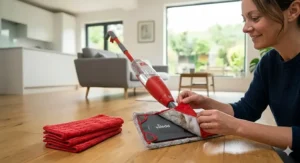
How to Choose the Right Spray Mop for UK Homes
Selecting the best spray mop requires looking beyond marketing claims to features that genuinely impact daily use in British households. Here’s what actually matters:
Floor Type Compatibility comes first. Laminate flooring dominates UK homes—it’s in roughly 35% of British properties according to recent trade figures—and it’s notoriously sensitive to excess moisture. Water pooling at laminate joints causes swelling and permanent damage, something our already-damp climate exacerbates. According to Which?, Britain’s trusted consumer watchdog, proper floor care significantly extends flooring lifespan and maintains home value. The spray mop you choose must deliver a fine mist rather than wet splashes. Bona models excel here with their professional-grade atomising spray, whilst budget options like MEXERRIS and BPAWA offer adequate fine-mist performance at lower price points. For sealed wood floors, pH-neutral cleaning solution matters enormously—generic cleaners gradually dull the finish, requiring expensive re-sealing sooner. Tiles and vinyl are more forgiving but still benefit from streak-free formulas.
Storage dimensions matter more in UK homes than most reviews acknowledge. Unlike sprawling North American properties, British homes average just 76 square metres—amongst Europe’s smallest. That utility cupboard is probably already crammed with the hoover, ironing board, and cleaning supplies. Measure your actual available space before buying. Slim-profile mops like the Vileda 1-2 Spray Standard fit 10cm-wide gaps, whilst models with detachable bottles (Vileda Spray Max, Bona Premium) need slightly more room but offer easier refilling. Consider vertical storage—most spray mops include wall hooks or retractable hanging options that save floor space.
Pad longevity and replacement cost impacts total ownership expense dramatically. A £15 mop with pads lasting 100 washes versus a £50 mop with 500-wash pads breaks even around the three-year mark if you’re cleaning twice weekly. Factor in that premium pads (Bona, Vileda) remain widely available on Amazon.co.uk with Prime delivery, whilst budget brand replacements sometimes disappear when manufacturers discontinue models. Check current pad availability before buying—nothing’s more frustrating than owning a mop with unavailable refills.
Spray mechanism reliability in hard water areas deserves consideration. Much of Southern and Eastern England has moderately hard to very hard water, meaning mineral buildup clogs spray nozzles over time. Vileda models handle this better with removable nozzles you can soak in vinegar solution, whilst some budget options have sealed mechanisms prone to permanent clogging. If your kettle needs regular descaling, your spray mop will face similar challenges.
Weight and manoeuvrability become crucial for anyone with mobility concerns or larger floor areas. Lightweight aluminium construction (1.5-2kg) reduces arm strain compared to heavier designs. The 360° rotating head isn’t marketing fluff—it genuinely matters when navigating around furniture legs and into corners without repositioning the entire mop. Test this feature in-store if possible; cheaper models sometimes offer 360° rotation on paper but require excessive force to actually pivot.
Common Mistakes When Buying Your First Spray Mop
British buyers frequently make predictable errors when entering the spray mop market, often because American-focused reviews don’t address UK-specific concerns. Avoid these pitfalls:
Ignoring hard water compatibility ranks highest amongst regrettable purchases. If you live in London, Essex, Kent, Sussex, or much of the South East, your water contains significant calcium carbonate. Spray mops with sealed, non-serviceable nozzles will clog within months, turning your new mop into expensive landfill. Always choose models with removable spray mechanisms or commit to monthly vinegar rinses. Vileda explicitly addresses this in their documentation; budget brands often don’t mention it at all.
Overlooking actual floor type requirements leads to damaged flooring and disappointment. “Universal” claims on packaging rarely tell the full story. Laminate flooring—Britain’s most popular choice—needs minimal moisture and pH-neutral solutions. If you buy a budget spray mop that sprays wet splodges rather than fine mist, you risk voiding your laminate warranty through moisture damage. Similarly, unsealed wood floors (rare in UK homes but present in some period properties) can’t handle any water-based mopping at all. Verify your flooring type before buying, and ensure your chosen mop specifically mentions compatibility.
Underestimating storage requirements creates buyer’s remorse in compact British properties. That impressive-looking mop with the large detachable bottle might not fit your cupboard. Measure your available storage height and width before ordering. Most spray mops stand 120-140cm tall, which exceeds standard under-stairs cupboard height in Victorian and Edwardian homes. Wall-mounted storage works brilliantly if you have available wall space, but not if every wall is already occupied with coat hooks, radiators, or picture frames.
Buying cheapest without checking pad availability seems sensible initially but creates long-term headaches. That £12 spray mop looks brilliant value until the original pads wear out and replacement pads are unavailable on Amazon.co.uk. Stick with established brands (Vileda, Bona, Addis) or budget brands with substantial UK review numbers indicating ongoing market presence (MEXERRIS, BPAWA). Check “frequently bought together” sections on Amazon to confirm replacement pads actually exist and are reasonably priced.
Neglecting British-specific considerations causes problems American reviews won’t mention. Our smaller room sizes mean you’re maneuvring around furniture more frequently—a stiff mop head becomes genuinely annoying. Our wet climate means pads need to dry quickly between uses or risk developing that musty smell. Our mixed housing stock (Victorian, Edwardian, 1930s semis, post-war housing, new builds) presents flooring variety most single-country reviews don’t address. Prioritise UK reviewer feedback on Amazon.co.uk over generic international reviews.
Spray Mop vs Traditional Mop: The UK Context
The debate between spray mops and traditional bucket-and-mop systems carries specific weight in British households where space, water usage, and flooring types create unique considerations.
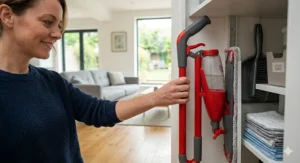
Storage and space efficiency heavily favours spray mops in UK properties. The average British home at 76 square metres offers limited storage compared to international counterparts. Traditional mopping requires a bucket (typically 12-15 litres), taking up substantial floor or cupboard space, plus somewhere to store the mop itself. Spray mops stand vertically in 10-15cm of space or hang on wall hooks. For anyone in a flat, terraced house, or new-build with minimal storage, spray mops eliminate an entire category of bulky cleaning equipment. The bucket itself also requires storage when not in use—not ideal in compact British properties where every cupboard does double or triple duty.
Water consumption matters more in 2026’s sustainability-conscious and cost-aware market. Traditional mopping uses 10-15 litres per cleaning session, refilling multiple times for larger areas. Spray mops use 400-850ml—roughly 95% less water. With UK water bills averaging £400+ annually and rising, reduced usage translates to measurable savings. More importantly, less water means less wastewater entering treatment systems, aligning with growing environmental awareness amongst British consumers. The reduced water also means floors dry faster, essential in our damp climate where slow-drying floors can develop mildew smells or attract settled dust before drying completes.
Physical demands differ significantly, especially relevant for Britain’s ageing population. Traditional mopping requires carrying full buckets (10-15kg), repeated wringing that strains wrists and forearms, bending to rinse mops, and manoeuvring the bucket whilst cleaning. Spray mops weigh 1.5-2kg when filled, require no bending or bucket-manoeuvring, and demand less physical strength for effective cleaning. For anyone over 60, managing arthritis, or simply wanting to reduce cleaning strain, spray mops offer genuine accessibility benefits that traditional systems can’t match.
Effectiveness on modern UK flooring tips balance toward spray mops. Laminate, engineered wood, and luxury vinyl—now dominant in British homes—benefit from minimal-moisture cleaning. Traditional wet mopping risks water pooling at joints and edges, potentially voiding warranties through moisture damage. Spray mops deliver precisely controlled moisture levels, cleaning effectively without saturation risks. Traditional mops remain superior for heavy-duty floor scrubbing or outdoor spaces, but modern British homes rarely feature floors requiring such intensive treatment indoors.
The verdict for typical UK households: spray mops win comprehensively for regular maintenance cleaning. Reserve traditional mops for deep-clean days (quarterly rather than weekly), outdoor patios, or utility rooms where heavy-duty scrubbing matters more than convenience.
Long-Term Cost & Maintenance in the UK Market
Understanding total cost of ownership reveals whether budget or premium spray mops deliver better value over realistic usage periods in British households.
Initial investment ranges from £15-£60 on Amazon.co.uk, but this tells only part of the story. Budget options (MEXERRIS £16-£20, BPAWA £15-£18) include multiple pads and bottles, providing immediate complete functionality. Mid-range choices (Vileda £20-£40) typically include 1-2 pads, requiring pad purchases for rotation. Premium models (Bona £45-£60) offer professional-grade components but similar pad counts. Factor in that you’ll need 3-4 pads minimum for practical rotation—one in use, one in the wash, spares for bathroom versus kitchen separation.
Replacement pad costs accumulate over years. Budget brand pads cost £8-£12 for 2-pack on Amazon.co.uk, premium Bona or Vileda pads run £12-£18 for similar quantities. However, wash durability differs dramatically. MEXERRIS pads last around 200 washes, Vileda around 100-200 washes, Bona up to 500 washes. Assuming twice-weekly cleaning (104 times yearly), budget pads need replacing every 18-24 months, premium pads every 4-5 years. Over five years, you’ll spend roughly £25-£35 on budget pad replacements versus £12-£18 on premium replacements—negating much of the initial price advantage.
Cleaning solution expenses vary wildly based on approach. Proprietary solutions (Bona, Vileda Active Cleaner) cost £8-£15 per 750ml-1L on Amazon.co.uk and last roughly 20-30 cleaning sessions. That’s £40-£75 annually for twice-weekly cleaning. DIY solutions (white vinegar diluted with water, or pH-neutral dish soap in water) cost under £10 annually. Spray mops with refillable bottles (all models reviewed) accommodate both approaches—budget-conscious households can DIY, whilst those prioritising convenience or specialist wood floor care can use branded solutions. This flexibility represents significant long-term savings compared to systems requiring proprietary refills.
Nozzle and mechanism longevity impacts whether your mop reaches five-year lifespan or fails within two years. Vileda and Bona models feature serviceable spray mechanisms—you can descale nozzles with vinegar solution or replace spray units if needed. Budget models often have sealed mechanisms that can’t be serviced, meaning mineral buildup from hard water permanently clogs them. If you live in hard water areas (London, South East, parts of Midlands), budget spray mops might need replacing every 18-24 months versus 4-5 years for serviceable premium models.
Total five-year ownership cost comparison reveals surprising insights. A £16 MEXERRIS with £35 pad replacements plus £50 DIY cleaning solutions totals £101. A £35 Vileda Spray Max with £25 pad replacements plus £50 DIY solutions totals £110. A £50 Bona Premium with £18 pad replacements plus £350 branded solutions totals £418. However, that Bona used with DIY solutions totals just £118—marginally more than budget options but with superior performance throughout. The lesson: initial price matters less than pad durability and cleaning solution flexibility over realistic ownership periods.
Features That Actually Matter (And Those That Don’t)
Marketing language around spray mops can obscure which features deliver genuine value versus which sound impressive but add little to daily cleaning reality in British homes.
360° rotating head genuinely improves cleaning efficiency. British homes feature abundant furniture—dining chairs, coffee tables, bedside cabinets, radiators—creating obstacle courses during floor cleaning. Fixed or limited-rotation mop heads require constant repositioning and multiple passes to clean around furniture legs. Full 360° rotation lets you pivot around obstacles in one smooth motion, cutting cleaning time by 20-30% in furniture-filled rooms. This isn’t marketing fluff; it’s measurably useful. All seven reviewed models offer 360° rotation, but quality varies—cheaper models sometimes require excessive force to rotate, partially negating the benefit.
Microfibre pad quality matters enormously but gets minimal marketing attention. Generic “microfibre” tells you nothing useful. What matters: fibre density (higher density traps more dirt), dual-zone design (different fibres for breaking up versus absorbing grime), and weave tightness (loose weaves push dirt around rather than lifting it). Bona’s dual-zone microfibre demonstrably outperforms budget single-zone designs, visible in how quickly floors clean and how long pads maintain effectiveness. This explains Bona’s 500-wash pad lifespan versus budget brands’ 100-200 washes—superior microfibre resists degradation longer. You’re paying for engineering, not just marketing.
Spray trigger design creates real usability differences. No-battery trigger systems (all reviewed models) are superior to battery-powered alternatives—simpler mechanisms, lower failure rates, no ongoing battery costs. However, trigger ergonomics vary. Vileda’s triggers require comfortable medium pressure; some budget triggers need surprisingly firm squeezes, causing hand fatigue during larger cleaning sessions. If you have arthritis or reduced hand strength, test trigger pressure before buying—this becomes your limitation for effective cleaning.
Bottle capacity (400-850ml across reviewed models) impacts refill frequency rather than cleaning effectiveness. Smaller bottles (400-500ml) need refilling when cleaning larger homes (100m²+) but offer lighter weight and more compact storage. Larger bottles (800ml+) handle whole-house cleaning without refills but add weight and storage bulk. For typical UK homes (70-90m²), 500-600ml bottles hit the sweet spot—enough for complete ground floor cleaning without excessive weight. This isn’t a make-or-break feature; just choose based on your specific floor area and refilling tolerance.
“Removes 99% of bacteria” claims appear on most models but require context. This typically refers to laboratory testing with specific bacteria strains under controlled conditions, not real-world performance in your kitchen. What actually matters for hygiene: regular pad washing (bacteria accumulate in dirty pads), using clean water for each session (dirty water redeposits bacteria), and proper floor drying (damp surfaces harbour bacterial growth). The spray mop itself contributes less to hygiene than good cleaning practices. Don’t choose models based on bacteria-removal percentages—focus on pad washability and effective cleaning solution delivery instead.
UK Regulations, Safety Standards & Practical Considerations
British buyers should understand regulatory and practical factors specific to purchasing and using spray mops in the UK market, particularly following Brexit-related changes.
UKCA marking replaced CE marking for products placed on the Great Britain market after January 2023. All spray mops reviewed carry appropriate conformity marking, indicating they meet UK safety standards for consumer products. For Amazon.co.uk purchases, established brands like Vileda and Bona clearly display compliance. Budget brands from Chinese manufacturers (MEXERRIS, BPAWA) typically show CE marking if manufactured for European export, which remains acceptable for Northern Ireland sales and during transition periods. Practically, this matters little for spray mops (simple mechanical products with minimal safety concerns), but it’s worth knowing for warranty and trading standards purposes.
Consumer Rights Act 2015 provides stronger protections for UK buyers than many international markets. You have 30 days to reject faulty goods for full refund (not just replacement), whilst products must remain fit for purpose for “reasonable periods”—typically 2-3 years for household goods like spray mops. If your spray mop’s spray mechanism fails within 18 months, you have legal grounds for refund or replacement beyond manufacturer warranty. Amazon.co.uk typically honours these rights easily, but knowing them empowers dealing with third-party marketplace sellers who might initially refuse.
Hard water considerations deserve emphasis in UK context. The Drinking Water Inspectorate maps water hardness across Britain—much of the South East, London, parts of Midlands and Yorkshire have moderately hard to very hard water (200-400mg/L calcium carbonate). This causes limescale buildup in kettles, shower heads, and spray mop nozzles. Vileda explicitly recommends cleaning spray mechanisms with vinegar solution in hard water areas; budget brands rarely mention this. Expect spray nozzle maintenance every 4-8 weeks if you live in hard water areas, regardless of brand. This isn’t product defect—it’s reality of British water chemistry.
Flat/apartment building considerations sometimes arise around greywater disposal. Some older converted flats have shared drainage systems where landlords discourage chemical cleaner disposal. Spray mops excel here—using diluted eco-friendly solutions or plain water with vinegar creates minimal drainage concerns compared to bucket mopping with harsher chemicals. The reduced water volume (400-850ml versus 10-15L) also matters in buildings with older plumbing where excessive water flow causes issues. Check letting terms if you’re renting, though spray mops rarely trigger concerns that traditional mopping doesn’t already raise.
Insurance and rental property implications occasionally surface. Some landlord insurance policies require “reasonable care” of flooring as lease conditions. Using appropriate cleaning methods contributes to this—spray mopping laminate with proper technique demonstrates care, whilst bucket-mopping laminate with excessive water could breach “reasonable care” if it damages flooring. For owned properties, using manufacturer-recommended cleaning methods (often spray mopping for modern flooring) helps maintain warranties. Bona cleaning systems are explicitly approved by most major flooring manufacturers, which matters if warranty claims arise.
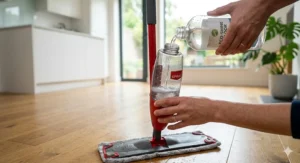
FAQ: Your Spray Mop Questions Answered
❓ Can spray mops damage laminate flooring in UK homes?
❓ Do spray mops work in hard water areas like London and the South East?
❓ Are expensive spray mops worth £50+ or should I buy budget options under £20?
❓ Can I use any cleaning solution in refillable spray mop bottles?
❓ How often should I replace microfibre mop pads on my spray mop?
Conclusion: Choosing Your Ideal Spray Mop
The British spray mop market in 2026 offers genuinely excellent options across all price points, meaning your perfect choice depends on specific circumstances rather than following blanket recommendations.
For budget-conscious households or first-time spray mop buyers testing whether the format suits your routine, the MEXERRIS 5-Pad at £16-£20 or BPAWA 4-Pad at £15-£18 deliver remarkable value. You receive complete systems with multiple pads and bottles, allowing immediate productive use without additional purchases. These perform admirably on typical UK mixed flooring (laminate, vinyl, basic tiles), though don’t expect the refinement or longevity of premium brands. Perfect for renters, students, small flats, or anyone unwilling to risk serious money before confirming spray mopping fits their lifestyle.
Mid-market buyers seeking reliable all-round performance should strongly consider the Vileda 1-2 Spray Max around £30-£40. This hits the sweet spot between value and quality, offering the double-sided flip pad system that genuinely speeds cleaning, backed by a century-old European brand’s reliability. It handles the flooring mixtures common in British homes without fuss, stores reasonably compact, and delivers consistent performance year after year. For typical 70-100m² UK properties with laminate and vinyl flooring, this represents the best overall value.
Wood floor specialists need the Bona Premium (£45-£60) or Bona Multi-Surface (£40-£55) for genuine floor protection rather than just cleaning. These models justify premium pricing through specialist formulations, professional-grade microfibre, and 500-wash pad longevity that actually saves money long-term. If you’ve invested £3,000-£8,000 in quality wood flooring—increasingly common in British homes—spending £50 to properly maintain that investment makes obvious financial sense. The pH-neutral formulas and residue-free cleaning protect your flooring’s finish rather than gradually degrading it like generic cleaners.
Compact living specialists in flats or terraced houses should prioritise the Vileda 1-2 Spray Standard (£20-£30) for its genuinely slim storage profile or the Addis 2-in-1 (£17-£25) for British brand heritage combined with dry/wet versatility. Both understand British housing constraints and design accordingly—no unnecessarily bulky components or fussy storage requirements.
The transformation from traditional bucket-and-mop cleaning to spray mopping represents genuine improvement for most British households. Reduced physical demands, minimal storage requirements, 95% less water usage, and faster cleaning sessions create compelling value regardless of which model you choose. The worst spray mop from this list still outperforms traditional mopping for regular maintenance cleaning in typical UK homes, making this category well worth exploring.
What matters most is matching your choice to your specific situation: flooring type, home size, cleaning frequency, storage capacity, and budget. Use this guide’s detailed analysis to identify which factors matter most for your household, then choose accordingly. Your back, your floors, and your weekly schedule will thank you.
Recommended for You
- 7 Best Electric Mops UK 2026
- Best Spin Mop UK: 7 Expert-Tested Models (2026 Guide)
- 7 Best Cordless Electric Mops UK 2026
Disclaimer: This article contains affiliate links. As an Amazon Associate, I earn from qualifying purchases. If you purchase products through these links, we may earn a small commission at no additional cost to you.
✨ Found this helpful? Share it with your mates! 💬🤗
