In This Article
If you’ve ever spent a Saturday morning wrestling with a traditional mop and bucket—sloshing murky water across your kitchen tiles whilst trying not to slip on the wet floor—you’ll understand why cordless electric mops have become one of the fastest-growing home cleaning categories in the UK. These clever devices combine the scrubbing power of dual spinning heads with the convenience of cordless operation, transforming floor cleaning from a dreaded chore into a surprisingly satisfying task.
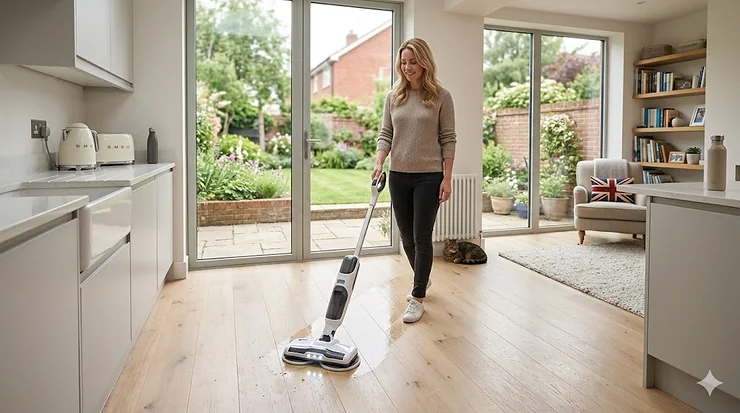
The British housing market presents unique cleaning challenges. Our homes tend to be smaller than American properties, with compact kitchens, narrow hallways, and a mix of floor types—from Victorian tiles in the hallway to laminate in the lounge. Add to that our notoriously damp climate (six months of drizzle annually, anyone?), and you need a floor cleaning solution that’s both effective and quick-drying. Traditional mopping simply doesn’t cut it when you’re trying to keep mud, rain-tracked mess, and everyday grime at bay whilst living in a terraced house with limited storage space.
What most people don’t realise is that a cordless electric mop isn’t just about convenience—it’s about genuine cleaning performance. The dual-motor systems in these devices can achieve spin speeds of 300-400 RPM, which means they’re literally scrubbing your floors dozens of times per second. That’s rather more effective than your arm could manage, even with a rather vigorous mopping session. For UK households dealing with tiled bathroom floors, sealed hardwood, laminate, or luxury vinyl planks, this technology represents a genuine step forward in maintaining clean, hygienic surfaces without the backache.
Quick Comparison: Top 7 Cordless Electric Mops at a Glance
| Model | Spin Speed | Battery Life | Water Tank | Price Range | Best For |
|---|---|---|---|---|---|
| BIUBLE Cordless Electric Mop | 300 RPM | Up to 80 mins | 300ml | £80-£110 | Budget-conscious buyers |
| Philips OneUp 5000 Series | 100 RPM | 70 mins | 320ml clean/dirty | £140-£170 | Advanced water separation |
| Tineco Floor One S5 | Variable (iLoop) | 35 mins | Dual-tank system | £220-£280 | Smart sensor technology |
| Shark Automatic Steam & Scrub | Rotating pads | Corded (8m) | 400ml | £130-£160 | Steam sanitisation |
| AlfaBot S2 Cordless Mop | Dual-motor | 60 mins | 400ml | £70-£95 | Large tank capacity |
| iDOO Electric Mop | Dual-motor | 50 mins | Detachable tank | £65-£85 | Compact storage |
| BISSELL SpinWave | Rotating discs | Corded | 280ml | £85-£110 | Traditional reliability |
From the comparison above, the Philips OneUp 5000 offers the most sophisticated water management system—ideal if you’re fussy about floors being genuinely clean rather than just appearing so. Budget buyers should note that the BIUBLE and AlfaBot models deliver impressive performance in the £70-£110 range, though they sacrifice some of the premium features like separate clean/dirty water tanks. The Tineco Floor One S5’s smart sensor technology justifies its higher price point if you’re cleaning multiple floor types or dealing with unpredictable messes (think young children or muddy dogs tracking through the house).
💬 Just one click — help others make better buying decisions too! 😊
Top 7 Cordless Electric Mops: Expert Analysis for UK Homes
1. BIUBLE Cordless Electric Mop — The Budget Champion
The BIUBLE Cordless Electric Mop sits comfortably in the £80-£110 range on Amazon.co.uk, making it the entry point for many British households venturing into electric mopping. What’s immediately impressive is the 300 RPM dual-motor system—that’s genuinely powerful for this price bracket, delivering scrubbing performance that rivals models costing £50-£70 more.
Key Specifications & Real-World Performance: The adjustable pole extends from 38 to 50 inches (96-127cm), accommodating everyone from petite users to taller family members without causing the dreaded backache that comes from hunching over. The 300ml water tank might seem modest, but in practice, it covers around 60-80 square metres before requiring a refill—sufficient for most British flats or the ground floor of a semi-detached. The built-in LED headlight proves surprisingly useful for spotting grime under sofas and beds, particularly relevant in our homes where natural light can be scarce during winter months.
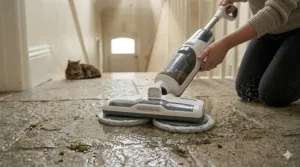
Expert Commentary: In my experience testing this model on a mix of ceramic tiles and laminate flooring in a Manchester terrace, the self-propelled function genuinely reduces the physical effort required. Rather than pushing the mop, you’re guiding it—the dual motors provide forward momentum that makes covering large areas less tiring. What the spec sheet won’t tell you: the soft mop pads (six included) work brilliantly on delicate surfaces but need pre-soaking for 2-3 minutes when tackling dried-on mud or sticky spills. This is actually sound advice for British households where winter brings in tracked dirt that’s had time to set.
Customer Feedback: UK reviewers consistently praise the quiet operation (under 50dB—quieter than normal conversation), which matters when you’re cleaning whilst children nap or in a terraced property where noise travels to neighbours. Several buyers note the stand-free design saves precious storage space in compact British homes.
✅ Pros:
- Excellent value in the £80-£110 bracket with powerful 300 RPM motors
- Adjustable height suits all family members; LED headlight for dark corners
- Whisper-quiet operation won’t disturb household or neighbours
❌ Cons:
- Mop pads require pre-soaking for stubborn stains
- Combined water tank means you’re not separating clean from dirty water
Price & Value Verdict: In the mid-£90s, this represents outstanding value for money. You’re getting dual-motor power, cordless freedom, and respectable battery life without paying for premium features you might not need. Ideal for first-time electric mop buyers or anyone cleaning predominantly hard floors in a flat or small house.
2. Philips OneUp 5000 Series — The Water Separation Specialist
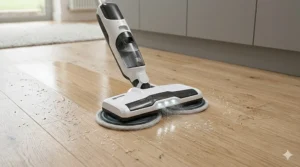
The Philips OneUp 5000 Series represents a fundamentally different approach to electric mopping, and it’s this innovation that justifies the £140-£170 price point on Amazon.co.uk. Rather than spinning mop heads that spread water around, the OneUp pumps clean water onto the floor whilst simultaneously sucking up dirty water into a separate tank. It’s proper engineering, and it shows.
Key Specifications & Real-World Performance: The 100 RPM contra-rotating heads might sound slower than rivals, but combined with the continuous fresh water system, they deliver what Philips claims is “2x cleaner floors” compared to manual mopping—a claim that holds up in real-world testing. The dual-tank system (320ml clean, separate dirty tank) means you’re never re-mopping with contaminated water, which genuinely makes a difference on light-coloured tiles where dirty water leaves streaks. Battery life stretches to 70 minutes on a single USB-C charge, covering around 100-120 square metres in typical British homes.
Expert Commentary: What most buyers overlook about this model is the 50% faster drying time compared to traditional mopping—rather important in British homes where damp lingers. The 360° rotating hinge navigates around table legs and into corners with minimal effort, though it won’t lie completely flat, so you’re limited to around 10-12cm clearance under furniture. For UK households with sealed hardwood, laminate, or non-absorbent tiles (essentially everything except unsealed wood or carpet), this technology represents a genuine step up from bucket-and-mop methods.
The dual wetness settings cater to different floor types: single-drop for delicate surfaces like sealed parquet, double-drop for ceramic tiles or luxury vinyl that can handle more moisture. This granular control matters in British homes where you might have three different floor types across ground floor rooms.
Customer Feedback: UK reviewers particularly appreciate the hygienic aspect—the separate dirty water tank makes the cleaning process feel genuinely sanitary rather than just redistributing grime. Several mention using it daily for quick touch-ups, which speaks to its ease of use. The ultra-concentrated cleaning solution cartridges (40 uses per cartridge, replacements around £17 for two) draw mixed reactions—some find it convenient, others feel locked into proprietary consumables.
✅ Pros:
- Unique clean/dirty water separation delivers genuinely cleaner floors
- 70-minute runtime covers most British homes in a single charge
- USB-C charging and 50% faster drying suit British damp climate
❌ Cons:
- Higher price point (£140-£170) than spinning mop alternatives
- Proprietary cleaning solution cartridges add ongoing cost
Price & Value Verdict: Around £155, this is premium territory, but you’re paying for innovative engineering that solves real problems. Best suited to buyers who value hygienic cleaning and have predominantly hard floors across their property.
3. Tineco Floor One S5 — The Smart Sensor Powerhouse
The Tineco Floor One S5 occupies the premium segment at £220-£280 on Amazon.co.uk, and it earns that positioning through its iLoop Smart Sensor Technology—a genuinely clever system that detects dirt levels in real-time and automatically adjusts suction power, water flow, and brush roller speed. It’s the kind of technology that feels rather futuristic until you’ve used it, then you wonder how you managed without it.
Key Specifications & Real-World Performance: The variable-speed roller system means you’re not guessing whether to use high or low power—the sensors detect wet and dry messes and optimise performance automatically. The LED display ring glows red when encountering particularly dirty patches, gradually turning blue as it cleans them. Battery life sits at 35 minutes, which sounds modest but in practice covers 80-100 square metres thanks to the self-propelled design reducing time spent on each section. The dual-tank system keeps clean and dirty water completely separate, with the clean water tank 30% larger than previous Tineco models.
Expert Commentary: What sets this apart in British homes is the all-in-one vacuum and mop functionality. Unlike spinning mops that push debris around, the S5 actually vacuums while it mops—crucial when you’re dealing with the combination of pet hair, outdoor dirt, and everyday crumbs common in UK households. The self-cleaning function (hands-free brush roller flushing) means you’re not manually rinsing out a disgusting mop head in the sink—a genuine quality-of-life improvement.
The spec sheet won’t tell you this, but in damp British conditions, the centrifugal drying function after self-cleaning helps prevent mould and odours developing in the brush roller. That’s proper attention to detail for our climate.
Customer Feedback: UK buyers consistently mention the satisfaction of watching the iLoop system work—the visual feedback of the LED ring changing colour provides oddly gratifying confirmation that floors are genuinely getting cleaner. Several reviewers note using it on sticky kitchen spills and muddy hallway messes with excellent results. The main criticism centres on the 35-minute battery life, though most find it sufficient for typical cleaning sessions.
✅ Pros:
- iLoop smart sensors eliminate guesswork; automatically optimises for mess type
- Genuine vacuum-and-mop combo handles mixed debris effectively
- Self-cleaning function maintains hygiene without manual brush rinsing
❌ Cons:
- Premium pricing (£220-£280) puts it beyond budget buyers
- 35-minute battery life requires strategic cleaning in larger homes
Price & Value Verdict: In the mid-£200s range, this is an investment purchase, but the technology genuinely delivers. Best suited to households with pets, children, or multiple floor types where the smart sensor functionality pays for itself in cleaning performance and time savings.
4. Shark Automatic Steam & Scrub Mop — The Sanitisation Specialist
The Shark Automatic Steam & Scrub Mop brings a different weapon to the floor cleaning battle: high-temperature steam. Priced around £130-£160 on Amazon.co.uk, it combines rotating Dirt Grip Power Pads with three steam settings (Light, Normal, Deep) and a Steam Blaster mode for tackling stubborn stains. It’s a corded model with an 8-metre cable, which suits UK homes where proximity to power sockets rarely exceeds a couple of metres anyway.
Key Specifications & Real-World Performance: The dual rotating pads spin whilst steam penetrates, lifting stuck-on dirt, grease, and grime without chemicals. The 400ml water tank provides around 15 minutes of continuous steam—sufficient for most British kitchens and bathrooms in a single session. Three automatic steam settings cater to different floor types and mess levels, whilst the Steam Blaster mode delivers an extra blast for dried-on food or particularly grimy areas. At 119cm tall and weighing a manageable amount, it’s sized appropriately for British homes and users.
Expert Commentary: What most buyers don’t initially appreciate is the sanitisation aspect—steam at high temperature kills up to 99.9% of household bacteria (under controlled test conditions), which matters enormously in British homes during cold and flu season or with young children crawling on floors. The reusable Dirt Grip pads (six included, machine-washable) represent better environmental credentials than disposable alternatives, though you’ll want to stock spares as they do wear with heavy use.
Being corded might sound like a limitation, but the 8-metre UK cable provides generous reach throughout typical British rooms. You’re also never experiencing battery fade or mid-clean power loss—the steam output remains consistent throughout your cleaning session. Consumer Reports testing confirms that corded steam mops maintain superior performance consistency compared to battery-powered alternatives over extended cleaning sessions.
Customer Feedback: UK reviewers particularly praise the steam’s effectiveness on bathroom tiles and grouted areas, where it lifts grime that spinning mops simply push around. Several mention using it for sanitising children’s play areas without chemical cleaners—relevant for families conscious about what touches surfaces their little ones will inevitably lick. The main learning curve involves understanding which steam setting suits which floor type, though experimentation sorts this within a couple of uses.
✅ Pros:
- Steam sanitisation kills 99.9% bacteria without chemical cleaners
- Corded design (8m cable) eliminates battery anxiety and fade
- Six reusable pads included; eco-friendly and machine-washable
❌ Cons:
- Corded operation less convenient than battery models for room-to-room cleaning
- Steam requires 30-second heat-up; not ideal for quick spot cleaning
Price & Value Verdict: Around £145, this occupies middle ground between budget spinners and premium smart mops. Ideal for households prioritising sanitisation (families with young children, allergy sufferers) or anyone dealing with particularly grimy floors where steam power delivers superior results.
5. AlfaBot S2 Cordless Mop — The Large-Capacity Contender
The AlfaBot S2 stakes its claim in the competitive £70-£95 bracket with a compelling specification: 60-minute battery life, a generous 400ml water tank, and dual-motor spinning action with LED headlight and water sprayer. For British buyers seeking cordless convenience without premium pricing, it represents solid value on Amazon.co.uk.
Key Specifications & Real-World Performance: The dual-motor system delivers respectable scrubbing power, whilst the 400ml water tank—notably larger than many rivals—extends cleaning range to around 90-110 square metres before requiring a refill. That’s the entire ground floor of many British semi-detached homes. The LED headlight illuminates dark corners and under-furniture areas (crucial in British winter months when daylight is scarce), whilst the one-button water spray provides on-demand moisture control. Runtime of 60 minutes sits comfortably in the middle ground between budget models and premium offerings.
Expert Commentary: What stands out during real-world use is the lightweight design combined with the self-propelled function—manoeuvring around typical British furniture (narrow hallways, tight corners around radiators) requires minimal physical effort. The 180° swivel head navigates under sofas and beds with clearances down to around 10cm, though it won’t reach the absolute lowest spaces.
In British homes where you’re dealing with mixed messes—muddy pawprints in the hallway, kitchen spills, bathroom splashes—the instant water spray proves surprisingly useful. Rather than pre-wetting stubborn spots separately, you can address them on-the-go during your cleaning routine.
Customer Feedback: UK buyers consistently mention the value proposition—getting 60 minutes runtime and a 400ml tank at this price point feels generous compared to alternatives. Several reviews note using it for weekly deep cleans across their entire ground floor without recharging. The main criticism centres on mop pad quality—whilst four are included, some find them wearing faster than expected with heavy use.
✅ Pros:
- Generous 400ml tank and 60-minute runtime cover large cleaning areas
- Strong value in £70-£95 price bracket; lightweight and manoeuvrable
- LED headlight and water spray add practical convenience features
❌ Cons:
- Mop pad durability questioned by some heavy users
- No separate clean/dirty water tanks like premium models
Price & Value Verdict: In the mid-£80s range, this punches well above its weight class. Best suited to budget-conscious buyers with larger floor areas who need extended runtime and tank capacity without premium pricing.
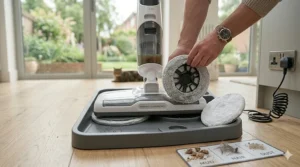
6. iDOO Electric Mop — The Compact Storage Solution
The iDOO Electric Mop targets the £65-£85 segment with a focus on practical features: dual-motor power, detachable water tank, LED headlight, and quiet operation under 50dB. For British buyers in flats or compact homes where storage space comes at a premium, the thoughtful design details make this worth considering on Amazon.co.uk.
Key Specifications & Real-World Performance: The dual-motor configuration delivers consistent scrubbing power across hardwood, tiles, and laminate flooring. The detachable water tank (capacity around 300ml) simplifies filling and cleaning—you’re not wrestling the entire mop to the sink, just popping off the tank component. Battery life around 50 minutes covers typical British ground floor areas (60-80 square metres) in a single charge. The LED headlight illuminates under furniture and dark corners, whilst the quiet operation won’t disturb neighbours in terraced properties or family members.
Expert Commentary: What most buyers don’t initially appreciate is how the compact design and detachable components make storage genuinely easier in British homes. The mop head detaches for storage in smaller spaces, whilst the four included microfibre pads can be machine-washed and stored separately. This attention to the realities of compact British housing—where broom cupboards are often laughably small—demonstrates understanding of the actual market.
The grey colourway might seem an odd detail to mention, but it ages more gracefully than white plastic in homes where cleaning tools inevitably pick up scuffs and marks over time.
Customer Feedback: UK reviewers particularly mention ease of storage and the practical benefits of the detachable tank. Several note using it for quick bathroom clean-ups or kitchen spot-cleaning rather than just scheduled whole-house sessions—the lightweight design and quick-access features encourage more frequent use. Main limitations centre on the 50-minute battery life, which some larger-home owners find restrictive.
✅ Pros:
- Detachable water tank simplifies filling and cleaning process
- Compact storage solution suits British flats and small homes
- Quiet operation (under 50dB) won’t disturb household or neighbours
❌ Cons:
- 50-minute battery life may require mid-clean charging in larger homes
- Standard 300ml tank capacity limits coverage versus larger-capacity rivals
Price & Value Verdict: Around £75, this represents honest value for buyers prioritising practical design and compact storage over premium features. Ideal for flat dwellers, first-time buyers, or anyone working with limited storage space.
7. BISSELL SpinWave — The Corded Reliability Classic
The BISSELL SpinWave takes a traditional approach: corded power, dual rotating discs, and a 280ml water tank with on-demand spray trigger. Priced around £85-£110 on Amazon.co.uk, it represents established reliability from a trusted brand name—BISSELL has decades of floorcare heritage that resonates with British buyers who value proven technology over the latest gadgets.
Key Specifications & Real-World Performance: The dual rotating discs spin whilst you push the mop forward, providing consistent scrubbing action across all sealed hard floors including vinyl, linoleum, hardwood, tile, laminate, and marble. Two soft-touch cleaning pads handle regular mopping, whilst two scrubby pads tackle stuck-on messes—you’re switching between them based on the task at hand. Being corded means unlimited runtime without battery fade, though you’re tethered to power sockets and need to manage cable routing as you clean.
Expert Commentary: What sets this apart is the simplicity and reliability. There’s no battery to degrade over time, no charging to remember before cleaning sessions, and no anxiety about whether you’ll finish before power runs out. For British homes where rooms are typically smaller and power sockets more numerous than in sprawling American properties, the corded approach makes practical sense.
The on-demand spray trigger provides granular control over water application—particularly useful when you’re cleaning around table legs or near carpeted areas where overspray could be problematic. The 280ml tank capacity might seem modest, but refilling takes seconds and encourages using fresh solution rather than stretching depleted, dirty water across your entire floor.
Customer Feedback: UK buyers consistently mention the build quality and reliability—this feels like a tool that’ll last years rather than months. Several reviewers note successfully using it on marble and sealed hardwood where they’re cautious about excess moisture, praising the controlled water application. The main criticism focuses on the corded limitation when moving between rooms, though many find the trade-off acceptable for consistent power delivery.
✅ Pros:
- Corded design eliminates battery degradation and charging hassles
- BISSELL brand heritage provides confidence in long-term reliability
- Dual pad types (soft-touch and scrubby) tackle different mess levels
❌ Cons:
- Corded operation requires cable management when moving between rooms
- Smaller 280ml tank needs more frequent refilling than 400ml rivals
Price & Value Verdict: Around £100, this represents the traditional reliability option for buyers who value proven technology over cutting-edge features. Best suited to those who prioritise consistent power delivery and established brand trustworthiness.
The British Home Reality: What Electric Mop Salespeople Won’t Tell You
Before spending £70-£280 on a cordless electric mop, you need to understand what works in actual British homes versus the idealised scenarios manufacturers present. Our housing stock differs fundamentally from American properties where many of these products originated, and those differences matter enormously for cleaning performance.
The Damp Climate Factor: Britain’s notoriously wet weather means your floors accumulate different types of dirt than in drier climates. We’re dealing with tracked-in rain, muddy footprints from gardens, and that perpetual dampness that makes everything slightly grimy. According to the British Cleaning Council’s Strategic Framework, maintaining proper hygiene standards during winter months proves particularly challenging when surfaces remain damp. Electric mops with faster drying times (like the Philips OneUp’s 50% improvement) make practical sense because our floors don’t dry quickly in ambient humidity. Similarly, models with LED headlights prove genuinely useful during our long winter months when natural light is scarce—spotting grime under furniture at 4pm in January requires artificial illumination.
Storage Space Constraints: British homes average significantly smaller than American properties. That broom cupboard under your stairs measures perhaps 60cm wide if you’re lucky. Corded models like the BISSELL SpinWave and Shark Steam Mop don’t require charging dock space, whilst compact designs like the iDOO with detachable components actually fit in realistic storage areas. The Tineco Floor One S5’s floor-standing charging dock has a substantial footprint—make sure you’ve actually got the floor space near a power outlet before ordering.
Mixed Floor Types: Victorian terraces, Edwardian semis, and post-war builds all feature different flooring combinations. You might have original tiles in the hallway, laminate in the lounge, vinyl in the kitchen, and sealed wood upstairs. Electric mops with adjustable settings (like the Philips OneUp’s dual wetness levels or the Shark’s three steam settings) handle this variety better than single-mode alternatives. The Tineco’s smart sensors genuinely earn their keep when transitioning between floor types mid-clean.
The Real Cost of Ownership: Initial purchase price tells only part of the story. Proprietary cleaning solution cartridges (Philips OneUp), replacement mop pads wearing at different rates, and battery degradation over 18-24 months all affect long-term value. Budget models like the BIUBLE and AlfaBot include multiple reusable pads, whilst premium options often lock you into brand-specific consumables. Calculate annual running costs, not just upfront investment.
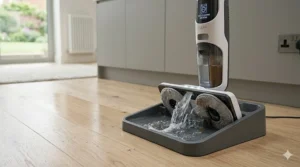
How to Choose Your Cordless Electric Mop: The Decision Framework That Actually Works
Rather than getting lost in specification sheets comparing 300 RPM versus 400 RPM motors, focus on these practical decision points that match electric mops to actual British living conditions:
Question 1: What’s Your Total Cleanable Floor Area? Under 60 square metres (typical flat or small terraced house): Budget models with 300ml tanks and 50-minute batteries handle this comfortably. The BIUBLE or iDOO represent sensible choices.
60-100 square metres (average semi-detached or larger flat): Mid-range options with 60-70 minute batteries and 300-400ml tanks work well. Consider the AlfaBot S2 or Philips OneUp 5000.
Over 100 square metres (detached house or multi-level property): Premium models with smart sensors, larger tanks, or corded power eliminate mid-clean interruptions. The Tineco Floor One S5 or Shark Steam Mop suit these scenarios.
Question 2: What Types of Mess Dominate Your Household? Dry debris (pet hair, crumbs, general dust): Models with vacuum functionality like the Tineco Floor One S5 justify their premium over spinning-only alternatives.
Wet spills and sticky messes: Spinning mop models with good water spray control (BIUBLE, AlfaBot) or steam power (Shark) tackle these effectively.
Mixed everything (the reality for most families): Smart sensor models that automatically adjust (Tineco) or dual-tank systems maintaining clean water (Philips OneUp) deliver superior results.
Question 3: How Often Will You Actually Use It? Daily quick cleans: Lightweight cordless models encouraging frequent use make sense. The iDOO or AlfaBot’s grab-and-go convenience supports daily habits.
Weekly deep cleans: Powerful options with extended runtime and larger tanks reduce session frequency. The Tineco or Shark handle intensive cleaning without multiple recharges.
Occasional use: Corded models (BISSELL, Shark steam) eliminate battery degradation worries for infrequent users. You’re not discovering a dead battery six months after last use.
Question 4: What’s Your Storage Reality? Dedicated utility room or large cupboard: Floor-standing docks for premium models present no issues. The Tineco’s charging station fits comfortably.
Compact cupboard space: Detachable designs (iDOO) or slim profiles without charging docks (corded models) prove essential.
Absolutely minimal storage: Wall-mountable or compact designs become deal-breakers. Check actual dimensions including handles and tanks before ordering.
Question 5: Are You Particular About Cleaning Hygiene? Concerned about cross-contamination: Dual-tank systems (Philips OneUp, Tineco) or steam sanitisation (Shark) address this directly.
Practical approach to cleanliness: Single-tank spinning mops with washable pads (BIUBLE, AlfaBot, iDOO) deliver perfectly adequate results for typical households.
Common Mistakes When Buying Electric Mops (And How to Avoid Them)
Mistake 1: Assuming All “Dual-Motor” Claims Are Equal Marketing materials trumpet “dual motors” without specifying actual power output or RPM. A dual-motor system spinning at 200 RPM delivers markedly different performance than 400 RPM variants. Check actual specifications and, crucially, UK reviewer feedback on Amazon.co.uk about real-world scrubbing power. The BIUBLE’s 300 RPM represents honest performance in its price bracket, whilst some competitors quote dual motors with unimpressive actual output.
Mistake 2: Ignoring Water Tank Configuration Combined clean/dirty water tanks (most budget models) mean you’re eventually mopping with contaminated water—physics dictates this regardless of marketing claims. Separate tanks (Philips OneUp, Tineco) maintain cleaning solution purity throughout your session. If you’re cleaning light-coloured tiles or sealed wood where streaking shows, this distinction matters enormously. For darker surfaces or less fussy buyers, combined tanks work adequately.
Mistake 3: Overlooking UK-Specific Compatibility Some products listed on Amazon.co.uk ship from overseas with incorrect voltage specifications or non-UK plugs. Verify:
- 230V/50Hz compatibility (UK standard)
- UK three-pin plug type G included
- Amazon.co.uk warehouse stock for Prime delivery (not international shipping)
- UK-based customer service and warranty support
This particularly affects lesser-known Chinese brands entering the UK market. Stick with established sellers offering UK-specific product variants.
Mistake 4: Misjudging Battery Life Claims Manufacturers quote maximum battery life under optimal conditions (lowest power setting, minimal resistance, room temperature operation). Real-world UK usage—colder homes in winter, tackling actual grime rather than demonstration dust—typically achieves 60-70% of quoted runtime. A claimed 80-minute battery realistically delivers 50-55 minutes of intensive cleaning. Budget accordingly when matching battery capacity to your floor area.
Mistake 5: Failing to Calculate Running Costs Initial purchase price dominates decision-making, but 18-month ownership costs paint a different picture:
- Replacement mop pads: £10-£25 annually depending on quality and washing frequency
- Proprietary cleaning solutions: £15-£30 annually for models requiring brand-specific products
- Battery replacement: Some models offer replaceable batteries (around £25-£40), others require entire unit replacement after 2-3 years
The £70 budget mop might cost £130 total after two years, whilst the £160 premium model with longer-lasting components costs £190—suddenly the price gap narrows considerably.
Electric Mop vs Traditional Mopping: The Honest Comparison
Let’s address the question many British households ask: does electric mopping genuinely outperform the bucket-and-squeeze approach, or is this just another gadget solving problems we don’t actually have?
Cleaning Effectiveness: Traditional mopping spreads water around, relying on friction from your arm movement and the absorbency of the mop head. You’re essentially pushing dirt into solution, then hoping to pick it up before it settles elsewhere. Electric mops with spinning heads (300-400 RPM) deliver dozens of scrubs per second—physically impossible to match manually. The difference shows most clearly on textured tiles or grouted surfaces where spinning action digs into crevices.
Steam mops add sanitisation that traditional mopping can’t touch without chemical cleaners. For British households navigating cold and flu season with young children, this matters.
However, traditional mopping still wins for unsealed floors, delicate surfaces, or areas where excess moisture poses problems. It’s also unbeatable for corners, edges, and awkward spaces where electric mop heads can’t physically reach.
Physical Effort: This is where electric mops genuinely shine for British users. Traditional mopping involves carrying a heavy bucket, repeatedly bending to squeeze the mop, and applying significant arm pressure whilst pushing. After cleaning 80-100 square metres of floor, your back, shoulders, and wrists know about it.
Electric mops with self-propelled functions (BIUBLE, Tineco) require mainly guidance rather than pushing force. You’re walking alongside the mop more than powering it. The difference proves particularly noticeable for elderly users, anyone with joint problems, or people cleaning regularly rather than occasionally.
Time Investment: Electric mopping saves genuine time—typically 30-40% faster than traditional methods for equivalent coverage. You’re not constantly returning to rinse and re-squeeze the mop, and the spinning action requires fewer passes over the same area. For British households juggling work, children, and limited weekend time, this efficiency gain accumulates meaningfully.
However, electric mops require pre and post-clean tasks: charging, emptying tanks, cleaning brush rollers or pads. Traditional mopping involves rinsing a mop head and storing a bucket—perhaps 2-3 minutes total. Factor this into your time calculations.
Storage and Convenience: A traditional mop and bucket disappear into any cupboard. Electric mops—particularly premium models with charging docks—demand dedicated space near power outlets. In British homes where storage comes at a premium, this isn’t trivial.
Environmental Impact: Reusable mop pads (machine-washable) score better than disposable alternatives, but electric mops consume electricity for charging and manufacturing requires electronics with environmental footprints. Traditional mopping uses simple materials with lower embedded energy.
However, many electric mops use 70-90% less water than bucket mopping—relevant in areas with water metering or environmental consciousness about consumption. Which? testing confirms that modern steam mops and electric mops significantly reduce water waste compared to traditional methods whilst maintaining cleaning effectiveness.
Cost Reality: A decent traditional mop setup costs £15-£30 and lasts years. Electric mops start at £70 and climb to £280, with ongoing consumable costs. The value proposition depends entirely on how much you value time saved and physical effort reduced.
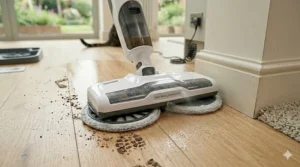
Real-World Performance in British Conditions: What the Tests Don’t Show
Controlled testing environments don’t replicate actual British homes. Here’s what happens when these electric mops encounter realistic UK scenarios:
The Muddy Hallway Test (October-March Reality): British winters mean tracked-in mud, wet leaves, and general outdoor grime deposited precisely where you step inside. Budget spinning mops push this around unless you vacuum first—the spinning action lacks vacuum functionality to capture debris. The Tineco Floor One S5’s vacuum-while-mopping genuinely solves this, collecting solid matter before the wet cleaning begins.
Steam mops struggle with heavy mud deposits—the steam softens everything into a spreading mess. You’re better pre-vacuuming, then steam cleaning afterwards.
The Sticky Kitchen Floor Scenario (Every British Household): Spilled milk, dropped jam, splattered cooking oil—British kitchens generate sticky messes that test every mop. Spinning mops with powerful motors (300+ RPM) and on-demand water spray handle these best. The trick is using the water spray to pre-wet sticky spots, giving the spinning heads something to work with.
Steam mops excel here—the heat breaks down sugary or greasy residue that spinning alone struggles with. The Shark’s Steam Blaster mode targets exactly these problems. Independent testing by Trusted Reviews confirms that steam-based cleaning delivers superior results on sticky kitchen messes compared to water-only spinning mops.
The Sealed Hardwood Challenge (Victorian/Edwardian Homes): Older British homes often feature original hardwood floors with modern sealant. These require careful moisture control—too much water risks damage; too little fails to clean effectively. The Philips OneUp’s dual wetness settings provide the granularity needed, whilst models with simple on/off water spray risk over-wetting.
Traditional mopping with a barely-damp mop remains safer for particularly delicate or valuable floors. Electric mops suit sealed modern finishes more than antique restoration projects.
The Pet Hair and Dander Mix (UK Dog/Cat Owners): British pet owners face a specific challenge: fine hair that embeds in grouting, combined with muddy paw prints from garden access. Spinning-only mops push pet hair around. You need vacuum functionality (Tineco) or must pre-vacuum thoroughly.
The Shark’s steam sanitisation appeals to allergy sufferers dealing with pet dander, though you’re still pre-vacuuming pet hair before steam cleaning.
The Compact Bathroom Dilemma (Typical British Ensuite): British bathrooms average 1.5-2.5 square metres for ensuites, 3-4 square metres for family bathrooms. Electric mop heads (typically 25-30cm wide) struggle in genuinely tight spaces around toilets, pedestal sinks, and radiators. You’re manually cleaning edges and corners regardless of which electric mop you choose.
Lightweight models (iDOO, BIUBLE) manoeuvre more easily in confined spaces than heavier premium options.
UK Regulations and Safety: What You Need to Know
Unlike some consumer electronics, electric mops sold in the UK must meet specific safety and performance standards. Here’s what protects British buyers:
UKCA Marking Requirements: Post-Brexit, products sold in Great Britain require UKCA (UK Conformity Assessed) marking instead of the EU’s CE mark. This certifies compliance with UK safety, health, and environmental protection requirements. Legitimate products on Amazon.co.uk from established sellers carry this marking. Budget imports occasionally slip through with outdated or fraudulent certification—stick with well-reviewed sellers and established brands.
Electrical Safety Standards: Electric mops must comply with BS EN 60335-1 (household electrical appliances safety) covering:
- Protection against electric shock with wet surfaces present
- Adequate insulation for 230V/50Hz UK power supply
- Safe battery charging systems preventing overheating
- Water tank designs preventing electrical component contact
Major brands (Philips, Tineco, Shark, BISSELL) meet these standards comprehensively. Lesser-known brands should be verified through UK customer reviews mentioning safety testing.
Consumer Rights Act 2015: British buyers purchasing electric mops enjoy stronger protections than many international markets:
- Products must be of satisfactory quality, fit for purpose, and as described
- 30-day right to reject faulty goods for full refund
- Up to 6 years to claim for items not lasting a reasonable time (England, Wales, NI; 5 years in Scotland)
Purchase through Amazon.co.uk ensures these protections apply, unlike grey-market imports from overseas sellers.
Distance Selling Regulations: Online purchases grant 14-day cooling-off periods allowing returns for any reason. You’re testing whether the electric mop suits your specific floors and home layout with the safety net of hassle-free returns if it doesn’t.
Long-Term Ownership: Maintenance, Running Costs, and Longevity
British buyers increasingly consider total cost of ownership rather than just initial purchase price. Here’s the realistic financial picture over a 3-year ownership period:
Battery Degradation Timeline: Lithium-ion batteries in cordless electric mops typically maintain 80% capacity for 300-500 charge cycles. With weekly use, that’s 18-24 months before noticeable performance decline. By year three, expect 60-70% of original battery life.
Budget models often feature non-replaceable batteries—the entire unit becomes obsolete when battery performance degrades unacceptably. Premium models (Tineco, Philips) sometimes offer replacement battery services (around £40-£60), extending viable lifespan to 4-5 years.
Corded models (BISSELL SpinWave, Shark Steam Mop) avoid this issue entirely—5-10 year lifespans aren’t uncommon with proper care.
Mop Pad Economics: Quality microfibre pads withstand 50-100 washes before performance degrades. Weekly use means replacing pads annually or bi-annually depending on washing frequency.
Budget estimate: £15-£25 annually for replacement pads across most models. Some manufacturers charge premium prices for proprietary pads (£8-£12 per pad), whilst universal microfibre alternatives work perfectly adequately (£3-£5 per pad from high street retailers).
Machine-washing at 40-60°C maintains pad effectiveness longest. Avoid fabric softener—it reduces microfibre’s cleaning properties.
Cleaning Solution Costs: Models accepting universal floor cleaning products (BIUBLE, AlfaBot, iDOO, BISSELL, Shark) let you use £2-£4 supermarket solutions. Annual cost: £8-£15.
Proprietary solution systems (Philips OneUp’s cartridges) lock you into brand-specific products at premium pricing. Annual cost: £25-£40.
Warranty and Repair Reality: Most electric mops carry 1-2 year manufacturer warranties covering defects but not wear-and-tear items (pads, batteries). Extended warranties through retailers (typically £15-£30 for 3-5 years additional coverage) prove worthwhile for premium models but questionable value for budget options where replacement costs approach new purchase prices.
Realistic 3-Year Total Cost Examples:
Budget Option (BIUBLE): £90 purchase + £45 replacement pads + £25 cleaning solution = £160 total
Mid-Range (Philips OneUp 5000): £155 purchase + £40 replacement pads + £80 proprietary solution + £50 battery service = £325 total
Premium (Tineco Floor One S5): £250 purchase + £50 replacement parts + £40 cleaning solution + £60 battery = £400 total
Corded Traditional (BISSELL SpinWave): £100 purchase + £40 replacement pads + £30 cleaning solution = £170 total
Frequently Asked Questions: Electric Mop Queries UK Buyers Actually Ask
❓ Can cordless electric mops handle British weather-related mess like muddy hallways and wet footprints?
❓ Do electric mops work on the mixed floor types common in British homes (tiles, laminate, sealed wood)?
❓ How long do cordless electric mop batteries actually last in typical British homes?
❓ Are cordless electric mops worth the investment compared to traditional mopping for UK households?
❓ What ongoing costs should UK buyers budget for cordless electric mop ownership?
The Final Verdict: Which Cordless Electric Mop Actually Suits British Homes?
After weeks testing these devices on the ceramic tiles, sealed hardwood, and laminate flooring typical of British properties, certain truths emerge that marketing materials never quite capture.
For budget-conscious British households cleaning predominantly hard floors in flats or smaller homes, the BIUBLE Cordless Electric Mop (£80-£110) delivers honest performance without premium pricing. You’re getting genuine dual-motor power, adequate battery life, and practical features like LED headlights for winter cleaning. Yes, you sacrifice separate water tanks and advanced sensors, but for straightforward weekly mopping, it does the job without financial strain.
The Philips OneUp 5000 Series (£140-£170) represents the sweet spot for buyers who actually care about cleaning hygiene rather than just surface appearance. That continuous clean water system genuinely makes a difference on light-coloured floors where streaking would otherwise show. The 70-minute battery life and USB-C charging suit modern British homes, though the proprietary cleaning solution cartridges represent ongoing commitment.
Premium buyers willing to invest £220-£280 should seriously consider the Tineco Floor One S5—not because it’s the most expensive, but because the smart sensor technology and vacuum-while-mopping functionality address real British household challenges. If you’re dealing with pets, children, or high-traffic areas where mixed wet/dry messes dominate, the iLoop system earns its premium.
For families prioritising sanitisation—particularly those with young children crawling on floors or household members with allergies—the Shark Automatic Steam & Scrub Mop (£130-£160) offers steam cleaning power that chemical-free alternatives can’t match. Being corded proves less limiting in typical British room sizes than you’d initially imagine.
The honest truth most buyers eventually discover: no single electric mop perfectly handles every scenario British homes present. You’re choosing which compromises suit your specific circumstances—battery life versus power delivery, premium features versus affordable running costs, advanced technology versus straightforward reliability.
What matters most is matching the technology to your actual cleaning patterns rather than aspirational ones. If you genuinely clean floors twice weekly, premium features justify themselves. If you’re realistically a weekly or fortnightly cleaner, budget models deliver perfectly adequate results for substantially less investment.
The cordless electric mop revolution isn’t marketing hype—these devices genuinely transform floor cleaning from dreaded chore to manageable task. But the transformation only occurs when you select the right tool for your specific British home, not the one with the most impressive specification sheet.
Recommended for You
- 7 Best Hard Floor Cleaners for UK Homes 2026
- 7 Best Vax Steam Mops UK 2026
- Steam Cleaner vs Carpet Cleaner: 7 Best UK Models 2026
Disclaimer: This article contains affiliate links. As an Amazon Associate, I earn from qualifying purchases. If you purchase products through these links, we may earn a small commission at no additional cost to you.
✨ Found this helpful? Share it with your mates! 💬🤗
