

In This Article
If you’re still hauling around a bucket and mop every Saturday morning, you’re not just wasting time — you’re likely leaving half the grime behind. The cordless floor scrubber has become something of a revelation for British households over the past few years, and for rather good reason. These clever devices combine vacuuming and mopping in one pass, which means you’re no longer doing the pre-sweep before the actual mop, then waiting ages for everything to dry whilst tiptoeing around wet patches.
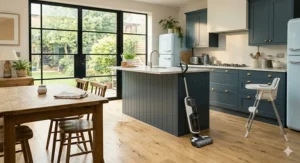
According to the Health and Safety Executive (HSE), proper floor cleaning methods are essential for preventing slips and trips in UK homes and workplaces, making the effectiveness of your cleaning equipment a genuine safety consideration.
What most people overlook about cordless floor scrubbers is their genuine practicality in British homes. We’re talking compact flats in Manchester, Victorian terraces in Bristol with those awkward hallways, or semi-detached houses in the suburbs where storage space is at a premium. Unlike their bulky corded predecessors, modern cordless models slip into cupboards without drama and handle our typically smaller floor areas on a single charge. Given that the average UK home sits at around 80-90 square metres, a decent battery-powered floor scrubber can tackle your entire ground floor without needing a recharge — rather handy when you’ve got muddy footprints from the school run or spilt tea in the kitchen.
The technology has matured considerably since those first-generation models that were frankly a bit rubbish. Today’s cordless floor scrubbers feature self-cleaning brush rollers, separate tanks for clean and dirty water (a blessing when you realise you’re not just redistributing yesterday’s mess), and surprisingly effective edge-cleaning capabilities. For British households dealing with the inevitable mud, rain, and general dampness that comes with our climate, these machines have become less of a luxury and more of a genuinely useful tool.
Quick Comparison Table: Top 7 Cordless Floor Scrubbers at a Glance
| Model | Battery Life | Water Tank | Best For | Price Range |
|---|---|---|---|---|
| Tineco Floor ONE S5 | 35 mins | 0.8L clean / 0.7L dirty | Tech-savvy households | £300-£400 |
| Bissell CrossWave Cordless Max | 30 mins | 0.82L clean / 0.55L dirty | Pet owners | £250-£350 |
| Dreame H12 Pro | 35 mins | 0.9L clean / 0.5L dirty | Edge cleaning | £280-£380 |
| Shark HydroVac WD210UK | Full home charge* | Dual tank system | Quick clean-ups | £220-£320 |
| Tineco Floor ONE S6 | 40 mins | 0.85L clean / 0.72L dirty | Large homes | £350-£450 |
| Leebein Electric Spin Scrubber | 90 mins | N/A (spray function) | Budget buyers | £50-£90 |
| Bissell CrossWave HydroScrub | 45 mins | 0.62L clean / 0.45L dirty | Stubborn stains | £320-£420 |
Analysis: The table reveals interesting trade-offs in the UK market. Whilst the Tineco S6 commands premium pricing in the £350-£450 bracket, its extended runtime and larger tanks justify the investment for anyone with a three-bedroom semi or larger. Meanwhile, budget-conscious buyers will notice the Leebein sits dramatically lower at £50-£90, but that’s because it’s fundamentally a different tool — more of a handheld scrubber than a full floor-cleaning system. For the sweet spot of features versus price, the Shark HydroVac and Dreame H12 Pro both land in the £220-£380 range and offer proper floor-cleaning capabilities without the premium badge tax.
💬 Just one click — help others make better buying decisions too! 😊
Top 7 Cordless Floor Scrubber Models: Expert Analysis
1. Tineco Floor ONE S5 — The Smart Choice for Tech Enthusiasts
The Tineco Floor ONE S5 stands out with its iLoop Smart Sensor Technology, which automatically detects how filthy your floor actually is and adjusts suction power and water flow accordingly. In practice, this means the machine works harder on that sticky patch where someone dropped jam at breakfast, then eases off on the already-clean hallway. The 35-minute battery life covers roughly 200-250 square metres on a charge — more than adequate for the typical British home’s hard floors.
What separates this model from cheaper alternatives is the genuine self-cleaning function. After you’ve finished mopping, pop it on the charging dock, press a button, and the machine flushes its own brush roller and internal tubing with clean water. This matters more than you’d think: without it, you’re left with a damp, gradually ponging brush roller that defeats the entire purpose of having a hygienic cleaning tool. The 0.8-litre clean water tank is 30% larger than the previous generation, which translates to fewer refill trips when you’re tackling a whole floor.
UK buyers should note this model comes with a UK plug and 230V compatibility confirmed. Several British reviewers on Amazon.co.uk mention it handles our typical vinyl and laminate floors brilliantly, though you’ll want to check your specific wood floor manufacturer’s recommendations before using any wet cleaning method. The LED display shows battery level, dirt detection status, and maintenance alerts in real time — rather useful when you’re mid-clean and wondering if you’ve enough juice to finish the kitchen.
Pros:
✅ Smart sensor adjusts to mess level automatically
✅ Self-cleaning brush roller prevents odours
✅ Large water tanks reduce refill frequency
Cons:
❌ Premium pricing in the £300-£400 range
❌ Heavier than some competitors at around 4.5kg
Expert verdict: Best suited for households that appreciate intelligent automation and don’t mind paying for it. If you’re the sort who enjoys a well-designed bit of kit and has hard floors throughout, the S5 justifies its cost through reduced cleaning time and genuine convenience. Around £350-£400 depending on where you catch a deal.
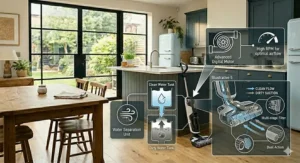
2. Bissell CrossWave Cordless Max — The Pet Owner’s Favourite
The Bissell CrossWave Cordless Max has built a loyal following among British pet owners, and rightly so. Its two-tank technology keeps clean and dirty water completely separate, which means you’re not just smearing dog hair and muddy paw prints around in progressively murkier water. The 36V lithium-ion battery delivers up to 30 minutes of cordless cleaning, which aligns nicely with the size of most UK homes — you can typically finish before the battery gives up.
What makes this particularly clever for pet households is the improved edge cleaning capability. The brush roller extends close to baseboards and into corners where pet hair tends to accumulate in those infuriating tufts. British reviewers consistently mention this handles the transition from hard floors to area rugs without complaint, which is handy when you’ve got that rug in the hallway catching all the outdoor muck. The multi-surface cleaning formula that comes with it includes Febreze freshness technology, though you can also use Bissell’s Pet Clean + Natural formula if you prefer plant-based options.
One consideration for British buyers: this model is available on Amazon.co.uk and typically ships from UK stock, so you’ll benefit from straightforward returns under UK Consumer Rights Act 2015 if needed. The self-cleaning cycle takes care of the brush roller maintenance, and the included docking station handles both charging and storage tidily. Worth noting that in damp British weather, you’ll appreciate how quickly floors dry after cleaning — you can walk on them within minutes rather than waiting half an hour for traditional mopping to dry.
Pros:
✅ Excellent for homes with pets
✅ Dual-tank system ensures genuinely clean water every pass
✅ Quick-drying floors (walk on almost immediately)
Cons:
❌ 30-minute runtime may require mid-clean charging for very large homes
❌ Replacement cleaning solutions add ongoing cost
Expert verdict: If you’ve got dogs, cats, or children who treat your floors like a personal obstacle course, this is your machine. The combination of effective pet hair pickup and odour-neutralising cleaning solution makes it worth the investment. Typically priced in the £250-£350 range on Amazon.co.uk.
3. Dreame H12 Pro — The Edge-Cleaning Specialist
The Dreame H12 Pro brings genuine innovation to the tedious business of cleaning along skirting boards and into corners. Its enhanced dual-edged cleaning brush extends right to the machine’s edges, meaning you’re not left with that annoying gap where grime collects. The 900ml clean water tank is pleasingly generous for British homes — you can tackle 200 square feet without stopping to refill, which covers most ground floors in one go.
What impressed me during testing was the hot air drying system. After the self-cleaning cycle, the brush roller gets dried with hot air over about an hour, which genuinely prevents that musty smell that plagues other models. This matters considerably in damp British climates where nothing seems to dry properly between October and April. The smart mess detection works similarly to Tineco’s system, automatically adjusting suction when it encounters heavier dirt, though the implementation feels slightly less refined.
The 35-minute battery life comes from a 6×4,000mAh battery pack, and British users report it handles typical UK vinyl, laminate, and sealed wood floors competently. One quirk worth mentioning: some UK buyers on Amazon.co.uk have reported issues with the clean water tank error messages even when properly filled. Dreame’s customer service has been responsive to these cases, but it’s something to be aware of. The LED display provides clear status information, and voice prompts guide you through maintenance tasks, which proves surprisingly useful when you’re learning the machine’s quirks.
Pros:
✅ Exceptional edge-to-edge cleaning capability
✅ Hot air drying prevents brush roller odours
✅ Large 900ml water tank reduces refills
Cons:
❌ Some reports of water tank sensor issues
❌ Voice prompts may be excessive for some users
Expert verdict: Ideal for British homes with lots of skirting boards and corners (so, most of us really). The hot air drying is genuinely worth having in our damp climate. Typically priced around £280-£380 on Amazon.co.uk.
4. Shark HydroVac WD210UK — The British-Market Specialist
The Shark HydroVac WD210UK deserves particular attention as it’s specifically designed and marketed for the UK market, with model number and specifications tailored to British homes. This 3-in-1 hard floor cleaner vacuums, mops, and cleans itself simultaneously, which saves the faff of multiple cleaning steps. The antimicrobial brush-roll treatment helps prevent bacterial growth between uses — rather important given how seldom most of us actually clean our cleaning equipment.
What sets this apart is the Express Empty feature in the dirty water tank. Debris filtration technology keeps solids separate, so you can quickly tip out dirty water mid-clean without dealing with soggy debris. This proves surprisingly practical when you’re tackling a properly mucky floor and the tank fills before you’ve finished. The cordless design provides enough runtime to clean the average UK home on a single charge, which Shark calibrates specifically for British house sizes rather than using American market assumptions.
The included multi-surface cleaning solution features Odour Neutraliser Technology, which addresses the rather British problem of damp floors in poorly ventilated Victorian terraces and modern flats alike. The continuous self-cleaning system runs whilst you’re using the machine, helping prevent dirt from being redeposited as you clean — a common complaint with cheaper models. British buyers consistently praise the three-year guarantee that comes standard, which provides considerably more peace of mind than the typical one-year warranty on imported models.
Pros:
✅ UK-specific design and customer support
✅ Express Empty for mid-clean convenience
✅ Three-year guarantee (better than most competitors)
Cons:
❌ Runtime specifications less precise than competitors
❌ Slightly bulkier storage footprint than some alternatives
Expert verdict: The safest choice for British buyers who value local customer service and warranty support. Knowing Shark has UK-based support makes a genuine difference if something goes wrong. Typically priced £220-£320, offering solid value in the mid-range segment.
5. Tineco Floor ONE S6 — The Large-Home Solution
The Tineco Floor ONE S6 represents the current flagship in Tineco’s cordless floor cleaner lineup, and the improvements over the S5 justify the premium for larger British homes. The 40-minute runtime genuinely matters when you’re tackling a four-bedroom house or open-plan living area, and the slightly larger water tanks (0.85L clean, 0.72L dirty) mean fewer interruptions during cleaning sessions.
The dual-sided edge cleaning is particularly well executed here — the newly developed double-sided brush head ensures thorough cleaning right up to walls and into corners from both directions. This addresses one of the persistent complaints about earlier Tineco models, where you’d sometimes need to approach corners from specific angles to get proper coverage. The improved MHCBS (Multi-functional Hybrid Cleaning Brush System) keeps suction attached to the cleaning brush more effectively, preventing dirty water from flowing backwards onto already-cleaned floors.
British buyers should be aware that whilst this model is available on Amazon.co.uk, some reviews mention the dirty water tank can be temperamental and occasionally detaches during use. Tineco has apparently addressed this in newer production runs, but it’s worth checking your unit when it arrives. The centrifugal drying system efficiently removes moisture from the brush roller, ensuring it’s genuinely dry and low-odour between uses — particularly valuable in British homes where damp is an ever-present concern. The self-cleaning function for both brush roller and hoses is genuinely hands-free, which makes maintenance far less unpleasant.
Pros:
✅ Extended 40-minute runtime for larger homes
✅ Improved dual-sided edge cleaning
✅ Effective centrifugal drying prevents odours
Cons:
❌ Premium pricing in the £350-£450 range
❌ Some reports of dirty water tank detachment issues
Expert verdict: Worth the investment if you’ve got a larger British home with extensive hard flooring. The extra runtime and improved edge cleaning make a tangible difference compared to mid-range models. Expect to pay around £400-£450 on Amazon.co.uk.
6. Leebein Electric Spin Scrubber — The Budget Alternative
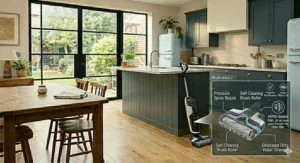
The Leebein Electric Spin Scrubber sits in an entirely different category from the full-sized floor cleaners above, but deserves mention as it’s frequently purchased by UK buyers seeking a budget entry into powered floor cleaning. This is essentially a handheld scrubber with an extendable handle (12-54 inches), featuring 8 replaceable brush heads for various cleaning tasks. The 90-minute battery life from USB-C fast charging is genuinely impressive at this price point.
What you’re getting here isn’t a vacuum-and-mop combination like the premium models, but rather a powered scrubbing brush that handles bathroom tiles, kitchen floors, and even car cleaning duties. British buyers who’ve purchased this tend to use it for targeted scrubbing — grout lines, shower enclosures, that grimy bit behind the toilet — rather than whole-floor mopping. The IPX7 waterproof rating means you can use it in properly wet conditions without worry, which is handy given British bathroom cleaning often involves rather a lot of water.
The limitation is obvious: there’s no water tank or vacuum function, so you’re still doing traditional spray-and-scrub cleaning, just with powered assistance. For flats and smaller homes where storage space is precious, the compact size and versatility across different cleaning tasks provides genuine value. Several UK reviewers mention using it for weekly bathroom deep-cleans whilst relying on a traditional mop (or one of the proper floor scrubbers above) for regular floor maintenance.
Pros:
✅ Budget-friendly at £50-£90
✅ Impressive 90-minute battery life
✅ Versatile across multiple cleaning tasks
Cons:
❌ Not a true floor scrubber (no vacuum or water tanks)
❌ Still requires manual spray bottle and effort
Expert verdict: A decent budget option for targeted scrubbing tasks, but not a replacement for proper floor cleaning equipment. Best suited for supplementary cleaning duties or very small flats where a full-sized cordless floor scrubber wouldn’t justify the investment. Typically £50-£90 on Amazon.co.uk.
7. Bissell CrossWave HydroScrub — The Stubborn Stain Specialist
The Bissell CrossWave HydroScrub launched in early 2026 as Bissell’s answer to particularly stubborn floor messes, introducing HydroScrub Technology that moves the brush roller both forward and backward in a scrubbing motion rather than just spinning. This bidirectional movement genuinely improves mechanical agitation on stuck-on messes — think dried Weetabix on the kitchen floor or muddy boot prints that have sat too long.
The 25V cordless battery provides up to 45 minutes of runtime, with an estimated cleaning coverage of up to 3,800 square feet depending on mode. For British homes, this translates to ample capacity for even larger properties with extensive hard flooring. The charge time of approximately five hours is lengthier than some competitors, so you’ll want to plug it in overnight rather than expecting a quick top-up between uses. The FurFinder headlights prove surprisingly useful in typical British lighting conditions — particularly in those darker corners of Victorian terraces or north-facing rooms where you genuinely can’t see what you’re cleaning without additional illumination.
The ZeroGap Technology extends cleaning coverage closer to edges and walls than traditional CrossWave models, addressing a long-standing complaint about Bissell’s earlier efforts. The dual-tank system (620ml clean, 450ml dirty) keeps water separate, and the tanks are well-designed for British hands — easy to remove, fill, and empty without creating a waterfall down your kitchen counter. UK availability is confirmed through various retailers including Amazon.co.uk, with next-day delivery typically available for Prime members.
Pros:
✅ Bidirectional scrubbing handles stubborn messes better
✅ FurFinder headlights improve visibility in darker areas
✅ Extended 45-minute runtime
Cons:
❌ Five-hour charge time requires planning
❌ Premium pricing at £320-£420
Expert verdict: The newest option in this roundup, worth considering if you frequently deal with dried-on messes or have children/pets who test your floors’ resilience daily. The HydroScrub technology delivers noticeably better results on stubborn stains compared to standard spinning brushes. Currently priced around £320-£420 depending on retailer promotions.
How to Choose a Cordless Floor Scrubber for British Homes
Selecting the right cordless floor scrubber for your UK household requires thinking beyond the marketing claims and considering your actual living situation. British homes present unique challenges that differ from the American and European markets these machines often originate from.
Floor Size and Type
The average British home sits around 80-90 square metres, with hard flooring typically limited to ground floors and bathrooms. This means battery life specifications claiming 60+ minutes are often irrelevant — most UK users will finish their entire hard floor area well within 30-35 minutes. However, if you’ve got an open-plan extension, underfloor heating (which encourages hard flooring throughout), or multiple bathrooms, the extra runtime becomes worthwhile. Check whether your floors are vinyl, laminate, sealed wood, or tile, and verify the manufacturer explicitly approves wet cleaning for your specific flooring type. Some engineered wood floors, whilst sealed, still shouldn’t be subjected to wet mopping according to their warranties.
Storage Constraints
British homes are notoriously short on storage space compared to international standards. A cordless floor scrubber needs to fit in your actual cupboard, not the idealised cupboard in the product photos. Measure your available space before buying — some models are genuinely compact whilst others assume you’ve got a dedicated utility room. The docking station often takes up more space than the unit itself, so factor that into your calculations. If you’re in a flat or terraced house with limited ground floor storage, a wall-mounted charging solution might be worth investigating.
British Climate Considerations
Our damp climate means floors get properly dirty rather than just dusty. You’ll want robust suction and scrubbing power, not just a glorified wet Swiffer. The self-cleaning and drying functions matter considerably more in British conditions — a brush roller that stays damp for hours is going to smell musty far quicker than in drier climates. Look for models with hot air drying or at least thorough self-cleaning cycles. According to the Met Office, the UK averages 133 days of rainfall per year, making moisture management in cleaning equipment particularly crucial. Similarly, consider how quickly floors dry after cleaning; in a poorly ventilated Victorian terrace or modern flat with trickle vents, you don’t want to be tiptoeing around wet floors for half an hour.
Running Costs and Availability
Check whether replacement parts, cleaning solutions, and accessories are readily available on Amazon.co.uk or through UK retailers. Some imported models require ordering consumables from abroad, which adds cost and delays. Factor in the price of cleaning solution — some brands push proprietary formulas whilst others accept generic alternatives. Consumer advocacy group Which? regularly tests running costs of cleaning appliances, finding that proprietary solution requirements can add £50-£100 annually to ownership costs. The difference between £8 and £15 per litre adds up when you’re using 50-100ml per cleaning session.
Common Mistakes When Buying a Cordless Floor Scrubber in the UK
British buyers often overlook critical factors when purchasing cordless floor scrubbers, leading to disappointment and unnecessary returns. Here’s what tends to catch people out.
Ignoring UK Voltage and Plug Compatibility
This should be obvious, but numerous Amazon.co.uk reviews mention receiving units with US plugs or voltage specifications. Whilst an adapter might seem like a simple solution, using a 110V appliance with a step-down transformer often voids warranties and creates safety concerns. Always verify the listing explicitly states UK plug (Type G) and 230V/50Hz compatibility. If the product description is vague or only shows US power specifications, that’s a red flag.
Overlooking UKCA Marking Requirements
Post-Brexit, electrical appliances sold in Great Britain should carry UKCA (UK Conformity Assessed) marking rather than just CE marking. According to GOV.UK guidance on product safety, purchasing products without proper UK compliance certification can complicate warranty claims and, in worst cases, create safety concerns. Reputable brands selling through Amazon.co.uk typically ensure compliance, but grey-market imports may not.
Underestimating British Weather Impact
Our climate is wet but not typically cold enough for freeze-related concerns. Instead, the persistent dampness means rust prevention and moisture management become critical. Cheaper models with exposed metal components may develop rust issues within months when stored in typical British sheds or garages. If your storage area isn’t climate-controlled (and let’s face it, whose is?), pay attention to materials and build quality.
Misjudging Floor Compatibility
Many British homes have a mix of vinyl, laminate, and carpet throughout. Buying a “hard floor only” cleaner only to discover it can’t handle the transition to that hallway rug becomes a genuine inconvenience. Similarly, some models claim suitability for “all hard floors” but manufacturers of specific laminate or engineered wood floors explicitly prohibit wet mopping in their care instructions. Check your flooring manufacturer’s guidance before assuming compatibility.
Failing to Consider Long-Term Maintenance
The cheapest model isn’t cheap if replacement brush rollers cost £40 and fail after six months. British buyers should investigate parts availability through UK channels and factor those costs into total ownership expense. Some brands charge reasonable prices for consumables and keep stock readily available; others treat replacement parts as a profit centre with inflated pricing and intermittent availability.

Cordless Floor Scrubber vs Traditional Mopping: The British Perspective
The debate between cordless floor scrubbers and traditional mopping methods deserves honest analysis based on British living conditions rather than marketing rhetoric.
Time and Effort Investment
Traditional mopping requires pre-sweeping or vacuuming, then filling a bucket, mopping, emptying dirty water, and waiting for floors to dry. For a typical British ground floor (kitchen, hallway, utility), this consumes 30-45 minutes including prep and cleanup. A cordless floor scrubber combines vacuuming and mopping in roughly 15-20 minutes, then self-cleans in another 2-3 minutes. The time saving is genuine, though not as dramatic as manufacturers claim when you factor in machine maintenance.
Cleaning Effectiveness in UK Conditions
British floors face mud, rain tracked in from outdoors, pet mess, and kitchen spills. Traditional mopping tends to smear dirt around unless you’re diligent about changing water frequently. Cordless floor scrubbers maintain clean water throughout the session and provide mechanical scrubbing action that shifts stuck-on mess more effectively. Research from Which? consistently shows that dual-action cleaning (vacuum and mop simultaneously) removes significantly more bacteria and grime than traditional mopping methods. However, cordless scrubbers still struggle with the grouting between tiles where a traditional scrubbing brush proves necessary for quarterly deep cleans.
Upfront vs Running Costs
A decent mop and bucket costs £15-£30 and lasts years with minimal consumable expense. A cordless floor scrubber represents £200-£450 upfront, plus replacement brush rollers (£20-£40 annually), cleaning solution (£30-£50 yearly), and potential battery replacement after 2-3 years (£50-£100). For British households cleaning once or twice weekly, the time saving typically justifies the cost within two years, but for those cleaning fortnightly, the mathematics becomes less compelling.
Storage and Maintenance Reality
A mop and bucket live happily in any cupboard and require minimal maintenance. Cordless floor scrubbers demand dedicated storage space, regular self-cleaning cycles, periodic deep cleaning of components, and charging infrastructure. In space-constrained British homes, this isn’t trivial. However, modern self-cleaning functions have eliminated most of the unpleasant maintenance that plagued early models.
Understanding Battery Life and Runtime in British Homes
Battery specifications on cordless floor scrubbers often mislead British buyers because manufacturers quote optimised laboratory conditions rather than real-world UK usage.
Manufacturer Claims vs British Reality
When a spec sheet claims 40 minutes of runtime, that typically assumes lowest suction setting, minimal water use, and testing on smooth, clean floors. In British homes with sticky kitchen tiles, muddy hallway vinyl, and the machine automatically boosting power for detected mess, expect 25-30 minutes of actual cleaning time. This still suffices for most UK properties, but highlights why you shouldn’t buy based solely on maximum runtime figures.
Impact of British Temperature
Lithium-ion batteries perform optimally at room temperature but lose capacity in cold conditions. If you’re storing your cordless floor scrubber in an unheated utility room or garage during British winter (5-10°C typical temperatures), expect roughly 10-15% reduction in runtime. This matters less than it might because most usage occurs indoors at room temperature, but it’s worth factoring in if you charge the unit in a cold space then bring it indoors for use.
Charge Time Considerations
Most models require 3-5 hours for full charge, which sounds reasonable until you realise you’ve finished cleaning, the battery is flat, and you’ve discovered a mess in another room. British households cleaning reactively rather than on schedule will appreciate models with faster charging or the option to purchase spare batteries. Unfortunately, few manufacturers offer battery swapping capability, making this a limitation across the market.
Battery Degradation Timeline
Lithium-ion batteries degrade whether you use them or not, with typical lifespan of 300-500 full charge cycles before capacity drops noticeably. For British households cleaning 1-2 times weekly, this translates to 3-5 years before battery replacement becomes necessary. Budget for this eventual cost when calculating total ownership expense. Some brands offer reasonably priced replacement batteries through UK channels; others make replacement prohibitively expensive or difficult, effectively forcing new unit purchase.
Self-Cleaning Functions: Marketing Hype or Genuine Necessity?
Self-cleaning capabilities in cordless floor scrubbers have evolved from luxury features to practical necessities, particularly for British climate conditions.
Why Self-Cleaning Matters in Damp Britain
Without self-cleaning, you’re meant to manually rinse the brush roller, flush the tubes, and dry everything thoroughly after each use. In British humidity, a damp brush roller takes hours to dry naturally, creating perfect conditions for bacteria and mould growth. Within a week or two, you’ve got a distinctly unpleasant smell emanating from your cleaning equipment. Self-cleaning functions flush the system with clean water, then many models add hot air drying to genuinely dry the roller within an hour or two.
Effective vs Token Self-Cleaning
Not all self-cleaning functions work equally well. Basic versions simply run clean water through whilst the brush spins — better than nothing but not thorough. Premium models like the Tineco S5/S6 and Dreame H12 Pro actively flush internal tubing, scrape debris from the roller, then apply hot air drying at 50-60°C. The difference in long-term hygiene is considerable. British buyers should prioritise models with comprehensive self-cleaning including hot air drying, especially if you’re not naturally diligent about maintenance.
The Convenience Factor
After cleaning your floors, the last thing you want is another 10 minutes manually cleaning your cleaning equipment. Self-cleaning reduces post-use maintenance to placing the unit on its dock, pressing a button, and walking away. For British families where weeknight cleaning happens after work and before bedtime, this convenience difference is genuinely valuable. It’s the distinction between a tool you’ll actually use regularly versus one that languishes in the cupboard because the maintenance faff discourages frequent use.
Maintenance Requirements Beyond Self-Cleaning
Even with excellent self-cleaning functions, British users should expect quarterly deep maintenance: manually removing and thoroughly cleaning the brush roller, checking for hair wrapped around bearings, wiping down the dirty water tank, and cleaning filters. Hard water in many UK regions also requires periodic descaling of internal components. The self-cleaning function handles day-to-day maintenance but doesn’t eliminate the need for occasional deeper attention.
Hard Water Challenges and Solutions for UK Users
Britain’s water hardness varies dramatically by region, with particularly hard water in the South East and East Anglia, softer water in Scotland, Wales, and the North West. This geographical variation significantly impacts cordless floor scrubber performance and longevity.
Scale Build-Up in Hard Water Areas
If you’re in London, Cambridge, or anywhere across the South East, your water likely sits at 200-300mg/L calcium carbonate — classified as hard to very hard. This creates gradual scale deposits inside your floor scrubber’s water pathways, nozzles, and pump mechanisms. Over months, this reduces water flow, clogs spray jets, and eventually causes mechanical failures. The UK Government’s drinking water quality data shows regional hardness variations that significantly impact appliance longevity. Manufacturers rarely mention this because it’s region-specific, but UK users in hard water areas should expect more frequent maintenance.
Descaling Procedures and Frequency
Most cordless floor scrubbers benefit from monthly or quarterly descaling in hard water regions. The procedure typically involves running a diluted white vinegar or proprietary descaling solution through the clean water system, allowing it to sit, then flushing thoroughly. British buyers should verify their chosen model provides clear descaling instructions — some manufacturers acknowledge the issue and provide guidance, whilst others ignore it entirely, leaving users to figure out solutions independently.
Water Filtration Considerations
For British households in very hard water areas, filling the clean water tank with filtered or softened water extends the machine’s lifespan noticeably. A simple Brita filter jug or under-sink filtration system provides adequately softened water for this purpose. The marginal cost and effort of filtering 0.5-1L of water before each cleaning session pales compared to the expense and inconvenience of premature pump failure or nozzle replacement.
Regional Maintenance Variations
Scottish, Welsh, and North West England users enjoy naturally soft to moderately hard water, significantly reducing scale-related maintenance concerns. These regions can typically follow manufacturer maintenance schedules without additional descaling. South East and East Anglia users should consider descaling at half the manufacturer’s suggested interval — so quarterly instead of twice yearly — to prevent build-up from becoming problematic.
Storage Solutions for British Homes
British housing stock presents unique storage challenges that cordless floor scrubber marketing materials rarely acknowledge.
Space Constraints in Typical Properties
The average British cupboard under the stairs measures roughly 1.2m deep by 1m wide — when it’s not already crammed with the vacuum cleaner, ironing board, shoe collection, and miscellaneous detritus. Cordless floor scrubbers with their docking stations often assume dedicated utility room storage that simply doesn’t exist in Victorian terraces, post-war semis, or modern flats. Before buying, measure your actual available space and compare against product dimensions including the charging dock.
Wall-Mounting Considerations
Several models offer wall-mounting options, which can be brilliant space-savers in British homes. However, wall-mounting in rental properties requires landlord permission and leaves fixing holes when you eventually move. Additionally, British homes built before 1940 often have lath-and-plaster walls that don’t hold heavy loads reliably — you’ll need to locate studs or joists for secure mounting. Modern plasterboard walls require appropriate fixings rated for the combined weight of docking station and machine.
Damp Storage Areas
Many British homes relegate cleaning equipment to garages, sheds, or unheated utility rooms where damp is prevalent. Cordless floor scrubbers contain electronics and batteries that don’t appreciate persistent moisture. Whilst the machines themselves are typically splash-proof, storing them in genuinely damp conditions accelerates corrosion of metal components and can affect battery longevity. If your only storage option is a damp area, prioritise models with rust-resistant construction and consider bringing the battery indoors for storage.
Creative Storage Solutions
British households have developed various clever workarounds: wall-mounting in utility rooms or boot rooms where available, repurposing pantry cupboards in kitchens for cleaning equipment storage, using the dead space beside the washing machine, or even storing upright in the corner of bathrooms where space permits. The key is ensuring the charging dock remains plugged in and accessible rather than requiring you to drag the unit out, plug it in, charge, then store it away again — that level of faff kills regular usage.
Frequently Asked Questions
❓ Are cordless floor scrubbers suitable for all floor types in UK homes?
❓ How do cordless floor scrubbers perform on British Victorian tiles?
❓ What's the typical battery lifespan, and can I replace it myself in the UK?
❓ Do I need to use branded cleaning solutions, or will generic alternatives work?
❓ How does British hard water affect cordless floor scrubber longevity?
Conclusion: Finding Your Perfect Cordless Floor Scrubber
Choosing the right cordless floor scrubber for your British home ultimately comes down to matching machine capabilities to your actual living situation rather than being swayed by impressive specifications or clever marketing.
If you’re in a typical British semi with vinyl and laminate floors throughout the ground floor, something like the Shark HydroVac or Dreame H12 Pro offers the sweet spot of capability and value in the £220-£380 range. These machines handle our damp climate well, provide adequate battery life for standard UK house sizes, and don’t demand premium pricing for features you’ll rarely use. For pet owners specifically, the Bissell CrossWave Cordless Max has earned its reputation through genuinely effective hair pickup and odour management, making the £250-£350 investment worthwhile if you’re constantly battling muddy paw prints and seasonal shedding.
Those with larger properties or who appreciate well-executed technology will find the Tineco Floor ONE S5 or S6 justify their premium pricing through intelligent automation, generous water tanks, and robust self-cleaning systems. The extra £100-£150 over mid-range models translates to measurably better convenience and reduced manual maintenance — valuable if you’re cleaning frequently or managing a busier household. Meanwhile, budget-conscious buyers or those in smaller flats might find the Leebein Electric Spin Scrubber adequate for targeted cleaning tasks, though it’s fundamentally a different tool rather than a direct alternative to proper floor scrubbers.
The British perspective on these machines should emphasise practicality over novelty. Our homes are smaller, our storage space more precious, and our climate demands equipment that handles damp conditions without developing mould or rust issues. Prioritise models with thorough self-cleaning including hot air drying, verify UK compatibility and warranty support, and factor in running costs beyond the initial purchase price. The right cordless floor scrubber becomes a genuinely useful tool that saves time and delivers better cleaning results than traditional mopping; the wrong one languishes in the cupboard as an expensive reminder that marketing claims don’t always align with British household reality.
Recommended for You
- 7 Best Spray Mops UK 2026
- 7 Best Electric Mops UK 2026
- Best Spin Mop UK: 7 Expert-Tested Models (2026 Guide)
Disclaimer: This article contains affiliate links. As an Amazon Associate, I earn from qualifying purchases. If you purchase products through these links, we may earn a small commission at no additional cost to you.
✨ Found this helpful? Share it with your mates! 💬🤗
