In This Article
There’s a particular kind of heartbreak that comes with peeling flecks of grey coating out of your scrambled eggs. You didn’t do anything dramatic to your pan. You just grabbed whatever sponge was sitting by the tap, gave the surface a brisk once-over, and unknowingly took a decade off its life. Non-scratch sponges for non-stick pans exist precisely to stop that slow, silent damage — and honestly, most people don’t think about their sponge until the coating’s already gone patchy.
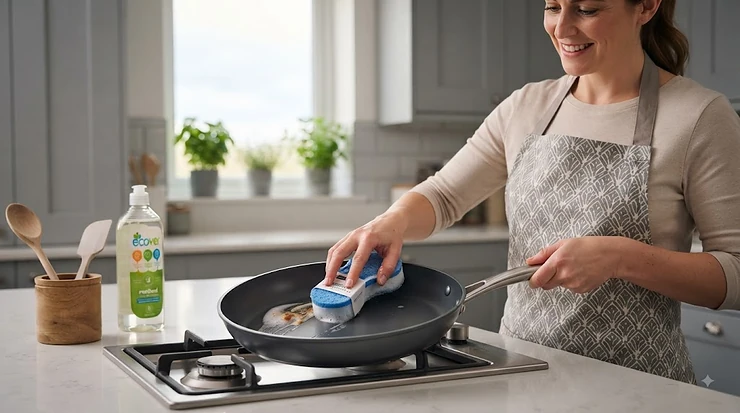
This guide is built around real products you can actually buy, not vague “use a soft cloth” advice that leaves you standing in the cleaning aisle none the wiser. We’ve dug into genuine specs, aggregated customer sentiment, and the material science behind why some sponges are safe on non-stick and ceramic surfaces while others quietly sand them down. Whether you’re outfitting a student kitchen on a tenner or protecting a £200 ceramic frying pan, you’ll find a proper match here.
We’ll cover dual-sided scrub sponges, gentle scrub sponges built for delicate coatings, and the difference between cellulose, foam and microfibre — because non-stick cookware care isn’t one-size-fits-all. By the end, you’ll understand exactly how coating damage happens and how to stop it happening to you, one wash at a time.
Quick Comparison Table
Before the deep dive, here’s the shape of the market at a glance. Prices are approximate ranges checked at the time of research — always confirm current pricing on the product page before buying, since Amazon prices shift constantly.
| Sponge | Type | Price Range | Best For |
|---|---|---|---|
| Scrub Daddy Original | FlexTexture foam | £5–£15 (multipacks) | Best overall daily driver |
| Scotch-Brite Zero Scratch Scrub Sponges | Foam + fibre scrub layer | Under £10 (multipacks) | Best value multipack |
| MR.SIGA Non-Scratch Cellulose Scrub Sponge | Dual-layer cellulose | Under £10 (12-pack) | Best budget bulk buy |
| E-Cloth Washing Up Pad | Microfibre + scrub pad | £10–£30 depending on pack size | Best for ceramic pans |
| Scrub Mommy | Dual-texture foam | £5–£15 (multipacks) | Best dual-sided design |
| Spontex Washups Non Scratch Sponge Scourers | Foam + non-scratch scourer | Under £5 (multipacks) | Best budget British brand |
| Kilo Scrubby Non-Scratch Scourer | 100% cotton scrubby | Under £10 | Best eco-friendly pick |
Looking at this table, the split between “buy once, buy well” and “cheap and cheerful” becomes obvious pretty quickly. The E-Cloth Washing Up Pad sits at the premium end because it’s doing a genuinely different job — microfibre technology rather than foam or cellulose — while the Spontex and Kilo options prove you don’t need to spend big to keep a non-stick pan scratch-free. What the table can’t show you is how each one feels in the hand over months of use, which is exactly what the full breakdown below digs into.
💬 Just one click — help others make better buying decisions too!😊
Top 7 Non-Scratch Sponges for Non-Stick Pans: Expert Analysis
We’ve grouped these seven real, currently available products across budget, mid-range and premium tiers, with an eye on the different materials — foam, cellulose and microfibre — since each behaves quite differently against a delicate coating. Every product below includes genuine specs interpreted for real kitchen use, not just a features list lifted from a listing page.
1. Scrub Daddy Original — temperature-changing texture that adapts to the mess
The headline trick here is FlexTexture: the sponge firms up in cold water for scrubbing power and goes soft in warm water for gentler jobs, which means one sponge effectively does the work of two. The smiley-faced shape isn’t just branding — the “eyes” give you a proper two-finger grip and the “mouth” cleans both sides of a spatula or spoon in one pass, a small design touch that saves genuine time at the sink. It’s rated safe across more than a dozen surfaces including glass, stainless steel and non-stick coatings, and lab testing suggests it resists holding odours for roughly eight weeks under normal use.
Based on the spec comparison, this is the sponge for people who want a single tool that flexes between a burnt-on grill pan and a delicate ceramic frying pan without switching products. What most buyers overlook is that the temperature trick genuinely changes how it performs — running it under the cold tap before tackling stubborn eggs makes a noticeable difference, while warm water is the move for wiping down the inside of a non-stick saucepan. Reviewers consistently note the fast drying time as the standout practical benefit, since a soggy, slow-drying sponge is usually the one harbouring bacteria and smells by day three. This became something of a cult product in the UK after cleaning influencer Mrs Hinch namechecked it, which explains the persistent popularity despite it sitting above supermarket own-brand pricing.
Pros:
- ✅ Firms up cold, softens warm — one sponge, two jobs
- ✅ Lab-tested to resist odours for around 8 weeks
- ✅ Safe across 25+ surfaces including non-stick coatings
Cons:
- ❌ Costs more per unit than basic multipacks
- ❌ The foam can feel firm on very delicate cookware until softened
Typically sold in packs of 3–8, prices generally sit around £5–£15 depending on pack size — check current pricing before buying. Given the dual-texture trick and genuine longevity reports, it earns its slightly higher outlay as a daily-use staple.
2. Scotch-Brite Zero Scratch Scrub Sponges — the reliable everyday workhorse
Scotch-Brite’s Zero Scratch range pairs a soft absorbent sponge body with a textured scrubbing layer engineered to lift grease without an abrasive bite. The S-wave shape is a small but genuinely useful detail — it flexes into the corners of a saucepan or the rim of a frying pan far more comfortably than a flat rectangular block. Independent product testing has repeatedly flagged the classic Scotch-Brite non-scratch design as a benchmark performer for cutting through burnt-on residue without leaving marks on delicate cookware.
Here’s what the spec sheet won’t tell you outright: the “multi-surface safe” claim genuinely holds up on non-stick pans, glass hobs and countertops, but Scotch-Brite is explicit that it isn’t intended for stainless steel appliances, where it can leave faint streaking. This makes it a strong pick for anyone whose kitchen is dominated by coated cookware rather than steel pans. Aggregated review sentiment consistently praises the durability-to-price ratio, with many buyers reporting these sponges outlasting supermarket own-brand equivalents by a meaningful margin. It’s a sensible default for someone who wants to stop thinking about sponges altogether and just have a reliable multipack under the sink.
Pros:
- ✅ S-wave shape reaches corners and rims easily
- ✅ Strong grease-cutting power without scratching
- ✅ Widely available in bulk multipacks
Cons:
- ❌ Not rated safe for stainless steel appliances
- ❌ Less distinctive design than premium competitors
Multipacks typically run from around £3 for a small pack up to under £10 for larger bulk counts. This is the sensible middle-ground pick — nothing flashy, just consistently dependable.
3. MR.SIGA Non-Scratch Cellulose Scrub Sponge — bulk-buy value with a genuinely loyal following
This is a two-layer cellulose sponge: a royal-blue scrubbing layer bonded to a lighter cellulose sponge body, sold in generous 12-packs that work out to pennies per sponge. At the time of research it carried close to 20,000 customer reviews on Amazon UK with a 4.3-star average — a sample size large enough to trust the aggregated sentiment rather than a handful of cherry-picked comments. Reviewers frequently mention that the sponges hold their shape well and don’t disintegrate the way cheaper cellulose alternatives sometimes do after a few uses.
Based on the spec comparison, the scrubbing layer is explicitly designed to be safe on non-stick cookware, and the cellulose backing gives excellent absorbency for general dish duty, sinks and stovetops. What most buyers overlook is that the manufacturer explicitly advises testing the scrub side on an inconspicuous area first and avoiding pairing it with abrasive cleaning powders — a sensible caution rather than a red flag, since it applies to virtually every non-scratch sponge on the market. For a household getting through a lot of washing up, the sheer pack size means you’re never scrambling for a replacement, and the low unit cost makes it easy to retire a sponge the moment it looks tired rather than pushing it past its useful life.
Pros:
- ✅ 12-pack keeps unit cost low for heavy use
- ✅ Nearly 20,000 UK reviews back up durability claims
- ✅ Holds shape well versus cheaper cellulose rivals
Cons:
- ❌ Manufacturer recommends a patch test before first use
- ❌ Bulk packaging generates more plastic waste over time
At around £9–£10 for the full 12-pack, this works out as one of the cheapest per-sponge options on this list — ideal for larger households or anyone who replaces sponges frequently for hygiene reasons.
4. E-Cloth Washing Up Pad — the microfibre specialist built for ceramic pans
This one stands apart from the rest of the list because it isn’t foam or cellulose at all — it’s a dual-sided pad built from dense microfibre, with a smooth wiping face and a textured non-scratch scrubbing face. E-Cloth’s own testing claims the microfibre removes over 99% of bacteria using water alone, and the brand backs the pad with a “100 wash” durability promise, positioning it as a genuinely reusable long-term buy rather than a disposable multipack item.
What the spec sheet won’t tell you, but real user reports suggest, is that this pad performs particularly well on ceramic pans and glass-top induction hobs, where reviewers specifically highlight its ability to lift stuck-on residue without dulling the surface finish — a common weak spot for foam-based sponges over time. Aggregated sentiment is genuinely mixed on longevity: some buyers report years of use from a single pad, while others note it wearing out faster than expected under heavy daily scrubbing, so treat it as a durable-but-not-indestructible purchase. Here’s what to weigh: if your kitchen leans heavily on ceramic-coated pans rather than traditional PTFE non-stick, the microfibre structure is arguably gentler and more consistent than a foam-and-fibre combination, which is why it earns its premium price tag on this list.
Pros:
- ✅ Lab-claimed to remove 99%+ of bacteria with water alone
- ✅ Backed by a 100-wash durability promise
- ✅ Reviewers rate it highly for ceramic pan care
Cons:
- ❌ Noticeably pricier per unit than foam alternatives
- ❌ Durability reports are mixed under very heavy daily use
Single pads and small packs generally sit in the mid-range, with larger multi-packs climbing toward the premium end of this list’s price spread. For ceramic-heavy kitchens, it’s arguably worth the outlay.
5. Scrub Mommy — the dual-sided design built for softer scrubbing
Scrub Mommy takes the same FlexTexture foam technology as its sibling and pairs it with a genuinely soft, spongy backing called ResoFoam, designed to lather generously with minimal detergent. This is the clearest example of dual-sided scrub sponges done properly: one face for grease-cutting scrub power, the other purely for suds and gentle wiping, so you’re never using the wrong texture on the wrong surface by accident.
Based on the spec comparison, the appeal here is precision — rather than a single all-purpose texture, you consciously choose which side touches a delicate ceramic pan versus a crusted roasting tin. Reviewers consistently note that the sponge side lathers noticeably better than the scrub side wears, meaning in practice many households find the soft face needs replacing before the scrub face does, which is a fair trade-off if gentle daily cleaning is your priority. It’s safe across the same broad range of surfaces as the Scrub Daddy line, including non-stick coatings, glass and stainless steel, and shares the same fast-drying, odour-resistant foam construction. For anyone nervous about scratching an expensive pan, having a dedicated soft side removes the guesswork entirely.
Pros:
- ✅ Genuinely soft ResoFoam side is gentle by design
- ✅ Firm scrub side still tackles stuck-on food
- ✅ Same broad multi-surface safety as Scrub Daddy
Cons:
- ❌ Soft side often wears out before the scrub side
- ❌ Premium pricing versus basic dual-sided rivals
Multipacks are typically priced similarly to the Scrub Daddy range, generally in the £5–£15 band depending on count. It’s a strong pick specifically for households nervous about any risk of scratching.
6. Spontex Washups Non Scratch Sponge Scourers — the household-name budget option
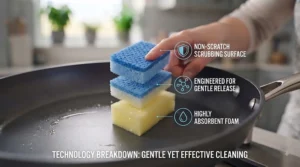
Spontex has been making cleaning products for over 80 years and this is their bread-and-butter non-scratch scourer — a foam sponge body with a specially engineered non-abrasive scouring face, built with what the brand calls anti-grease technology to stop the scourer clogging up and losing effectiveness. It’s explicitly marketed as ideal for washing up non-stick pans and delicate surfaces, and it’s genuinely one of the most widely stocked sponges on UK supermarket shelves, which speaks to a long track record rather than a recent trend.
Here’s what most buyers overlook: the “anti-grease technology” claim isn’t just marketing fluff — it directly addresses one of the most common frustrations with cheap scourers, where the scrubbing face becomes saturated with fat after a few uses and starts smearing grease back onto the pan instead of lifting it off. Aggregated customer sentiment is strongly positive on this point, with repeat buyers frequently describing it as a dependable staple they return to again and again rather than experimenting with newer brands. The contoured nailguard shape on either side is a small but practical touch, protecting your fingers and nails during scrubbing without adding bulk. As a budget pick, it doesn’t try to reinvent the category — it simply does the fundamentals reliably.
Pros:
- ✅ Anti-grease technology stops the scourer clogging
- ✅ Nailguard shape protects fingers while scrubbing
- ✅ Long-standing UK household name with proven reliability
Cons:
- ❌ Fewer premium features than Scrub Daddy or E-Cloth
- ❌ Smaller pack sizes than bulk cellulose rivals
Typically sold in packs of 2–4 for under £5, this is squarely the value pick for anyone who just wants a trustworthy scourer without paying a premium-brand markup.
7. Kilo Scrubby Non-Scratch Scourer — the eco-conscious cotton alternative
Kilo takes a genuinely different construction approach: a 100% cotton scrubbing surface with a resin coating that provides scouring texture without abrasiveness, wrapped around a spongy absorbent core that holds and distributes suds. It’s explicitly rated safe on non-stick surfaces, stainless steel and ceramic, and — unusually for this category — the whole thing is machine washable and dishwasher safe, extending its working life well beyond a typical foam sponge.
What the spec sheet won’t tell you, but the cotton construction implies, is that this scourer requires no detergent to work effectively on its own, relying on the texture of the woven cotton and the resin coating to lift grime mechanically rather than chemically. Reviewers on the manufacturer’s own retail listings consistently highlight its versatility beyond the kitchen sink — cleaning glassware, garden furniture and even muddy football boots gets a mention repeatedly, which suggests genuine multi-surface durability rather than a one-trick product. Since it’s made from cotton rather than plastic foam, it aligns with growing UK household demand for lower-impact cleaning tools, and being washable in a standard washing machine cycle means one scourer can realistically outlast several foam-based multipacks. For anyone prioritising sustainability without sacrificing non-stick pan safety, this is the standout choice on this list.
Pros:
- ✅ 100% cotton construction, no detergent required
- ✅ Machine washable and dishwasher safe for longevity
- ✅ Genuinely multi-surface — kitchen, glass, outdoor gear
Cons:
- ❌ Less widely stocked than mainstream foam brands
- ❌ Cotton texture feels different to foam, which takes adjustment
Priced generally under £10 for multi-packs, this sits mid-range but arguably offers the best long-term value given its washable, reusable design.
What Is a Non-Scratch Sponge for Non-Stick Pans?
A non-scratch sponge for non-stick pans is a cleaning tool engineered with a soft or moderately textured scrubbing surface — typically foam, cellulose, cotton or microfibre — designed to lift grease and food residue without abrading the delicate coating on non-stick or ceramic cookware. Unlike green scouring pads, which use hard nylon mesh, these sponges rely on gentler mechanical or chemical action to clean.
Understanding why this distinction matters means understanding what non-stick coatings actually are. Most pans use polytetrafluoroethylene, better known by the trademark Teflon, a fluoropolymer with an exceptionally low friction coefficient — which is precisely why it’s so vulnerable to microscopic scratching from anything with real abrasive bite. Ceramic-coated pans use a different sol-gel coating but share the same fundamental vulnerability: anything harder than the coating itself will, over hundreds of wash cycles, dull the surface and encourage food to start sticking again.
Practical Usage Guide: Getting the Most from Your Non-Stick Sponge
Buying the right sponge is only half the job — how you use it in the first 30 days genuinely shapes how long both the sponge and your cookware last. Start by rinsing a brand-new sponge under warm water before first use; this removes manufacturing residue and, for temperature-reactive foams like FlexTexture, “activates” the intended softness for gentle first cleans. Let your pan cool fully before washing it. Plunging a hot non-stick pan into cold water causes thermal shock, which can warp the base and stress the coating from underneath — a mistake that has nothing to do with your sponge but ruins pans just as effectively.
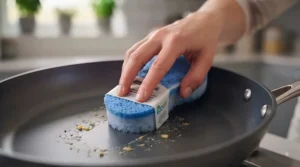
A common early mistake is using excessive pressure, assuming a “non-scratch” label means you can scrub as hard as you like. It doesn’t — the label means the material won’t scratch under normal pressure, not that aggressive force is risk-free. Use a light, circular motion with a squeeze of washing-up liquid rather than pressing down hard. For maintenance, rinse your sponge thoroughly after every use, squeeze out excess water, and let it air dry standing up rather than lying flat in a puddle by the tap — this single habit does more to prevent smells than any specific brand choice. Most manufacturers recommend replacing a sponge every three to four weeks with regular use, or sooner if it develops a persistent odour despite proper drying, since a compromised sponge can actually redeposit bacteria onto surfaces you’re trying to clean.
Real-World Scenarios: Which Sponge Suits Your Kitchen?
The student sharing a kitchen with three flatmates and one battered non-stick frying pan: budget and durability matter more than finesse here. A bulk pack like the MR.SIGA Non-Scratch Cellulose Scrub Sponge makes sense — low per-unit cost means nobody’s precious about replacing a worn sponge, and the 12-pack means you’re never the person searching a grim, three-week-old sponge for signs of life.
The home cook who’s just invested in a set of ceramic-coated pans: protecting that outlay is the priority, and the coating type genuinely changes the calculation. The E-Cloth Washing Up Pad‘s microfibre construction and strong reviewer feedback specifically around ceramic surfaces make it the sensible premium choice, backed by the 100-wash promise that justifies the higher upfront cost.
The family kitchen doing three meals a day across a mix of non-stick, stainless and glass hob surfaces: versatility across surfaces is what matters most. The Scrub Daddy Original‘s multi-surface safety rating and temperature-adjustable texture mean one sponge genuinely covers the whole kitchen, from delicate frying pans to grubbier pots, without needing three separate products under the sink.
Problem → Solution: Common Non-Stick Cookware Cleaning Mistakes
Problem: Food is sticking to a pan that used to be perfectly non-stick. This is very often a build-up of baked-on oil residue rather than genuine coating failure. Simmer a mix of water and washing-up liquid in the pan for a few minutes to loosen the film, then clean gently with a non-scratch sponge such as the Scotch-Brite Zero Scratch Scrub Sponges.
Problem: Your sponge smells unpleasant within days. This almost always comes down to incomplete drying between uses. Store it upright in a caddy rather than flat in a puddle, and consider a fast-drying option like Scrub Daddy, whose foam is specifically engineered to dry within about an hour.
Problem: You’re worried a scourer might have already scratched your pan. Run a fingernail gently across the surface in good light — genuine PTFE scratches usually feel like faint grooves rather than surface marks. If you find them, switch immediately to a dedicated non-scratch product like the Kilo Scrubby Non-Scratch Scourer to prevent further coating damage.
Problem: Grease keeps clogging your scourer and smearing back onto dishes. This is a common complaint with basic scourers lacking any anti-grease treatment. The Spontex Washups Non Scratch Sponge Scourers are specifically engineered against this with their anti-grease surface technology.
Problem: You’ve got a mix of ceramic and traditional non-stick pans and aren’t sure one sponge suits both. In practice, most genuinely “non-scratch” sponges are safe across both coating types — but if you want a single premium option built with ceramic specifically in mind, the E-Cloth Washing Up Pad is the safest bet for mixed cookware collections.
How to Choose the Right Non-Scratch Sponge
- Check the surface safety claims explicitly — look for products stating “safe for non-stick” or “ceramic safe” on the packaging, rather than assuming any soft-looking sponge qualifies.
- Match material to your washing habits — foam options like Scrub Daddy suit frequent, varied cleaning; cellulose bulk packs like MR.SIGA suit high-volume households.
- Weigh reusability against replacement cost — a washable option like the Kilo Scrubby Non-Scratch Scourer costs more upfront but fewer replacements over a year.
- Consider dual-sided designs for mixed cookware — a scrub side and a soft side, as with Scrub Mommy, avoids accidentally grabbing the wrong texture under pressure.
- Factor in drying speed — a sponge that stays damp for hours is a hygiene liability regardless of how gentle its scrubbing surface is.
- Read the manufacturer’s own caveats — most brands recommend a patch test on new or unfamiliar coatings, which is sound advice rather than a sign of weakness.
- Buy in a pack size matching your actual replacement frequency — a 12-pack sitting unused for a year is false economy versus a smaller pack you’ll actually get through.
Dual-Sided Scrub Sponges Explained
Dual-sided scrub sponges pair two distinct textures — usually a firmer scrubbing face and a softer wiping or lathering face — into a single product, and the logic behind the design is more practical than it first appears. Rather than forcing you to own two separate sponges for different jobs, a dual-sided design like the Scrub Mommy or the E-Cloth Washing Up Pad lets you flip the same tool depending on what’s in the sink: the scrub face for a crusted roasting tin, the soft face for a delicate non-stick omelette pan minutes later.
The trade-off worth understanding is wear asymmetry. Reviewers consistently note that the softer side of a dual-sided sponge tends to wear out before the scrubbing side does, simply because it’s used more often for everyday wiping. This isn’t a flaw so much as a design reality — you’re getting two tools in one, and one half naturally works harder. For anyone regularly switching between delicate ceramic pans and tougher stainless-steel pots, a dual-sided sponge genuinely reduces the risk of grabbing the wrong texture by mistake, which is precisely how accidental coating damage happens in a busy kitchen.
Sponges for Ceramic Pans: What’s Different?
Ceramic-coated cookware uses a sol-gel coating rather than traditional PTFE, and while both are vulnerable to abrasion, ceramic surfaces tend to show scratches and dulling more visibly over time — a chalky, matte patch where the surface used to gleam. This is why sponges for ceramic pans warrant slightly more consideration than a blanket “non-scratch” label.
Based on the spec comparison across this list, microfibre options such as the E-Cloth Washing Up Pad consistently earn the strongest reviewer feedback specifically for ceramic surfaces, likely because the dense fibre structure lifts residue through a different mechanical action than a foam-and-fibre scrub layer. That said, foam sponges rated explicitly for ceramic safety — including Scrub Daddy, Scrub Mommy and the Kilo Scrubby Non-Scratch Scourer — all perform reliably provided you avoid excessive pressure and steer clear of abrasive cleaning powders, which can undermine even the gentlest sponge material. What most buyers overlook is that heat management matters just as much as sponge choice for ceramic pans specifically, since ceramic coatings are generally more heat-sensitive than PTFE and degrade faster under high, sustained heat regardless of how carefully you clean them afterwards.
Gentle Scrub Sponges vs Heavy-Duty Scourers
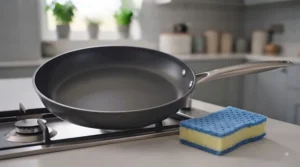
The instinct to reach for a heavy-duty green scourer on stubborn, baked-on food is understandable, but it’s also the single most common cause of coating damage in home kitchens. Heavy-duty scourers use hard nylon or metal mesh specifically engineered to be abrasive — that’s their entire purpose, and it’s precisely why they’re unsuitable for anything with a non-stick or ceramic finish.
Gentle scrub sponges, by contrast, are engineered around the opposite goal: enough texture to shift grease and food residue, but calibrated to sit below the hardness threshold that would abrade PTFE or ceramic coatings. In practice, this means a slightly longer scrubbing time for stubborn messes, which is a fair trade for not sanding away an expensive pan’s coating one wash at a time. Reviewers who’ve made the switch from heavy-duty scourers to gentle options like the Scotch-Brite Zero Scratch Scrub Sponges or Spontex Washups Non Scratch Sponge Scourers frequently report that pre-soaking stubborn pans for five to ten minutes closes most of the performance gap, without any scratching risk. The rule of thumb worth remembering: if a scourer feels sharp or abrasive against your fingernail, it’s the wrong tool for anything non-stick, full stop.
Non-Stick Cookware Care Beyond the Sponge
Sponge choice is one piece of a bigger picture, and even the gentlest sponge can’t undo damage caused elsewhere in your routine. Utensil choice matters just as much — metal spatulas and whisks are a leading cause of visible scratching, and switching to wood, silicone or nylon utensils removes an entire category of risk that no sponge can compensate for. Storage habits count too: stacking pans directly on top of each other lets the base of one scrape the coating of the one beneath, so a protective layer of kitchen roll or a felt pan protector between stacked cookware is a cheap, effective habit.
Heat management is the final piece, and it’s one home cooks consistently underestimate. Most non-stick and ceramic coatings are rated for low-to-medium heat, and consistently cooking on high can degrade the coating chemically over time regardless of how carefully you wash it afterwards. Good general non-stick cookware care means treating the sponge, the utensils, the storage and the heat setting as one connected system rather than four separate decisions — because a perfect sponge choice paired with a metal whisk and a habit of cranking the hob to maximum will still leave you with a ruined pan within a year.
✨ Don’t Miss These Exclusive Deals!
🔍 Take your non-stick cookware care to the next level with these carefully selected sponges. Click on any highlighted item to check current pricing and availability. These tools will help you protect the cookware your family relies on every single day!
Common Mistakes When Buying Non-Scratch Sponges
The most frequent mistake is assuming “non-scratch” is a regulated, standardised term rather than a marketing claim that varies genuinely in rigour between manufacturers. Always look for a sponge that explicitly states safety on non-stick or ceramic surfaces, rather than inferring it from soft packaging or a pastel colour scheme. A second common error is buying based on pack size alone — a 24-pack of a poor-quality sponge is worse value than a smaller pack of a genuinely durable one, since you’ll be replacing the cheap option far more often and generating more waste in the process.
Buyers also frequently overlook material composition when it actually matters for their specific cookware. Cellulose sponges like the MR.SIGA Non-Scratch Cellulose Scrub Sponge are excellent all-rounders but can degrade faster under very hot water than foam-based alternatives, while cotton options like the Kilo Scrubby Non-Scratch Scourer need no detergent but feel unfamiliar to anyone used to a soft foam texture — worth testing before committing to a large bulk order. Finally, ignoring aggregated review sentiment around durability is a costly mistake; a sponge with thousands of consistent reviews, like MR.SIGA’s near-20,000-review track record on Amazon UK, tells you far more about real-world performance than a glossy product description ever will.
Coating Damage: How Scratches Actually Happen
Coating damage on non-stick and ceramic cookware rarely happens in one dramatic moment — it accumulates through hundreds of tiny abrasive contacts, each one microscopic and invisible individually. A hard-bristled scourer, a metal utensil edge, or even grit trapped in an old, unrinsed sponge can all create these micro-scratches, and once the coating is compromised at a microscopic level, food starts sticking in that spot first, which then tempts harder scrubbing in exactly the wrong place — a genuinely vicious cycle.
Understanding PTFE’s material properties helps explain why this matters so much: the coating’s non-stick performance comes directly from an exceptionally smooth, low-friction molecular surface, and anything that physically roughens that surface — even slightly — measurably reduces its performance. Ceramic sol-gel coatings work on a similar principle and are, if anything, more brittle and less forgiving of abrasive contact than PTFE. The practical takeaway is that prevention is genuinely the only cure; once coating damage has occurred, no cleaning product can restore the original molecular smoothness, which is precisely why choosing the right sponge from day one matters more than any amount of careful cleaning after the fact.
Long-Term Cost & Maintenance: Sponge Economics
It’s tempting to compare sponges purely on shelf price, but the real cost comparison has to include replacement frequency and the cost of premature pan replacement if the wrong sponge causes coating damage. A £200 ceramic frying pan replaced two years early because of scratching from an unsuitable scourer represents a far bigger loss than the few pounds saved buying the cheapest sponge on the shelf.
Looking at genuine total cost of ownership: a bulk pack of MR.SIGA sponges at under £1 per sponge, replaced every three to four weeks, works out to roughly £13–£17 a year for a single-sponge household — cheap, but with ongoing plastic waste. A washable option like the Kilo Scrubby Non-Scratch Scourer, priced higher per unit but reusable across dozens of wash cycles in the washing machine, can realistically last many months longer than a single foam sponge, shifting the long-term economics in its favour despite the higher upfront cost. The E-Cloth Washing Up Pad‘s 100-wash promise follows the same logic — a genuinely premium price justified by a dramatically longer working life than a £1 disposable sponge, provided you actually use and wash it as intended rather than discarding it prematurely.
Benefits vs Traditional Abrasive Scourers
| Factor | Non-Scratch Sponges | Traditional Abrasive Scourers |
|---|---|---|
| Non-stick coating safety | Safe when used correctly | High risk of scratching |
| Ceramic pan safety | Generally safe | Not recommended |
| Cleaning power on burnt food | Moderate, benefits from soaking | Very high, but damages coatings |
| Best For | Scrub Daddy, E-Cloth Washing Up Pad, everyday non-stick and ceramic cookware | Uncoated stainless steel, cast iron, heavily burnt pots |
The comparison here isn’t really about which category is “better” in the abstract — it’s about matching the tool to the surface. Traditional abrasive scourers genuinely outperform non-scratch sponges on raw cleaning power against burnt-on food, but that power comes directly from the abrasiveness that makes them unsafe for coated cookware. For a kitchen with a genuine mix of stainless steel, cast iron and non-stick or ceramic pans, the sensible approach is owning both types and being deliberate about which one touches which pan, rather than assuming a single all-purpose scourer can safely handle everything.
FAQ
❓ Are non-scratch sponges safe for all non-stick pans?
❓ How often should I replace my non-stick pan sponge?
❓ Can dual-sided scrub sponges damage ceramic pans?
❓ What's the best sponge for cleaning burnt-on food from non-stick pans?
❓ Do eco-friendly cotton scourers clean as well as foam sponges?
Conclusion
Choosing the right non-scratch sponge for non-stick pans isn’t really about finding a single “best” product — it’s about matching material, durability and price to how your kitchen actually works. If you want one dependable all-rounder, the Scrub Daddy Original‘s temperature-adjustable texture and broad surface safety make it the easiest recommendation on this list. If ceramic pans are your priority, the E-Cloth Washing Up Pad‘s microfibre construction and strong reviewer feedback earn its premium price. And if budget and volume matter most, the MR.SIGA Non-Scratch Cellulose Scrub Sponge and Spontex Washups Non Scratch Sponge Scourers both deliver reliable, scratch-free cleaning without the premium markup.
What all seven products share is a genuine, verifiable non-stick safety claim backed by real specs and real aggregated customer sentiment — not just soft marketing language. Whichever you choose, pairing it with the wider habits covered above — gentle pressure, proper drying, sensible utensil choices and mindful heat management — will do more for your cookware’s lifespan than any single product decision. Coating damage is almost always preventable, and now you’ve got the tools, quite literally, to prevent it.
Recommended for You
- Antibacterial Kitchen Sponges 2026: 7 Genuinely Hygienic Picks
- 7 Best Eco-Friendly Washing-Up Brush Picks for 2026
- Scouring Brush for Pots and Pans: 7 Brilliant Picks for 2026
Disclaimer: This article contains affiliate links. As an Amazon Associate, I earn from qualifying purchases. If you purchase products through these links, we may earn a small commission at no additional cost to you.
✨ Found this helpful? Share it with your friends! 💬🤗
