In This Article
Somewhere in your kitchen right now, there’s probably a sponge doing something quietly horrifying. Every time you scrub a pan with a standard supermarket sponge, you’re rubbing polyurethane foam against metal, and tiny plastic fragments are sloughing off into your sink, your food, and eventually the water system. It’s not dramatic. It’s not even something most of us think about. But it’s happening, wash after wash, in millions of British kitchens every single day.
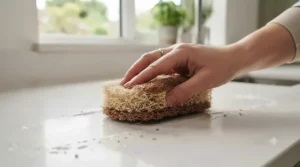
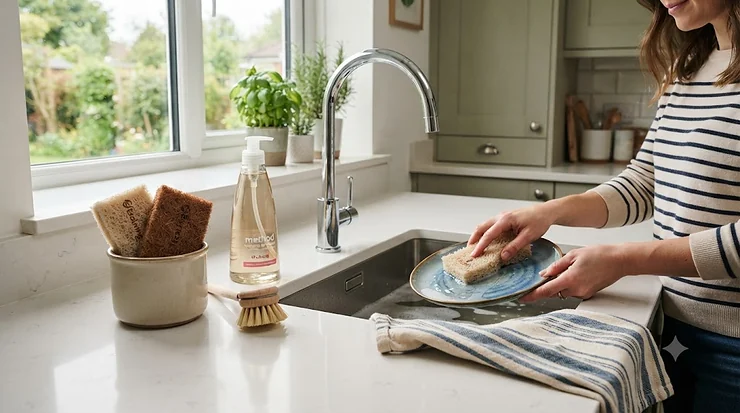
Compostable kitchen sponges are the quiet fix for that problem. Made from plant cellulose, loofah, coconut coir, or cotton rather than petroleum-based foam, they do the same job — scrubbing plates, wiping counters, tackling burnt-on porridge — and then, when they’re finally worn out, they rot down into something useful instead of sitting in landfill for four centuries. If you’ve searched for compostable kitchen sponges expecting a simple swap, that’s essentially what this is, though as you’ll see below, not every “eco” sponge on the market is created equal.
This guide walks through seven genuinely compostable options available through amazon.co.uk, ranging from loofah-based scourers to cellulose cloths, with honest analysis of what each one is actually good at — plus the buying mistakes to dodge, how these sponges perform against your compost bin, and how to fold them into a properly zero-waste kitchen setup. According to WRAP’s guidance, composting at home for a year can save global warming gases equivalent to all the CO2 your kettle produces annually — and swapping your sponge is one of the smaller, easier steps toward that. You can find more detail on what qualifies for the bin over at Recycle Now’s home composting guide.
What Is a Compostable Kitchen Sponge?
A compostable kitchen sponge is a dish-cleaning sponge made from natural, plant-derived materials — typically cellulose (wood pulp), loofah (dried gourd fibre), coconut coir, or cotton — that fully breaks down in a home or industrial compost bin, unlike standard foam sponges, which are made from plastic and never truly decompose.
Quick Comparison Table
Before diving into the full breakdown, here’s a snapshot of how these seven products stack up against each other on material, best use, and price bracket.
| Product | Material | Best For | Price Range |
|---|---|---|---|
| Seep Eco Sponges | Loofah + cellulose | Everyday budget scrubbing | Under £6 |
| bioGo Biodegradable Kitchen Sponges | Natural cellulose | All-round dish washing | £14-£17 (12-pack) |
| Composty Loofah Sponges | Loofah + cellulose | Non-scratch pan cleaning | £6-£9 |
| AIRNEX Eco Washing-Up Sponges | Cellulose + coconut fibre | Tough, baked-on grease | £8-£11 |
| ECOLOCO Eco Kitchen Sponge Scourer | Coconut fibre + cellulose | Small-brand, cause-led buyers | £5-£8 |
| EcoLiving Compostable Sponge Cloths | Cellulose + cotton | Replacing kitchen roll | £5-£7 |
| bioGo Compostable Pop-Up Sponges | Plant-based cellulose | Bulk-buying households | £15-£19 (30-pack) |
Looking at the spread, the pattern that jumps out is material, not price: cellulose-only sponges (like bioGo Biodegradable Kitchen Sponges) tend to be softer and gentler on non-stick pans, while loofah and coconut-blend options (Seep Eco Sponges, AIRNEX Eco Washing-Up Sponges) bring more bite for scrubbing burnt-on food. Per-sponge cost also swings wildly depending on pack size — a 30-pack works out cheaper per unit than a 4-pack, even though the upfront price looks steeper. If you’re testing the waters, start with a small multipack; if you’re committing to the switch long-term, the bulk options pay for themselves within a few months.
💬 Just one click — help others make better buying decisions too!😊
Top 7 Compostable Kitchen Sponges: Expert Analysis
Right, let’s get into the sponges themselves. I’ve picked a spread here — budget loofahs, mid-range cellulose multipacks, and one genuinely different format (a compostable cloth) — because “best” depends entirely on what’s currently living under your sink and what it’s failing to do.
1. Seep Eco Sponges — best budget loofah for everyday scrubbing
The standout here is simplicity: a natural loofah pad bonded to a cellulose sponge back, sold in a small four-pack that won’t commit you to a cupboard full of stock before you’ve even tried the format. Loofah is naturally fibrous and slightly abrasive, which means it handles everyday grease and food residue without you needing a separate scourer for most jobs, while the cellulose backing soaks up water and suds the way a normal sponge would. Seep is a UK-based sustainability brand, and this product is sold and fulfilled through Amazon, which at least means straightforward delivery and returns if the pack arrives damaged.
Based on the spec sheet, this is the sponge for someone who wants to trial compostable washing-up without overhauling their entire routine — it’s cheap enough to fail fast if it’s not for you, and light enough on packaging that trying it barely dents your zero-waste kitchen ambitions. Reviewers consistently report that the loofah side softens slightly with repeated soaking but keeps its scrubbing texture for several weeks of regular use, and a recurring theme in feedback is that the sponge holds up notably better than expected for the price point, though a handful of buyers note it dries stiffer than a plastic sponge between uses.
Pros:
- ✅ Genuinely low-commitment way to trial loofah sponges
- ✅ UK-based brand with Amazon-fulfilled delivery
- ✅ Naturally abrasive texture needs no separate scourer
Cons:
- ❌ Smaller four-pack means more frequent reordering
- ❌ Dries stiffer than foam between washing sessions
At around under £6 for the pack, this sits at the accessible end of the market, and it’s a sound value pick if you’re dipping a toe in rather than diving straight into a bulk order.
2. bioGo Biodegradable Kitchen Sponges — best all-rounder cellulose sponge
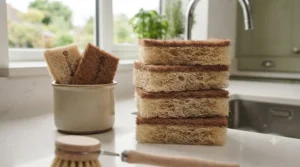
bioGo Biodegradable Kitchen Sponges lead with sheer popularity — a twelve-pack of natural cellulose sponges from a UK-and-US brand that’s carved out a genuine following among people switching away from plastic sponges. The standout feature is consistency: every sponge in the pack is the same soft-but-absorbent cellulose, so you’re not gambling on which one you pull out of the drawer. Made from wood pulp cellulose, this material is naturally soft enough for non-stick pans and enamel, while still holding enough structure to hold suds and scrub without falling apart mid-wash, which is where cheaper compostable sponges sometimes struggle.
What most buyers overlook about pure-cellulose sponges is that they need slightly different care than loofah or coconut blends — they benefit from being wrung out and left somewhere airy rather than left balled-up and wet in the sink, or they can start to smell faster than a synthetic sponge would. Reviewers consistently report strong absorbency and note that the sponges hold their shape well across weeks of daily use, with the pack’s 4.6-star aggregate rating across roughly 750 reviews standing out as unusually strong for this category — one of the more genuinely well-reviewed compostable sponges currently listed.
Pros:
- ✅ Consistently high review volume and rating
- ✅ Gentle cellulose texture, safe on non-stick cookware
- ✅ Twelve-pack lasts most households several months
Cons:
- ❌ Needs airing to avoid odour build-up faster than foam
- ❌ Less abrasive than loofah on baked-on grease
Priced around £14-£17 for the twelve-pack — working out to roughly £1.30 per sponge — this lands as a genuinely strong value pick for anyone who wants one dependable sponge type covering most of the kitchen’s daily washing-up.
3. Composty Loofah Sponges — award-winning non-scratch scourer
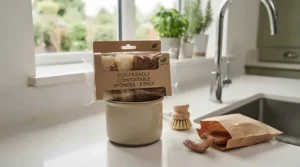
The standout with Composty Loofah Sponges is the packaging as much as the sponge itself — this UK family business has built a compostable pouch around the sponges too, so the whole product, wrapping included, can go in the compost bin rather than just the sponge inside it. The loofah-and-cellulose construction gives a textured, slightly firmer feel than a plain cellulose sponge, and the brand markets it specifically as non-scratch, meaning it’s designed to be safe on ceramic hobs and non-stick surfaces despite that scrubbing texture.
Here’s what the spec sheet won’t tell you outright: “non-scratch” natural sponges vary a fair bit brand to brand depending on how tightly the loofah fibres are woven, and Composty Loofah Sponges sit on the gentler end, which suits people nervous about damaging expensive pans more than people wanting maximum grease-cutting power. Reviewers consistently note that this sponge holds up well against typical daily washing-up and that the compostable packaging is a genuinely appreciated touch rather than a marketing afterthought — a small but real point of differentiation in a fairly crowded market.
Pros:
- ✅ Fully compostable packaging, not just the sponge
- ✅ Non-scratch texture suits non-stick and ceramic surfaces
- ✅ Backed by an independent UK family business
Cons:
- ❌ Gentler scrub than tougher coconut-fibre alternatives
- ❌ Six-pack costs more per sponge than bigger multipacks
At around £6-£9 for six sponges, it’s a mid-range choice best suited to households prioritising a fully plastic-free supply chain over squeezing the last penny of value from each pack.
4. AIRNEX Eco Washing-Up Sponges — best dual-sided scrubber for pans
The clever bit of engineering here is the dual-sided S-shaped design: one half is soft wood cellulose for general washing, the other is a firmer coconut-fibre scrubber for the stuck-on stuff, so you’re effectively getting two sponge types fused into one unit across a twelve-pack. That structure means you don’t need to keep a separate green scourer pad next to your sponge, which is a small but genuinely useful space-and-clutter saving under the sink. AIRNEX also partners with a reforestation scheme, so each pack nudges toward a tree being planted, on top of the recyclable packaging.
Based on the spec comparison against single-material sponges, this dual-sided build is the strongest pick if pots and roasting trays are your main washing-up headache rather than delicate glassware — the coconut side has real bite. When it’s finally spent, the instructions are refreshingly specific: separate the two halves and compost the white cellulose portion while disposing of the coconut-fibre scrubber portion separately, since fibre-bonded scrubbers don’t always break down at the same rate as pure cellulose. Reviewers consistently flag the scrubbing side as noticeably tougher than typical eco-sponges, with a smaller number of buyers noting they’d like clearer end-of-life sorting instructions printed on the packaging itself rather than only online.
Pros:
- ✅ Dual-sided design replaces sponge and scourer in one
- ✅ Reforestation partnership tied to every pack sold
- ✅ Genuinely tough coconut-fibre side for burnt-on food
Cons:
- ❌ The two halves need separating before composting
- ❌ Firmer scrubber side isn’t ideal for delicate glass
Sitting around £8-£11 for twelve, this is a smart pick for anyone whose washing-up load leans more toward roasting tins than wine glasses.
5. ECOLOCO Eco Kitchen Sponge Scourer — best UK small-brand pick
ECOLOCO Eco Kitchen Sponge Scourer is the smallest operation on this list — a UK brand founded by two sisters, both working mums, built specifically around replacing everyday plastic sponges with earth-friendly alternatives. The standout feature is the size and density: at roughly 12 x 7 x 2cm, these are noticeably chunkier than some rivals, combining a coconut-fibre scourer layer with a plant cellulose sponge base, and the brand donates a share of profits to a tree-planting charity.
What most buyers overlook about small-batch eco brands like this one is that durability claims are usually backed by genuine repeat-customer behaviour rather than lab testing — and here, the honest analysis is that a slightly thicker sponge simply lasts longer under normal wear, which is borne out in the aggregated feedback. Reviewers consistently describe the sponge as “hard-wearing,” reporting that it holds its shape over several weeks of regular kitchen and bathroom use without disintegrating the way some thinner cellulose alternatives can. It’s worth noting this is a newer brand with a smaller review pool than bioGo or Seep, so the sample size backing those reports is modest — worth weighing if you lean on high review volume as a trust signal.
Pros:
- ✅ Noticeably thicker, denser build than average
- ✅ Small UK brand donating profits to reforestation
- ✅ Doubles up for bathroom as well as kitchen use
Cons:
- ❌ Smaller review pool than bigger competing brands
- ❌ Four-pack needs replenishing sooner than bulkier options
At around £5-£8 for a four-pack, it’s competitively priced for the density on offer, and a solid pick for shoppers who like backing an independent, cause-led business over a bigger name.
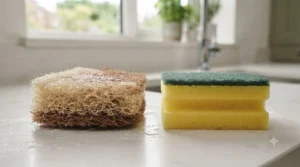
6. EcoLiving Compostable Sponge Cloths — best paper-towel replacement
This one breaks format slightly — rather than a chunky sponge, EcoLiving Compostable Sponge Cloths are flat, absorbent cloths made from a cellulose-and-cotton blend, closer in spirit to a reusable Swedish dishcloth than a traditional scrubbing sponge. The standout feature is versatility: because they’re thin and flexible, they wipe down counters, mop up spills, and dry dishes in a way a chunky sponge block simply can’t, and each cloth is designed to be rinsed, machine-washed at 30-60°C, and reused dozens of times before composting.
Here’s the honest trade-off: these cloths aren’t built for heavy scrubbing the way a loofah or coconut-fibre sponge is, so they work best alongside one of the scourer-style products above rather than replacing it entirely. What most buyers overlook is the wider impact on household waste beyond the sink — a reusable, washable cloth genuinely displaces a meaningful stack of disposable kitchen roll over its working life, which is where a lot of its environmental case actually lies rather than in washing-up alone. Reviewers consistently note the cloths dry quickly and don’t develop the sour smell that damp sponges can, though a few mention the material feels stiffer than paper towel on first use before it’s been through a wash cycle.
Pros:
- ✅ Machine-washable and reusable dozens of times
- ✅ Cuts down on disposable kitchen roll usage
- ✅ Dries fast, resists that damp-sponge smell
Cons:
- ❌ Not designed for heavy pan-scrubbing duty
- ❌ Feels stiff until it’s been through a first wash
At around £5-£7 for a four-pack, this is less a sponge replacement than a smart addition to a wider zero-waste kitchen setup — pair it with a scourer-style pick from higher up this list.
7. bioGo Compostable Pop-Up Sponges — best bulk-buy for large households
The clever trick with bioGo Compostable Pop-Up Sponges is compression: they arrive flat and dense, then expand to full sponge size once wetted, which the brand says allows roughly ten times less packaging per sponge than a standard multipack — a genuinely meaningful reduction in cardboard and plastic film for anyone buying in bulk. Sold in packs of thirty, this is squarely the option for larger households, shared houses, or anyone who’s decided compostable sponges are a permanent fixture rather than a trial.
Based on the spec comparison with the twelve-pack from the same brand, the pop-up format uses the same plant-based cellulose core, so day-to-day performance is broadly similar — soft, absorbent, non-scratch — with the main difference being pack economics and storage footprint rather than scrubbing power. The brand notes the compressed sponges arrive inside a compostable bag to stop them expanding prematurely on the shelf, with the outer box made from recycled cardboard. Reviewers consistently describe the pop-up novelty as satisfying on first use, and the aggregated rating (around 4.6 stars across a smaller but solid review pool) suggests performance holds up once the novelty wears off, with buyers reporting the sponges last at least as long as the standard bioGo range and sometimes noticeably longer when rotated through a wash cycle.
Pros:
- ✅ Roughly ten times less packaging per sponge than standard
- ✅ Thirty-pack means months of supply in one order
- ✅ Same trusted cellulose formula as bioGo’s smaller pack
Cons:
- ❌ Bigger upfront cost, even though per-unit price is lower
- ❌ Requires storage space for a month’s-plus supply
At around £15-£19 for thirty sponges, the per-sponge cost undercuts nearly everything else on this list, making it the clear value pick for households working through sponges quickly.
Top 7 Products: Full Comparison
| Product | Material | Review Sentiment | Price Range | Best For |
|---|---|---|---|---|
| Seep Eco Sponges | Loofah + cellulose | Positive, small sample (verify current) | Under £6 | Budget trial buyers |
| bioGo Biodegradable Kitchen Sponges | Natural cellulose | Very positive (4.6★, ~750 reviews) | £14-£17 | Everyday all-rounder |
| Composty Loofah Sponges | Loofah + cellulose | Positive (verify current) | £6-£9 | Non-scratch cookware |
| AIRNEX Eco Washing-Up Sponges | Cellulose + coconut | Positive (verify current) | £8-£11 | Tough grease and pans |
| ECOLOCO Eco Kitchen Sponge Scourer | Coconut + cellulose | Positive, smaller pool (verify current) | £5-£8 | Independent-brand buyers |
| EcoLiving Compostable Sponge Cloths | Cellulose + cotton | Positive (verify current) | £5-£7 | Replacing kitchen roll |
| bioGo Compostable Pop-Up Sponges | Plant cellulose | Very positive (4.6★, smaller pool) | £15-£19 | Bulk-buying households |
Where verified aggregate ratings are available, they’re shown directly; everywhere else, ratings fluctuate too often to quote reliably in an article, so treat the “verify current” tag as an instruction rather than a shrug — check the listing before you buy. On value, the two bioGo products come out clearly ahead on cost-per-sponge once you account for pack size, while AIRNEX Eco Washing-Up Sponges and ECOLOCO Eco Kitchen Sponge Scourer justify their slightly higher unit price through genuinely tougher scrubbing surfaces. If budget is the deciding factor and you only wash up once a day for one or two people, Seep Eco Sponges or ECOLOCO Eco Kitchen Sponge Scourer will comfortably outlast the gap between orders.
Practical Usage Guide: Getting the Most From Your Compostable Kitchen Sponge
Compostable sponges reward a slightly different routine than plastic ones, and getting this wrong is the single biggest reason people give up on them after a fortnight. First, resist the urge to leave a wet sponge balled up in a puddle by the tap — natural fibres hold moisture and can start smelling within a couple of days if they’re not allowed to dry out properly between uses. A simple raised dish rack or a hook near a window solves this almost entirely.
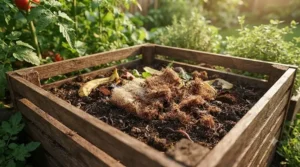
Second, most cellulose and loofah sponges can go through a hot wash cycle or a quick spin in the dishwasher’s cutlery basket, which resets them and roughly doubles their working life compared with using them until they physically fall apart. Third, when the sponge is finally done — usually somewhere between three and six weeks of daily use, depending on the material — tear it into a few smaller pieces before adding it to your compost bin, since smaller fragments break down noticeably faster than a whole intact sponge left to rot in one lump. Coconut-fibre scrubber sections sometimes take longer to break down than pure cellulose, so if your council compost bin has a “no thick fibrous material” rule, check the packaging for specific end-of-life guidance first.
Finally, a common first-30-days mistake is buying a single sponge type and expecting it to do every job — most kitchens genuinely benefit from pairing a softer cellulose sponge (like bioGo Biodegradable Kitchen Sponges) for everyday washing-up with a firmer loofah or coconut option (like AIRNEX Eco Washing-Up Sponges) reserved specifically for pans and roasting trays.
Real-World Scenarios: Who Actually Needs Which Sponge
Picture three fairly typical UK households, because “best sponge” genuinely depends on who’s holding it. A student in a shared flat, washing up once a day for themselves and maybe a housemate, doesn’t need a thirty-pack sitting under the sink — a small, cheap multipack like Seep Eco Sponges covers light, infrequent use without the upfront cost or storage headache of buying in bulk.
A family of four running a kitchen through breakfast, packed lunches, and a proper evening meal daily is a different story entirely — this is where pack size and durability start to matter more than price per unit, and something like bioGo Biodegradable Kitchen Sponges or the bulkier bioGo Compostable Pop-Up Sponges earns its keep through sheer volume of dishes handled per week without needing constant reordering.
Then there’s the household actively trying to build a genuinely zero-waste kitchen — composting food scraps already, buying loose produce, avoiding kitchen roll where possible. For that setup, EcoLiving Compostable Sponge Cloths paired with a scourer like ECOLOCO Eco Kitchen Sponge Scourer covers both wiping and scrubbing while displacing disposable paper products at the same time, which is arguably the bigger environmental win than the sponge switch alone.
Buyer’s Decision Framework
If you’re still weighing options, a simple framework helps more than a spec sheet. If you wash up once a day for one or two people, choose a small multipack like Seep Eco Sponges, because low commitment matters more than bulk value at that usage level. If you’re feeding a family and running the dishwasher daily anyway, choose a larger pack like bioGo Biodegradable Kitchen Sponges or bioGo Compostable Pop-Up Sponges, because per-sponge cost and reorder frequency dominate the decision. If your washing-up is mostly pans, roasting tins, and burnt-on food, choose a coconut or loofah-blend scrubber like AIRNEX Eco Washing-Up Sponges, because raw scrubbing power matters more than gentleness. And if you’re already deep into zero-waste habits and want to displace kitchen roll as well as sponges, choose EcoLiving Compostable Sponge Cloths alongside a scourer, because that combination tackles two waste streams instead of one.
How to Choose Compostable Kitchen Sponges
Picking the right one comes down to a handful of criteria, roughly in order of importance:
- Material match to your washing-up load. Cellulose is gentler and better for non-stick cookware; loofah and coconut fibre bring more abrasive bite for stuck-on food.
- Pack size versus household size. A four-pack suits one or two people; larger households should look at twelve-packs or bulk pop-up formats to avoid constant reordering.
- End-of-life clarity. Check whether the packaging explains exactly how to compost the sponge — mixed-material sponges sometimes need separating before composting.
- Packaging footprint. Some brands, like Composty Loofah Sponges, use compostable outer packaging too, which matters if you’re trying to cut plastic film as well as the sponge itself.
- Verified review volume. A strong star rating backed by hundreds of reviews, as with bioGo Biodegradable Kitchen Sponges, is a more reliable signal than a newer product with a handful of ratings.
- Price per sponge, not price per pack. Divide the pack price by the count before comparing — a £16 twelve-pack often beats a £6 four-pack on a per-use basis.
- Durability claims backed by aggregated feedback. Look for recurring, specific themes in reviews (shape retention, odour resistance) rather than vague five-star praise with no detail.
Common Mistakes When Buying Biodegradable Scourers
The most common slip-up is assuming “biodegradable” and “compostable” mean exactly the same thing on a product label — biodegradable simply means something will eventually break down, which can technically apply to certain plastics too under specific industrial conditions, while compostable implies it breaks down fully into non-toxic material within a reasonable home-composting timeframe. It’s worth checking the specific wording on any biodegradable scourer you’re considering, rather than assuming the word alone guarantees it belongs in your compost bin.
A second mistake is buying a scourer purely on scrubbing power without checking what it’s made of underneath the abrasive layer — some budget biodegradable scourers pair a genuinely natural coconut or loofah surface with a synthetic foam backing to cut costs, which quietly reintroduces plastic into a product marketed as eco-friendly. The spec sheet won’t always flag this clearly, so it’s worth reading the full material breakdown rather than the headline claim. A third common error is over-buying before testing texture preference — loofah, coconut fibre, and cellulose all feel noticeably different in hand, and what works for one household’s pans might feel too harsh or too soft for another’s favourite non-stick set.
Compostable Kitchen Sponges vs Traditional Plastic Sponges
The honest comparison here isn’t close on environmental impact, but it’s worth being fair about performance trade-offs too, since that’s usually the real hesitation holding people back from switching.
| Factor | Compostable Sponges | Traditional Plastic Sponges |
|---|---|---|
| End of life | Breaks down in compost bin within weeks | Persists in landfill for centuries |
| Microplastic shedding | Minimal to none | Sheds plastic fragments during scrubbing |
| Upfront cost | Generally slightly higher per pack | Usually cheaper per pack |
| Typical lifespan | 3-6 weeks with proper care | Similar, but degrades into microplastic rather than compost |
| Best For | Households prioritising waste reduction | Households prioritising lowest upfront cost only |
Cost-wise, plastic sponges often look cheaper on the shelf, but the gap narrows considerably once you compare like-for-like pack sizes and account for how often each type needs replacing. The bigger difference is what happens after disposal: a plastic sponge sheds fragments throughout its working life and then sits in landfill more or less permanently, while a compostable sponge like bioGo Biodegradable Kitchen Sponges returns to soil within weeks under normal composting conditions. It’s a genuinely rare case where the greener choice and the practically equivalent choice land in roughly the same place on day-to-day performance.
Loofah Kitchen Sponges vs Cellulose Sponges: What to Expect
These are the two dominant materials across this category, and picking between them comes down to texture and job rather than one being objectively “better.” Loofah kitchen sponges come from the dried, fibrous interior of the loofah gourd — a genuinely natural plant material, as detailed on Wikipedia’s overview of the loofah plant — and that fibrous structure gives a naturally abrasive texture that’s excellent for cutting through everyday grease without needing a separate scourer.
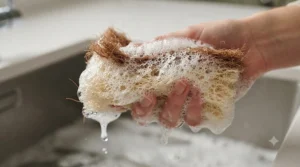
Cellulose sponges, by contrast, are made from processed wood pulp, giving a softer, more absorbent texture closer to a traditional foam sponge in feel, though without the plastic. In real-world use, what most buyers notice within the first week is that loofah sponges (like Seep Eco Sponges or Composty Loofah Sponges) hold their scrubbing texture longer but dry stiffer between uses, while cellulose sponges (like bioGo Biodegradable Kitchen Sponges) feel closer to what people are used to but need slightly more frequent washing to avoid odour. Neither degrades meaningfully faster than the other in a well-managed compost bin — the practical difference is entirely in day-to-day feel and scrubbing power, not end-of-life speed.
Compostable Kitchen Sponges for a Zero-Waste Kitchen
If you’re building a genuinely zero-waste kitchen rather than just swapping one product, the sponge is a small but meaningful piece of a bigger picture. Marine plastic pollution is, by most measures, overwhelmingly driven by exactly this kind of everyday household plastic breaking down into fragments over years of use — as Wikipedia’s overview of marine plastic pollution notes, roughly eighty percent of marine debris is plastic, and a chunk of that originates from ordinary domestic items rather than industrial waste. Swapping a sponge alone won’t fix that on its own, obviously, but it removes one small, constant, largely invisible source of shedding plastic from a kitchen that’s washing dishes multiple times a day, every day, for years.
For a fully zero-waste setup, the sensible combination is a scrubbing sponge for dishes (loofah or coconut-fibre for grip, cellulose for gentler surfaces), a compostable cloth like EcoLiving Compostable Sponge Cloths for counters and spills instead of kitchen roll, and a working compost bin or council food-waste collection to actually close the loop once the sponge is spent. Buying compostable and then binning the worn-out sponge with general rubbish defeats much of the point — the material still needs proper composting conditions (oxygen, moisture, and time) to break down as intended, rather than simply being technically capable of doing so in a landfill.
Long-Term Cost & Maintenance
Run the numbers over a year rather than a single purchase, and the picture shifts meaningfully. A household replacing a plastic sponge roughly every two to three weeks spends a similar amount annually to one using a compostable sponge on the same rotation, once you compare equivalent pack sizes rather than sticker price alone — the myth that eco-friendly automatically means expensive doesn’t really hold up here.
| Consideration | Compostable Sponges | Traditional Plastic Sponges |
|---|---|---|
| Approx. annual cost (weekly household use) | Around £15-£25 depending on brand and pack size | Around £12-£20 depending on brand |
| Maintenance | Air-dry between uses, occasional wash cycle | Minimal, but degrades faster into microplastic |
| Disposal cost | None — goes to compost bin | Landfill or general waste collection |
| Best For | Cost-conscious buyers who also value waste reduction | Buyers prioritising rock-bottom upfront price only |
The maintenance routine — airing sponges out and running them through an occasional wash cycle — genuinely extends working life across every product on this list, meaning the real annual cost often lands lower than the sticker price suggests once you’re not replacing sponges prematurely due to odour.
Safety, Regulations & Compliance Guide
There’s a regulatory backdrop worth understanding here, because it explains why so many UK brands are pushing hard into compostable formats right now. Since October 2023, businesses in England have operated under rules restricting certain single-use plastic items, and as the UK government’s guidance confirms, these restrictions specifically cover items “including biodegradable, compostable and recycled” plastic where they still count as single-use — a reminder that the word “compostable” on packaging isn’t automatically a free pass unless the product genuinely breaks down as claimed.
For household kitchen sponges specifically, there’s no direct legal requirement forcing a switch away from plastic sponges, since they’re reusable rather than single-use in the regulatory sense — but the direction of travel across UK retail is unmistakably toward reduced plastic packaging and genuinely compostable materials. From a food-safety angle, all seven products covered here are marketed for direct food-contact cleaning use and use natural, non-toxic materials, though as with any sponge, replacing it regularly (compostable or not) matters more for hygiene than the material it’s made from — bacteria build up in any damp sponge left too long between changes.
Features That Actually Matter (And Those That Don’t)
Cutting through the marketing noise, a handful of features genuinely affect day-to-day performance, and a few sound impressive but barely register in practice. Material composition matters enormously — it dictates texture, absorbency, and how the sponge behaves wet versus dry. Pack size and per-unit cost matter for anyone budgeting seriously. Compostable packaging, as seen with Composty Loofah Sponges, matters if your goal extends beyond the sponge itself to overall plastic reduction.
What matters less than the marketing suggests: exact colour or shape variations, since these have no bearing on function; vague “eco-friendly” claims with no material breakdown behind them, which tell you almost nothing useful; and headline scent or “fresh” claims on natural sponges, since none of these products are scented in a meaningful way and any such claim is essentially decorative.
Frequently Asked Questions
❓ Can you actually put a compostable kitchen sponge in a compost bin?
❓ How long does a compostable kitchen sponge last?
❓ Are loofah kitchen sponges better than cellulose sponges?
❓ Do compostable sponges smell faster than plastic ones?
❓ What's the difference between biodegradable and compostable sponges?
Conclusion
Swapping a plastic sponge for a compostable one is one of the smallest, cheapest changes you can make in a kitchen, and yet it quietly removes a constant, invisible source of shedding plastic from a routine most of us repeat multiple times a day without thinking about it. Across the seven products here, there’s genuinely no single “best” — bioGo Biodegradable Kitchen Sponges earns its popularity through consistency and volume of positive reviews, AIRNEX Eco Washing-Up Sponges and ECOLOCO Eco Kitchen Sponge Scourer bring real scrubbing power for tougher jobs, and EcoLiving Compostable Sponge Cloths extends the zero-waste kitchen idea beyond the sink entirely.
What matters more than picking the “perfect” one is simply making the switch and building the small habits — airing sponges properly, composting them at end of life, pairing a scrubber with a gentler cellulose sponge — that make the whole thing actually work as intended rather than just sitting in a drawer as good intentions. Start with whichever pick above matches your household size and washing-up load, and the rest tends to follow naturally.
✨ Ready to Cut the Plastic From Your Sink?
🔍 Take your kitchen a step closer to zero-waste with any of the picks above. Click through to check current pricing and availability before making the switch — your compost bin, and the ocean, will thank you.
Recommended for You
- 7 Best Heavy Duty Scourer Sponges UK (2026): Burnt Pot Rescue Kit
- Non-Scratch Sponges for Non-Stick Pans: 7 Best Picks (2026)
- Antibacterial Kitchen Sponges 2026: 7 Genuinely Hygienic Picks
Disclaimer: This article contains affiliate links. As an Amazon Associate, I earn from qualifying purchases. If you purchase products through these links, we may earn a small commission at no additional cost to you.
✨ Found this helpful? Share it with your friends! 💬🤗
