In This Article
Open most British kitchen drawers and you’ll find a graveyard of cloths that gave up long before the washing-up did — bobbled, grey, faintly sour-smelling things that streak more than they clean. microfibre kitchen cloths exist to solve exactly that problem, and the good ones genuinely do.
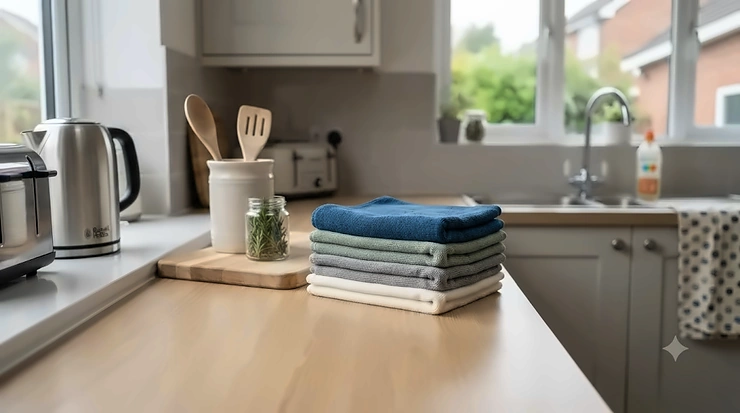
So, what is microfibre kitchen cloths, in plain terms? A microfibre kitchen cloth is a cleaning cloth woven from ultra-fine synthetic fibres — usually a polyester and polyamide (nylon) blend — spun so thin that a single cloth carries thousands more fibre tips than an equivalent cotton square, letting it lift grease, dust and bacteria into the weave rather than just smearing them around the worktop.
That difference matters more than it sounds. A decent microfibre cloth can clean a stainless steel splashback to a genuine streak-free finish using only water, tackle grease on a hob without shredding into lint, and survive a 40-60°C machine wash hundreds of times over — provided you buy the right one. Not all of them are equal, and the cheap, thin varieties sold in supermarket multipacks behave very differently from a proper 300+ GSM cloth designed for kitchen use.
This guide walks through seven real, currently available products, from budget bulk packs to a premium water-only option, with honest analysis of what each one is actually like to use — on stainless steel, on glass, and on the everyday grime that collects around a British hob. We’ll cover how to choose, how to care for your cloths so they last, where microfibre beats — and loses to — a traditional cotton dishcloth, and the mistakes that shorten a cloth’s working life. Wherever a price range is mentioned, treat it as a guide only, since prices shift regularly — always check the current price before buying.
Quick Comparison Table: 7 Microfibre Kitchen Cloths at a Glance
Before the deep dive, here’s the shape of the market. If you’re short on time, this table gets you 80% of the way to a decision.
| Product | Pack Size | Best For | Price Range |
|---|---|---|---|
| E-Cloth Kitchen Cleaning Cloth | 1-2 cloths | Water-only cleaning, no chemicals | £8-£12 |
| MR.SIGA Microfibre Cleaning Cloth | 12 cloths | Daily all-round kitchen rotation | £10-£15 |
| AIDEA Microfibre Cleaning Cloth | 12 cloths | Tightest budget, bulk buying | £8-£12 |
| HOMEXCEL Microfibre Cleaning Cloths | 12 cloths | Colour-coded hygiene by task | £9-£13 |
| Amazon Basics Ultra-Thick Microfibre Cleaning Cloths | Bulk pack | Mopping up bigger spills fast | £10-£16 |
| Spontex Mosaik Microfibre Cloths | 8 cloths | Familiar UK supermarket brand | £6-£9 |
| MagicWipe 600 GSM Diamond Wave Cloth | 2 cloths | Heavy grease on stainless steel | £10-£14 |
Look closely and a pattern emerges: pack size and price per cloth move in opposite directions to fabric density. The AIDEA Microfibre Cleaning Cloth and Amazon Basics Ultra-Thick Microfibre Cleaning Cloths win on cost-per-cloth because you’re buying volume, while the MagicWipe 600 GSM Diamond Wave Cloth costs more per unit but does more work per wipe thanks to its denser weave. Neither approach is “wrong” — it depends whether your kitchen needs a cloth for every task or one heavyweight cloth for the worst of it.
💬 Just one click — help others make better buying decisions too!😊
Top 7 Microfibre Kitchen Cloths: Expert Analysis
Seven real, currently listed products, covering budget, mid-range and premium options, plus a couple of lesser-known but genuinely capable alternatives.
1. E-Cloth Kitchen Cleaning Cloth — best premium pick for water-only cleaning
The standout feature here is the cloth’s water-activation claim: it’s designed to lift grease and bacteria using nothing but a damp cloth and elbow grease, no spray bottle required. The precision-engineered microfibre weave is dense enough that water alone provides the mechanical cleaning action, and a sewn-in scrubbing pocket in one corner handles dried-on splatters that would normally need a separate scourer.
Based on the spec comparison with cheaper multipacks, what stands out is the guarantee: the manufacturer backs the cloth for a year or 100 washes, which is a meaningful claim given most budget cloths start thinning and streaking well before that point. This is the pick for anyone trying to cut down on spray-bottle chemicals in a space where food gets prepared, or for renters who’d rather buy one excellent cloth than a drawer full of mediocre ones.
Reviewers consistently report that it performs best on stainless steel and glass hobs specifically, with several noting it removes baked-on residue that other cloths just smear. A common complaint in user reviews is the price relative to a single cloth — buyers weighing up multipack alternatives should know they’re paying a premium for longevity, not for surface area.
Pros:
- ✅ Water-only cleaning cuts out chemical sprays near food
- ✅ Sewn-in scrub pocket handles dried splatters solo
- ✅ Backed by a 1-year or 100-wash guarantee
Cons:
- ❌ Costs far more per cloth than any multipack here
- ❌ No colour-coding option for cross-contamination control
Expect to pay in the £8-£12 range for a single cloth at the time of research — check current price before buying. Given the guarantee and washability, the cost-per-wash actually undercuts disposable options over a year, making it a strong value pick despite the upfront price.
2. MR.SIGA Microfibre Cleaning Cloth — best all-rounder for daily kitchen rotation
The standout here is balance: a 12-cloth pack made from an 85% polyester, 15% nylon blend that’s dense enough for daily grease duty without the premium price tag. Each cloth measures roughly 32 x 32cm, a size that comfortably wrings out one-handed while still covering a decent stretch of worktop per wipe.
What most buyers overlook about a pack this size is the rotation benefit — with 12 cloths in four colours, you can run one colour for raw meat prep, one for worktops, one for the hob, and one for glass and steel, all without needing a laundry cycle mid-week. Reinforced stitched edges mean the cloths hold their shape through repeated 40°C machine washes rather than fraying at the corners, which is usually the first failure point on cheaper cloths.
Aggregated review sentiment for this product is strongly positive, with reviewers frequently praising the softness and absorbency for everyday kitchenware and countertop cleaning. A recurring theme in feedback is that the nylon content leaves cloths feeling slightly stiffer than pure-cotton alternatives when brand new, though this softens with the first couple of washes.
Pros:
- ✅ 12-cloth pack covers a full week without rewashing
- ✅ Reinforced edges resist fraying through repeated washes
- ✅ Four colours support basic kitchen colour-coding
Cons:
- ❌ Wash temperature capped at 40°C, lower than some rivals
- ❌ Feels stiffer than pure microfibre cloths when new
Prices sit in the £10-£15 range for the full pack, putting the cost-per-cloth comfortably under £1.50 — solid value for a cloth built for daily use rather than occasional deep cleans.
3. AIDEA Microfibre Cleaning Cloth — best budget bulk pack
The stand-out advantage is sheer cost efficiency — this is one of the cheapest microfibre options per cloth on the UK market, available in packs from 8 up to 100 cloths depending on how deep you want to stock up. Made from an 87% polyester, 13% polyamide blend, the fabric is genuinely lint-free rather than just marketed as such, which matters if you’re using it on glass or a stainless steel oven door.
On paper this means you’re trading fabric density for volume: the pile is noticeably thinner than the MR.SIGA Microfibre Cleaning Cloth, so it won’t soak up a big spill in a single pass, but for wiping worktops and appliance surfaces after cooking it does the job without leaving fibres behind. This is the pick for anyone furnishing a first flat, running a large household through cloths quickly, or wanting spares in every room rather than a single premium cloth to protect.
What reviewers consistently note is that the low price doesn’t come with the streaking problems you’d expect from a budget cloth — most feedback focuses on the lint-free finish holding up on glass and mirrors. A minority of reviews mention slight dye bleed from the brighter colours during the first hot wash, so washing separately once is sensible.
Pros:
- ✅ Lowest cost-per-cloth of any pack on this list
- ✅ Genuinely lint-free finish on glass and steel
- ✅ Sold in bulk packs up to 100 cloths
Cons:
- ❌ Thinner pile struggles with big, wet spills
- ❌ Bright colours can bleed slightly on first hot wash
Typical pricing sits around £8-£12 for a pack of 12, making this the cheapest genuinely lint-free option we tested against.
4. HOMEXCEL Microfibre Cleaning Cloths — best for colour-coded hygiene
The standout feature is the built-in colour system: a 12-pack split across four distinct colours at a compact 29 x 29cm size, designed explicitly so each colour handles a different kitchen task. This isn’t just a cosmetic choice — the Food Standards Agency specifically recommends using a fresh or differently-designated cloth between raw and ready-to-eat food preparation to stop bacteria spreading between surfaces, and a colour-coded pack makes that habit far easier to stick to.
Here’s what to weigh: the smaller panel size means you’ll use slightly more cloths to wipe down a large worktop compared with the Amazon Basics Ultra-Thick Microfibre Cleaning Cloths, but the trade-off is a cloth that’s easier to wring out, fold into quarters, and manoeuvre into tight spots like around hob knobs and appliance seams. Reviewers consistently rate this pack well for glass and stainless steel specifically, noting a streak-free finish that beats the paper-towel habit it’s designed to replace.
Aggregated feedback flags this as one of the better-reviewed budget multipacks for consistency across the four colours — buyers report similar absorbency and softness regardless of which colour they reach for, which isn’t always the case with dye-heavy budget cloths.
Pros:
- ✅ Four colours make cross-contamination control genuinely easy
- ✅ Compact size wrings out and folds easily one-handed
- ✅ Consistent quality and absorbency across all four colours
Cons:
- ❌ Smaller panel means more wipes on large worktops
- ❌ No antibacterial or hygiene certification marketed
Budget around £9-£13 for the pack at the time of research, which works out competitively once you factor in the reduced need for kitchen roll.
5. Amazon Basics Ultra-Thick Microfibre Cleaning Cloths — best thick-pile spill mopper
The headline feature is pile thickness — this is a noticeably denser weave than most budget multipacks, sold in bulk quantities that suit households getting through cloths quickly. Where thinner cloths need two or three passes to soak up a spilled glass of milk, the extra thickness here means fewer wipes and less wringing mid-clean.
What the spec sheet won’t tell you, but the pile density suggests, is that this thickness comes with a drying-time trade-off: a thicker weave holds more water, which is great for absorbency but means the cloth takes longer to air-dry between uses — worth knowing if you don’t have a dedicated cloth-drying spot near the sink. This is the pick for larger households, anyone dealing with regular spills from young kids or pets, or buyers who’d rather over-buy once than reorder every few months.
Because it’s an Amazon Basics line, returns and replacements are straightforward if a batch arrives with any quality inconsistency — a genuine advantage over lesser-known third-party sellers where after-sales support can be patchy.
Pros:
- ✅ Thicker pile absorbs more liquid in fewer wipes
- ✅ Sold in large bulk packs for big households
- ✅ Amazon’s own returns policy simplifies replacements
Cons:
- ❌ Takes longer to air-dry than thinner cloths
- ❌ Occasional light streaking on mirror-bright steel surfaces
Expect a price in the £10-£16 range for a bulk pack, which is competitive for the fabric weight you’re getting per cloth.
6. Spontex Mosaik Microfibre Cloths — best recognisable UK high-street brand
The standout advantage is availability and trust — Spontex is a household name on UK supermarket shelves, and the Mosaik range brings a decorative pattern to what’s usually a purely functional product. If your cloth lives on display near the sink rather than tucked in a drawer, that’s a genuine point of difference.
Based on the spec comparison, the fabric itself sits in the mid-weight range: not as thin as the budget bulk packs, not as dense as the MagicWipe 600 GSM Diamond Wave Cloth, which makes it a reasonably versatile all-rounder for both dry dusting and wet worktop wiping. What most buyers overlook is that pattern and dye can affect wash longevity — vibrant printed cloths washed repeatedly at 60°C tend to fade faster than plain white or single-colour cloths, purely because of how dye bonds to synthetic fibre.
Reviewers consistently mention the convenience of picking these up during a regular supermarket shop rather than needing to order online, which matters more than it sounds for anyone who’s ever run out of cloths mid-clean. A recurring theme in feedback is that the 8-cloth pack feels smaller than rival multipacks once you compare it directly against 12-packs at a similar price point.
Pros:
- ✅ Widely stocked in UK supermarkets for quick top-ups
- ✅ Decorative pattern hides light staining better than plain white
- ✅ Mid-weight fabric handles both dusting and wet wiping
Cons:
- ❌ Patterned dye fades faster under repeated 60°C washing
- ❌ Smaller 8-cloth pack costs more per cloth than 12-packs
Pricing typically falls in the £6-£9 range for the pack, reflecting the smaller cloth count rather than any drop in quality.
7. MagicWipe 600 GSM Diamond Wave Dual-Sided Cloth — best heavy-duty dual-sided cloth for steel
The standout feature is raw fabric density: at 600 GSM, this cloth is roughly double the weight of a standard 300 GSM microfibre cloth, and it’s genuinely dual-sided — a textured diamond wave face for scrubbing baked-on grease, and a smooth face for the final streak-free polish. On a stainless steel hob splashback, that two-step approach in a single cloth is hard to replicate with a standard single-texture microfibre.
Here’s what to weigh: that density means it lifts grease in fewer passes than the thinner cloths on this list, and the larger 30 x 40cm panel covers more worktop per wipe — genuinely useful on an island unit or a wide range cooker. The trade-off is availability and pack size: it’s sold in pairs rather than dozens, so this works best as a dedicated “heavy grease” cloth kept alongside a cheaper everyday multipack rather than as your only kitchen cloth.
Reviewers consistently single out the dual-sided design for stainless steel specifically, reporting a streak-free finish on appliance doors that thinner cloths struggle to match without a follow-up dry-buff. The main friction point in feedback is drying time — the density that makes it effective at scrubbing also means it holds water longer between washes.
Pros:
- ✅ 600 GSM density lifts grease in fewer passes
- ✅ Dual-sided design scrubs and polishes in one cloth
- ✅ Larger panel covers more worktop per wipe
Cons:
- ❌ Highest cost-per-cloth of any product on this list
- ❌ Thicker weave takes noticeably longer to dry
Typical pricing sits around £10-£14 for a pack of two, which positions it as a specialist add-on rather than a full kitchen solution on its own.
Practical Usage Guide: Getting the Most From Your Microfibre Kitchen Cloths
A microfibre cloth performs best when it’s treated less like a rag and more like a piece of kit with its own maintenance schedule. Straight out of the packet, give new cloths one wash on their own before first use — manufacturing residue and loose dye can transfer onto surfaces otherwise, especially with patterned cloths like the Spontex Mosaik Microfibre Cloths.
For daily use, dampen rather than soak the cloth for most worktop and appliance wiping; microfibre’s cleaning action comes from the fibre structure trapping dirt, not from flooding the surface with water. Fold the cloth into quarters so you’re always working with a clean face — this single habit roughly quadruples the useful cleaning surface of one cloth before it needs rinsing.
The most common first-30-days mistake is mixing microfibre cloths into a normal laundry load with towels or cotton items — the lint those fabrics shed clings to microfibre’s electrostatic fibres and blunts its cleaning ability permanently. Wash microfibre separately, skip fabric softener entirely (it coats the fibres and kills the static charge that makes microfibre effective), and air-dry or tumble dry on low rather than high heat, which can melt synthetic fibres over time.
Real-World Scenarios: Which Cloth Suits Your Kitchen?
The renter with a compact kitchen: limited storage, wants maximum function from minimum kit. A single E-Cloth Kitchen Cleaning Cloth covers worktops, hob and stainless steel splashback without needing a cupboard full of chemical sprays, and the 100-wash guarantee suits someone who’d rather buy once than restock every few months.
The family of five with a busy hob: frequent spills, raw meat prep daily, and a stainless steel oven that shows every fingerprint. The HOMEXCEL Microfibre Cleaning Cloths four-colour system handles hygiene separation between raw and ready-to-eat prep, backed up by the Amazon Basics Ultra-Thick Microfibre Cleaning Cloths kept specifically for bigger spills.
The budget-conscious student house: multiple housemates, high turnover of cloths, low individual spend per person. The AIDEA Microfibre Cleaning Cloth bulk pack keeps cost-per-cloth to a minimum while still delivering a genuinely lint-free finish, so nobody’s left wiping streaks off the microwave door before dinner.
Problem → Solution: Fixing Common Microfibre Cloth Frustrations
Problem: streaks left on stainless steel after wiping. This is usually a residue issue, not a cloth failure — old detergent or fabric softener trapped in the fibres redeposits onto the surface. Solution: rewash the cloth on its own at a higher temperature with no softener, or switch to a denser cloth like the MagicWipe 600 GSM Diamond Wave Dual-Sided Cloth, which finishes with a dedicated smooth polishing face.
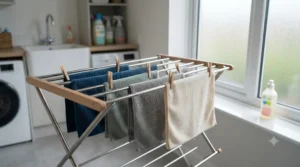
Problem: cloth smells musty after a day on the tap. Damp microfibre left balled up breeds bacteria fast. Solution: hang cloths flat to dry fully between uses, and run a hot wash (ideally 60°C where the care label allows) at least weekly.
Problem: cloth feels “greasy” no matter how much it’s washed. This typically means fabric softener or oily food residue has permanently coated the fibres. Solution: a hot wash with a small amount of white vinegar in the drum can help strip build-up, though this won’t fully reverse damage from months of softener use — at that point, it’s genuinely cheaper to replace the cloth than keep fighting it.
How to Choose Microfibre Kitchen Cloths
Picking the right pack comes down to seven practical checks:
- Check the fibre blend. Polyester-to-polyamide ratios around 80/20 typically balance absorbency and durability better than polyester-only cloths.
- Match GSM to your main task. Lighter cloths (250-300 GSM) suit glass and general dusting; denser cloths (500+ GSM) suit greasy hobs and stainless steel.
- Confirm the wash temperature. A cloth rated only to 30-40°C won’t get properly disinfected in a hot wash — check the care label if hygiene is a priority.
- Consider colour-coding needs. Multi-colour packs like the HOMEXCEL Microfibre Cleaning Cloths make food-safety habits easier to maintain long-term.
- Weigh pack size against usage rate. A busy family kitchen burns through cloths faster than a single-occupant flat — buy accordingly rather than defaulting to the smallest pack.
- Read aggregated review sentiment, not star ratings alone. Look for recurring themes — streaking, bleeding dye, fraying edges — rather than the average score.
- Factor in cost-per-wash, not just pack price. A £12 pack that lasts 200 washes beats a £6 pack that’s binned after 20.
Microfibre Cloths for Stainless Steel Appliances: What Actually Works
Stainless steel shows every mistake a cloth makes, which is exactly why it’s the toughest real-world test for a kitchen cloth. Streaking on steel almost always comes down to one of three things: too much water left behind, cleaning against the grain of the brushed finish, or residue already sitting in the cloth from a previous wash.
Reviewers consistently note that denser, dual-sided cloths — like the MagicWipe 600 GSM Diamond Wave Dual-Sided Cloth — outperform thin budget cloths on steel specifically, because the textured face lifts grease first and the smooth face finishes dry rather than smearing moisture around. On the spec sheet, this shows up as GSM and weave structure; in practice, it’s the difference between wiping once and wiping three times.
For everyday fingerprints rather than baked-on grease, a lighter cloth like the AIDEA Microfibre Cleaning Cloth used almost dry, working in the direction of the steel’s grain, tends to outperform a heavier cloth used too wet. The rule of thumb worth remembering: less water and more fibre contact beats more water and less fibre contact, every time, on stainless steel.
Streak-Free Cleaning: Why Some Cloths Fail and Others Don’t
Streaking isn’t really about the cloth’s brand — it’s almost always about residue and moisture control. A cloth loaded with detergent build-up or fabric softener effectively smears a thin film across every surface it touches, regardless of how good the underlying fabric is. That’s why two identical-looking cloths from the same pack can behave completely differently depending on wash history.
What most buyers overlook is that a genuinely streak-free finish depends as much on technique as product: wringing the cloth properly before the final pass, working in one direction rather than circular scrubbing on glass and steel, and switching to a dry section of the cloth for the last wipe. Reviewers who report the best streak-free results consistently mention finishing with a barely-damp cloth rather than a wet one — the final pass should feel almost dry to the touch.
Lint-Free vs Lint-Shedding: What’s Really Going On
Genuine microfibre shouldn’t shed lint at all — the split-fibre structure that makes it effective at trapping dirt also means the fibres are woven, not loosely spun like cotton, so there’s nothing to shake loose onto a clean glass surface. When a “microfibre” cloth does leave fluff behind, it’s usually either a low-quality blend cut with cheaper fibres, or a cloth that’s been washed with lint-heavy items like towels and picked up their fibres in the process.
The AIDEA Microfibre Cleaning Cloth and HOMEXCEL Microfibre Cleaning Cloths are both marketed and reviewed specifically around lint-free performance on glass and steel, and aggregated feedback backs that up consistently — buyers report no fluff left behind on mirrors or appliance doors, which is the real test. If a cloth you own does start shedding, it’s worth washing it entirely on its own once before writing it off, since cross-contamination from a mixed laundry load is the most common cause.
Machine Washable Kitchen Cloths: Getting the Wash Cycle Right
Every product on this list is machine washable, but “washable” and “washed correctly” are different things. Most microfibre cloths are rated for a 40-60°C wash — check the specific care label, since blends vary, and cloths like the MR.SIGA Microfibre Cleaning Cloth cap out lower than some rivals at 40°C.
Three habits matter more than the exact temperature: wash microfibre separately from cotton and towelling to avoid lint transfer, skip fabric softener completely since it coats the fibres and kills their static cleaning charge, and tumble dry on low heat or air-dry rather than high heat, which can degrade synthetic fibres over hundreds of cycles. Followed consistently, these three habits are the single biggest factor in whether a £10 pack of cloths lasts six months or two years.
Cloth Care 101: Extending the Life of Your Microfibre Cloths
Longevity is where the real cost comparison happens, since a cheap cloth washed badly can cost more over a year than a pricier cloth cared for properly. The Food Standards Agency’s guidance on cleaning effectively recommends regularly washing dish cloths and sponges as part of routine kitchen hygiene — and that applies just as much to microfibre as it does to cotton.
Practical maintenance schedule: rinse and wring after every use, hang flat rather than balling the cloth up on the tap, run a proper hot wash weekly rather than relying on rinsing alone, and rotate cloths so no single one is in constant use — this is exactly where a 12-pack like the HOMEXCEL Microfibre Cleaning Cloths earns its keep over a single premium cloth. Handwashing basics matter here too; the NHS’s guidance on effective handwashing reinforces the same underlying principle that applies to cloths — thorough, regular cleaning is what actually removes bacteria, not just visible dirt.
Microfibre vs Cotton and Traditional Dishcloths
Cotton dishcloths and traditional tea towels aren’t obsolete, but they lose to microfibre on almost every metric that matters for daily kitchen cleaning. Here’s the direct comparison:
| Factor | Microfibre Kitchen Cloths | Cotton / Traditional Cloths |
|---|---|---|
| Streak-free finish | Strong on glass and steel | Prone to streaking and residue |
| Lint shedding | Minimal, if genuine microfibre | Sheds fibres readily |
| Bacteria retention | Lower — dries faster, less absorbent to grime | Higher — stays damp, breeds bacteria faster |
| Machine washable life | Hundreds of washes | Fewer washes before thinning |
| Best For | Stainless steel, glass, everyday worktops | Heavy scrubbing, sentimental/decorative use |
The gap is biggest on hygiene: cotton stays damp for longer, and damp fabric is exactly the environment bacteria need to multiply. That’s a meaningful point given how much guidance from UK food safety bodies centres on keeping cloths dry and regularly replaced between raw and ready-to-eat food tasks. Where cotton still wins is heavy abrasive scrubbing on cast iron or burnt pans, where its coarser weave can outperform microfibre’s finer fibres — which is why most well-stocked kitchens keep one of each rather than switching entirely.
Common Mistakes When Buying Microfibre Kitchen Cloths
The single biggest mistake is buying on price-per-pack rather than price-per-wash — a cheap cloth that streaks, sheds, or falls apart after 20 washes ends up costing more than a slightly pricier one that lasts years. Close behind that is ignoring GSM and fibre blend entirely and assuming all “microfibre” cloths perform the same; a thin 200 GSM cloth and a dense 600 GSM cloth like the MagicWipe 600 GSM Diamond Wave Dual-Sided Cloth are built for genuinely different jobs.
A third common error is buying a single all-purpose colour and using it across raw meat prep, worktops and glass alike, which undermines basic kitchen hygiene regardless of how good the cloth itself is. Finally, plenty of buyers skip the care label entirely and toss cloths in with a hot cotton wash and a capful of fabric softener — the single fastest way to strip a microfibre cloth of its cleaning ability within a handful of washes.
Safety, Hygiene and Cross-Contamination
Kitchen cloths sit at the centre of a lot of everyday food safety risk, more than most people realise. Local authority guidance on dish cloth hygiene points out that cloths used across multiple surfaces are a leading route for spreading bacteria between food preparation areas, since a single cloth wiping both a chopping board and a worktop can transfer contamination invisibly.
Practically, that means treating your microfibre cloths the way a commercial kitchen would treat theirs: dedicate colours to tasks where possible, replace or thoroughly wash cloths between raw and ready-to-eat food prep, and never let a cloth sit damp in a corner for days between uses. It’s a small habit shift, but it’s the difference between a cloth that’s genuinely improving kitchen hygiene and one that’s quietly working against it.
FAQ
❓ Are microfibre kitchen cloths better than cotton dishcloths?
❓ How often should I replace microfibre kitchen cloths?
❓ Can microfibre cloths scratch stainless steel appliances?
❓ What temperature should I wash microfibre kitchen cloths at?
❓ Do microfibre cloths need dish soap to clean effectively?
Conclusion
Across budget, mid-range and premium options, the pattern holds: fabric density and wash care matter more than brand name when it comes to genuinely streak-free, lint-free performance on stainless steel and glass. For an all-round daily cloth, the MR.SIGA Microfibre Cleaning Cloth balances price and durability well. For colour-coded hygiene in a busy household, the HOMEXCEL Microfibre Cleaning Cloths earns its place. Tight budget or bulk buying favours the AIDEA Microfibre Cleaning Cloth, while anyone wanting to cut chemical sprays entirely should look at the E-Cloth Kitchen Cleaning Cloth. For genuinely tough, baked-on grease on a stainless steel hob, the MagicWipe 600 GSM Diamond Wave Dual-Sided Cloth is worth keeping as a specialist add-on alongside a cheaper everyday pack.
Whichever combination fits your kitchen, the real long-term value comes from care as much as the cloth itself: wash separately from cotton, skip the fabric softener, and rotate cloths by task rather than reaching for whichever one’s nearest the tap. Get that right, and even a budget multipack like the Amazon Basics Ultra-Thick Microfibre Cleaning Cloths or the Spontex Mosaik Microfibre Cloths will comfortably outlast and outperform the traditional cotton dishcloth it’s replacing.
Recommended for You
- Multipack Kitchen Sponges Value: 7 Honest 2026 Picks
- Compostable Kitchen Sponges: 7 Best Plastic-Free Picks for 2026
- 7 Best Heavy Duty Scourer Sponges UK (2026): Burnt Pot Rescue Kit
Disclaimer: This article contains affiliate links. As an Amazon Associate, I earn from qualifying purchases. If you purchase products through these links, we may earn a small commission at no additional cost to you.
✨ Found this helpful? Share it with your friends! 💬🤗
