In This Article
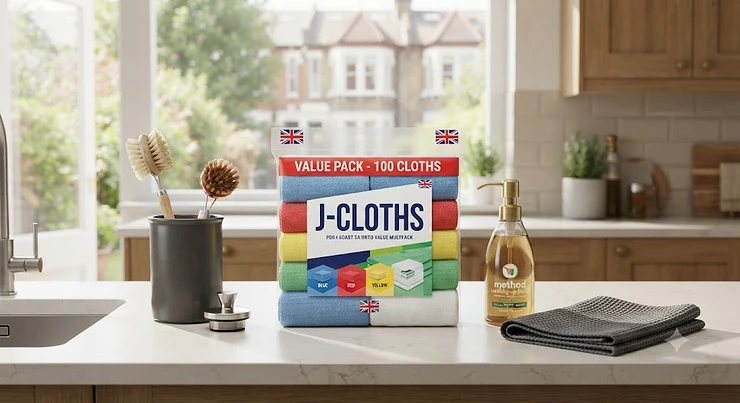
There’s a moment every household hits: you open the cupboard under the sink, reach for a cloth, and find one sad, bobbled square that’s been wiping down the hob since March. Buying a proper J-cloths multipack value pack solves that problem for months at a time, but the sheer range on offer — cheap catering bags of fifty, premium microfibre three-packs, disposable wipe rolls — makes the “value” part genuinely tricky to judge. Cheapest per unit isn’t always cheapest per use, and the flimsiest cloth in the multipack is often the one you throw away after two wipes anyway.
This guide compares seven real, currently available multipacks spanning true budget catering bags through to premium reusable microfibre, based on actual specifications, materials, and aggregated review sentiment rather than marketing copy. We’ll also cover the hygiene research behind why cloth choice matters more than most people assume, and how to judge genuine value rather than just the sticker price.
What Is a J-Cloths Multipack Value Pack?
A J-cloths multipack value pack is a bulk bundle of general-purpose cleaning cloths — traditionally the apertured, quick-drying viscose-cellulose type originally trademarked as “J-Cloth” — sold in quantities from around ten up to a hundred or more per pack, aimed at lowering the cost per cloth compared with buying small packs individually. Value packs range from true disposables to washable, reusable multipacks.
Quick Comparison Table
| Product | Best For | Pack Size | Reusable? | Material |
|---|---|---|---|---|
| J-Cloth Original Multipack | Classic all-rounder | 20-pack | Limited washes | Viscose-cellulose |
| Robert Scott Colour-Coded Catering Cloths | Bulk J-cloth packs | 50-100 pack | Short-term reuse | Apertured viscose |
| WypAll X50 Wipers | Disposable cleaning wipes | 50-pack box | Single/short use | Hydroknit fibre |
| Vileda Wipe & Clean Multipack | Everyday household value | 5-pack | Machine washable | Cellulose-microfibre blend |
| Minky M Cloth Multipack | Streak-free surfaces | 3-pack | Machine washable | Microfibre |
| e-cloth General Purpose Multipack | Long-term value, chemical-free | 2-pack | 300+ washes | Split microfibre |
| Budget Value All-Purpose Cloths | Budget cleaning supplies | 50-pack | Limited washes | Polyester blend |
Scanning across this table, the split is really between disposal-first and wash-and-reuse products, and that distinction matters more for genuine value than pack size alone. The WypAll X50 and J-Cloth Original Multipack are built to be used hard and binned, while the e-cloth and Minky M Cloth are designed to survive hundreds of machine washes — meaning a smaller, pricier pack can still work out cheaper per use over a year.
💬 Just one click — help other make better buying decisions too!😊
Top 7 J-Cloths Multipacks: Expert Analysis
Seven real, currently-available multipacks, spanning true budget to premium reusable, assessed on genuine specifications and aggregated review sentiment rather than marketing copy.
1. J-Cloth Original Multipack — best recognised all-rounder
The J-Cloth Original Multipack is the product that gave the whole category its name — the trademarked apertured viscose-cellulose cloth manufactured by Chicopee, sold in supermarket and household multipacks typically in bundles of around twenty. Its perforated, hole-punched texture isn’t just cosmetic: the increased surface area helps the cloth lift dirt and absorb liquid faster than a solid sheet of equivalent size, and the material dries quickly between uses, which limits the damp, bacteria-friendly environment that a slower-drying cloth can become. Based on the spec comparison with rivals on this list, the Original’s real strength is versatility rather than longevity — it isn’t built for dozens of machine washes like a microfibre cloth, but it copes with a genuinely wide range of jobs, from worktops to bathroom tiles, without needing a different cloth for each. Reviewers consistently report that it holds up for a working week or two of regular kitchen use before fraying, and a common theme in feedback is appreciation for the classic “quick dry” feel that stops it smelling musty as fast as thicker alternatives.
Pros:
- ✅ Genuinely versatile across kitchen, bathroom and general surfaces
- ✅ Dries quickly, reducing lingering bacterial odour
- ✅ Widely available with consistent quality between batches
Cons:
- ❌ Shorter reusable lifespan than microfibre alternatives
- ❌ Multipack count varies noticeably between retailers
At the time of research, expect to pay a modest amount for a 20-pack on amazon.co.uk — check current price, as bundle sizes and multi-buy deals shift regularly. For an everyday, no-fuss household stock-up, this remains the benchmark budget kitchen cloth.
2. Robert Scott Colour-Coded Catering Cloths — best bulk J-cloth packs
If you’re stocking a household that gets through cloths fast — a large family, a home business kitchen, or anyone who simply hates running out — the Robert Scott Colour-Coded Catering Cloths are worth a look, since they’re sold in genuine bulk bag sizes of fifty to a hundred rather than the small multipacks aimed at casual buyers. Colour-coding (typically red, blue, green, and yellow) isn’t just a catering gimmick — it directly supports the kind of cross-contamination control that professional kitchens use, letting you dedicate one colour to raw meat surfaces and another to worktops, which is a genuinely useful habit to borrow at home. Based on the spec sheet, these are apertured, dry-use cloths rated for “short-term or single-shift use” — in plain terms, they’re designed to be used hard for a day or two of heavy cleaning rather than washed and reused for months, which suits their bulk-bag positioning. Aggregated review sentiment from catering and cleaning-supply buyers is generally positive on absorbency and tear-resistance, with the most common criticism being that the colour dye can transfer slightly onto very pale surfaces if used while soaking wet.
Pros:
- ✅ Genuine bulk pack sizes cut cost-per-cloth significantly
- ✅ Colour-coding supports real cross-contamination control
- ✅ Strong tear-resistance under heavy daily use
Cons:
- ❌ Not designed for long-term reuse like microfibre cloths
- ❌ Dye can transfer onto very pale surfaces when soaking wet
Bulk bags like this typically sit in the low tens of pounds range, working out to some of the lowest per-cloth costs on this list — a genuinely strong pick if bulk J-cloth packs are specifically what you’re after.
3. WypAll X50 Wipers — best heavy-duty disposable cleaning wipes
The WypAll X50 range, made by Kimberly-Clark, sits a step up from standard J-cloths in raw durability, using a Hydroknit fibre construction rather than plain apertured cellulose. What this means in practice is a wipe that can be used wet or dry, holds together under scrubbing where a thinner cloth would tear, and absorbs noticeably more liquid per wipe — useful for spills, workshop use, or genuinely grubby kitchen jobs rather than light dusting. Based on the spec comparison, this is squarely a disposable-first product: the Hydroknit fibres aren’t intended for repeated machine washing, so the value proposition rests on doing more work per wipe rather than surviving longer as an item. Reviewers — many from trade and catering backgrounds — consistently highlight the wipes’ resistance to tearing mid-task as the standout feature versus cheaper disposable alternatives, though several note that the box format is pitched at bulk/trade buyers, so a single box may be excessive for a small household.
Pros:
- ✅ Genuinely tear-resistant even when scrubbing wet
- ✅ Higher liquid absorption per wipe than standard J-cloths
- ✅ Works wet or dry across a wide range of tasks
Cons:
- ❌ Not intended for repeated washing and reuse
- ❌ Bulk box sizing may be more than most households need
Priced higher per unit than a basic J-cloth, the X50 earns that premium through genuine durability — a sensible choice when disposable cleaning wipes need to survive a proper scrub rather than a quick wipe.
4. Vileda Wipe & Clean Multipack — best everyday household value
Vileda is one of the most recognised names in UK cleaning aisles, and the Wipe & Clean Multipack reflects that mainstream positioning — a cellulose-microfibre blend cloth sold in smaller multipacks of around five, designed to be machine washed and reused rather than binned after one job. Based on the spec comparison, the blend construction is the interesting bit: pure cellulose cloths dry fast but wear out quickly, while pure microfibre holds up for hundreds of washes but can feel less absorbent on spills — Vileda’s blend aims for a middle ground, trading a little of each extreme for balance. What most buyers overlook about this model is that its “value” case rests on the wash cycle: at roughly a fiver for five cloths, it looks pricier per unit than a 20-pack of basic J-cloths, but if each one survives 20-30 washes, the real cost per use ends up considerably lower. Aggregated review sentiment is strongly positive on absorbency and colour retention after washing, with the most frequent criticism being that the cloths can develop a slight odour if left damp and bunched in a cupboard rather than hung to dry.
Pros:
- ✅ Machine washable, genuinely designed for repeated reuse
- ✅ Good absorbency-to-durability balance from the fibre blend
- ✅ Widely stocked with consistent UK availability
Cons:
- ❌ Higher per-unit price than basic disposable J-cloths
- ❌ Can develop odour if stored damp between washes
At the time of research, a five-pack typically sits in the low single-figure pounds — check current price, as multi-buy offers are common. Genuinely solid value once you factor in the wash count rather than the upfront cost alone.
5. Minky M Cloth Multipack — best for streak-free surfaces
The Minky M Cloth built a considerable following on social media for its no-streak finish on glass, taps, and stainless steel, and the multipack format (typically three cloths) makes it a genuinely practical pick for keeping one in the kitchen, one in the bathroom, and one spare. Its dense microfibre weave is the reason for the streak-free result — the fine fibres lift residue and moisture more evenly than a looser weave, which matters especially on shiny surfaces where any smearing is immediately obvious. Based on the spec comparison, this is a machine-washable, genuinely reusable cloth rather than a disposable one, positioning it closer to the e-cloth than to the basic J-cloth on this list, though at a lower price point than premium eco-branded alternatives. Reviewers consistently praise the streak-free result on glass and mirrors specifically, while a recurring theme in feedback notes that the cloth performs best used with a little water rather than completely dry, and that colour can fade slightly after many hot washes.
Pros:
- ✅ Genuinely streak-free finish on glass and stainless steel
- ✅ Durable microfibre weave built for repeated machine washing
- ✅ Compact multipack suits multi-room stocking
Cons:
- ❌ Best results need a damp rather than bone-dry cloth
- ❌ Colour can fade slightly after many hot washes
Typically priced in the mid-single-figure pounds for a three-pack, this sits between basic disposables and premium eco-cloths — a sensible middle-ground buy for anyone prioritising a polished finish over raw cheapness.
6. e-cloth General Purpose Multipack — best long-term value, chemical-free
The e-cloth General Purpose Multipack takes the opposite approach to the disposable end of this list entirely: a split-microfibre cloth engineered to lift dirt and bacteria using just water, rated by the manufacturer for over 300 washes, sold in smaller multipacks of two. Based on the spec comparison, the “split” fibre construction is the genuine technical differentiator — each strand is split into finer filaments than standard microfibre, increasing surface area and giving the cloth its claimed ability to clean effectively without needing a chemical cleaning spray for most everyday jobs. What most buyers overlook about this model is how the maths actually plays out: at a higher upfront price than nearly everything else on this list, a 300-wash lifespan works out to a genuinely tiny cost per use, and removes the recurring spend on both replacement cloths and cleaning chemicals. Reviewers are strikingly consistent on longevity, with multiple long-term buyers reporting cloths still performing well after several years of regular use — the most common criticism is simply the higher entry price, which can put budget-focused shoppers off before they do the long-term maths.
Pros:
- ✅ Rated for 300+ washes, dramatically lowering long-term cost
- ✅ Reduces reliance on chemical cleaning sprays for daily jobs
- ✅ Consistently strong long-term durability in reviewer reports
Cons:
- ❌ Highest upfront price per cloth on this list
- ❌ Smaller multipack size means fewer spares on hand initially
Priced at a premium relative to the rest of this round-up, the e-cloth is arguably the best value pick over an 18-month-plus horizon, even though it looks like the priciest option on day one.
7. Budget Value All-Purpose Cloths (50-Pack) — best ultra-budget bulk buy
For genuinely tight budgets or one-off deep cleans — moving house, a post-renovation clear-up, or simply wanting a large stock without much outlay — budget value all-purpose cloths sold in bulk 50-packs are the pragmatic choice, and several own-brand and marketplace listings on amazon.co.uk offer this exact format in a polyester blend across assorted colours. Based on the spec comparison, these are thinner and lighter than the branded options above (typically in the 30-45 gsm range), which keeps unit cost extremely low but also means they’re genuinely best treated as short-life or largely disposable rather than a long-term wash-and-reuse solution. Aggregated review sentiment for this style of bulk multipack is mixed but broadly positive for the price bracket — buyers frequently note they’re perfectly adequate for wiping down surfaces, cars, or workshop tools, while a repeated criticism is that the thinner material can tear if used for scrubbing rather than wiping.
Pros:
- ✅ Lowest cost-per-cloth of any option in this round-up
- ✅ Large pack size means you’re stocked for months at once
- ✅ Assorted colours help with informal cross-contamination control
Cons:
- ❌ Thinner material tears more easily under scrubbing
- ❌ Shorter realistic lifespan than branded reusable options
Typically priced under a tenner for the full fifty-pack, this is the clearest example of pure budget cleaning supplies on this list — ideal as a backup stash rather than your only cloth in rotation.
Full Spec Comparison: All 7 Multipacks Side by Side
| Product | Approx. Cost per Cloth | Wash Cycles Rated | Colour-Coded | Best For |
|---|---|---|---|---|
| J-Cloth Original Multipack | Low | Limited | No | Everyday all-rounder |
| Robert Scott Catering Cloths | Very low (bulk) | Short-term | Yes | Bulk stocking |
| WypAll X50 Wipers | Medium | Not intended | No | Heavy-duty disposable |
| Vileda Wipe & Clean | Low-medium | 20-30 washes | No | Balanced household use |
| Minky M Cloth | Medium | 50+ washes | No | Streak-free finishes |
| e-cloth General Purpose | High upfront, low long-term | 300+ washes | No | Long-term chemical-free |
| Budget Value All-Purpose | Lowest | Very limited | Some ranges | Ultra-budget bulk stash |
This second table strips away marketing language and focuses on the number that actually determines value: wash cycles, not shelf price. If you only take one thing from this table, make it this — the e-cloth and Minky M Cloth both justify a higher sticker price through genuinely higher wash counts, while the Robert Scott and Budget Value packs earn their keep through sheer bulk volume rather than individual cloth longevity.
Choosing Between Bulk and Premium: A Practical Usage Guide
Getting genuine value from a multipack starts before you even open it. When a new batch of disposable-style cloths arrives, resist the urge to grab straight from the bag for every task — instead, designate colours or a rough rota (kitchen surfaces, bathroom, floors) so cloths aren’t cross-used between raw food areas and general dusting, a habit borrowed directly from catering hygiene practice. For reusable multipacks like the Vileda, Minky, or e-cloth, the single biggest factor in getting your money’s worth is drying: hang cloths flat or over a rail between uses rather than leaving them bunched damp in a cupboard, since trapped moisture is what shortens fibre life and causes odour far more than the washing itself. In the first month of a new multipack, get into the habit of a proper hot wash (60°C where the label allows) every few days for reusable cloths, since a quick rinse under the tap won’t fully clear built-up residue or bacteria. A common early mistake is treating every cloth the same regardless of job — using your best microfibre cloth on a greasy oven job will shorten its streak-free performance far faster than saving it for glass and taps, and using a delicate cloth for scrubbing pans is a fast route to fraying.
Real-World Scenarios: Matching Multipacks to Households
Consider a single person or couple in a small flat, running through perhaps two or three cloths a week on light kitchen and bathroom duties. Here, a five-pack of the Vileda Wipe & Clean or a three-pack of Minky M Cloth comfortably covers a couple of months, with low enough upfront cost that reordering isn’t a big decision.
Now picture a busy family household — school lunches, muddy shoes, pets, and a kitchen in near-constant use. This is where bulk genuinely pays off: a Robert Scott Colour-Coded Catering Cloths bag or a Budget Value All-Purpose 50-pack means never being caught short, with colour-coding helping keep raw meat prep separate from general worktop wiping without a second thought.
Finally, consider someone actively trying to cut down on both plastic waste and recurring spend — the classic “buy it for life” mindset applied to cleaning cupboards. The e-cloth General Purpose Multipack is built for exactly this scenario: a higher day-one cost that, spread across 300-plus washes, becomes the cheapest option on this entire list per use, while also reducing reliance on chemical sprays.
How to Choose Budget Kitchen Cloths
Choosing the right budget kitchen cloths comes down to weighing five practical factors, in this order of importance:
- Work out cost per use, not cost per pack — a £2 pack of ten disposables and a £6 pack of two washable cloths can land at a similar real cost once wash cycles are factored in.
- Match material to job — apertured cellulose (classic J-cloth) suits general wiping and drying; microfibre suits glass and stainless steel; Hydroknit-style disposables suit heavy scrubbing and spills.
- Check genuine pack size, not marketing language — “value multipack” is not a regulated term, so compare actual cloth count and dimensions between listings rather than the word “value” itself.
- Consider colour-coding if you cook raw meat regularly — even an informal version of catering colour-coding meaningfully reduces cross-contamination risk at home.
- Factor in drying and storage habits honestly — if cloths tend to sit damp in your household, lean toward quick-drying cellulose over slower-drying dense microfibre.
Common Mistakes When Buying Cleaning Cloth Multipacks
The most common mistake is buying purely on pack size without checking individual cloth dimensions — a “50-pack” of small offcuts can actually offer less total material than a 20-pack of full-size cloths. A close second is assuming all multipacks are interchangeable regardless of job: using a thin disposable cloth to scrub a baked-on roasting tin wastes several cloths where one heavy-duty wipe would do the job in one go. Shoppers also frequently overlook wash-cycle ratings on reusable products, comparing sticker price alone rather than the long-term cost that a genuinely durable microfibre cloth can deliver. Finally, storage is routinely underestimated — buying a large bulk pack and leaving cloths damp and bunched together in a cupboard breeds odour and bacteria far faster than the cloths themselves would suggest, undermining even a genuinely good-value purchase.
Disposable Kitchen Cloths vs Reusable Multipacks
It’s worth being honest about the genuine trade-offs here rather than declaring one type an outright winner. Disposable kitchen cloths — true single or short-use products like the WypAll X50 or basic catering bags — win on hygiene certainty, since a fresh cloth for a risky job (raw meat, an ill household member’s dishes) removes any doubt about lingering bacteria, which research on kitchen cleaning utensils has repeatedly flagged as a genuine contamination risk. A study mapping bacteria across European kitchens found that cleaning utensils such as sponges and cloths carried a distinct core microbiota compared with kitchen surfaces, with bacteria genera including Acinetobacter, Pseudomonas, and Staphylococcus commonly identified across households, underlining that cloths themselves are a genuine bacterial reservoir regardless of how careful the rest of the kitchen routine is. Reusable multipacks like the e-cloth or Minky M Cloth, on the other hand, win decisively on cost-per-use and environmental impact over time, provided they’re washed properly and regularly rather than left to accumulate residue. In practice, most households do best with both: a reusable multipack for daily general cleaning, backed up by a small stash of true disposables for higher-risk jobs.
Benefits vs Traditional Cleaning Alternatives
| Approach | Cost Over 12 Months | Hygiene Certainty | Environmental Footprint | Effort Required |
|---|---|---|---|---|
| Bulk disposable J-cloths | Low-medium | High (fresh cloth each time) | Higher (frequent replacement) | Low |
| Reusable microfibre multipack | Low (after initial spend) | Medium (depends on wash routine) | Lower over time | Medium (regular washing) |
| Paper kitchen roll only | Medium-high | High per sheet | Higher (single-use paper) | Low |
| Traditional cotton tea towels only | Low | Lower (slow drying, frequent reuse) | Lower | Medium (frequent washing) |
The table highlights a genuine trade-off between upfront effort and ongoing cost: paper kitchen roll offers similar hygiene certainty to disposable cloths but at a noticeably higher running cost over a year, while cotton tea towels are cheap to buy but, without frequent washing, can actually harbour more bacteria than a fresh disposable cloth. For most kitchens, a mixed approach — reusable multipacks for daily jobs, disposables kept in reserve for raw meat or illness in the household — balances cost, hygiene, and environmental impact more effectively than committing entirely to one category.
✨ Don’t Miss These Exclusive Deals!
🔍 Stock up your cleaning cupboard with the multipacks compared above. Click through to check current pricing and availability, and never be caught without a decent cloth again!
What to Expect: Real-World Performance from Bulk J-Cloth Packs
Specs on a packet rarely tell the full story of day-to-day use, so here’s the honest picture. In the first few days with a genuine bulk pack — fifty or more cloths — the main thing you’ll notice is simply not thinking about cloths at all, which is the actual point of buying in bulk rather than any single performance metric. Over the following weeks, the difference between apertured cellulose and denser microfibre becomes obvious in how quickly each dries between uses: cellulose-based J-cloths are typically touch-dry within an hour on a rail, while thicker microfibre can stay damp for considerably longer in a poorly ventilated cupboard, which is worth factoring in if storage space is tight. By the one-to-two month mark, reusable multipacks start to show their real character — genuine microfibre holds shape and colour well, while cheaper polyester-blend budget packs are more likely to show fraying edges or thinning in high-use spots, which is the expected trade-off for their lower price rather than a fault.
Bulk J-Cloth Packs, Hygiene, and Household Cost Savings
Buying bulk J-cloth packs makes the most financial sense for households that genuinely churn through cloths quickly, but the savings only materialise if bulk buying doesn’t quietly encourage waste. Research into household cleaning habits consistently flags cross-contamination from cloths as an underappreciated risk, and the same discipline that professional kitchens apply — a fresh or freshly laundered cloth for high-risk jobs, and dedicated cloths for different areas — scales down perfectly well to a domestic bulk pack. Government-backed guidance from the Food Standards Agency is explicit on this point, stating that food businesses shoulduse disposable cloths wherever possible and throw them away after each task to prevent bacteria and allergens picked up by the cloth from spreading, and that reusable cloths should be removed for thorough washing and disinfection after contact with raw meat, poultry, eggs, or raw vegetables. You can read the full official guidance via the Food Standards Agency’s safe method for cloths. Applied at home, this simply means treating a bulk pack as a genuine stock of dedicated, frequently refreshed cloths rather than one cloth stretched across every job in the house for as long as it physically holds together.
Long-Term Cost & Maintenance
Working out genuine long-term cost means looking past the multipack price tag entirely. A Budget Value All-Purpose 50-pack costs very little upfront, but with a realistically short lifespan per cloth and no meaningful wash-and-reuse cycle, the true annual cost for a busy household can end up comparable to a mid-range reusable option once you factor in repeat purchases. By contrast, the e-cloth General Purpose Multipack‘s higher entry price is offset dramatically by its 300-wash rating — spread over even two to three years of regular use, the cost per clean drops to a fraction of a penny, and the reduced need for chemical sprays adds a secondary saving many buyers don’t factor in at purchase time. Maintenance matters as much as the initial spec: reusable cloths washed at appropriate temperatures and hung to dry properly will consistently outlast the same product used carelessly, so a slightly pricier cloth cared for well can easily out-value a cheaper one replaced constantly through avoidable wear.
Environmental Considerations for Disposable Cleaning Wipes
It’s worth being upfront about the environmental trade-offs of leaning heavily on disposable cleaning wipes, since it’s genuinely part of the value equation for many buyers. Government-backed recycling initiatives have specifically flagged textiles — including the fibre-based materials used in many disposable and semi-disposable cloths — as an area needing better end-of-life recycling infrastructure, noting funding aimed at boosting recycling of hard-to-recycle plastics and textiles precisely because so much of this material currently goes to landfill rather than being reprocessed. Separately, researchers studying synthetic textile laundering have found that plastic microfibre pollution from clothes laundering is considered a major source of primary microplastics reaching the oceans, with fibres frequently among the most common plastics found in aquatic wildlife — a relevant consideration for anyone choosing polyester-blend or microfibre reusable cloths, since every hot wash sheds some fibre into wastewater. Practically, this doesn’t mean disposables are automatically greener (frequent replacement carries its own footprint), but it does mean a wash bag designed to catch microfibres, or simply choosing cellulose-based cloths over pure synthetic microfibre where performance allows, is a small, genuinely evidence-based way to reduce the impact of either choice.
Problem → Solution Guide
Problem: cloths going mouldy or smelling within days. Solution: switch storage habits first — hang cloths flat or on a rail rather than leaving them bunched in a closed cupboard; if the smell persists, a quick-drying option like the J-Cloth Original Multipack will outperform denser microfibre in poorly ventilated spaces.
Problem: getting through an entire multipack in a couple of weeks. Solution: you’re likely using one cloth for too many different jobs — introduce informal colour-coding, similar to the Robert Scott Colour-Coded Catering Cloths, so cloths last longer doing one job well rather than being run ragged across several.
Problem: streaky glass and stainless steel however hard you scrub. Solution: swap to a genuine microfibre option like the Minky M Cloth, used slightly damp rather than dry, for a noticeably better finish than cellulose-based cloths on shiny surfaces.
Problem: spending more on cloths over a year than expected. Solution: run the wash-cycle maths — a higher-cost, long-life option like the e-cloth General Purpose Multipack frequently beats repeatedly rebuying cheap disposables over a 12-month view.
Problem: worried about cross-contamination from raw meat prep. Solution: dedicate a dark or specific-colour cloth solely to raw meat surfaces, following the same logic as catering colour-coding, and wash it separately at a high temperature after each use.
Frequently Asked Questions
❓ How many J-cloths should a household buy at once?
❓ Are reusable cloths actually cheaper than disposable multipacks?
❓ How often should kitchen cloths be washed or replaced?
❓ Do budget bulk packs perform as well as branded J-cloths?
❓ Is it better to use the same cloth for the whole kitchen?
Conclusion
The right J-cloths multipack value pick genuinely depends on how you use cloths day to day, not just which pack looks cheapest on the shelf. For pure budget stocking, the Robert Scott Colour-Coded Catering Cloths or a Budget Value All-Purpose 50-pack deliver the lowest cost per cloth; for households wanting a long-term, lower-hassle solution, the e-cloth General Purpose Multipack or Minky M Cloth earn back their higher upfront price many times over through genuine durability. Whichever you choose, the research is consistent on one point — dedicating cloths to specific jobs and washing or replacing them properly matters more for hygiene than any single product spec. Work out your household’s actual cloth turnover, weigh cost-per-use rather than cost-per-pack, and you’ll land on a genuinely good-value choice rather than just a cheap one.
Recommended for You
- Microfibre Kitchen Cloths: 7 Best Streak-Free Picks 2026 UK
- Multipack Kitchen Sponges Value: 7 Honest 2026 Picks
- Compostable Kitchen Sponges: 7 Best Plastic-Free Picks for 2026
Disclaimer: This article contains affiliate links. As an Amazon Associate, I earn from qualifying purchases. If you purchase products through these links, we may earn a small commission at no additional cost to you.
✨ Found this helpful? Share it with your friends! 💬🤗
