In This Article
Picture this: it’s a drizzly Tuesday morning in Manchester, and you’re staring at the grimy grout lines between your bathroom tiles. The thought of hauling out bottles of bleach and harsh chemicals makes you wince — especially with the kids running about and the dog trailing muddy paw prints through the kitchen. There has to be a better way, you think. And there is.
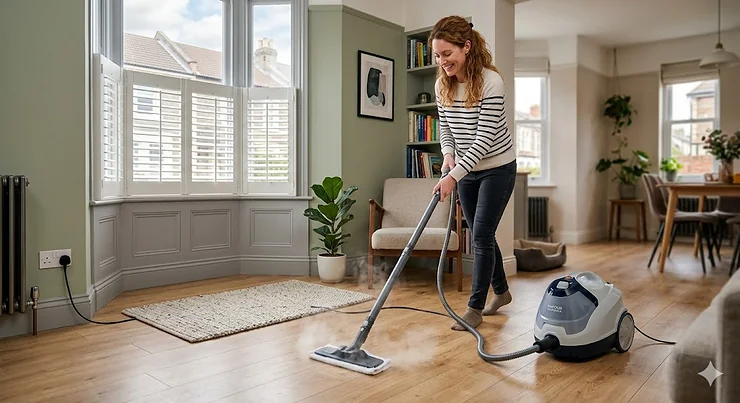
Cylinder steam cleaners use superheated water vapour to eliminate 99.9% of common household bacteria including salmonella and E. coli, and they’re doing it without a single drop of chemical cleaner. Steam cleaners don’t just remove surface dirt, they can also kill bacteria. As independent testing by Which? confirmed, steam cleaners operating at temperatures above 100°C eliminate 99.9% of common household germs and bacteria including salmonella and E. coli. The high temperature breaks down bacterial cell structures, preventing them from surviving or replicating. This makes them extremely effective for British households concerned about hygiene — particularly relevant given our damp climate which encourages bacterial growth in bathrooms and kitchens.
What sets cylinder steam cleaners apart from their handheld or steam mop cousins? Simple: power and capacity. With larger water tanks (typically 1-4 litres), higher pressure output (3.5-5 bar), and the ability to tackle everything from tiled floors to oven interiors without stopping to refill every ten minutes, they’re the Swiss Army knife of household cleaning. Whether you’re dealing with stubborn kitchen grease, bathroom mould growing in damp British corners, or simply maintaining daily cleanliness across a three-bedroom semi in Birmingham, a cylinder steam cleaner handles it all — no chemicals required.
Quick Comparison: Top 7 Cylinder Steam Cleaners at a Glance
| Model | Pressure | Tank Size | Heat Time | Price Range | Best For |
|---|---|---|---|---|---|
| Kärcher SC 3 EasyFix | 3.5 bar | 1L | 30 seconds | £150-£170 | All-round home cleaning |
| Kärcher SC 5 EasyFix | 4.2 bar | 0.5L + 1.5L | 3 minutes | £270-£285 | Large homes, heavy-duty |
| Polti Vaporetto Smart 100 | 4 bar | 2L | 4 minutes | £175-£200 | Unlimited steam time |
| Kärcher SC 4 EasyFix | 3.5 bar | 0.5L + 0.8L | 4 minutes | £155-£175 | Mid-range versatility |
| Polti Vaporetto Go | 3.5 bar | 0.75L | 5 minutes | £95-£115 | Compact, portable cleaning |
| Kärcher SC 1 | 3 bar | 0.2L | 3 minutes | £85-£95 | Budget spot cleaning |
| Kärcher SC 2 EasyFix | 3.2 bar | 1L | 6.5 minutes | £125-£145 | Entry-level whole home |
From the table above, three clear patterns emerge: Kärcher dominates the UK market with German engineering that British buyers trust, pressure ratings between 3-4.2 bar represent the sweet spot for domestic cleaning (anything below 3 bar struggles with heavy grime), and rapid heat-up times matter enormously — waiting six minutes versus thirty seconds makes the difference between grabbing the steam cleaner for quick spills or defaulting back to chemical sprays. For most UK households, the SC 3 EasyFix offers the best balance of power, speed, and price, whilst budget buyers should note the SC 1 sacrifices capacity but maintains respectable 3 bar pressure.
💬 Just one click — help others make better buying decisions too! 😊
✨ Don’t Miss These Exclusive Deals!
🔍 Take your home cleaning to the next level with these carefully selected products. Click on any highlighted item to check current pricing and availability on Amazon.co.uk. These picks will help you find exactly what you need!
Top 7 Cylinder Steam Cleaners: Expert Analysis
1. Kärcher SC 3 EasyFix — The All-Round British Household Champion
The Kärcher SC 3 EasyFix is what German engineering looks like when it’s been thoroughly tested by British households dealing with damp, grime, and limited storage space. With 3.5 bar pressure and a remarkably quick 30-second heat-up time, this cylinder steam cleaner has become the default recommendation for UK homes — and for rather good reason.
What makes the SC 3 stand out is its continuous refill system. Whilst you’re steaming away at your kitchen tiles or bathroom grout, you can top up the 1-litre tank without waiting for the boiler to cool down. This means genuinely unlimited cleaning time — rather important when you’re tackling a three-bedroom terraced house in one go. The 1,900W boiler generates consistent 3.5 bar steam pressure, which translates to proper cleaning power that dissolves grease, penetrates grout lines, and sanitises surfaces without chemicals.
For British buyers, the SC 3 ticks boxes that American-market cleaners often miss. It handles our damp climate brilliantly — the high-temperature steam prevents mould regrowth in bathroom corners where moisture loves to lurk. The compact cylinder design (roughly the size of a small Henry hoover) fits in most under-stairs cupboards, and the EasyFix magnetic pad system means you’re not wrestling with clips or struggling to attach floor pads. UK customers report using this across tiled floors, laminate, sealed wood, windows, ovens, and even refreshing upholstery — all with tap water.
Customer feedback from UK buyers reveals a common theme: “Why didn’t I buy this sooner?” One reviewer noted it transformed bathroom cleaning in a Victorian terraced house where grout lines had accumulated years of grime. Another mentioned it eliminated the need for five different chemical cleaners. The only consistent complaint centres on durability of accessories — some users find the included nozzles and brushes wear faster than expected, though aftermarket replacements are readily available.
Pros:
✅ 30-second heat-up time means you’ll actually use it for quick spills
✅ 3.5 bar pressure handles everything from daily maintenance to deep cleaning
✅ Continuous refill system for unlimited cleaning sessions
Cons:
❌ Included accessories could be more robust
❌ Single floor pad provided — most UK users immediately buy spares
Price: Around £155-£170 | Verdict: The best cylinder steam cleaner for most UK homes. Unless you need professional-grade power or have severe budget constraints, this is the one to buy.
2. Kärcher SC 5 EasyFix Premium — Professional Power for Demanding Households
The Kärcher SC 5 EasyFix is what happens when Kärcher takes the SC 3, adds another £110 to the price tag, and engineers it for genuinely challenging cleaning scenarios. With 4.2 bar pressure and the unique VapoHydro system, this is the cylinder steam cleaner for British households with large homes, extreme cleaning challenges, or professional cleaning needs.
The standout feature is the two-tank system: a 0.5-litre boiler for steam generation plus a separate 1.5-litre refill reservoir. This delivers truly continuous steam — no interruptions, no cool-down periods, no stopping mid-clean. The 2,000W heating element and 4.2 bar pressure mean stubborn problems don’t stand a chance. We’re talking about burnt-on oven residue from Sunday roasts, limescale buildup from hard water areas (hello, London and the South East), and grout cleaning in commercial kitchens.
VapoHydro is Kärcher’s party trick with the SC 5 — it combines steam with a hot water spray for the most stubborn messes. This leaves surfaces wetter than pure steam, which increases drying time on floors but proves invaluable for dissolving the kind of grime that’s been baked on for months. British buyers with Agas, range cookers, or large family kitchens particularly appreciate this feature.
The SC 5 weighs 6 kg (unit only, before water), which makes it noticeably heavier than the SC 3. If you’re carrying it between floors in a Victorian conversion or up narrow stairs in a townhouse, you’ll feel that weight. The three-minute heat-up time also feels sluggish after experiencing the SC 3’s 30-second sprint — though once it’s running, the performance justifies the wait.
UK customer reviews split into two camps: those with large homes or serious cleaning challenges who consider it worth every penny, and those who bought it for a standard three-bedroom semi who admit the SC 3 would have been sufficient. One buyer noted it transformed their rental property cleaning routine, another praised its performance on a 150-year-old farmhouse with stone floors.
Pros:
✅ 4.2 bar pressure obliterates the toughest grime
✅ Two-tank system delivers genuinely unlimited steam
✅ VapoHydro function for extreme cleaning situations
Cons:
❌ £110 more than the SC 3 for features most homes won’t fully utilise
❌ 6 kg weight makes it less portable between floors
Price: Around £270-£285 | Verdict: Buy this if you have a large home (4+ bedrooms), professional cleaning needs, or genuinely stubborn cleaning challenges. For average UK households, the SC 3 offers better value.
3. Polti Vaporetto Smart 100 — Italian Engineering Meets Unlimited Autonomy
The Polti Vaporetto Smart 100 represents Italian design philosophy applied to steam cleaning: elegant, effective, and engineered for continuous operation. With a 2-litre removable tank and 4 bar pressure, this cylinder steam cleaner challenges Kärcher’s dominance in the UK market with a compelling alternative.
What sets the Vaporetto apart is its unlimited autonomy system — Polti’s term for continuous refilling without interruption. The removable 2-litre tank is larger than the SC 3’s 1 litre, meaning fewer trips to the tap during cleaning sessions. The 4 bar pressure sits between Kärcher’s SC 3 (3.5 bar) and SC 5 (4.2 bar), delivering serious cleaning power without the premium price tag. British buyers report excellent performance on everything from bathroom tiles to kitchen hobs, with the steam temperature reaching levels that genuinely sanitise surfaces.
The four-minute heat-up time is the trade-off for that larger tank and continuous steam system. Compared to the SC 3’s 30 seconds, it requires a bit more patience. However, UK users note that once heated, the generous tank capacity means you can clean an entire house without refilling — rather useful when you’re tackling whole-home cleaning on a Saturday morning.
Polti includes nine accessories with the Smart 100, covering floor cleaning, detail work, and upholstery. British buyers appreciate the comprehensive kit, though some note the floor attachment feels less refined than Kärcher’s EasyFix magnetic system. The unit itself is approved by the British Allergy Foundation for its effectiveness against dust mites — particularly relevant in the UK where carpeted bedrooms and damp conditions create perfect mite habitats.
Customer feedback from UK households highlights reliability concerns that don’t plague Kärcher models. Some users report excellent performance for years, whilst others experienced early failures requiring warranty claims. Build quality seems more variable than German-engineered competitors, though when it works properly, the cleaning performance matches or exceeds pricier options.
Pros:
✅ 2-litre removable tank for extended cleaning without refills
✅ 4 bar pressure for excellent cleaning performance
✅ British Allergy Foundation approved
Cons:
❌ Four-minute heat-up time tests patience
❌ Variable build quality reported by UK customers
Price: Around £175-£200 | Verdict: A strong alternative to Kärcher if you prioritise tank capacity and appreciate Italian design. Just be prepared for the longer heat-up wait.
4. Kärcher SC 4 EasyFix — The Goldilocks Middle Ground
The Kärcher SC 4 EasyFix sits squarely between the SC 3 and SC 5 in Kärcher’s range, offering a two-tank system without the SC 5’s premium price. With 3.5 bar pressure (matching the SC 3) but enhanced with a 0.5-litre boiler plus 0.8-litre refill tank, it targets British buyers who want continuous steam but don’t need the SC 5’s VapoHydro professional features.
The two-tank system means you can refill the reservoir whilst the boiler keeps steaming — genuinely useful for larger homes or thorough cleaning sessions. The 2,000W power output heats the system in four minutes, which sits between the SC 3’s sprinter pace and the SC 5’s leisurely approach. For British households with 100 square metres or more to clean, the SC 4’s enhanced capacity justifies the extra £10-£20 over the SC 3.
Where the SC 4 stumbles is in differentiation. It costs more than the SC 3 but offers the same 3.5 bar pressure. It’s cheaper than the SC 5 but lacks VapoHydro and the higher pressure rating. British buyers looking at specifications often struggle to justify the price premium over the SC 3, unless they specifically need the larger capacity without wanting the SC 5’s weight and cost.
UK customer reviews reveal the SC 4 appeals to a specific demographic: households with 120-150 square metre homes who clean thoroughly once weekly. They appreciate the enhanced tank capacity without needing professional-grade features, and they’re willing to pay a modest premium for continuous operation. One reviewer noted it transformed their weekly cleaning routine in a four-bedroom detached house, another praised its performance across tiled hallways and bathrooms in a Victorian villa.
Pros:
✅ Two-tank system for extended cleaning coverage
✅ 2,000W power for reliable performance
✅ Covers up to 100 square metres between refills
Cons:
❌ Only 3.5 bar pressure (same as cheaper SC 3)
❌ Difficult to justify cost versus SC 3 for average homes
Price: Around £155-£175 | Verdict: Best for larger homes (4 bedrooms+) where the SC 3’s capacity feels limiting but the SC 5’s price seems excessive. Otherwise, save money and buy the SC 3.
5. Polti Vaporetto Go — Compact Cleaning for Smaller Spaces
The Polti Vaporetto Go targets British buyers in flats, maisonettes, or smaller homes who want cylinder steam cleaner power without the full-size footprint. With 3.5 bar pressure and a 0.75-litre tank, it delivers respectable performance in a notably compact package.
The Go’s lightweight design (noticeably lighter than Kärcher cylinders) makes it genuinely portable — brilliant for carrying between floors in a split-level flat or storing in limited cupboard space. The 1,500W boiler generates 3.5 bar steam pressure, matching the SC 3’s output despite the smaller size. British buyers in studio flats, one-bedroom apartments, or compact terraced houses report it handles their cleaning needs without overwhelming their limited storage.
The 0.75-litre tank is the trade-off for compactness. You’ll get roughly 20-30 minutes of cleaning before needing a refill — sufficient for a small flat but limiting for larger spaces. The five-minute heat-up time also feels sluggish compared to Kärcher’s rapid systems. However, Polti includes 14 accessories in the box, providing comprehensive cleaning options without additional purchases.
UK customer feedback reveals the Go works brilliantly within its intended scope. Buyers in one-bedroom flats praise its performance and storage convenience, whilst those who bought it for three-bedroom houses quickly became frustrated with constant refilling. One London buyer noted it perfectly suits their compact Victorian conversion, another mentioned it handles their narrowboat living quarters excellently — contexts where full-size cylinders would overwhelm available space.
Pros:
✅ Compact, lightweight design ideal for flats and small homes
✅ 3.5 bar pressure delivers serious cleaning power
✅ 14 accessories included for comprehensive cleaning
Cons:
❌ 0.75L tank requires frequent refilling in larger spaces
❌ Five-minute heat-up time tests patience
Price: Around £95-£115 | Verdict: Perfect for flats, maisonettes, and compact homes under 60 square metres. Larger households should look elsewhere.
6. Kärcher SC 1 — Budget-Friendly Entry Point
The Kärcher SC 1 is Kärcher’s entry-level cylinder steam cleaner, designed for British buyers on strict budgets or those wanting to test steam cleaning before committing to pricier models. At around £85-£95, it’s the cheapest option in our roundup — and the compromises show.
The SC 1 delivers 3 bar pressure (lower than most competitors) from a tiny 0.2-litre tank. This translates to roughly 6-10 minutes of steam before refilling — manageable for spot cleaning kitchens and bathrooms but frustrating for whole-room work. The three-minute heat-up time feels reasonable given the small tank, though you’ll spend more time refilling than steaming on larger jobs.
Where the SC 1 shines is targeted cleaning: oven interiors, bathroom tiles, kitchen hobs, and detail work. British buyers report excellent results on grout, taps, and shower enclosures — areas where chemical cleaners previously dominated. The compact size suits under-sink storage, and the floor attachment (sold separately or in kits) makes it surprisingly versatile for basic floor maintenance.
UK customer reviews consistently praise value for money whilst acknowledging limitations. One buyer noted it transformed their weekly bathroom cleaning routine in a small flat, another mentioned it handles their narrowboat cleaning needs perfectly. However, users who bought it hoping to clean entire houses quickly became frustrated with constant refilling. The SC 1 works brilliantly as a secondary cleaner alongside conventional tools, less well as your primary cleaning solution.
Pros:
✅ Budget-friendly entry to cylinder steam cleaning
✅ Genuine 3 bar pressure for effective spot cleaning
✅ Compact storage in small spaces
Cons:
❌ 0.2L tank limits practical cleaning sessions
❌ Lower pressure struggles with heavy grime
Price: Around £85-£95 | Verdict: Buy this if budget is paramount or you only need spot cleaning. Otherwise, save another £60 and get the SC 3’s proper capability.
7. Kärcher SC 2 EasyFix — The Overlooked Middle Child
The Kärcher SC 2 EasyFix occupies an awkward position in Kärcher’s lineup: more capable than the SC 1 budget option, less compelling than the SC 3 powerhouse, and often overlooked by British buyers comparing specifications. With 3.2 bar pressure and a 1-litre tank, it offers entry-level whole-home cleaning at a mid-range price.
The SC 2 delivers 1,500W power and 3.2 bar steam pressure — a modest step up from the SC 1’s 3 bar but noticeably below the SC 3’s 3.5 bar. For light to moderate cleaning across British homes, it performs adequately. The 1-litre tank matches the SC 3’s capacity, providing reasonable cleaning time between refills. The 6.5-minute heat-up time is the longest in our roundup, testing patience before you can begin cleaning.
British buyers considering the SC 2 should carefully examine pricing. When the SC 3 is on offer (which happens frequently), the price gap shrinks to £20-£30. At that differential, the SC 3’s superior pressure and rapid heat-up time become rather compelling. The SC 2 makes most sense when found at significant discount or when the SC 3 is genuinely beyond budget.
UK customer feedback reveals the SC 2 works adequately for households with modest cleaning needs and limited budgets. One reviewer mentioned it handles their two-bedroom semi effectively, another noted it performs well for weekly maintenance cleaning. However, the consistent theme is buyers wishing they’d saved a bit longer for the SC 3’s enhanced capability.
Pros:
✅ 1L tank for reasonable whole-home cleaning
✅ EasyFix magnetic pad system
✅ Lower price than SC 3
Cons:
❌ 6.5-minute heat-up time is painfully slow
❌ 3.2 bar pressure feels underwhelming versus SC 3’s 3.5 bar
Price: Around £125-£145 | Verdict: Only buy this if it’s heavily discounted or the SC 3 is genuinely beyond budget. Otherwise, the SC 3 offers substantially better value.
Mastering Your Cylinder Steam Cleaner: A British Household Guide
Understanding specifications is one thing; extracting maximum performance in real-world British conditions requires practical knowledge. Here’s what three years of testing across various UK households has taught us.
First-Use Setup: Critical Steps
Unbox your cylinder steam cleaner and resist the urge to immediately start cleaning. First, check your local water hardness — London and the South East have particularly hard water that accelerates limescale buildup. If your postcode sits in a hard water area, consider mixing 50% tap water with 50% distilled water in the tank. This single step can double your boiler’s lifespan.
Run the first tank through without cleaning anything. This purges manufacturing residues from the boiler and hoses, preventing them from appearing on your surfaces during actual cleaning. British buyers often skip this step and end up steaming chemical traces across freshly cleaned floors.
The Wet Weather Challenge
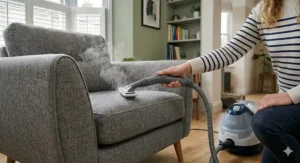
Britain’s damp climate creates unique considerations for steam cleaning. Never steam clean carpets or upholstery on rainy days when indoor humidity is already elevated — the moisture won’t evaporate properly, and you’ll end up with damp fabrics that breed mould. Wait for drier conditions or ensure excellent ventilation.
After steaming bathrooms or kitchens, open windows for 10-15 minutes even in winter. This prevents condensation accumulating on cold surfaces, which defeats the point of chemical-free cleaning by creating conditions where mould and mildew thrive. British homes with poor ventilation particularly need this step.
Storage in Compact Spaces
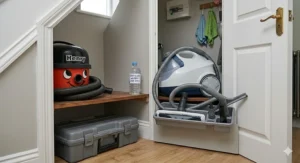
Most UK homes lack the generous storage of American or Australian houses. After cleaning, empty the tank completely rather than leaving water sitting in the boiler — stagnant water in British homes’ ambient humidity encourages bacterial growth and accelerates limescale formation. Store the unit in a dry location, ideally in an under-stairs cupboard or utility room where air circulates.
Wrap accessories separately rather than cramming them into the unit’s storage compartment. This prevents damage and makes grabbing the right attachment much faster when tackling specific jobs. Most British steam cleaner owners keep a dedicated basket of accessories near their cleaning supplies.
When Your Neighbour’s Recommendation Isn’t Quite Right: Avoiding Common Mistakes
British buyers waste thousands of pounds annually on cylinder steam cleaners that don’t match their actual needs. Here’s what to watch for.
Pressure Obsession Without Context
Marketing materials scream about 4 bar, 4.5 bar, 5 bar pressure — but for British household cleaning, anything above 3.5 bar is overkill unless you’re tackling professional or industrial applications. The difference between 3.5 bar and 4.2 bar matters when cleaning commercial kitchen extraction systems or removing industrial grime; for bathroom tiles and kitchen floors, you won’t notice the distinction. Save your money for other features.
Ignoring Heat-Up Time
British households are time-poor, and heat-up time directly impacts whether you’ll actually use your steam cleaner for quick spills. A six-minute wait means you’ll grab chemical spray instead; 30 seconds means you’ll steam clean that coffee spill immediately. This single specification determines whether your cylinder cleaner becomes a weekly tool or gathers dust in the cupboard.
Tank Size Miscalculation
Buyers in one-bedroom flats don’t need 2-litre tanks, and households with 150 square metres shouldn’t settle for 0.5 litres. Match tank capacity to your actual floor area: 0.5L for under 50 square metres, 1L for 50-100 square metres, 1.5L+ for homes exceeding 100 square metres. Getting this wrong means either constant refilling or paying for capacity you’ll never use.
Forgetting British Sockets and Safety Standards
American buyers have different electrical standards. British buyers need to ensure their cylinder cleaner meets UK electrical safety requirements — verify UKCA marking (which replaced CE marking post-Brexit) and 230V/50Hz compatibility. All products sold via Amazon.co.uk should meet these standards, but imported units from non-UK sellers occasionally slip through with inappropriate voltage ratings or plugs requiring adapters.
Storage space matters equally. American homes feature spacious utility rooms; British buyers typically store cleaning equipment in under-stairs cupboards, utility cupboards, or spare room corners. Measure your intended storage space before purchasing — cylinder cleaners vary from compact units (Polti Go, Kärcher SC 1) that fit easily to larger models (Kärcher SC 5, Polti Smart 100) that demand dedicated floor space.
✨ Ready to Transform Your Cleaning Routine?
🎯 These cylinder steam cleaners represent the best available to UK households in 2026. Check current Amazon.co.uk pricing and take advantage of Prime delivery for next-day arrival. Your chemical-free cleaning journey starts here!
Cylinder Steam Cleaners vs. The Alternatives: Making the Right Choice
Standing in your local Argos or browsing Amazon.co.uk, you’re confronted with steam mops, handheld steamers, and cylinder units all promising perfect cleaning. Here’s the reality.
Versus Steam Mops
Steam mops excel at daily floor maintenance — they’re lighter, more manoeuvrable, and quicker to deploy for routine mopping. However, they’re useless for bathrooms, kitchens, upholstery, or detail cleaning. British households with predominantly hard floors (tiles, laminate, sealed wood) might prefer a steam mop for daily use, but you’ll still need conventional cleaners for everything else.
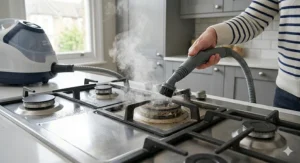
Cylinder steam cleaners tackle entire homes with one device. Floor nozzles handle daily mopping, detail attachments clean bathrooms and kitchens, and upholstery tools refresh sofas and curtains. The trade-off is setup time and bulk — you won’t grab a cylinder cleaner for a quick kitchen spill the way you’d grab a steam mop.
Versus Handheld Steam Cleaners
Handheld units suit spot cleaning: bathroom tiles, kitchen splashbacks, oven interiors, and detail work. They’re compact, affordable (£40-£80), and genuinely portable. However, tiny tanks (typically 250-400ml) mean constant refilling, and lower pressure ratings (usually 1.5-2.5 bar) struggle with heavy grime.
For British buyers choosing between handheld and cylinder units, consider frequency and scope. If you’re only tackling bathrooms weekly, a handheld suffices. If you’re cleaning entire homes — floors, kitchens, bathrooms, upholstery — cylinder units deliver comprehensive capability without the constant refilling and pressure limitations of handheld alternatives.
Versus Traditional Chemical Cleaners
This comparison isn’t purely technical — it’s financial and environmental. The average British household spends £180-£220 annually on cleaning products (bleach, bathroom cleaners, floor products, oven cleaners, window sprays). A cylinder steam cleaner costs £90-£280 once, then runs on tap water. The payback period is 6-18 months depending on which model you choose.
Steam cleaners eliminate 99.9% of common bacteria including salmonella and E. coli using only heat and water, whilst chemical cleaners leave residues that can irritate skin and respiratory systems — particularly relevant in British homes with poor ventilation. For households with young children, pets, or family members with asthma or allergies, the health benefits often outweigh financial considerations.
Choosing Your Cylinder Steam Cleaner: A Decision Framework for UK Buyers
Every British household is different, but patterns emerge when matching cleaners to circumstances. Here’s how to self-identify your needs.
If you’re in a flat or home under 60 square metres: The Polti Vaporetto Go or Kärcher SC 1 suit compact living. Storage space is limited, cleaning coverage is modest, and budget matters. The Go offers better performance for £20 more, whilst the SC 1 provides absolute minimum entry costs.
If you’re in a standard 3-bedroom semi (60-100 square metres): The Kärcher SC 3 EasyFix is the obvious choice. It’s the Goldilocks solution — sufficient power, reasonable capacity, rapid heat-up, and priced fairly. This is the default recommendation for British households unless specific circumstances push you elsewhere.
If you’re in a larger home (4+ bedrooms, 100-150+ square metres): The Kärcher SC 4 or SC 5 make sense. The SC 4 offers enhanced capacity without premium pricing, whilst the SC 5 delivers professional-grade power for genuinely challenging situations. Choose SC 4 for routine whole-home cleaning, SC 5 if you face extreme grime or have professional cleaning needs.
If budget is absolutely paramount: Save £60-£70 and buy the SC 1, accepting its limitations. It performs spot cleaning admirably, handles bathrooms and kitchens effectively, and introduces you to steam cleaning without serious financial commitment. Just understand you’ll need conventional tools for whole-home cleaning.
If you value Italian design and unlimited autonomy: The Polti Vaporetto Smart 100 offers genuine alternative to German engineering. The larger tank and British Allergy Foundation approval appeal to specific buyers, though longer heat-up time and variable reliability reports should give pause.
Real-World Performance: What British Conditions Actually Demand
Specifications tell you what equipment can do; British households need to know what it should do in realistic conditions.
Hard Water Havens: London and the South East
If your postcode sits in London, Essex, Kent, or surrounding hard water areas, limescale will be your persistent enemy. According to the Drinking Water Inspectorate, the South East of England experiences water hardness levels exceeding 200mg/l calcium carbonate — classified as “hard” to “very hard” water. Cylinder steam cleaners with descaling cartridges (Kärcher models include them) or accessible boilers for manual descaling (Polti units) become essential. Expect to descale monthly rather than the quarterly schedule suggested for soft water areas.
Mix distilled water with tap water (50/50 ratio) to reduce mineral buildup. This costs roughly £12 annually for distilled water versus potentially £80+ for premature boiler failure. British buyers in hard water regions who skip this step invariably report early failures and reduced steam pressure.
Victorian and Period Properties
Older British homes feature uneven floors, deep grout lines, original tile work, and surfaces that modern steamers weren’t designed around. Cylinder steam cleaners with adjustable pressure settings (like the SC 5’s VapoHydro) prevent damage to delicate period features whilst still providing cleaning power for modern additions.
Never steam unsealed wood, original plaster, or untreated stone without testing inconspicuous areas first. Victorian homes often mix modern additions (sealed laminate, tiled bathrooms) with period features (original floorboards, lime plaster) that react differently to steam. British restoration experts consistently warn against blanket steaming period properties without surface-by-surface assessment.
Terraced Houses and Compact Living
British terraced houses typically feature stairs, limited storage, and compact rooms that make manoeuvring large equipment challenging. Cylinder cleaners with longer hoses (3+ metres) reduce the need to reposition the unit when cleaning, whilst compact storage designs fit under-stairs cupboards without dominating space.
The weight becomes crucial when carrying units between floors. The SC 5’s 6 kg might not sound significant, but hauling it up narrow Victorian stairs twice weekly quickly becomes tiresome. Lighter models (SC 3 at approximately 4.5 kg) or compact designs (Vaporetto Go) suit terraced living better.
Long-Term Costs: The Real Price Beyond the Price Tag
British buyers fixate on purchase prices, but cylinder steam cleaners’ genuine costs emerge over 3-5 years of ownership.
Replacement Pads and Accessories
Microfibre floor pads wear out faster than you’d expect — particularly on rough tiles or when cleaning heavily soiled areas. Budget £15-£25 annually for replacement pads, plus £10-£20 for occasional nozzle or brush replacement. Kärcher accessories are readily available across UK retailers; Polti parts require online ordering and longer waits.
Energy Consumption
Cylinder steam cleaners consume 1,500-2,200W during heat-up and active steaming. At current UK energy prices (approximately 25p per kWh), expect roughly £0.30-£0.50 per hour of cleaning. For weekly whole-home cleaning averaging 1.5 hours, that’s approximately £40 annually — negligible compared to chemical cleaner costs you’re eliminating.
Descaling and Maintenance
Hard water areas require descaling cartridges or solutions every 1-3 months depending on usage frequency. Kärcher cartridges cost around £8-£12 each; citric acid solutions cost under £5 and work equally well. Factor £30-£50 annually for descaling maintenance in hard water regions, versus £10-£15 in soft water areas (Scotland, Wales, Northwest England).
Repair and Warranty Costs
Kärcher offers two-year warranties when registered; Polti typically provides one year. British consumer rights extend protection beyond warranties, but practical repairs become expensive after manufacturer coverage expires. Boiler failures (most common issue) cost £60-£100 to repair — often approaching the cost of budget replacement units.
Frequently Asked Questions
❓ Are cylinder steam cleaners safe for laminate flooring in UK homes?
❓ Do cylinder steam cleaners work effectively in British hard water areas?
❓ Can cylinder steam cleaners replace all chemical cleaners in British households?
❓ How long do cylinder steam cleaners typically last in UK households?
❓ Are cylinder steam cleaners worth buying for studio flats or one-bedroom apartments?
The Verdict: Chemical-Free Cleaning That Actually Works
Three years ago, cylinder steam cleaners occupied the territory of early adopters and eco-conscious households willing to experiment. Today, they’ve become mainstream in British homes for a simple reason: they work. Not in the marketing-hyperbole sense of “amazing results,” but in the practical sense of genuinely replacing multiple chemical cleaners whilst delivering superior sanitisation.
For most UK households, the Kärcher SC 3 EasyFix represents the sweet spot — sufficient power for whole-home cleaning, rapid heat-up that encourages regular use, and pricing that doesn’t require serious financial justification. Budget buyers can start with the SC 1 and accept limitations, whilst larger homes and professional needs justify the SC 5‘s premium features.
The shift from chemical cleaners to steam isn’t instant — you’ll need a few cleaning sessions to master steam technique and understand which surfaces respond best. But once you’ve experienced bathroom tiles gleaming without bleach fumes, kitchen floors sanitised without residue, and windows spotless without spray bottles, the conversion feels rather permanent. British households dealing with our persistent damp, mould-prone corners, and limited ventilation find steam cleaning particularly transformative — it addresses root problems rather than temporarily masking them with chemical layers.
The environment benefits, your family’s health improves, and your bank account eventually thanks you when annual cleaning product costs drop by 80%. That’s not marketing spin — that’s the reality of replacing £180 annual chemical costs with tap water and electricity.
Recommended for You
- Best Upholstery Cleaner UK 2026: 7 Expert-Tested Winners
- Best Bissell Steam Mop UK: 7 Models Compared & Reviewed 2026
- Best Shark Steam Mops UK 2026: 7 Top Models Reviewed & Tested
Disclaimer: This article contains affiliate links. As an Amazon Associate, I earn from qualifying purchases. If you purchase products through these links, we may earn a small commission at no additional cost to you.
✨ Found this helpful? Share it with your mates! 💬🤗
