
In This Article
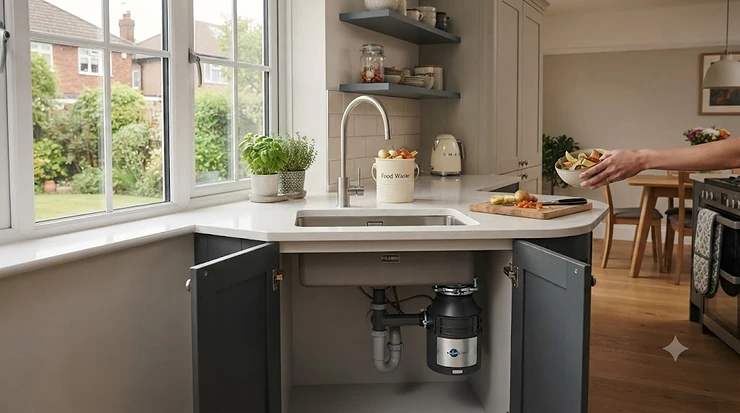
There’s a specific kind of dread that comes with peeling prawns over a bin that’s already three days from collection day. A food waste disposer is an electric grinder, fitted under your kitchen sink, that liquefies scraps into particles fine enough to flow safely away through your existing plumbing — no caddy, no smell, no seagulls investigating your wheelie bin at 6am. If you’ve been circling the idea of a best food waste disposer for your own kitchen, you’re in good company: UK households throw away around 6.0 million tonnes of food and drink every year, working out to roughly 210 kg per household, according to WRAP’s household food waste research. A disposer won’t fix your shopping habits, but it will change what happens to the bits you can’t eat anyway.
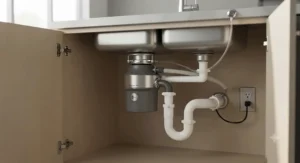
This guide isn’t a rewritten spec sheet. We’ve dug into real InSinkErator and Franke models sold on amazon.co.uk, cross-referenced their grind technology and warranty terms against genuine owner feedback, and built out honest, practical advice around motor horsepower, septic tank compatibility, and what actually happens when the thing jams at 8pm on a Tuesday. Whether you’re renting a flat with a tiny under-sink cupboard or kitting out a forever-home kitchen, there’s a model here that fits — and a lot of reasoning to help you tell the difference between marketing gloss and genuine engineering.
Quick Comparison Table
Before we get into the weeds, here’s the fast version. Each of these seven units is a real, currently available product, and every one of them earns its place for a different reason — budget, brute strength, quiet operation, or sheer longevity of warranty.
| Product | Motor | Grind Stages | Best For | Price Range |
|---|---|---|---|---|
| InSinkErator Badger 5 | 1/2 HP | 1-stage | Renters and light use | Under £150 |
| Franke Elite Slimline 50 | 1/2 HP | 1-stage | Tight, shallow cupboards | £150–£200 range |
| InSinkErator Premium 550 EC | Dura-Drive | 2-stage | Everyday value | £150–£200 range |
| InSinkErator Premium 700 EC | Dura-Drive (high-torque) | 2-stage | Large, busy households | £200–£250 range |
| Franke Elite Slimline 100 | 1 HP | 1-stage | Tough, fibrous scraps | £250–£300 range |
| InSinkErator Evolution 200 S | 0.75 HP | 3-stage | Quietest all-rounder | £250–£300 range |
| InSinkErator Evolution 250 | 0.75 HP | 3-stage | Premium, longest warranty | £300–£350 range |
What jumps out here isn’t just the price spread — it’s that horsepower and grind stages don’t move in lockstep. The Franke Elite Slimline 100 packs a full 1 HP motor but only a single grinding stage, which trades ultra-fine mulching for raw chewing power on stringy veg. Meanwhile the InSinkErator Evolution 200 S gets away with a smaller 0.75 HP motor because its 3-stage grind does more work per rotation, which is a large part of why it’s also markedly quieter. Bigger numbers on a spec sheet don’t automatically mean a better disposer for your kitchen.
💬 Just one click — help others make better buying decisions too!😊
Top 7 Best Food Waste Disposers: Expert Analysis
We’ve ordered these from most affordable to most premium, covering entry-level renters’ units right through to the longest-warrantied option on the UK market. Every product name below stays in bold throughout the article, so you can scan back to any model in seconds.
1. InSinkErator Badger 5 — most affordable way to start
The InSinkErator Badger 5 is the no-frills entry point into disposer ownership, and it earns that reputation honestly: this is a continuous-feed, 1/2 HP unit with a single-stage permanent magnet motor and none of the acoustic dampening you’ll find further up the range. In practice that means it handles standard daily scraps — vegetable peelings, eggshells, small bits of leftover pasta — without fuss, but it’s noticeably louder than the Evolution-branded units and will grind more slowly through fibrous waste like celery strings. Based on the spec comparison with pricier Emerson-owned siblings, this is best suited to single people, couples, or a first rental flat where you want the convenience without the premium spend. Aggregated review sentiment across Amazon and appliance forums consistently flags the Badger 5 as reliable for its price bracket, though several reviewers note it’s genuinely audible from an adjoining room — worth knowing if you’ve got open-plan living. It has no auto-reverse jam-clearing feature, so you’ll lean on the manual wrenchette more than with premium models.
Pros:
- ✅ Lowest entry price in the InSinkErator range
- ✅ Simple continuous-feed operation, no learning curve
- ✅ Compact enough for most standard cupboards
Cons:
- ❌ No sound insulation — noticeably loud in use
- ❌ No auto-reverse jam protection built in
At under £150 at the time of research, the Badger 5 is straightforward value: you’re paying for grinding, not hush.
2. Franke Elite Slimline 50 — slimmest footprint for tight cupboards
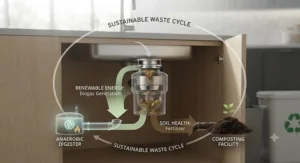
If your under-sink cupboard is more shoebox than storage unit, the Franke Elite Slimline 50 was built with you in mind. It runs a permanent, high-torque dual magnetic motor at 2,600 RPM, and Franke’s own product literature confirms it’s designed specifically for compact installation spaces without sacrificing continuous-feed capability. What that spec actually means day to day: quick spin-up from a standing start, no warm-up lag, and a grinding action that liquefies food fast enough that clogging is rare if you run the tap properly. On paper this makes it a strong pick for narrow galley kitchens or older homes with shallow under-sink plumbing runs, where bulkier InSinkErator premium units simply won’t physically fit. Verified review volume for Franke’s disposer range is thinner than InSinkErator’s on UK retail sites, but installer and trade-forum commentary consistently describes the Slimline range as dependable workhorses rather than flashy showpieces — which, frankly, is exactly what you want bolted under a sink. The magnetic cutlery-catching rim is a genuinely useful touch that’s easy to overlook on a spec sheet.
Pros:
- ✅ Slimmest physical profile in this comparison
- ✅ Magnetic rim catches dropped cutlery before damage
- ✅ Antibacterial protection built into the housing
Cons:
- ❌ Single-stage grind, coarser output than Evolution models
- ❌ Fewer verified UK owner reviews to draw on
Expect to pay in the £150–£200 range, positioning it as a value pick specifically for space-constrained kitchens.
3. InSinkErator Premium 550 EC — best value stainless chamber
The InSinkErator Premium 550 EC sits right at the point where “budget” starts becoming “sensible mid-range,” and its 980 ml stainless steel grind chamber with 2-stage MultiGrind technology is the reason why. What that means practically is a genuinely tougher build than the Badger 5 — stainless steel resists the pitting and odour retention that plastic components can develop over years of use — paired with a grinding process that runs waste through two separate stages before it’s flushed away. Here’s what to weigh: this model uses Lift & Latch mounting, which InSinkErator designed to make DIY installation realistic for a confident homeowner rather than strictly a plumber’s job. Reviewers on Trustpilot and Amazon consistently note that InSinkErator’s UK customer service line is unusually helpful even for warranty-expired units, which matters more than it sounds once you own an appliance that lives under running water. The built-in air switch accessory is included as standard, saving you a separate purchase that some rival brands treat as an optional extra.
Pros:
- ✅ Stainless steel grind chamber resists corrosion
- ✅ 2-stage grinding for finer particle output
- ✅ Built-in air switch included as standard
Cons:
- ❌ Motor torque sits below the Premium 700 EC
- ❌ Not the quietest option at this price point
At roughly £150–£200, it’s a sensible middle ground for buyers who want stainless-steel durability without stretching to the Evolution tier.
4. InSinkErator Premium 700 EC — best for big family kitchens
Step up to the InSinkErator Premium 700 EC and you get the same 2-stage grind philosophy as the 550 EC, but paired with what InSinkErator describes as a higher-torque Dura-Drive motor built to cope with heavier, more frequent use. What most buyers overlook about this model is that torque, not top-line horsepower, is usually the more relevant number for a family kitchen that’s grinding chicken carcasses and corn cobs three times a week rather than the occasional carrot peeling. The removable baffle and one-piece stainless stopper make daily cleaning genuinely quick, which matters more than any single grinding spec once you’re using a disposer multiple times a day. Based on the spec comparison against the 550 EC, the jump in price buys you resilience under sustained load rather than a dramatically different user experience for light users. Aggregated feedback from InSinkErator’s UK Trustpilot page repeatedly praises the brand’s willingness to send replacement parts and troubleshoot over the phone, which is reassuring for a household that can’t afford a broken disposer during a dinner party rush.
Pros:
- ✅ Higher-torque motor built for frequent, heavy use
- ✅ Quick-clean removable baffle and stopper design
- ✅ Strong aggregated customer service sentiment on Trustpilot
Cons:
- ❌ Larger footprint may not suit small cupboards
- ❌ Premium pricing versus the entry-level EC models
Priced around £200–£250 at the time of research, it’s the sensible pick for households of four or more who cook from scratch regularly.
5. Franke Elite Slimline 100 — best power-to-price for tough scraps
The Franke Elite Slimline 100 doubles the motor output of its Slimline 50 sibling, running a full 1 HP permanent motor at 2,750 RPM. In practice, that extra headroom shows up most clearly with fibrous or dense waste — think broccoli stalks, sweetcorn husks, or a stack of chicken bones from a roast dinner — where lower-powered units can bog down mid-grind. Here’s what the spec sheet won’t spell out: single-stage grinding at this horsepower still processes waste quickly, it just produces a slightly coarser particle size than a multi-stage InSinkErator unit, which is rarely an issue unless your household plumbing runs particularly narrow or has existing flow problems. What most buyers overlook about this model is the antimicrobial housing treatment, which genuinely reduces the “damp bin” smell that put a lot of people off disposers in the first place. Trade feedback and kitchen-fitter commentary consistently rates Franke’s build quality as commercial-adjacent, which tracks given Franke’s parallel presence in professional kitchen equipment.
Pros:
- ✅ Full 1 HP motor handles fibrous waste confidently
- ✅ Antimicrobial housing reduces odour buildup
- ✅ 3-bolt mounting compatible with most Franke sinks
Cons:
- ❌ Coarser single-stage grind than 2- or 3-stage rivals
- ❌ Premium pricing for a single grinding stage
Expect to pay in the £250–£300 range, a fair ask for buyers whose food waste regularly includes tougher scraps.
6. InSinkErator Evolution 200 S — quietest all-rounder on the market
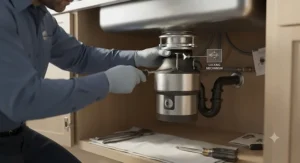
The InSinkErator Evolution 200 S is the model most UK kitchen fitters reach for when a client asks for “the good one” without a specific budget in mind, and the reasoning holds up under scrutiny. Its 1,180 ml grind chamber runs a genuine 3-stage grind process, and InSinkErator’s own testing puts it at 60% quieter than standard models, thanks to Evolution-Quiet technology, an anti-vibration mount, and an inductor motor with fewer moving parts. What that means in a real kitchen: you can run it mid-conversation without raising your voice, which sounds trivial until you’ve lived with a Badger 5 under an open-plan island. The auto-reverse feature genuinely earns its keep here — rather than manually clearing every minor jam with the wrenchette, the unit automatically reverses grind direction to work around most blockages on its own. Reviewers consistently describe this as the tier where disposers stop feeling like a compromise and start feeling like a proper kitchen appliance, and the removable baffle keeps cleaning painless despite the more complex internals.
Pros:
- ✅ 60% quieter operation than standard InSinkErator models
- ✅ 3-stage grind produces genuinely fine particles
- ✅ Auto-reverse clears most minor jams automatically
Cons:
- ❌ Noticeably pricier than the Premium EC range
- ❌ Larger grind chamber needs adequate cupboard depth
At around £250–£300, this is the model most reviewers and installers recommend as the default “just get the good one” choice.
7. InSinkErator Evolution 250 — longest warranty, premium finish
Sitting at the top of this line-up, the InSinkErator Evolution 250 shares its core engineering — 0.75 HP motor, 1,180 ml stainless chamber, 3-stage grind — with the Evolution 200 S, but InSinkErator positions it as the special-edition, premium-retailer model, and the details back that up. The most meaningful upgrade isn’t cosmetic: it carries an 8-year warranty against the 200 S’s 6 years, plus a one-piece stainless steel stopper rather than a strainer basket. What most buyers overlook is that warranty length is effectively a proxy for manufacturer confidence in long-term motor reliability — InSinkErator isn’t offering an extra two years of cover on a component it expects to fail early. Based on the spec comparison, the actual grinding and noise performance is functionally identical to the 200 S, so you’re paying the premium specifically for peace of mind and finish quality rather than a meaningfully different day-to-day experience. For buyers who plan to stay in a property for a decade or more, that calculation tends to make sense.
Pros:
- ✅ 8-year warranty, the longest in this comparison
- ✅ Premium stainless steel stopper included
- ✅ Identical quiet, 3-stage grind performance to the 200 S
Cons:
- ❌ Little functional difference over the cheaper 200 S
- ❌ Only sold through select premium retailers
At around £300–£350 at the time of research, it’s a considered long-term buy rather than a bargain-hunter’s pick.
Full 7-Model Comparison
| Product | Grind Chamber | Noise Level | Warranty | Best For |
|---|---|---|---|---|
| InSinkErator Badger 5 | Standard | Loud | Standard InSinkErator cover | Renters, light use |
| Franke Elite Slimline 50 | Compact | Moderate | Manufacturer standard | Tight cupboards |
| InSinkErator Premium 550 EC | 980 ml stainless | Moderate | Standard InSinkErator cover | Everyday value |
| InSinkErator Premium 700 EC | 980 ml stainless | Moderate | Standard InSinkErator cover | Large households |
| Franke Elite Slimline 100 | Compact | Moderate-loud | Manufacturer standard | Tough, fibrous waste |
| InSinkErator Evolution 200 S | 1,180 ml stainless | Whisper-quiet | 6 years | Quietest all-rounder |
| InSinkErator Evolution 250 | 1,180 ml stainless | Whisper-quiet | 8 years | Long-term premium buy |
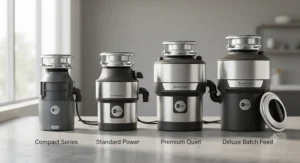
Read across this table and a pattern emerges: warranty length and noise reduction track together almost exactly with price, while raw motor power doesn’t. The Franke Elite Slimline 100 proves that a genuinely muscular 1 HP motor can still be a mid-tier product if it skips the sound-dampening engineering that InSinkErator builds into its Evolution range. If your priority is a quiet kitchen over sheer grinding force, spend your money on the Evolution tier rather than chasing horsepower numbers alone.
Practical Usage Guide: Setup, First Use and the First 30 Days
Getting a disposer humming properly starts before you’ve even switched it on. Most models need a 90 mm sink hole and a standard 13 amp socket within 600 mm of the install point — check both before you buy, because retrofitting a socket is the single most common surprise cost buyers report. On first use, run the cold tap for a few seconds before feeding in any waste, keep it running throughout grinding, and continue for a further five to ten seconds after the noise changes to a smoother tone, which signals the chamber is clear. Cold water matters more than people expect: hot water can soften fats into a semi-liquid state that later re-solidifies further down your pipework, creating exactly the kind of blockage the disposer was meant to prevent.
In the first month, feed waste in gradually rather than dumping a full washing-up bowl of peelings at once — small, steady batches let the grind stages work efficiently and reduce jam risk while you’re still learning the unit’s rhythm. Avoid fibrous items like celery, corn husks, and onion skins until you’re confident with the machine, since these are the most common culprits behind early jams on every model in this guide. A common mistake in the first 30 days is running the disposer dry or switching it off before the water clears the chamber; both habits shorten motor life. Finally, resist the urge to pour cooking oil or fat down afterward “to keep it moving” — that’s precisely the opposite of what keeps a disposer, and your drains, running cleanly.
Real-World Scenarios: Which Disposer Fits Your Kitchen?
If you’re a student or young professional in a rented one-bed flat, cooking mostly solo meals and wary of a big upfront spend, the InSinkErator Badger 5 or Franke Elite Slimline 50 covers your actual usage pattern without over-investing in a rental property you might leave within eighteen months. Neither model demands premium installation, and both fit the kind of compact cupboard common in newer flat conversions.
If you’re a family of four or five in a semi-detached home, cooking from scratch most nights and regularly dealing with meat trimmings, vegetable peelings, and the odd chicken carcass, the InSinkErator Premium 700 EC or Franke Elite Slimline 100 matches that load. You need the torque and grind capacity for genuinely tough, frequent waste, and the higher price reflects genuine mechanical headroom rather than branding.
If you’re renovating a forever-home kitchen and open-plan living means every appliance noise is audible from the sofa, the InSinkErator Evolution 200 S or Evolution 250 earns its price purely on acoustic grounds. Combine that with an eight-to-ten-year ownership horizon and the Evolution 250’s longer warranty starts to look less like an indulgence and more like sensible budgeting for a fit-and-forget appliance you won’t want to touch again for a decade.
Problem → Solution: Fixing the Most Common Food Waste Disposer Issues
Problem: the unit hums but won’t grind. This is almost always a jam, and every model in this guide ships with a hex-shaped jam release wrench — sometimes called a wrenchette — designed to insert into a socket underneath the unit and manually rotate the flywheel free. Switch off power at the isolator first, always.
Problem: it trips the circuit repeatedly. Most units have a reset button on the underside; press it once the jam is cleared and the unit has cooled. Persistent tripping after a proper reset usually points to a failing motor rather than a simple blockage, and it’s worth calling manufacturer support before assuming the worst — InSinkErator’s UK team in particular has a strong aggregated reputation on Trustpilot for diagnosing this over the phone.
Problem: lingering odours despite regular use. Ice cubes made from white vinegar, ground through the unit every couple of weeks, scour the grind chamber without harsh chemicals. Citrus peel does something similar and smells considerably better doing it.
Problem: water drains slowly after installation. Check the discharge pipe connection first; a loose or misaligned gasket at the installation stage is the single most common cause, and it’s a five-minute fix rather than a fault with the unit itself.
Problem: unusual grinding noise, not a jam. This is often loose cutlery or a stray bone fragment lodged against the impeller wall. Power off, use the wrenchette to check the chamber visually where the model allows, and never reach in with your hand.
Buyer’s Decision Framework: Which Disposer Should You Actually Buy?
If noise is your top priority, choose an Evolution-tier model, because its 3-stage grind and inductor motor design were specifically engineered around sound reduction rather than just raw grinding power. If budget is your top priority, choose the Badger 5 or Franke Slimline 50, because they deliver genuine functional disposal without paying for acoustic engineering you may not need in a small flat. If your household regularly grinds tough, fibrous, or bony waste, choose the Franke Slimline 100 or Premium 700 EC, because their higher torque and grind capacity are built for sustained heavy use rather than occasional light scraps. If you’re planning to stay in your home for a decade or longer, choose the Evolution 250, because its 8-year warranty effectively front-loads your peace of mind against the one component — the motor — that’s genuinely expensive to replace out of warranty.
How to Choose the Best Under Sink Food Waste Disposer
Picking the best under sink food waste disposer comes down to matching seven practical factors to your actual kitchen, not chasing the biggest number on a spec sheet. Here’s the reasoning behind each:
- Measure your cupboard depth first. A disposer that doesn’t physically fit under your sink alongside existing pipework and a bin isn’t a bargain at any price.
- Check your sink hole size. Most UK models need a 90 mm waste hole; older sinks may need an adaptor or a new sink altogether, which changes your total budget.
- Confirm you have a nearby power source. A 13 amp socket within 600 mm of the install area is standard across this comparison; retrofitting one adds real cost.
- Match motor type to your waste habits. Light, mostly vegetable waste suits a 1/2 HP single-stage unit; bony, fibrous, or high-volume waste justifies the extra torque of a Premium or Slimline 100-tier model.
- Weigh noise against your kitchen layout. Open-plan living spaces benefit disproportionately from Evolution-tier sound engineering compared with closed, separate kitchens.
- Check septic tank compatibility before anything else if you’re off mains drainage — this single factor can rule out or reshape your shortlist entirely, and we cover it in detail below.
- Factor in warranty length as a proxy for expected lifespan. A jump from 6 to 8 years, as with the Evolution 200 S versus 250, tells you something real about manufacturer confidence.
Motor Horsepower Rating: What It Actually Means for Performance
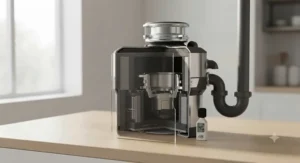
Horsepower gets treated like a headline number, but on its own it’s a poor predictor of real-world performance. A 1 HP Franke Slimline 100 and a 0.75 HP InSinkErator Evolution 200 S will both clear a typical dinner’s worth of vegetable peelings without drama; the meaningful difference shows up on tougher waste, where the Franke’s extra raw torque pushes through fibrous stalks and small bones that a lower-horsepower single-stage unit might need a second pass to finish. What the spec sheet won’t tell you, but engineering documentation makes clear, is that grind stages matter as much as motor size: InSinkErator’s 3-stage Evolution units achieve finer, more consistent particle output at 0.75 HP than many 1 HP single-stage competitors, because the waste passes through multiple grinding surfaces rather than one. In practice, treat horsepower as a rough guide to how the unit copes with dense or stringy waste, and treat grind-stage count as the better predictor of how fine — and how flushable — the final output actually is.
Food Waste Disposers vs Traditional Waste Bins
| Factor | Food Waste Disposer | Traditional Kitchen Bin |
|---|---|---|
| Odour control | Minimal — waste is flushed away immediately | Ongoing, especially in warm weather |
| Weekly effort | Near-zero once installed | Regular bagging and bin-day carrying |
| Upfront cost | £150–£350 range plus installation | Low, often already owned |
| Environmental route | Wastewater treatment, potential biogas recovery | Landfill or council food waste collection |
| Pest attraction | Very low | Higher, particularly with meat scraps |
The upfront cost gap is real and shouldn’t be waved away, but it’s a one-off outlay against years of avoided bin bags, reduced odour, and one less trip to the outside bin in the rain. Where a disposer genuinely loses ground is flexibility — a bin can hold literally anything, while a disposer has hard limits around fats, large bones, and fibrous waste. For households already served by an efficient weekly food waste collection, the case for a disposer is more about convenience and hygiene than environmental necessity; for those without reliable collection, it’s considerably stronger.
Septic Tank Compatibility and Safety Guide
This is the single most important check for anyone living off mains drainage, and it’s genuinely worth doing before you fall in love with a specific model. Not every food waste disposer is suitable for septic tank systems, and running one incorrectly can accelerate solids build-up in the tank faster than a household without a disposer would experience. Grinding food waste doesn’t destroy it — it just breaks it into smaller particles that still need to settle and break down inside the tank, and a peer-reviewed study simulating disposer use in a septic system found it increased total suspended solids by over 30% and chemical oxygen demand by nearly half over a 110-day test period. That doesn’t mean disposers and septic tanks are incompatible — it means septic households need to be more disciplined about what goes down the chute and how often the tank gets professionally emptied.
InSinkErator’s own support guidance confirms its disposers can be used with septic systems, and the brand even offers septic-specific models designed with enzyme-assist features elsewhere in its range, though none of the seven units in this guide is a dedicated septic-assist model. If you’re on a septic tank, stick to smaller, more frequent grinding sessions rather than one large batch, run cold water generously throughout, and have your tank inspected and pumped more regularly than you would without a disposer installed. Councils and industry bodies also stress that solid food waste output should ideally be captured and separated rather than allowed straight into the wastewater stream wherever local guidance and equipment allow, a point echoed in official guidance on introducing food waste disposers to households. If any of this feels uncertain for your specific setup, a conversation with your septic tank supplier before installation is a genuinely worthwhile hour spent.
Common Mistakes When Buying a Food Waste Disposer
The most frequent mistake is buying on horsepower alone, which — as covered above — tells you less than grind-stage count and chamber capacity about real-world output quality. A close second is skipping the cupboard measurement step; more than one buyer has purchased an Evolution-tier unit only to discover its larger 1,180 ml chamber doesn’t clear existing pipework. Underestimating installation costs is another common trap — while many models are DIY-friendly, buyers without existing 13 amp sockets nearby or without plumbing confidence often end up paying a tradesperson roughly what they saved by choosing a cheaper unit in the first place. Ignoring septic tank status entirely, rather than checking it before purchase, is a mistake that can cause genuine problems months down the line rather than an easy return. Finally, plenty of buyers skip reading the warranty terms closely, only to discover that continuous-feed and batch-feed units — or DIY versus professionally installed units — sometimes carry different cover, a detail Grand Designs Magazine’s consumer guide rightly flags as worth checking before you commit to a specific retailer.
Long-Term Cost & Maintenance
Running costs are lower than most people assume. Electricity consumption for a typical 1/2 HP unit is roughly comparable to leaving a 100-watt bulb on for an hour across a whole month of normal use — genuinely negligible against your overall energy bill. Water usage rises only marginally, since a disposer’s cycle time is short and modern units are engineered to minimise the extra flow needed to flush particles through. The real long-term cost sits in three places: occasional descaling or vinegar-ice cleaning cycles (essentially free), the eventual wrenchette-assisted jam clearance that every owner faces at some point regardless of model, and — many years down the line — motor replacement once a unit is past its warranty. This is where the warranty-length gap between the Evolution 200 S and Evolution 250 becomes a genuine financial argument rather than just marketing: two extra years of cover on the most expensive component to replace is worth factoring into your total cost of ownership, not just your purchase price.
InSinkErator Review: What UK Buyers Actually Report
Given how much of this comparison leans on InSinkErator models, it’s worth pausing on the brand specifically rather than just the individual products. Aggregated sentiment across InSinkErator’s UK Trustpilot presence — thousands of reviews at the time of research — skews heavily toward praise for customer service responsiveness: multiple reviewers describe support staff talking them through troubleshooting over the phone, and several mention goodwill gestures like replacement wrenchettes sent free of charge well outside the warranty period. Reviewers consistently note that even faulty units bought through third-party retailers like Amazon have been replaced without excessive friction. On the negative side, a recurring theme in older reviews involves jamming on well-used units, occasionally requiring a paid engineer callout once warranty cover has lapsed — a reminder that the DIY wrenchette fix genuinely is worth attempting first, since call-out charges for a straightforward jam can run into the tens of pounds per hour. Taken together, the pattern that emerges isn’t “flawless appliance” so much as “a company that backs its products meaningfully when something does go wrong,” which for a device that lives permanently plumbed under your sink is arguably the more useful thing to know.
✨ Don’t Miss These Exclusive Deals!
🔍 Take your kitchen upgrade to the next level with one of the disposers featured above. Click through on any highlighted model to check current pricing and availability before you decide. A properly matched disposer will keep your kitchen fresher and your bin considerably lighter for years to come!
Features That Actually Matter (And Those That Don’t)
Grind chamber capacity and stage count matter — they directly determine how finely waste is processed and how likely you are to face a blockage further down the line. Motor torque matters, particularly if your household generates fibrous or bony waste regularly. Warranty length matters more than most buyers initially credit, since it’s the clearest external signal of how long a manufacturer expects the core motor to last. Sound insulation matters disproportionately in open-plan kitchens and matters far less in a separate, closed kitchen where noise doesn’t travel into living space.
What matters less than the marketing suggests: exact RPM figures in isolation, since a well-engineered lower-RPM multi-stage unit can outperform a higher-RPM single-stage one on output quality. Colour and finish options are genuinely cosmetic and worth zero weighting in a comparison that’s fundamentally about a component you’ll never actually see once it’s installed. And “antibacterial” branding, while not meaningless, shouldn’t be treated as a substitute for basic maintenance — regular cold-water flushing and occasional vinegar-ice cleaning do more for odour control than any marketed coating.

Frequently Asked Questions
❓ What is the best food waste disposer for a small UK kitchen?
❓ Do I need a plumber to install a food waste disposer?
❓ Can I use a food waste disposer with a septic tank?
❓ What's the difference between InSinkErator's Evolution and Premium ranges?
❓ How long does a food waste disposer typically last?
Conclusion
Choosing the best food waste disposer really does come down to matching real specifications to your actual kitchen rather than chasing the biggest horsepower figure on the box. If you want the quietest possible experience and don’t mind paying for it, the InSinkErator Evolution 200 S or Evolution 250 are the honest top picks in this comparison — the latter specifically if you’re planning to stay put for the best part of a decade. If your household grinds through genuinely tough, fibrous waste on a regular basis, the Franke Elite Slimline 100 or InSinkErator Premium 700 EC bring the torque to match. And if you just want a reliable way to stop food scraps sitting in a caddy without spending a small fortune, the Badger 5 or Franke Slimline 50 do the job without ceremony. Whichever you choose, check your cupboard depth, your power supply, and — critically, if you’re off mains drainage — your septic tank compatibility before you click buy. Get those three right and the rest of this decision is really just about how much quiet you’re willing to pay for.
Recommended for You
- How to Clean a Smelly Kitchen Bin: 7 Fixes That Work (2026)
- Best Kitchen Bin Cleaner UK: 7 Top Picks for 2026
- Integrated vs Freestanding Dishwasher: 7 Best Picks for 2026
Disclaimer: This article contains affiliate links. As an Amazon Associate, I earn from qualifying purchases. If you purchase products through these links, we may earn a small commission at no additional cost to you.
✨ Found this helpful? Share it with your friends! 💬🤗
