

In This Article
Let’s be honest: a damp mop has never in the history of British households actually restored a tile floor to its former glory. It shuffles the grime around, leaves streaks, and dries with the charm of a petrol station forecourt. What you actually need is a proper tile floor polisher — a machine that buffs, scrubs, and shines with the kind of conviction your mop fundamentally lacks.
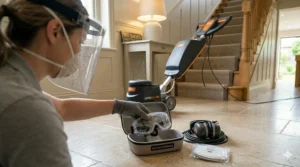
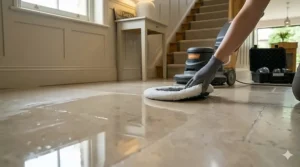
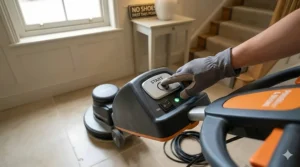
A tile floor polisher is exactly what the name suggests: a motorised machine — typically fitted with rotating pads or brushes — designed to clean, buff, and restore hard floor surfaces including ceramic tile, porcelain, stone, marble, and granite. Unlike a standard mop or steam cleaner, a floor polisher works mechanically, applying consistent pressure and rotation to lift embedded grime and bring up a uniform shine. The difference, once you’ve seen it, is rather difficult to unsee.
In Britain in 2026, more homeowners are making this switch. Our kitchens and hallways take a beating — muddy boots, persistent damp, and the kind of foot traffic that comes from not having the luxury of a boot room (unless you live somewhere rather splendid). Small terraced houses and compact flats mean hard floors dominate, and the demand for machines that actually work on tile has surged accordingly.
This guide covers the seven best tile floor polishers available on Amazon.co.uk right now — from budget-friendly domestic buffers to serious semi-professional machines. Whether you’ve got a cramped bathroom, an open-plan kitchen-diner, or a sprawling hallway that needs bringing back to life, there’s a pick here with your name on it.
Quick Comparison: Best Tile Floor Polishers UK 2026
| Product | Type | Power | Cleaning Width | Cord/Cordless | Best For |
|---|---|---|---|---|---|
| Ewbank EP170 | Corded | 160W | 24cm | Corded (7m) | Budget home use |
| AirCraft PowerGlide City+ | Cordless | Battery | 43cm | Cordless | Everyday tile maintenance |
| Kärcher FP 303 | Corded | 600W | 29cm | Corded (7m) | Thoroughness + vacuuming |
| BISSELL SpinWave 2052E | Corded | — | 28cm | Corded (6.7m) | Wet cleaning + polishing combo |
| Ewbank FP90 | Cordless | Battery | 43.5cm | Cordless (35 min) | Cordless flexibility |
| VIBRATWIN Dual Action | Corded | — | ~30cm | Corded | Light-duty restore & buff |
| Industrial 17″ Floor Buffer (EEYZD) | Corded | 1100W | 43cm (17 inch) | Corded (12m) | Commercial/large floor spaces |
Reading the table: The Kärcher FP 303 is the clear standout if thoroughness matters — that built-in vacuum function genuinely saves a step. But for an average UK semi-detached or flat, the Ewbank EP170 does a surprisingly creditable job at a fraction of the price. If you’re polishing a commercial space or a very large open floor, the industrial 17-inch machine is a different beast entirely — not a domestic product, but one worth knowing about.
💬 Just one click — help others make better buying decisions too! 😊
✨ Don’t Miss These Exclusive Deals!
🔍 Take your tile floor to the next level with these carefully selected products. Click any highlighted item to check current pricing and availability on Amazon.co.uk. These picks will help you find exactly what you need!
Top 7 Tile Floor Polishers: Expert Analysis
1. Ewbank EP170 Lightweight Floor Polisher — Best Budget Pick
The Ewbank EP170 is the kind of machine that surprises you. Unbox it, think that’s a bit modest isn’t it, and then watch it make your kitchen tiles look like someone’s poured liquid glass over them.
The 160W motor runs twin contra-rotating discs at 2,200 RPM — which sounds technical, but the practical upshot is this: both discs spin in opposite directions simultaneously, which prevents the machine from pulling to one side and means you’re not wrestling it across the floor like a small angry robot. The 24cm cleaning path is on the narrow side, making it better suited to domestic spaces than cavernous rooms. It comes with interchangeable pads — polishing, buffing, and scrubbing — and a telescopic handle with a butterfly grip that can be folded for one-handed use in tighter spots.
This is the right machine for a UK homeowner with tiles in the kitchen, hallway, or bathroom who wants a genuine improvement over mopping without spending a fortune. It’s light enough to retrieve from under the stairs without throwing your back out, and compact enough to store in a typical British under-sink cupboard. The 7m cord is also generous — though, as one reviewer noted, the telescopic joint feels slightly optimistic in its engineering. For the price range (under £100), it’s exceptional value.
UK buyers should note: confirmed 230V/UK plug compatible, and widely available on Amazon.co.uk — often with Prime next-day delivery.
✅ Lightweight and easy to manoeuvre
✅ Interchangeable pads for different tasks
✅ Compact — fits in small UK storage spaces
❌ 24cm cleaning width means more passes in larger rooms
❌ Not suitable for heavy commercial use
Price range: Under £100 | Verdict: Outstanding value for domestic tile polishing.
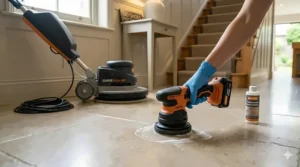
2. AirCraft Home PowerGlide City+ Cordless Floor Polisher — Best Cordless for Everyday Use
The AirCraft PowerGlide City+ is a very British success story — designed and developed in the UK, bearing a Good Housekeeping Institute approval, and genuinely popular with homeowners who’ve spent too long dragging a cord from room to room.
The cordless design is the obvious headline, but what makes it clever is the 43.5cm cleaning path — substantially wider than the Ewbank — meaning fewer passes and less time spent polishing. Eight washable microfibre pads are included, suitable for tile, laminate, wood, and stone surfaces. The machine cleans, polishes, buffs, and lightly scrubs in one. Battery run time sits around 30-40 minutes on a full charge, which is comfortable for a flat or smaller house.
Here’s what the spec sheet won’t tell you: in a typical UK terrace or flat, you’re rarely polishing for more than 20 minutes at a stretch. The City+ handles that comfortably with charge to spare. It’s also whisper-quiet — a real advantage when you want to clean without waking the whole household. The compact design is thoughtfully sized for British kitchens, where manoeuvrability between cupboard islands and dining chairs matters considerably.
The downside? It’s a premium cordless product, priced accordingly (in the £150-£200 range). And if your tiles are heavily soiled with embedded grout grime, this is more of a maintenance machine than a deep-cleaner — set expectations accordingly.
✅ Cordless freedom — no trailing lead hazard
✅ Good Housekeeping Institute approved
✅ Wide 43.5cm cleaning path
❌ Battery-dependent — not suited for very large continuous sessions
❌ Not a deep-scrubbing machine for neglected tiles
Price range: £150-£200 | Verdict: The premium cordless choice for regular tile upkeep.
3. Kärcher FP 303 Floor Polisher — Best All-Rounder
Kärcher is the brand that put pressure washers in every British garden shed, and the FP 303 brings that same German engineering sensibility to indoor floor care — which is to say, it’s built properly and it does exactly what it claims without drama.
The 600W motor is the most powerful in the domestic range covered here, spinning at 1,000 RPM across a 29cm working width. That triangular polishing head is the clever bit: it gets into corners and along skirting boards where conventional circular buffers simply cannot reach — a detail that matters enormously in the narrow hallways typical of Victorian terraces and modern new-builds alike. The built-in vacuum function collects dust and debris during polishing rather than redistributing it, which means you’re not hoovering after you’ve just polished (a minor quality-of-life upgrade that becomes a major one once you’ve experienced it).
At 6.6kg, it’s heavier than the Ewbank — not unwieldy, but you’ll notice it on the stairs. The 7m cord is standard. It handles ceramic tile, porcelain, parquet, laminate, marble, cork, and linoleum with equal confidence. For UK buyers polishing larger rooms or open-plan living areas, the FP 303 justifies its mid-range price (£100-£150) through time saved and quality of finish. It’s available on Amazon.co.uk and direct from Kärcher UK.
Note: earlier European versions required an adaptor; the UK version (240V) uses a standard Type G plug — confirm this when ordering.
✅ Built-in vacuum function — polish and collect dust simultaneously
✅ Triangular head reaches corners and skirting boards
✅ 600W — most powerful domestic option here
❌ Heavier than budget alternatives at 6.6kg
❌ Premium pricing compared to simpler polishers
Price range: £100-£150 | Verdict: The most complete domestic tile floor polisher for serious results.
4. BISSELL SpinWave 2052E Hard Floor Cleaner & Polisher — Best for Wet Cleaning Combined with Polishing
The BISSELL SpinWave 2052E occupies a slightly different lane from a pure polisher: it’s a powered wet-cleaning machine with rotating pads, specifically designed to combine mopping, scrubbing, and buffing in a single pass. For tile floors with grout lines that accumulate daily grime — kitchens with cooking splatter, bathrooms with soap scum — that combination is genuinely useful.
The 830ml water tank dispenses cleaning solution on demand via a trigger, so you’re not flooding the floor or mopping up puddles afterwards. The rotating pads do the mechanical work — soft-touch pads for everyday polishing, scrubby pads for more stubborn tile and grout messes. It runs on a 6.7m cord, BISSELL UK guarantee applies (confirmed UK-warranty model, 2052E), and it’s widely available on Amazon.co.uk and at Currys. Swivel steering makes it easy to navigate around kitchen islands, chair legs, and the chaos of a typical British utility room.
What it won’t do is deliver the deep mirror-shine of a dedicated polishing machine. The SpinWave’s strength is in the wet-clean-plus-buff combination, not pure polish output. Think of it less as a floor polisher and more as the best wet-cleaning machine that also happens to buff. For households where the floor needs cleaning and maintaining regularly, it’s an excellent single solution.
✅ Wet cleaning + polishing in one pass — saves significant time
✅ On-demand spray — precise solution control
✅ UK warranty model (2052E), sold by major UK retailers
❌ Not a replacement for a dedicated polisher on neglected or heavily stained tiles
❌ Requires BISSELL cleaning formula for best results (ongoing cost)
Price range: £70-£120 | Verdict: Ideal for regular tile maintenance combining cleaning and polishing.
5. Ewbank FP90 Lightweight Cordless Floor Polisher — Best Cordless Budget Option
The Ewbank FP90 is the cordless sibling to the EP170, and it answers the one complaint most EP170 owners have: the cable. At 250 RPM — notably lower than the corded EP170’s 2,200 RPM — it’s a gentler machine, designed more for buffing and light polishing than deep-scrubbing. But that’s rather the point.
The 43.5cm cleaning path is pleasantly wide, the 350ml water spray adds a damp-cleaning element, and the LED lights illuminate dark corners under kitchen units where tiles go longest unnoticed (and most uncleaned). Battery run time is around 35 minutes, charged via a standard adapter. Button controls on the handle mean you don’t have to bend down mid-session to adjust settings — a small courtesy, but you notice its absence on cheaper machines.
At around £90-£100, the FP90 sits in an interesting spot: more expensive than the corded EP170, less expensive than the AirCraft PowerGlide City+. For a UK buyer who values cord-free operation over raw polishing power — and whose tiles are already in reasonable condition — it’s a sensible middle ground. Not ideal for heavily soiled grout or large commercial spaces, but for a two-bedroom flat’s worth of tile, perfectly suited.
✅ Cordless convenience with a generous 43.5cm cleaning path
✅ Built-in LED lights for edge and corner visibility
✅ Water spray function included
❌ 250 RPM — lighter polishing action than corded alternatives
❌ 35-minute run time can be limiting for larger floors
Price range: £90-£100 | Verdict: The sensible cordless pick if the PowerGlide feels like overkill.
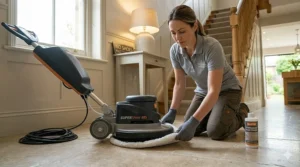
6. VIBRATWIN Electric Floor Polisher Dual Action — Best for Light Restore and Buff
The VIBRATWIN takes a somewhat different technical approach: dual-action oscillating pads rather than continuous rotation, which reduces the risk of over-polishing softer floor surfaces and makes it particularly gentle on marble, granite, and delicate porcelain tiles. If you’ve installed expensive floor tiles and you’re nervous about a high-speed buffer causing micro-scratches, the VIBRATWIN’s lower-aggression approach is a meaningful reassurance.
It’s available on Amazon.co.uk in a range of configurations, comes with reusable pads, and works across tile, hardwood, laminate, and stone. It’s a lighter domestic machine — not suited to commercial use or deeply stained grout — but for a homeowner who wants to maintain recently cleaned floors and keep polished tile looking fresh week-to-week, it does the job without drama or excessive noise.
The VIBRATWIN also has a loyal following among those with smaller floor areas: it’s compact, easy to store, and doesn’t require a dedicated cupboard shelf like the heavier machines. If your concern is maintenance rather than restoration, it’s well worth considering.
✅ Dual-action oscillation — gentle on delicate tile surfaces
✅ Suitable for marble, granite, and porcelain
✅ Compact and easy to store in UK homes
❌ Not a deep-cleaning machine — pure maintenance tool
❌ Pads wear faster than rotary alternatives on abrasive grout
Price range: Under £60 | Verdict: The gentle choice for preserving delicate or expensive tile finishes.
7. Industrial 17″ Floor Buffer Polisher Machine (EEYZD) — Best for Large/Commercial Spaces
And then there’s this one. If the previous six products are sensible kitchen appliances, the EEYZD Industrial 17″ Floor Buffer is more like a piece of actual machinery — because that’s precisely what it is.
The 1,100W pure copper motor runs at 175 RPM across a 43cm (17-inch) cleaning path, with a 12-metre power cord that means you can cover a substantial commercial floor without searching for the next socket. The 8-litre water tank supports continuous operation — the machine is designed for property management, airports, hotels, factories, and shopping centres. It weighs 48kg. You will not be storing this under the stairs.
For UK buyers: this is most relevant to landlords managing HMOs or commercial properties, letting agents responsible for communal areas, or small business owners — a café, a restaurant, a gym — who need professional-grade tile polishing without hiring a specialist cleaning company every time. The long-term cost saving over repeated professional cleaning contracts can be considerable.
One practical note: the 12m cord length is designed for large spaces, but in a domestic setting it becomes a genuine tripping hazard. This machine earns its place on this list because the need for it is real — but it is emphatically not a domestic floor polisher. Treat it accordingly.
✅ 1,100W commercial-grade power with 12m cord
✅ Large 43cm cleaning path — covers serious floor area efficiently
✅ 8-litre water tank for continuous operation
❌ 48kg — requires proper storage and two people to handle safely
❌ Absolute overkill for domestic use
Price range: £300-£500 | Verdict: The serious choice for commercial tile floors or large-scale domestic projects.
How to Actually Use a Tile Floor Polisher: A Practical UK Guide
Step 1: Start with a proper clean
A tile floor polisher is not a substitute for cleaning — it’s what comes after. Sweep or vacuum thoroughly first to remove grit and debris. Running a polishing machine over loose particles is how you scratch tiles rather than buff them.
Step 2: Check your floor is sealed
Most polishers — including every machine on this list — are designed for sealed hard floors. Unsealed natural stone, unglazed terracotta, or any floor with damaged sealant should be re-sealed before polishing. The British Ceramic Tile industry’s guidance and manufacturers’ care instructions should be your first reference point if you’re unsure.
Step 3: Start with the correct pad
New to polishing? Start with a soft buffing or microfibre pad. Reserve the scrubbing brushes for grout lines and stubborn staining. Working from the far corner of the room toward the door — classic painter’s logic — prevents you walking over freshly polished sections.
Step 4: British climate considerations — damp and humidity
UK homes, particularly in winter, deal with condensation, damp, and tiles that never quite fully dry between sessions. Allow tiles to dry completely before polishing — polishing damp tiles produces streaks rather than shine, regardless of how good your machine is. In older homes with solid floors, consider running a dehumidifier for an hour before polishing if condensation is an ongoing issue.
Step 5: Regular maintenance beats annual restoration
Polishing monthly (or even every six weeks) is far less work than letting tiles degrade for a year and then spending a weekend trying to restore them. A 15-minute run with a maintenance machine like the AirCraft PowerGlide or Ewbank EP170 every few weeks keeps tiles in a condition where heavy scrubbing is rarely necessary.
Real UK Buyer Scenarios: Which Polisher Actually Suits You?
🏠 The London flat-dweller with 20m² of open-plan tile
Space is premium, storage is non-negotiable, and you’ve had enough of the mop leaving tide marks across your kitchen floor before your morning coffee. The AirCraft PowerGlide City+ is your machine. Compact, cordless, no cable to trip over on the way to the kettle, and it fits in the cupboard alongside your hoover without argument. Run it weekly and your tiles will reliably look like you’ve just moved in.
🏡 The suburban family in a three-bed semi
Hallway, kitchen, downstairs bathroom — roughly 40-50m² of tile getting muddy boot treatment six days a week. You need something with proper power, the ability to genuinely scrub grout, and the versatility to handle stone worktops in the conservatory as well. The Kärcher FP 303 is built for exactly this. The vacuum function means you’re not adding hoovering to your Saturday morning list, and the triangular head gets into the awkward corner by the radiator that every semi-detached in Britain seems to have.
🏪 The café owner or Airbnb host
You have large commercial tiles or stone flooring that sees genuine foot traffic, and calling a professional cleaning company every time is an expense that adds up. The Industrial 17″ EEYZD Buffer represents the break-even point between hired help and ownership very quickly. It’s heavy, it means business, and it will restore heavily trafficked tile to a condition that impresses without the ongoing cost.
👵 The retired homeowner maintaining a well-kept home
Good tiles, kept well for years, just needing regular maintenance without lifting heavy equipment. The Ewbank FP90 or VIBRATWIN — both light, quiet, and gentle on fine floors. Neither will frighten the cat or require a physiotherapy appointment afterwards.
How to Choose a Tile Floor Polisher in the UK: 5 Key Criteria
1. Floor size and layout
For rooms under 25m², any domestic polisher works fine. For 25-50m², prioritise a wider cleaning path (40cm+). Above that, seriously consider whether a commercial-grade machine is the better long-term investment.
2. Corded vs cordless
Cordless machines are more convenient for smaller spaces and multi-room use, but battery life limits continuous operation. Corded machines offer unlimited run time but require socket planning — important in UK homes where sockets aren’t always where you’d like them.
3. Tile type
High-gloss porcelain responds beautifully to high-RPM buffing. Textured ceramic or natural stone requires gentler pads and lower RPM to avoid micro-scratching. The VIBRATWIN’s dual-action approach is specifically designed for the latter.
4. Storage space
A 48kg industrial machine in a two-bedroom flat is an absurdity. A compact domestic machine stored in a cupboard under the stairs — very sensible. British homes are smaller than the marketing copy for most floor machines assumes; factor storage into your decision.
5. Maintenance cost
Reusable, washable pads save significantly over disposable systems. The AirCraft PowerGlide, Ewbank EP170, and FP90 all use washable microfibre — better for your wallet and better for the environment. Check pad replacement costs before buying: the machine price is only part of the picture, as Which? has noted in its floor care reviews.
Tile Polisher vs Scrubber vs Steam Cleaner: What’s Actually Different?
This comparison trips up a lot of UK buyers, so let’s settle it plainly.
A tile floor polisher focuses on buffing, shining, and maintaining a sealed floor’s finish. It applies mechanical pressure through rotating pads to restore gloss and remove surface-level grime. A floor scrubber — like the BISSELL SpinWave — uses water and rotating pads or brushes to clean and lightly buff simultaneously. A steam cleaner uses high-temperature steam to sanitise and loosen dirt, but applies no mechanical buffing action and doesn’t restore shine.
In practice: steam cleaning sanitises but doesn’t shine. Scrubbing cleans and maintains. Polishing restores and protects the surface finish. For tile floors in most UK homes, a combination of occasional steam cleaning (for hygiene, particularly bathrooms) and regular polishing (for appearance) gives the best long-term result. Some machines, like the Kärcher FP 303, partially bridge the gap with their vacuum function.
According to NHS infection control guidance and general hygiene standards, mechanically cleaned surfaces are consistently more hygienic than those cleaned by hand — another practical argument for investing in a proper machine rather than persevering with a mop.
| Method | Cleans | Shines | Sanitises | Best For |
|---|---|---|---|---|
| Tile Floor Polisher | ✅ (light) | ✅✅ | ❌ | Shine restoration, maintenance |
| Floor Scrubber | ✅✅ | ✅ | ❌ | Regular deep cleaning |
| Steam Cleaner | ✅ | ❌ | ✅✅ | Sanitising, grout hygiene |
| Traditional Mop | ✅ (partial) | ❌ | ❌ | Light daily cleaning |
Analysis: For most UK homeowners, a tile floor polisher and an occasional steam clean covers everything. The scrubber-polisher combos (SpinWave, PowerGlide) let you reduce that to one machine — useful in compact storage situations.
✨ Don’t Miss These Exclusive Deals!
🔍 Ready to upgrade your tile floors? Check current pricing and availability on Amazon.co.uk for any highlighted product in this guide. All picks have been verified for UK availability and 230V/UK plug compatibility.
Common Mistakes When Buying a Tile Floor Polisher in the UK
Buying a machine designed for 110V US voltage. This one is worth emphasising. Several budget floor buffers sold online are designed for the American 110V supply. Plug them into a UK 230V socket without a step-down transformer and you will, at best, damage the machine immediately. At worst, you’ll create a fire hazard. Always confirm the voltage specification before purchasing. Every machine on this list operates at 220-240V and uses a standard UK Type G plug.
Ignoring the UKCA marking requirement. Post-Brexit, the relevant product safety marking for the UK market is UKCA (UK Conformity Assessed), which replaced CE marking. Not all imported floor polishers sold online — particularly through grey-market listings — carry this marking. For electrical products specifically, purchasing a non-UKCA marked machine from an unknown seller is a genuine safety risk, and your consumer rights under the Consumer Rights Act 2015 may be compromised if the product lacks appropriate UK certification.
Polishing without cleaning first. Mentioned in the usage guide above, but worth repeating: running a polisher over debris-covered tiles causes scratching, not shining. The polishing pad becomes a very expensive piece of sandpaper.
Choosing the wrong pad for the tile type. High-speed rotary machines with abrasive scrubbing pads on high-gloss porcelain will scratch the surface. Always start with the softest pad available and work up to abrasive options only if genuinely needed.
Underestimating cord length for UK sockets. UK homes — particularly older ones — often have surprisingly few sockets in kitchens and hallways. A 7m cord is usually adequate for a domestic space, but if your sockets are positioned awkwardly (as they frequently are in converted Victorian terraces), measure before assuming.
Long-Term Cost and Maintenance: Is a Tile Polisher Worth It?
A professional tile and grout cleaning service in the UK typically costs between £150 and £400 for an average home, depending on floor area and condition — and that’s a one-time clean, not an ongoing maintenance programme. Most tile floors realistically need professional attention every 12-18 months if not maintained mechanically.
A decent domestic tile floor polisher (£80-£150 for the Ewbank or Kärcher range) pays for itself within the first year compared to a single professional clean. The ongoing cost is essentially washable pads (typically £10-£20 for a replacement set) and an appropriate floor polishing solution — many of which, for sealed tile and porcelain, are available for a few pounds per litre.
The industrial 17″ buffer is a larger investment (£300-£500), but for a landlord or small business owner paying for professional cleaning quarterly, the maths becomes very favourable within six to twelve months.
Maintenance-wise: all machines on this list are straightforward to service. Washable pads should be laundered after every two or three uses. The machines themselves require minimal maintenance beyond occasional pad holder cleaning and cable inspection. British weather being what it is, if you’re storing a corded machine in an outbuilding or damp garage, keep it in a sealed bag to prevent connector corrosion — a minor point, but one the manuals rarely mention.
Frequently Asked Questions
❓ Can I use a tile floor polisher on porcelain?
❓ Are tile floor polishers available with free delivery on Amazon.co.uk?
❓ Will a tile floor polisher remove grout haze?
❓ Do I need to re-seal my tiles before polishing?
❓ Is a tile floor polisher safe to use on underfloor heating?
Conclusion: Ditch the Mop, Pick the Right Polisher
Here’s the truth of it: a good tile floor polisher transforms a chore into something closer to a satisfying ten minutes rather than a frustrating half-hour. The right machine makes the difference between tiles that look merely acceptable and tiles that catch the light properly, look clean in corners, and quietly improve the whole character of a room.
For most UK homeowners, the Ewbank EP170 is the obvious starting point — inexpensive, effective, compact, and available on Amazon.co.uk with Prime delivery. Step up to the Kärcher FP 303 if you want thoroughness and that clever vacuum function, or the AirCraft PowerGlide City+ if cordless convenience is worth the premium. The BISSELL SpinWave 2052E earns its keep if you want cleaning and polishing in a single pass. And if you’re looking after commercial tiles, the Industrial 17″ Buffer is an investment that pays for itself relatively quickly.
Whatever you choose, verify UK voltage compatibility (230V, Type G plug), check for washable pad systems to reduce ongoing costs, and remember that any polisher — however good — works best on a floor that’s been properly swept first.
✨ Don’t Miss These Exclusive Deals!
🔍 Found your match? Click any highlighted product to check current pricing and availability on Amazon.co.uk. All picks verified for UK delivery and compatibility — happy polishing! 😊
Recommended for You
- Best Dustpan and Brush Set UK 2026: 7 Expert Picks Reviewed
- Best Floor Polisher for Laminate: 7 Top UK Picks (2026)
- Best Microfibre Floor Cloths UK 2026: 7 Top Picks Reviewed
Disclaimer: This article contains affiliate links. As an Amazon Associate, I earn from qualifying purchases. If you purchase products through these links, we may earn a small commission at no additional cost to you.
✨ Found this helpful? Share it with your mates! 💬🤗
