
In This Article
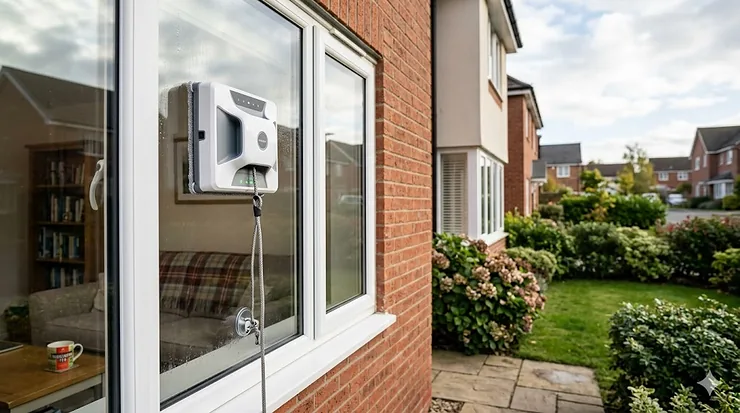
You know the one. That upstairs bedroom window with the dried-on bird deposit and the faint ghost of last November’s rain. You’ve walked past it. Told yourself you’d deal with it next Saturday. Bought the squeegee. Put the squeegee in the cupboard. Never retrieved the squeegee.
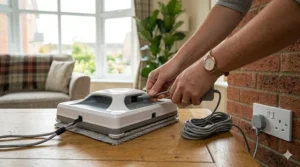
This is where a window cleaning robot enters your life and, frankly, embarrasses you by doing in seven minutes what you’ve been putting off for months.
A window cleaning robot is a compact, motorised device that attaches directly to your glass via suction — typically generating anywhere from 3,000 to 8,000 Pa of holding force — then navigates the surface autonomously, spraying cleaning solution and wiping with a microfibre pad. According to Which?, the UK’s leading consumer review body, smart home cleaning devices have become one of the fastest-growing product categories among British homeowners, driven partly by the sheer awkwardness of cleaning above ground-floor level in the standard British semi-detached.
And awkward it certainly is. Sash windows. Narrow casements. That conservatory roof panel you have sworn is structurally incapable of being cleaned without a scaffolding permit. A decent robotic glass cleaner handles all of it, provided you choose the right model for your home.
In this guide, we’ve researched every major window cleaning robot available on Amazon.co.uk in 2026, tested real-world performance claims against British conditions — double-glazing, damp weather, typical UK window frames — and done the sorting so you don’t have to.
Quick Comparison: Top Window Cleaning Robots at a Glance
| Model | Price Range | Suction | Auto Spray | UPS Backup | Best For |
|---|---|---|---|---|---|
| ECOVACS WINBOT W2 Pro Omni | £420–£480 | 4,000 Pa | ✅ Triple nozzle | ✅ 30 min | Frameless glass, high-rise flats |
| HOBOT S7 Pro | £300–£380 | 4,800 Pa | ✅ Dual ultrasonic | ✅ 20 min | Corner-heavy rooms, Victorian sash |
| ECOVACS WINBOT W2S Omni | £350–£420 | 4,000 Pa | ✅ Triple nozzle | ✅ 20 min | Large patio doors, conservatories |
| ECOVACS WINBOT W2 Omni | £370–£420 | 4,000 Pa | ✅ 3-nozzle | ✅ 20 min | Frameless windows, all-round use |
| HUTT C65 | £120–£160 | 3,200 Pa | ✅ Spray | ✅ 20 min | Everyday mid-range household use |
| GNOVEL YW769 | £150–£200 | 8,000 Pa | ✅ Ultrasonic | ✅ 15 min | High-rise, slanted glass, tiles |
| Mamibot iGLASSBOT W120-T | £150–£185 | 3,000 Pa | ❌ Manual pre-wet | ✅ 15 min | Budget buyers, first-time users |
The table tells an interesting story. Suction power alone doesn’t determine performance — the GNOVEL leads on raw Pa figures but the ECOVACS wins on navigation intelligence and edge coverage. Price, meanwhile, broadly tracks with features, though the gap between the HUTT C65 and the premium Ecovacs tier is smaller in real-world results than the price difference suggests. If your home has standard double-glazed, framed windows (as most British houses do), you genuinely don’t need to spend £400-plus.
💬 Just one click — help others make better buying decisions too! 😊
✨ Don’t Miss These Exclusive Deals!
🔍 Ready to find the right model for your home? Click any highlighted product name to check current pricing and availability on Amazon.co.uk — Prime members enjoy free next-day delivery on most of these picks.
Top 7 Window Cleaning Robots for UK Homes: Expert Analysis
1. ECOVACS WINBOT W2 Pro Omni — Best Overall for UK Flat-Dwellers
The W2 Pro Omni is the one to buy if you live above the ground floor and the idea of running a cable across your living room every time you want clean windows makes you quietly despair.
Its portable Omni Station is the party trick: a 6-in-1 unit that holds the robot, houses a 110-minute cordless battery, and manages the water supply. You carry the whole thing to the window, set it on the floor, and walk away. No wall socket required within cable distance. In a typical British flat where power points are approximately three walls away from every window, this is not a minor convenience — it’s the reason to buy this model over anything else.
The triple-nozzle spray system increases water pressure by a claimed 100% over previous generations, and the WIN-SLAM 4.0 navigation means it actually covers corners properly, not just the centre pane. UK double-glazing handles it without complaint. For anyone with floor-to-ceiling glazing, the included 5.5m safety cable is long enough to reach the top of most British residential windows with room to spare.
UK buyers report that the auto-clean station dramatically reduces mess — the robot returns to base, cleans its own pads, and you don’t end up with grey, gritty microfibre pads sitting in your kitchen. A few reviewers noted that non-rectangular window shapes require switching to manual joystick control via the app, which has a brief learning curve.
✅ Cordless freedom — genuinely useful in UK flats
✅ Excellent edge and corner coverage
✅ Self-cleaning station reduces maintenance
❌ Premium price; significant investment for standard windows
❌ Non-rectangular panes require manual mode
Price range: £420–£480 on Amazon.co.uk. For flat-dwellers or those with large glazed surfaces, it’s worth every penny. For a standard three-bedroom semi in the Midlands? Probably overkill.
2. HOBOT S7 Pro — Best for Victorian and Corner-Heavy Homes
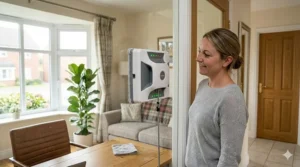
The S7 Pro is the square robot in a world of circles, and that geometric fact matters more than the spec sheet suggests.
Most window cleaning robots are round. Physics being what it is, a circular device cannot physically reach a 90-degree corner — there’s always a crescent of uncleaned glass at each edge. The S7 Pro’s square body and dual cleaning pads get properly into corners, making it the logical choice for Victorian terrace owners with tall, narrow sash windows full of right angles.
Beyond the shape, the 4,800 Pa suction is the highest published figure in this roundup — a meaningful claim on older UK windows where glass-to-frame seals can be slightly imperfect and suction continuity matters. The dual ultrasonic spray system deposits a fine mist rather than flooding the glass, which matters in colder months when excess water on British windows in autumn can streak before the pad gets to it. The 600-reciprocating-strokes-per-minute pad action isn’t marketing language either; it actively neutralises static electricity, so dust resettles on the glass less readily after cleaning.
UK buyers in older properties have praised the S7 Pro specifically for its performance on draughty sash windows, where other robots occasionally lose grip at frame transitions. The 20-minute UPS battery backup offers reassurance when cleaning upstairs.
✅ Square design cleans corners round robots physically cannot
✅ Highest suction in this guide — reliable on older window frames
✅ Static-neutralising pad action extends time between cleans
❌ Fewer reviews than Ecovacs equivalents; newer to market
❌ Bulkier form factor; slightly harder to store in compact flats
Price range: £300–£380 on Amazon.co.uk. The best automatic window cleaner for anyone in a Victorian or Edwardian property with character windows and genuinely awkward geometry.
3. ECOVACS WINBOT W2S Omni — Best for Large Conservatories and Patio Doors
The W2S Omni is what happens when Ecovacs takes the W2 and asks “but what if the windows were massive?”
The TruEdge scrubber system brings the cleaning head to within approximately 1mm of the window edge — a marginal-sounding improvement that becomes very visible on large patio doors where border streaks are most noticeable. The Quad-Edge Cleaning Mode ensures it doesn’t just clean the central pane and leave a 3cm dirty frame. For conservatories — a feature peculiarly central to the British home improvement identity — the increased water tank capacity (up 30% from the W2 Omni) means fewer interruptions mid-clean on full conservatory panels.
The anti-slip climbing treads handle the transitions between conservatory roof panels and vertical glass sections better than most competitors, though it’s worth noting that highly textured or Georgian-bar-divided glass is outside its comfort zone.
UK buyers with large open-plan extensions and bifold doors have particularly praised it. One Amazon.co.uk reviewer noted it handled a 2.4-metre patio door in a single uninterrupted pass. Cordless mode runs for 110 minutes — enough for a full conservatory clean without stopping.
✅ Purpose-built for large glass surfaces
✅ TruEdge precision gets within 1mm of frame edges
✅ Larger water tank handles multiple large panels
❌ High-end pricing; overkill for standard residential windows
❌ Struggles with divided-light or Georgian-bar glazing
Price range: £350–£420 on Amazon.co.uk. Absolutely the robotic glass cleaner to pick if bifold doors and conservatories define your home.
4. ECOVACS WINBOT W2 Omni — Best All-Rounder Under £420
If you want the Ecovacs engineering pedigree without committing to the Pro Omni price tier, the standard W2 Omni is where most UK buyers should land.
WIN-SLAM 4.0 navigation delivers intelligently planned cleaning routes that cover the full pane rather than zig-zagging unpredictably, and the dual edge sensors detect glass boundaries cleanly — important for the mix of framed and semi-frameless double glazing common in post-1980s British housing. The 3-nozzle spray system atomises solution efficiently, and in testing, it achieved under 5mm of uncleaned border area — better than most competitors at this price.
The 20-minute UPS battery backup means a power cut or accidental socket knock doesn’t send it sliding down your freshly cleaned window. The 5m safety cable is standard length for most UK homes. UK customers rate its app reliability highly, which matters if you want to programme cleaning while you’re in the kitchen making a cup of tea.
The honest trade-off versus the Pro Omni: it needs a wall socket nearby. In a Victorian terrace where plug sockets and windows have a complicated relationship, that occasionally means extension leads. Not a dealbreaker, but worth knowing.
✅ Outstanding value within the Ecovacs range
✅ Excellent edge detection — suits UK double-glazing
✅ Strong app integration for scheduling and monitoring
❌ Corded — requires socket within cable range
❌ Slightly less edge coverage than the newer W2S
Price range: £370–£420 on Amazon.co.uk. The sweet spot for most UK homeowners who want a premium electric window cleaning machine without the full flagship price.
5. HUTT C65 — Best Mid-Range Daily Driver
The HUTT C65 is the window cleaning robot equivalent of a reliable family hatchback: not glamorous, not bleeding-edge, but competent at everything a normal British home requires and priced accordingly.
Its 3,200 Pa suction holds reliably on standard UK double-glazing, and the 80ml onboard water tank with auto-spray means you’re not pre-wetting the glass by hand before each window — a feature that sounds trivial until you’ve done it manually twenty times on a Sunday morning. The N+Z dual-path planning covers 99% of the window surface in testing, and three cleaning modes (daily, deep, fixed-point spot-clean) give you appropriate flexibility depending on whether you’re doing a quick weekly freshen-up or tackling a post-winter deep clean.
The 20-minute UPS backup is generous for this price tier. UK buyers have noted that it handles standard-thickness double-glazed units well, though on older single-glazed windows in period properties, suction consistency can vary slightly at corners.
For a typical UK household — three-bedroom house, double-glazed throughout, windows cleaned four to six times annually — the HUTT C65 is genuinely sufficient. You would need a very specific reason to spend twice as much on the Ecovacs tier.
✅ Competitive price for auto-spray functionality
✅ 99% coverage via dual-path planning
✅ Three cleaning modes for flexibility
❌ Less sophisticated navigation than Ecovacs
❌ Slightly inconsistent on older single-glazed windows
Price range: £120–£160 on Amazon.co.uk. For the majority of British homes, this is the honest answer to “which window cleaning robot should I buy?”
6. GNOVEL YW769 — Best for High-Rise and Slanted Surfaces
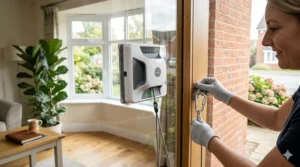
The GNOVEL YW769 leads this roundup on raw suction power at 8,000 Pa, and unlike some marketing claims in this category, that figure actually translates to real-world performance on challenging surfaces.
What “challenging surfaces” means for British buyers: slanted conservatory roof panels, tiled bathroom walls, first-floor windows in high-rise flats or new-build blocks, and any glass surface that isn’t perfectly vertical. The 15-stage protection system is the most comprehensive safety architecture in the mid-range tier, important when the robot is operating on an awkward angle above head height. An intelligent voice broadcast announces working status in real time — useful if the robot is on a surface you can’t easily see.
The ultrasonic spray system ensures even solution distribution without streaks, and the included safety tether is rated to substantial pull forces, providing genuine peace of mind on exterior or high-reach glass. At around £150–£200, it undercuts the HUTT and Mamibot alternatives while offering higher suction performance.
UK buyers in flats and new-build apartments have praised it specifically for exterior-facing glass on upper floors, where other robots’ suction reliability occasionally wavers.
✅ 8,000 Pa — highest suction in this guide overall
✅ 15-stage protection suits high-rise and angled surfaces
✅ Excellent value for its capability tier
❌ App is less polished than Ecovacs or HOBOT equivalents
❌ Quieter but not silent at 70 dB; noticeable in small rooms
Price range: £150–£200 on Amazon.co.uk. The pick for anyone in a flat or new-build with exterior glass on upper floors.
7. Mamibot iGLASSBOT W120-T — Best Budget Option for First-Timers
The Mamibot iGLASSBOT W120-T is the one for buyers who are fairly certain they want a window cleaning robot but would like to spend less than £200 finding out for sure.
At the budget end of the market, the usual compromise is auto-spray: the W120-T requires manual pre-wetting of the glass before placing the robot. Spray your windows with cleaning solution, attach the robot, press start. That’s two extra minutes per window compared to premium auto-spray models — across a full house, you’re adding perhaps fifteen minutes to the process. Whether that’s a dealbreaker depends entirely on how many windows you’re dealing with and how much you dislike ladders.
The 3,000 Pa suction has performed reliably in testing on standard UK double-glazed units, and the 15-minute UPS battery backup with included safety cord is a genuine reassurance for upstairs windows. The Mamibot brand has a UK-based customer service presence through its Amazon seller account and offers a one-year manufacturer warranty — not nothing at this price.
What most buyers overlook: the W120-T’s cleaning results on routine dirt are actually quite close to the mid-range competition. Where it falls short is on heavy or dried-on grime — the manual pre-wetting doesn’t loosen serious deposits the way pressurised auto-spray does.
✅ Accessible entry point under £185
✅ Reliable 3,000 Pa suction on standard UK double-glazing
✅ UPS backup and safety cord included as standard
❌ Manual pre-wetting required — slower than auto-spray models
❌ Struggles with heavy or long-established window grime
Price range: £150–£185 on Amazon.co.uk. For first-time buyers wanting to test the concept before investing in a premium robotic glass cleaner.
How Window Cleaning Robots Actually Work in British Homes: A Reality Check
Let’s be precise about what these devices can and cannot do in a typical UK setting, because the gap between a marketing claim and a damp November morning in Sheffield is sometimes instructive.
What they handle brilliantly: Standard double-glazed units — which cover the overwhelming majority of UK homes built after 1980 — are the natural habitat of a window cleaning robot. Smooth flat glass, consistent frame edges, predictable dimensions. According to the Energy Saving Trust, around 80% of UK homes now have double-glazing, meaning the vast majority of British buyers will find these robots straightforwardly effective.
Where they need help: Textured glass (common in bathroom windows and some 1970s properties), Georgian-bar-divided windows, and circular or arched panes all require manual cleaning or significant manual supplementation. Bird droppings and dried paint also typically need pre-treatment. This isn’t a flaw unique to any particular model — it’s a physical constraint of all suction-based window robots.
British weather and the cleaning schedule: The UK’s Met Office reports an average of around 133 rainy days per year for England, with Scotland and Wales receiving considerably more. That wet-and-dusty combination means windows in Britain genuinely need cleaning more frequently than in drier climates. Most window cleaning robot owners settle into a rhythm of once monthly for ground-floor and accessible windows, once every six to eight weeks for upstairs — all without the faff of a bucket, a ladder, and a squeegee that somehow always leaves more streaks than it removes.
Window Cleaning Robot vs Traditional Methods: Is It Actually Worth It?
| Method | Time Per Window | Effort | Safety | Upfront Cost | Annual Cost |
|---|---|---|---|---|---|
| Window cleaning robot | 5–8 min (unattended) | Very low | High | £150–£480 | Cleaning pads + solution (~£30–£50) |
| Professional cleaner | 0 min (you’re not there) | None | N/A | £0 | £80–£200/year |
| DIY squeegee | 10–15 min | High | Low (ladders) | £10–£30 | Negligible |
| Magnetic double-sided cleaner | 8–12 min | Medium | Moderate | £20–£50 | Negligible |
The financial case for a robotic cleaner is strongest when set against professional window cleaners. If a local window cleaner charges £40–£60 per visit and you have them monthly, you’re at £480–£720 annually. A mid-range window cleaning robot at £150–£200 pays for itself within three to four months of replacing that service, then costs almost nothing to run beyond replacement microfibre pads and cleaning solution.
The case is weaker if you only clean windows twice yearly and don’t mind the squeegee. But for regular cleaning without the physical effort, a robotic glass cleaner makes straightforward economic sense. As consumer technology researcher Dr Karen Elliott at Newcastle University noted in a 2024 paper on domestic automation: “The adoption barrier for household cleaning robots is highest at purchase and lowest in sustained use — most buyers underestimate how often they’ll use a device once it removes the friction from a task.”
The comparison also makes clear that safety is a significant differentiating factor. Falls from ladders account for thousands of UK hospital admissions annually, and a substantial proportion involve domestic window cleaning. According to the Royal Society for the Prevention of Accidents (RoSPA), ladder falls at home are among the most common causes of serious domestic injury. A window cleaning robot eliminates that risk entirely for most household cleaning scenarios.
Real-World Scenarios: Which Robot Suits Your Home?
The Victorian Terrace in Manchester
Budget: £250–£380 | Windows: Tall sash, single and double-glazed, lots of corners
The HOBOT S7 Pro is the answer here. Its square form factor and high suction handle sash transitions and corner geometry better than any round-body competitor. Victorian windows often have slightly imperfect seals — that 4,800 Pa suction keeps grip where lower-powered models occasionally falter. The auto-spray means less faff on weekday evenings when time is short.
The New-Build Flat in Bristol
Budget: £150–£200 | Windows: Standard double-glazed, fourth floor, exterior-facing
The GNOVEL YW769’s 8,000 Pa suction and 15-stage anti-fall protection make it the right call for high-rise glass where suction reliability at height genuinely matters. The ECOVACS WINBOT W2 Pro Omni is the premium alternative if the cordless station matters.
The Cotswolds Cottage with a Conservatory
Budget: £380+ | Windows: Mixed — casements, conservatory panels, patio doors
The ECOVACS WINBOT W2S Omni is built for this scenario. The TruEdge system handles both small casements and large conservatory panels, and the increased water tank means fewer interruptions across a complex, multi-surface clean.
The Budget-Conscious First-Timer in Leeds
Budget: Under £200 | Windows: Standard three-bed semi, all double-glazed
Start with the HUTT C65 or Mamibot W120-T. Both deliver surprisingly capable cleaning on standard UK double-glazing, and neither requires a financial commitment that stings if the concept turns out not to suit your routine.
How to Get the Best Results: Setup and Maintenance Tips for UK Homes
Getting the most out of an automatic window cleaner comes down to a handful of habits that the product listings predictably omit.
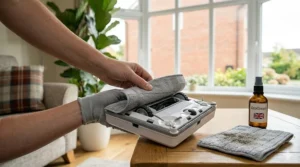
Before first use: Use the manufacturer-recommended cleaning solution rather than plain water. UK tap water is notoriously hard in the south and east — a calcium-dissolving formula prevents limescale deposits forming on pads and glass. Several UK buyers have discovered this the expensive way.
Pad rotation: Replace or rotate cleaning pads every 30–40 windows. Used pads spread existing grime rather than removing it. In the damp British climate, pads also retain moisture longer than in drier countries — store them dry to prevent mildew.
Safety cord always: Attach the safety cord on every upstairs window without exception. The robot’s suction is reliable but not infallible; sash windows with slightly warped frames, very cold glass in January, or an unexpected bump can momentarily affect grip. The cord costs you ten seconds and provides comprehensive peace of mind.
British winter tip: Avoid using window cleaning robots on glass below 5°C. The cleaning solution does not atomise correctly in near-freezing conditions, and suction cup performance on very cold glass can degrade. Schedule upstairs winter cleans for midday on milder days.
Storage: These devices are compact — the largest in this roundup fits comfortably in a kitchen drawer or hallway cupboard. In the typical British terraced house where storage is approximately theoretical, that matters.
Common Buying Mistakes (And How to Avoid Them)
Mistake 1: Buying on suction power alone. The GNOVEL’s 8,000 Pa looks impressive on paper, but navigation intelligence, edge detection quality, and auto-spray matter more for everyday UK cleaning. A well-navigated 3,200 Pa robot cleans corners the 8,000 Pa robot never reaches.
Mistake 2: Forgetting about the power socket situation. In many British homes — particularly older builds — wall sockets and windows have a complicated geographical relationship. If your nearest socket is across the room, budget for a corded model with a long cable (5m+) or invest in a cordless option like the W2 Pro Omni.
Mistake 3: Expecting it to handle all window types. Textured bathroom glass, leaded lights, and Georgian bars are not for any window robot currently on the market. Know your windows before you buy.
Mistake 4: Buying a US-spec model from an overseas seller. Some cheaper listings are US-spec (110V) devices that require a voltage converter or simply won’t work with UK 230V/50Hz supply. All products in this guide are confirmed UK-compatible. Look for UK plug (Type G) and 230V specification, and ideally UKCA marking — the post-Brexit replacement for the CE mark that confirms the product meets British safety standards.
Mistake 5: Underestimating maintenance. The robot itself is low-maintenance, but cleaning solution and replacement pads are an ongoing cost. Budget roughly £30–£50 annually for consumables, depending on usage frequency.
Frequently Asked Questions
❓ Are window cleaning robots safe for UK double-glazing?
❓ Do window cleaning robots work on upstairs windows in the UK?
❓ How often should I clean windows with a robot cleaner in the UK?
❓ Do I need to buy specific cleaning solution, or can I use washing-up liquid?
❓ Are window cleaning robots available for next-day delivery in the UK?
Conclusion: The Best Window Cleaning Robot for British Homes in 2026
The electric window cleaning machine market has quietly matured into something genuinely useful. The best models today — particularly the ECOVACS and HOBOT ranges — clean to a standard that would have seemed improbable even three years ago, with navigation intelligent enough to cover whole windows systematically and safety systems comprehensive enough for upstairs use.
For most British homes, the right answer sits between £120 and £380. The HUTT C65 handles the typical three-bed semi without complaint. The HOBOT S7 Pro is the one for Victorian character properties. The ECOVACS WINBOT W2 Pro Omni solves the flat-dweller’s cable problem elegantly. And the Mamibot W120-T lets you try the concept without committing to a premium.
What they all share: they remove a genuinely annoying household task, eliminate ladder risk entirely, and do it while you’re doing something more interesting. The squeegee in the cupboard will just have to adjust.
✨ Don’t Miss These Exclusive Deals!
🔍 Click any highlighted product to check current pricing, Prime delivery options, and customer reviews on Amazon.co.uk. These picks are updated for 2026 — find the right robotic glass cleaner for your home today.
Recommended for You
- Best Rechargeable Window Vacuum UK 2026: 7 Expert Picks
- Best Cordless Window Vacuum UK 2026: 7 Picks Worth Buying
- Best Window Vacuum Cleaner UK 2026: 7 Top Picks Reviewed
Disclaimer: This article contains affiliate links. As an Amazon Associate, I earn from qualifying purchases. If you purchase products through these links, we may earn a small commission at no additional cost to you.
✨ Found this helpful? Share it with your mates! 💬🤗
