
In This Article
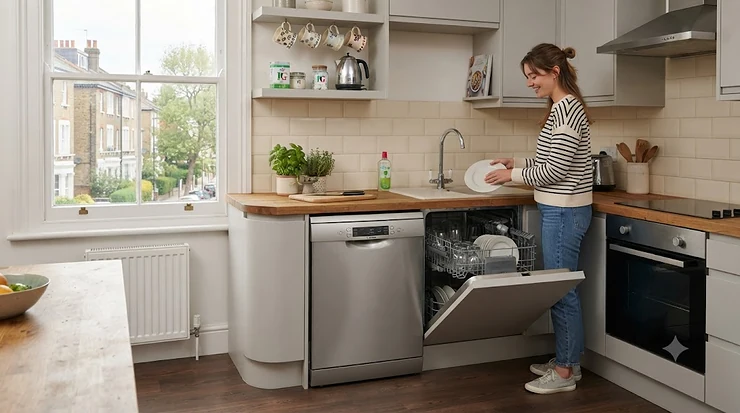
Nobody warns you, when you’re kitchen-hunting or flat-viewing, that the cupboard under the sink is going to become the single most contested piece of real estate in your life. You measure it twice. You Google it at 11pm. You start using the phrase “the gap” like it’s a member of the family. If that sounds familiar, you’ve landed in exactly the right place, because this guide is built entirely around one mission: finding a slimline dishwasher for small kitchen spaces that don’t forgive an inch of error.
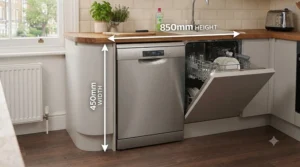
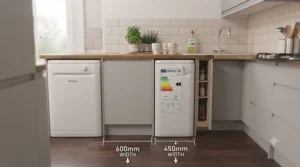
A slimline dishwasher, for the uninitiated, is roughly 45cm wide rather than the standard 60cm — fifteen centimetres that, in a poky galley kitchen or a converted flat, can be the difference between “we finally have a dishwasher” and “we’re still doing this by hand at 11pm.” Below, you’ll find seven genuinely available models spanning budget, mid-range and premium, backed by real specifications, aggregated review sentiment and honest analysis of who each one actually suits — not a rehashed spec sheet, but the reasoning you’d want from a friend who’s already done the research. We’ll also dig into 45cm dishwasher sizing quirks, why a space saving appliance earns its keep in ways that go beyond the obvious, what under counter installation actually involves, and how all of this plays out differently in a studio flat kitchen than it does in a three-bed semi.
Prices below are shown as ranges rather than exact figures, because retail pricing shifts weekly — always check the current price before buying. Right, kettle on. Let’s get into it.
What Is a Slimline Dishwasher?
A slimline dishwasher is a dishwashing appliance roughly 45cm wide — about 15cm narrower than a standard 60cm model — designed to fit tight kitchen gaps, galley layouts, and small flats. It typically holds 9-10 place settings, available as freestanding or fully integrated under counter installation, and offers most of the wash programmes and features you’d find on a full-size machine.
That last point is the one people underestimate. A slimline dishwasher for small kitchen use isn’t a “lesser” appliance bolted together to fit a gap — Which?’s independent slimline dishwasher lab tests cover 45cm models from brands including Beko, Bosch, Hotpoint, Indesit, Miele, AEG, Hoover, Whirlpool and Zanussi, and consistently find that narrower doesn’t mean worse when it comes to cleaning quality. What you lose is raw capacity — these compact machines are around 15cm thinner than the average full-sized model — not necessarily performance.
Quick Comparison Table: 7 Best Slimline Dishwashers at a Glance
| Product | Type | Price Range | Best For |
|---|---|---|---|
| Beko DVS04X20W | Freestanding | £220-£260 | Tightest budgets |
| Candy CDPH2L1049W | Freestanding | £180-£250 | Fast 30-min washes |
| Hisense HS523E15WUK | Freestanding | £230-£280 | Quiet open-plan living |
| Bosch Serie 4 SPS4HKI45G | Freestanding | £450-£590 | Smart home / app control |
| Montpellier MDWBID4553 | Integrated | £280-£320 | Cheapest hidden-look install |
| CDA CDI4251 | Integrated | £430-£460 | Feature-packed built-in |
| AEG 7000 GlassCare | Freestanding | £550-£700 | Premium glassware care |
Looking at the spread above, there’s a genuine £400+ gap between the cheapest and priciest options here, and that gap almost entirely buys you smart connectivity, quieter operation and gentler wash cycles rather than a jump in basic capacity — most of these still top out around 9-10 place settings. Budget-conscious renters and students should look toward the top three rows, while anyone installing behind cabinetry needs to shortlist the two integrated models specifically, since a freestanding unit won’t fit a cabinet housing designed for a built-in door.
💬 Just one click — help others make better buying decisions too!😊
Top 7 Slimline Dishwashers for Small Kitchens: Expert Analysis
Every model below has been chosen to represent a genuine, currently available option in a specific budget bracket or use case, from cheapest freestanding units to the sort of machine you’d install behind a bespoke cabinet door. Real specs, real aggregated review sentiment, honest verdicts — no invented five-star raves.
1. Beko DVS04X20W — best genuine budget pick under £260
The Beko DVS04X20W opens our list because it’s the model most people land on when they just need something that works, without ceremony. It holds up to 10 place settings, which makes it suitable for smaller households or kitchens where space is at a premium, and the headline feature is its Quick & Shine programme, which cleans and dries dishes in just 58 minutes — genuinely useful on a weeknight when the sink is filling up faster than you can deal with it.
On the spec sheet, you’re looking at an E energy rating, 49dB(A) noise level, and water consumption of roughly 11.9 litres per cycle, with annual energy consumption around 211kWh. In practice, that puts it firmly in “acceptable, not exceptional” territory for running costs — fine for a couple doing a cycle every day or two, less fine if you’re hoping to offset a high electricity tariff. What most buyers overlook about this model is that its four programmes (Intensive, Eco, Mini, Quick + Shine) cover the essentials without the confusing eight-programme menus some rivals throw at you, which is genuinely a selling point for anyone who just wants to press a button and walk away.
Aggregated review sentiment is consistently positive on reliability: one verified buyer switching from a full-size Beko after moving noted they stayed with the brand due to their good experience with the last one, describing this as “no frills, just clean dishes,” while acknowledging the loading pattern takes a little adjustment. Feefo-collected reviews echo this, with several buyers rating it “exceptional” value for money, though one flagged the cutlery holder’s design as poorly thought out, with two cut-out channels that let the holder fall and interfere with the bottom spray arm.
Pros:
- ✅ Genuinely low entry price for a slimline unit
- ✅ 58-minute Quick & Shine cuts weeknight faff
- ✅ Simple 4-programme menu, no learning curve
Cons:
- ❌ E energy rating trails newer rivals
- ❌ Cutlery holder design draws recurring complaints
At around £220-£260, the Beko DVS04X20W earns its place as the sensible, no-drama entry point — not the most efficient machine here, but honest value for anyone prioritising upfront cost over long-term running savings.
2. Candy CDPH2L1049W — fastest 30-minute wash for tight budgets
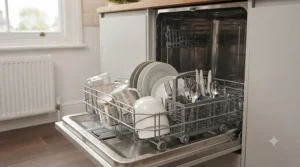
If the Beko is “no frills,” the Candy CDPH2L1049W is “no frills, but faster.” It offers 10 place settings, glass/delicate and intensive cycles, four wash temperatures, and a pre-rinse option across seven wash programmes, with a genuine 30-minute quick wash for a smaller batch of lightly soiled crockery being the standout feature that separates it from the Beko above.
Here’s what to weigh: the manufacturer’s own manual confirms a noise level of 49dB, a 230V/10A power draw, and condensation-based drying rather than a dedicated heating element for the dry cycle — meaning glassware can come out slightly damp on shorter programmes, a known trade-off on budget machines rather than a fault. It also includes an AquaStop leak-protection function, which is a genuinely reassuring inclusion at this price point, particularly if you’re installing near wood flooring or in a rented flat where a leak means more than just an inconvenience.
Aggregated sentiment here is unusually strong for a budget appliance: reviewers on AO.com describe it as “as good as any,” with dishes coming out “certainly very clean,” though more than one buyer flagged that the printed manual is poorly translated and not especially helpful. Others independently praised it as “a very roomy small dishwasher with great height between shelves” that “washes brilliantly well.” Reviewers consistently note the quiet running as a pleasant surprise for the price bracket.
Pros:
- ✅ True 30-minute cycle for light, quick loads
- ✅ AquaStop leak protection included
- ✅ Strong review consistency on cleaning results
Cons:
- ❌ Condensation drying leaves glassware slightly damp
- ❌ Printed instruction manual is poorly translated
Typically sitting in the £180-£250 range depending on retailer promotions, the Candy CDPH2L1049W is arguably the sharpest value pick on this list for anyone whose priority is speed over smart features.
3. Hisense HS523E15WUK — quietest budget-to-mid pick with a cutlery drawer
The Hisense HS523E15WUK is the model that keeps surprising reviewers, largely because Hisense still carries a slight “budget newcomer” perception in UK kitchens that its actual spec sheet doesn’t support. It runs at just 47dB, offers six wash programmes including a 90-minute wash, Eco, Glass/Delicate, Intensive, Quick wash and Universal, and includes a built-in water softener — a feature that’s usually reserved for pricier machines and genuinely matters if you live in a hard water area, since it protects both the appliance and your glassware from limescale build-up over time.
What most buyers overlook is the basket layout: rather than a bolt-on cutlery basket eating into rack space, it uses a dedicated cutlery tray sitting above the top basket, freeing up the racks for actual dishes — reviewers on Argos specifically called this out, with one buyer noting they “usually only get a cutlery tray on a more premium model,” and that’s exactly why they chose this one. Based on the spec comparison with the Beko and Candy above, this is genuinely the better-engineered budget option if drawer space in your cupboards is already tight.
Reviewer sentiment is strongly positive on capacity and quietness, backed by a 4.6 out of 5 rating from well over 500 owner reviews. The recurring criticism, however, is consistent across independent sources: drying performance and occasional error codes come up repeatedly in customer feedback, alongside mixed opinions on the cutlery tray’s exact design (some love it, others find the slots fiddly for larger serving spoons).
Pros:
- ✅ Built-in water softener rare at this price
- ✅ Space-saving cutlery drawer over basket
- ✅ Very quiet 47dB operation for open-plan living
Cons:
- ❌ Drying performance inconsistently reported
- ❌ Occasional error codes flagged by owners
At roughly £230-£280, the Hisense HS523E15WUK is the pick for anyone in a hard-water postcode or an open-plan kitchen-diner where a whirring dishwasher during dinner is a genuine social hazard.
4. Bosch Serie 4 SPS4HKI45G — smartest slimline with app control
Stepping up meaningfully in price brings you to the Bosch Serie 4 SPS4HKI45G, and the jump is justified by a noticeably more sophisticated engineering approach rather than just a badge. It includes Home Connect smart connectivity, an ExtraDry option for hard-to-dry loads, a dedicated Silence Programme, Rackmatic height-adjustable racking for maximum flexibility, and an LED display that flags remaining programme time plus salt and rinse aid levels.
Here’s what the spec sheet won’t spell out plainly: the LoadSensor feature uses a rotary speed sensor to detect load weight and adjust water levels accordingly, meaning a half-empty rack genuinely uses less water rather than running a fixed volume regardless of load — a real running-cost difference over hundreds of cycles, not just marketing copy. DosageAssist also ensures the detergent tablet dissolves fully and consistently rather than clumping mid-cycle, which anyone who’s ever pulled out a dishwasher-tablet husk stuck to a rack will appreciate.
Aggregated review sentiment leans heavily positive and centres on trust in the brand as much as the individual model: one long-term Bosch owner who switched from a full-size unit to this slimline model in a new kitchen noted they’d stopped using their old full-size machine entirely since installing this one, while another simply summarised it as “as ever, Bosch quality — enough said.” A recurring, mild criticism across owner feedback is cycle length — the Eco programme commonly runs past three hours, which is standard for efficiency-focused Eco cycles across the market but worth knowing if you’re expecting a fast turnaround.
Pros:
- ✅ Home Connect app control via Alexa and Google Assistant
- ✅ LoadSensor genuinely adjusts water to load size
- ✅ Rackmatic offers real basket flexibility
Cons:
- ❌ Eco programme regularly exceeds three hours
- ❌ Meaningfully pricier than budget alternatives
Sitting around £450-£590, the Bosch Serie 4 SPS4HKI45G is the sensible splurge for anyone who wants smart-home integration and a brand reputation for longevity baked into a 45cm footprint.
5. Montpellier MDWBID4553 — cheapest fully integrated slimline
Everything above has been freestanding. If your kitchen calls for under counter installation behind a matching cabinet door instead, the Montpellier MDWBID4553 is the entry point worth knowing. It offers 5 programmes and 3 temperatures with capacity for 10 place settings, plus an Auto Door function that automatically releases the door slightly in the final stage of the programme, allowing air to circulate into the cavity and assist drying — a genuinely clever workaround for the fact integrated machines can’t rely on ambient room air the way freestanding units do.
Based on the spec comparison, the programme list is deliberately unfussy: Prewash, Quick 30 minutes at 40°C, Eco, Super 50 minutes at 65°C, and Intensive at 65°C, alongside rear foot adjustments accessible from the front panel, sparing you the hassle of pulling the whole unit out to level it during installation. That last detail matters more than it sounds on paper — anyone who’s wrestled a heavy appliance back out of a tight cabinet housing to adjust a wonky foot will understand why it’s worth calling out specifically.
What most buyers overlook here is the warranty structure: it comes with a genuine 2-year manufacturer guarantee, which is a meaningful reassurance at this price point given integrated appliances are typically more involved (and costly) to have serviced or replaced than freestanding equivalents, since a cabinet door has to come off first.
Pros:
- ✅ Cheapest genuinely integrated slimline option here
- ✅ Auto Door assists drying without extra energy use
- ✅ Front-accessible rear foot adjustment
Cons:
- ❌ Lower D energy rating than newer integrated rivals
- ❌ Only 3 temperature settings limits fine-tuning
Priced around £280-£320, the Montpellier MDWBID4553 is the obvious shortlist entry for anyone renovating a small kitchen who wants the appliance completely hidden behind cabinetry without paying integrated-appliance prices for the privilege.
6. CDA CDI4251 — most feature-packed integrated slimline
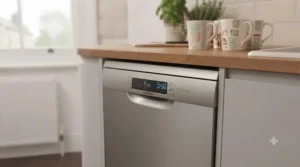
One rung up the integrated ladder sits the CDA CDI4251, and the extra spend buys a noticeably longer features list. It runs 7 programmes across 10 place settings, includes an Antibacterial Filter and Hygiene Pro programme for genuinely deeper cleaning, and adds a floor-projected LED beam that shows red or green depending on whether a cycle is running — small, but genuinely useful if you’ve ever opened an integrated dishwasher mid-cycle without realising it was on.
The practical extras keep coming: LED rinse aid and salt indicators, a 1-19 hour delay timer for flexible scheduling, three spray levels, and AquaStop leak protection round out a spec sheet that, on paper, comfortably rivals some freestanding machines costing considerably more. Reviewers consistently note the Hygiene Pro programme as a genuine differentiator for households dealing with baby bottles or reusable food containers, where a standard 65°C cycle sometimes isn’t quite enough.
Honest analysis: this is the sort of appliance that rewards buyers who actually use the extra programmes rather than defaulting to Eco every time — the Antibacterial Filter and Hygiene Pro combination is wasted spend if you’d have been just as happy with the simpler Montpellier above. It’s for households who specifically want that extra hygiene assurance, not a universal upgrade.
Pros:
- ✅ Hygiene Pro programme and antibacterial filter
- ✅ Floor-beam indicator shows cycle status at a glance
- ✅ Flexible 1-19 hour delay timer
Cons:
- ❌ Premium spend only pays off if features get used
- ❌ Installation still requires a cabinet housing and door
Expect to pay around £430-£460 for the CDA CDI4251, making it the considered upgrade pick for anyone integrating a slimline unit who wants genuinely useful extras rather than just a longer spec sheet.
7. AEG 7000 GlassCare — premium pick for the gentlest glass care
Closing the list at the top of the price bracket is the AEG 7000 GlassCare, a model that leans hard into a single, well-executed idea: protecting glassware from scratching, clouding and chipping over years of repeated washing. Specced with an D energy rating, 8 programmes, a 10 place setting capacity and dimensions of 85 x 44.6 x 61.5cm, it runs at a genuinely hushed 45dB — quieter than every freestanding model on this list bar the Hisense.
What the spec sheet won’t tell you, but a genuine long-term owner review does, is how that GlassCare positioning plays out day-to-day: one reviewer who tested the unit over six months for a family of four described it as feeling “surprisingly roomy” for a slimline model, with a good mix of programmes including a quick wash, an eco option, and an auto setting that adjusts depending on how dirty things are, adding that the gentle glass holders were specifically designed to stop stemware wobbling about mid-cycle. That’s a real, honest verdict from actual usage rather than a manufacturer claim repeated back — the AEG name buys 135 years of German engineering heritage as part of the wider Electrolux group, and this model reflects that pedigree in build quality rather than raw feature count.
Based on the spec comparison against the Bosch above, the AEG trades slightly worse energy efficiency (D versus effectively A-class Bosch programmes) for genuinely superior noise levels and glassware protection — a fair trade for households that entertain often and care more about stemware surviving intact than shaving a few pounds off the annual electricity bill.
Pros:
- ✅ Quietest freestanding model on this list at 45dB
- ✅ GlassCare holders genuinely protect stemware
- ✅ Auto programme adjusts cleaning to actual soil level
Cons:
- ❌ D energy rating undercuts the premium price tag
- ❌ Highest upfront cost of all seven picks
At around £550-£700, the AEG 7000 GlassCare is the splurge for households that host regularly and have decided a small kitchen doesn’t mean compromising on how their glassware comes out the other side.
Top 7 Products: Full Comparison Table
| Product | Place Settings | Noise Level | Energy Rating | Price Range | Best For |
|---|---|---|---|---|---|
| Beko DVS04X20W | 10 | 49dB | E | £220-£260 | Tightest budgets |
| Candy CDPH2L1049W | 10 | 49dB | E | £180-£250 | Speed over polish |
| Hisense HS523E15WUK | 10 | 47dB | E | £230-£280 | Hard water areas |
| Bosch Serie 4 SPS4HKI45G | 9 | Low (Silence Programme) | A-class programmes | £450-£590 | Smart home users |
| Montpellier MDWBID4553 | 10 | Standard | D | £280-£320 | Cheapest built-in |
| CDA CDI4251 | 10 | Standard | Not specified | £430-£460 | Hygiene-focused households |
| AEG 7000 GlassCare | 10 | 45dB | D | £550-£700 | Glassware-heavy entertaining |
Reading across this table, the three cheapest models — the Beko DVS04X20W, Candy CDPH2L1049W and Hisense HS523E15WUK — all cluster around the same E energy rating and roughly 9-10 litre water use, which tells you the real differentiator between them isn’t efficiency but small usability details like cycle length and cutlery storage. The Bosch Serie 4 SPS4HKI45G and AEG 7000 GlassCare justify their higher prices through genuinely quieter operation and smarter load management rather than dramatically more capacity, since every model here tops out at 9 or 10 place settings regardless of price.
How to Choose a 45cm Dishwasher for Your Small Kitchen
Picking a 45cm dishwasher for a genuinely tight space comes down to matching the appliance’s constraints to your kitchen’s constraints, in this order:
- Confirm your exact gap width first. Measure the housing or floor space three times, at the top, middle and bottom of the gap — old kitchens are rarely perfectly square, and a 45cm dishwasher needs roughly 45.5-46cm of clearance to allow for pipework and ventilation.
- Decide freestanding or integrated early. This determines your entire shortlist; an integrated door-mounted unit like the CDA CDI4251 physically cannot be swapped for a freestanding model like the Candy CDPH2L1049W without changing your cabinetry.
- Check your water pressure and drainage route. Older flats, particularly converted period properties, sometimes have lower mains pressure that can extend cycle times regardless of which model you buy.
- Weigh energy rating against your actual usage frequency. The Energy Saving Trust’s home appliance guidance explains how the UK’s dishwasher energy label is calculated from eco-cycle performance, so a cheaper E-rated machine used twice weekly may still cost less over its lifetime than an efficient model that never gets used to capacity.
- Prioritise noise level if you live open-plan. In a studio flat kitchen or open living space, the difference between 45dB and 49dB is genuinely noticeable during a quiet evening.
- Factor in place settings against household size realistically. Two people rarely need more than 9-10 place settings; couples or solo households are the ideal audience for slimline units generally.
- Read aggregated review sentiment, not star ratings alone. A 4.6-star rating built on 500+ reviews tells you far more than a 5-star rating built on four.
Under Counter Installation: A Practical Setup Guide
Getting a slimline dishwasher for small kitchen use installed correctly under a worktop or inside a cabinet housing is where most of the avoidable headaches live, and it’s worth walking through properly rather than winging it on delivery day.
Before delivery arrives, confirm your housing gap is at least 1cm wider than the appliance’s stated width to allow for the door hinge swing and any skirting overhang, and check that your water inlet, drainage outlet and a grounded electrical socket are all within reach of the appliance’s supplied hoses — typically around 1.5 metres. If you’re doing genuine under counter installation into an integrated cabinet, you’ll also need a matching door panel cut to the manufacturer’s template, which is usually supplied separately by your kitchen fitter rather than the appliance brand.
During first setup, run one empty cycle on the hottest programme before loading any actual dishes — this clears any manufacturing residue and lets you check for leaks around the hose connections while nothing valuable is at risk. Common mistakes in the first 30 days include overloading the detergent dispenser (most tablets are designed for 60cm machines and can leave residue on 45cm loads if you’re not adjusting dosage down), and forgetting to top up the salt reservoir separately from rinse aid — they serve different functions and neither substitutes for the other.
For ongoing maintenance, wipe the door seal monthly to prevent limescale build-up, run a monthly empty maintenance cycle with a dishwasher cleaner in hard water areas, and check the filter basket at the base every couple of weeks if you’re running loads daily — slimline machines have proportionally smaller filter capacity than full-size units, so they clog faster with food debris relative to how often they’re used.

Slimline Dishwashers for Studio Flat Kitchens and Other Real-World Scenarios
Specs only tell half the story — how a slimline dishwasher for small kitchen use actually fits into a life matters just as much. Here are three genuinely different households and how the reasoning above maps onto each.
The studio flat kitchen tenant. If you’re renting a studio flat kitchen with a kitchenette rather than a full run of units, even a 45cm freestanding model may simply not fit anywhere sensible, and landlord permission for plumbing alterations is often a non-starter. In this scenario, it’s worth knowing that plumbing-free tabletop mini dishwashers exist as a genuinely different category — compact machines around 43-44cm wide that sit on a worktop and connect to a tap rather than fixed pipework, needing no permanent installation at all. They hold far fewer place settings than anything on our main list above, so they’re a fallback for renters specifically, not a genuine like-for-like alternative to a proper slimline unit.
The young couple in a galley kitchen. Two people generating maybe one load every one to two days are the textbook audience for the Candy CDPH2L1049W or Beko DVS04X20W — 10 place settings comfortably covers a couple’s daily crockery without ever needing the intensive programme, and the lower upfront cost matters more than marginal efficiency gains when usage is light.
The small family renovating a period kitchen. A family of three or four in a kitchen too narrow for a 60cm run typically benefits from going integrated, both for the finished look and because a family generates enough daily washing-up to justify the CDA CDI4251‘s Hygiene Pro programme, particularly with young children’s bottles and cups in the mix.
Common Mistakes When Buying a Slimline Dishwasher
The pitfalls here are consistent enough across buyer feedback and retailer returns data that they’re worth calling out directly.
Buyers frequently assume “slimline” and “compact” or “tabletop” are interchangeable terms, then order the wrong category entirely and face a costly return. They also commonly skip measuring pipework clearance behind the appliance, only to find the water inlet fouls against a skirting board once it’s slid into place. A third recurring error is choosing based on price alone without checking place settings against actual household size — a single person buying a 10-place-setting unit is paying for capacity they’ll rarely use, while a family of four squeezing by on a 9-setting model will be running near-daily cycles regardless of energy rating. Finally, plenty of buyers overlook noise level entirely until the machine is running in an open-plan space during a dinner party, at which point 49dB suddenly feels a lot louder than the spec sheet implied.
Slimline vs Full-Size vs Countertop: Which Space Saving Appliance Wins?
Choosing the right space saving appliance for a small kitchen means understanding what you’re actually trading away at each size tier, not just picking the smallest option available.
| Type | Typical Width | Capacity | Price Range | Best For |
|---|---|---|---|---|
| Full-Size Dishwasher | 60cm | 12-16 place settings | £300-£800+ | Families of 4+, high daily wash volume |
| Slimline Dishwasher | 45cm | 9-10 place settings | £180-£700 | Couples, small families, tight housing gaps |
| Countertop/Mini Dishwasher | 43-44cm | 2-6 place settings | £150-£350 | Renters, studio flats, no fixed plumbing |
Unlike larger dishwashers which can generally accommodate 13 or 14-place settings, slimline dishwashers tend to have space for nine or ten — a genuinely modest capacity gap given the 15cm width reduction, which is exactly why slimline units have become the default recommendation over full-size machines for anyone without a genuinely large household. Countertop models sit in an entirely different bracket: they solve a plumbing problem rather than a width problem, and shouldn’t be judged against slimline units on capacity or features, since they’re built for a completely different constraint.
Features That Actually Matter (And Those That Don’t)
Marketing copy on dishwasher listings tends to flatten every feature into equal importance, which isn’t remotely how they play out in daily use.
Genuinely worth prioritising: a dedicated cutlery tray over a basket (saves rack space you’ll actually use every load), an integrated water softener if you’re in a hard water postcode, a genuine sub-60-minute quick wash programme, and AquaStop-style leak protection, particularly for integrated installs where a leak can damage flooring or cabinetry before anyone notices. Delay timers are also worth having if your electricity tariff has an off-peak window, since running a cycle overnight on a cheaper rate adds up meaningfully over a year.
Routinely overrated: the total number of wash programmes. Most households genuinely use two or three programmes — Eco, a daily/normal cycle, and an intensive setting for pots and pans — regardless of whether the machine offers four programmes or eight. App connectivity via something like Bosch’s Home Connect is genuinely handy for checking cycle progress remotely, but it’s a convenience layer, not a cleaning-performance improvement, and shouldn’t be the deciding factor if budget is tight. Similarly, a higher place-setting count within the slimline category (9 versus 10) rarely changes real-world usability enough to justify chasing it over other features.
Long-Term Cost & Maintenance of a 45cm Dishwasher
The purchase price of a 45cm dishwasher is only the opening figure in its total cost of ownership, and running costs compound meaningfully over a typical 8-10 year appliance lifespan. Under the UK’s household dishwasher energy labelling regulations, every model sold must be tested and rated on its eco programme specifically, which is why the eco cycle is nearly always the slowest, most water-frugal setting on the menu rather than an arbitrary “green” option. An A-rated dishwasher typically uses between 70 and 85 kWh per year, while standard B-rated models consume around 95 to 110 kWh annually — modest-sounding gaps that widen considerably once multiplied across a decade of ownership and current electricity pricing.
Water consumption tells a similar story: most of the slimline models on this list use somewhere between 9 and 12 litres per cycle, and running roughly one cycle daily adds up to a meaningful annual water bill on a metered supply, though still comfortably less than washing the equivalent load by hand. Filter cleaning, salt refills for machines with a built-in softener, and periodic descaling in hard water regions are the main recurring maintenance costs beyond the electricity and water bill itself — budget for a bottle of dishwasher cleaner every couple of months if you’re in a hard water area, since limescale build-up on heating elements is one of the most common causes of premature appliance failure.
Value verdict: for light-to-moderate household use, a cheaper E-rated slimline machine like the Beko DVS04X20W or Candy CDPH2L1049W will often work out similarly priced over its lifetime to a pricier A-class alternative, simply because the usage volume is low enough that the efficiency gap never has enough cycles to pay for itself. Heavy daily users, by contrast, genuinely do recoup the difference on something like the Bosch Serie 4 SPS4HKI45G over several years.
Problem → Solution: Fixing Common Slimline Dishwasher Issues
Problem: Dishes coming out with a white, chalky residue. This is almost always hard water limescale rather than a machine fault — check your salt reservoir is topped up separately from rinse aid, and consider a model with a built-in softener, like the Hisense HS523E15WUK, if you’re in a known hard water area.
Problem: Glasses coming out cloudy or scratched over time. Softer glass-holding racks, as found on the AEG 7000 GlassCare, reduce stemware movement during the wash cycle; in the meantime, switching to a gentler Glass or Delicate programme and reducing rinse aid dosage slightly often helps.
Problem: Cycle finishes but dishes are still visibly damp. This is typically a condensation-drying limitation rather than a fault, common on budget models like the Candy CDPH2L1049W — cracking the door open for ten minutes at the end of a cycle solves it without buying a new machine.
Problem: Integrated dishwasher door doesn’t sit flush with cabinetry. Nearly always a foot-levelling issue rather than a manufacturing fault; models with front-accessible rear foot adjustment, such as the Montpellier MDWBID4553, make this a five-minute fix without pulling the unit back out.
Problem: Machine seems louder than the spec sheet suggested. Worn floor levelling, an unbalanced load, or installation on an uneven floor tile can all amplify noise beyond the rated decibel figure — rechecking the feet are level and evenly weight-bearing solves this in the majority of reported cases.
✨ Don’t Miss These Exclusive Deals!
🔍 Ready to Reclaim Your Kitchen Space?Take your small kitchen to the next level with these carefully selected slimline picks. Click on any highlighted product above to check current pricing and availability. These compact appliances will help you create a genuinely space saving appliance setup your whole household will actually enjoy using!
FAQ
❓ What is the smallest slimline dishwasher width available?
❓ Can a slimline dishwasher fit under a standard worktop?
❓ How many place settings does a 45cm dishwasher hold?
❓ Is a slimline dishwasher worth it for a studio flat?
❓ Do slimline dishwashers use more water per place setting than full-size models?
Conclusion
Fitting a genuinely capable dishwasher into a small kitchen isn’t the compromise it used to be. Across the seven models covered here, you’ve got a genuinely honest spread — from the unglamorous but reliable Beko DVS04X20W at the budget end, through smart, quiet, feature-rich mid-range options like the Bosch Serie 4 SPS4HKI45G, up to the glassware-babying AEG 7000 GlassCare for households who’ve decided a tight footprint shouldn’t mean compromised results.
The right choice ultimately comes down to matching the appliance to your actual gap, your actual household size, and your actual usage pattern rather than chasing the longest feature list. A couple in a galley kitchen doing a load every other day has fundamentally different needs to a family of four squeezing a 45cm unit into a period kitchen renovation, and the analysis above is built to help you separate marketing noise from genuine, use-case-relevant differences. Whichever slimline dishwasher for small kitchen use you land on, the core promise holds: fifteen centimetres less width doesn’t have to mean fifteen percent less dishwasher.
✨ Found Your Perfect Match?
🔍Compare the full lineup one more time, check today’s price on your favourite pick, and reclaim that cupboard space for good. Your future self, not scrubbing pans at midnight, will thank you.
Recommended for You
- Best Slimline Dishwasher UK 2026: 7 Top 45cm Picks Compared
- Cheap Freestanding Dishwasher: 7 Best Budget Picks for 2026
- Best Freestanding Dishwasher UK 2026: 7 Top Picks You’ll Love
Disclaimer: This article contains affiliate links. As an Amazon Associate, I earn from qualifying purchases. If you purchase products through these links, we may earn a small commission at no additional cost to you.
✨ Found this helpful? Share it with your friends! 💬🤗
