

In This Article
What is a dishwasher cleaner for smells? It’s a tablet, powder or liquid that you run through the machine to dissolve the grease, limescale and food film that odour-causing microbes feed on. Detergent cleans your plates. A dishwasher cleaner for smells cleans the appliance itself.

You know the moment. You open the door expecting a gust of sparkling steam and get eau de forgotten casserole instead. It’s grim, and it’s also common.
The explanation isn’t flattering. A peer-reviewed PLOS ONE study of 30 household dishwashers found fungi in 83% of them, mostly around the rubber door seals. The researchers pointed to tap water as the most likely way in. A warm, wet, nutrient-rich box that gets fed leftovers daily is basically a very small, very tidy swamp.
The good news is that the fix is cheap, quick and mostly a matter of habit. Most smells come from three places: the filter, the greasy film on the walls and spray arms, and the damp seal. The right product tackles the film, and a decent routine tackles the rest.
I haven’t tested these products myself. This guide is built from manufacturer instructions, retailer listings, UK buyer-guide recommendations and aggregated review themes. Below you’ll find seven real UK-available picks, the main odour causes, a proper look at filters, and a no-nonsense routine. Prices are ranges only, so check current price before you buy.
Quick Comparison: Dishwasher Cleaner for Smells at a Glance
| Product | Format | Best For | Price Range (check current price) |
|---|---|---|---|
| Finish In-Wash Dishwasher Machine Cleaner Tablets | Tablet, used in a normal wash | Busy households who forget maintenance | Around £5-£7 for 3 |
| Dr. Beckmann Service-it Deep Clean Dishwasher Cleaner | Powder plus seal wipe | Stubborn, musty odours | Around £3-£6 |
| Finish Dishwasher Cleaner (Lemon Deep Cleaner, 250ml) | Liquid, empty cycle | Grease and limescale in hard-water homes | Around £3-£4 a bottle |
| HG Service Engineer Dishwasher & Washing Machine Cleaner | Liquid, empty cycle | Older machines with grime and mould-prone corners | Around £8-£10 |
| Ecozone Washing Machine & Dishwasher Cleaner Tablet | Tablet, empty hot cycle | Eco-minded, fragrance-free households | Around £5-£7 for 6 |
| Elbow Grease Dishwasher Cleaner | Liquid, top-shelf bottle | Slimline machines and lemon-scent fans | Around £2-£4 |
| Crystale Dishwasher Cleaner Pink Grapefruit & Pomegranate | Liquid, empty cycle | Tight budgets | Around £1-£2 |
Looking at the table, Finish In-Wash Dishwasher Machine Cleaner Tablets wins on convenience because it needs no empty cycle, while Dr. Beckmann Service-it Deep Clean Dishwasher Cleaner earns its slightly higher price through the seal wipe, which targets the spot where odours like to settle. Crystale Dishwasher Cleaner Pink Grapefruit & Pomegranate is the budget floor. If you’re in a hard-water postcode, the descaling liquids and tablets are worth a closer look.
💬 Just one click — help others make better buying decisions too!😊
Top 7 Dishwasher Cleaner for Smells Picks: Expert Analysis
Here are seven real, UK-available options, from budget to premium-ish. Every verdict below rests on specs, instructions and aggregated review themes, not on invented testing.
1. Finish In-Wash Dishwasher Machine Cleaner Tablets — loads with dirty dishes, no extra cycle
The big idea is that the cleaning happens during a normal wash, so there’s no separate maintenance day to forget.
You get three 17g tablets per pack. You place one on the floor of the machine alongside your usual detergent and run a regular cycle. Finish advises monthly use and says the tablets carry extra grease-removal actives compared with detergent alone. In practice, that means the greasy film on the filter area and spray arms gets dissolved before it turns rancid. That film is the root of most “stale” smells.
Based on the format, this suits people who know they won’t do a quarterly empty-cycle ritual. It’s a maintenance tool more than a rescue remedy, so a long-neglected machine will still need its filter scrubbed by hand. The pack lists an enzyme (subtilisin) that may cause allergic reactions, so handle with dry hands and keep it away from small children.
Reviewers consistently like the no-planning convenience. Mumsnet’s buyer guide named it best overall, and users there describe a monthly routine on a hotter programme. Ratings vary by retailer, from mid-3s on a supermarket listing with few reviews to the mid-4s on a price-comparison aggregator.
Pros:
- ✅ Runs inside a normal wash cycle
- ✅ Tackles limescale and grease build-up
- ✅ Leaves no scent on glasses
Cons:
- ❌ Unscented, so no fresh-lemon finish
- ❌ Won’t unblock a clogged filter alone
Price: around £5-£7 for a pack of three, and multipacks work out cheaper per clean. Solid value for the set-and-forget crowd.
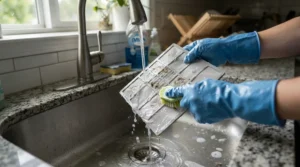
2. Dr. Beckmann Service-it Deep Clean Dishwasher Cleaner — two-step wipe-and-powder, the odour specialist
The standout is the included wipe, which sends you to the rubber seal where musty smells collect.
Step one is wiping the door seal and frame. Step two is running the empty machine at 60°C or above with no detergent, then pouring the powder onto the floor after about 30 minutes and finishing the cycle. The powder is an oxygen-based bleach formula. The listing describes it as chlorine-free, and the maker claims it removes 99.9% of bacteria. That is a manufacturer claim I can’t verify independently. The pack guidance is every one to two months.
What most people overlook is that wiping the seal matters as much as the powder. The PLOS ONE research found the heaviest fungal growth right there. A cleaner that includes a wipe addresses the habitat, not just the pipework.
Mumsnet’s guide picked it as the best dishwasher cleaner for odours. Deal-tracker pages reporting Amazon data showed a rating of roughly 4.5 out of 5 from several thousand reviews at the time of research.
Pros:
- ✅ Wipe targets the odour-prone door seal
- ✅ Reaches filter, drain and spray-arm areas
- ✅ Low outlay per hygiene treatment
Cons:
- ❌ Needs an empty machine and hot cycle
- ❌ Costs more per clean than most liquids
Price: around £3-£6 depending on retailer. Good value if musty smells are your problem.
3. Finish Dishwasher Cleaner (Lemon Deep Cleaner, 250ml) — dual-layer liquid for grease and limescale
The two-layer bottle is the clever bit: one layer targets grease and the other targets limescale.
You remove the sticker, place the bottle upside down in the rack and run an empty cycle at 65°C minimum. Finish markets its “clog-dissolving” formula as working through filter, drain and pipes, and says it neutralises odours. Retailers differ on whether the bottle goes on the top or bottom rack, so follow your pack.
My read is that this is the most sensible all-rounder for hard-water homes. Odours often start with grease and scale trapping food in the hidden plumbing, and a product that attacks both is aimed squarely at that. Reviewers in hard-water areas describe using it monthly. One mentions needing to hand-clean the filter when it had been a long time since the last deep clean.
Ratings are mixed by retailer. Amazon-sourced aggregates reported by deal trackers sit in the mid-4s across thousands of ratings, while a couple of supermarket listings with far fewer reviews show mid-3s.
Pros:
- ✅ Two-layer formula targets grease and scale
- ✅ Bottle sits in the rack, no measuring
- ✅ Neutralises odours, with a lemon option
Cons:
- ❌ Needs an empty 65°C cycle
- ❌ Single-use plastic bottle
Price: around £3-£4 a bottle, with twin packs often cheaper per bottle. Good value.
4. HG Service Engineer Dishwasher & Washing Machine Cleaner — engineer-recommended, tough on soap scum
Its pitch is professional credibility: Mumsnet notes it’s recommended by dishwasher engineers and repair services.
It’s a dual-purpose liquid for dishwashers and washing machines. You run it through an empty machine on the hottest setting, roughly every three months. Each bottle gives two to four treatments, and an unscented version is listed at some retailers. It’s aimed at soap scum, limescale and general grime, which makes it a good candidate for older machines with smelly corners.
The quarterly rhythm is the interesting part. Less frequent use suits people who’d rather do one proper service than monthly top-ups. If you also own a washing machine that needs the same treatment, the dual-purpose bottle spreads the cost.
Mumsnet flags that some reviewers found a residue afterwards. If you notice any, a follow-up rinse on a hot cycle is a sensible precaution.
Pros:
- ✅ Recommended by professional dishwasher engineers
- ✅ Works in dishwashers and washing machines
- ✅ Targets soap scum, limescale and grime
Cons:
- ❌ Some reviewers report residue left behind
- ❌ Higher upfront cost than most rivals
Price: around £8-£10 per bottle, so roughly £2-£5 per treatment. Worth it if you’ll use both appliances.
5. Ecozone Washing Machine & Dishwasher Cleaner Tablet — plant-based, plastic-free double duty
The standout is the eco credentials: a plant-based, vegan-friendly formula in soluble, plastic-free packaging.
Each pack holds six fragrance-free tablets suitable for both dishwasher and washing machine. In the dishwasher you place one on the floor and run a hot wash, monthly. This sits in the dishwasher deep clean tablets category. The aim is to shift detergent residue and sludge and to neutralise odours.
This is the one I’d shortlist if you dislike chemical-heavy cleaners or want to cut plastic. A Mumsnet user in a hard-water area describes a first-Saturday-of-the-month routine for both machines. The trade-off is that it’s fragrance-free. If you want a lemony hit when you open the door, look elsewhere.
Pros:
- ✅ Plant-based formula with plastic-free packaging
- ✅ Six tablets cover two appliances
- ✅ Fragrance-free, so nothing lingers on glasses
Cons:
- ❌ Needs an empty hot cycle
- ❌ No fresh-scent boost
Price: around £5-£7 for six, which works out near £1 per treatment. Excellent value.

6. Elbow Grease Dishwasher Cleaner — top-shelf bottle with a punchy lemon scent
The bottle’s shape is the hook: it’s designed to wedge into the top shelf of any dishwasher, slimline models included.
Mumsnet’s guide rates it as its best liquid cleaner. It’s a 250ml bottle that cleans and descales hidden parts and works well at neutralising food-residue odours. The lemon fragrance is described as relatively strong, which is either a bonus or a dealbreaker.
For compact kitchens, the fit matters more than it sounds. A bottle that won’t sit properly can tip over mid-cycle, which wastes the treatment. If you’re comparing it with Crystale Dishwasher Cleaner Pink Grapefruit & Pomegranate, this is the more assertive-smelling option and costs a little more.
Check the pack for temperature and frequency, since the guide doesn’t specify them.
Pros:
- ✅ Bottle fits any top shelf, even slimline
- ✅ Neutralises food-residue odours
- ✅ Descales hidden parts
Cons:
- ❌ Strong lemon scent isn’t for everyone
- ❌ Single-use plastic bottle
Price: around £2-£4. Good value for small kitchens.
7. Crystale Dishwasher Cleaner Pink Grapefruit & Pomegranate — the cheapest route to a fresh-smelling machine
The headline is the price: roughly the cost of a bag of crisps.
You remove the label, place the bottle upside down on the top shelf and run an empty cycle at 65°C or above. Use it monthly. The formula targets grease, grime and limescale and leaves a grapefruit-and-pomegranate scent. Reviewers largely praise the fragrance.
This is where realism helps. Mumsnet notes that some reviewers felt it didn’t disperse fully, and that you still need to clean the filter separately. So treat it as a budget monthly top-up that works best on a machine you already maintain, not a rescue for a neglected one.
Pros:
- ✅ Very low price per clean
- ✅ Fresh scent praised by reviewers
- ✅ Simple upside-down bottle method
Cons:
- ❌ Some reviewers say it doesn’t fully disperse
- ❌ Filter still needs hand-cleaning
Price: around £1-£2. Strong value as a maintenance habit, not a miracle cure.
Odour Causes: What’s Actually Making Your Dishwasher Smell
Before you buy anything, diagnose the smell. Different odour causes need different fixes, and a perfumed cleaner on the wrong problem is just a nicer-smelling stink.
The filter
This is the usual suspect. It traps food debris, and unless you clean it, that debris rots. Manufacturers and appliance firms alike put it at the top of the list, and Bosch’s own troubleshooting advice starts with checking the filter isn’t blocked.
Greasy film and limescale
Grease coats the walls, racks and spray arms, and limescale gives it something to cling to. A good dishwasher cleaner for smells is aimed at precisely this layer.
Damp seals and mould
A musty, cellar-ish smell usually points to the rubber seal. Leaving the door slightly ajar after a cycle lets steam escape, and wiping the seal dry helps.
Standing water and drain issues
Water pooling in the base suggests a clogged filter or drain. If the smell is more drains than dinner, suspect a blocked hose or waste connection. Cleaners won’t fix that, so inspect the hose or call an engineer.
Neglect
If the machine’s been off for a while, run the hottest cycle empty before loading it. Stagnant water is not a delicacy.
How to Choose a Dishwasher Cleaner for Smells
Here’s the checklist I’d use, in order of importance.
- Match the product to the smell. Food-and-filter pongs need a filter clean first. Musty smells need seal attention. Grease-and-scale smells suit a degreasing and descaling cleaner.
- Pick a format you’ll actually use. In-wash tablets win for people who forget. Empty-cycle products win for deeper treatments.
- Check temperature requirements. Most liquids want 65°C or hotter, and Dr. Beckmann Service-it Deep Clean Dishwasher Cleaner asks for at least 60°C. Confirm your machine’s programmes can reach that.
- Factor in your water. The Drinking Water Inspectorate explains that hard water scales appliances and shortens heating-element life. In hard areas, favour descaling products and use dishwasher salt as your manual advises.
- Decide on scent. Fragrance-free products like Ecozone Washing Machine & Dishwasher Cleaner Tablet leave nothing behind. Scented ones like Elbow Grease Dishwasher Cleaner add a freshness boost.
- Compare cost per clean, not pack price.
- Read the hazard labels. Several products warn about eye irritation, and tablets can be a choking hazard for small children.
Dishwasher Deep Clean Tablets vs Liquids vs Powders
Which format suits you? Dishwasher deep clean tablets are the tidy option, because you drop one in and go. Liquids come in a bottle you balance in the rack. Powders, like the Dr. Beckmann formula, get poured in mid-cycle.
Here’s the practical comparison, using what’s verified on the packs and in UK buyer guides.
| Product | Empty Cycle? | Scent | Suggested Frequency | Best For |
|---|---|---|---|---|
| Finish In-Wash Dishwasher Machine Cleaner Tablets | No | Unscented | Monthly | Forgetful maintainers |
| Dr. Beckmann Service-it Deep Clean Dishwasher Cleaner | Yes (60°C+) | Citrus | Every 1-2 months | Musty seals |
| Finish Dishwasher Cleaner (Lemon Deep Cleaner, 250ml) | Yes (65°C+) | Lemon | Monthly | Hard-water grease and scale |
| HG Service Engineer Dishwasher & Washing Machine Cleaner | Yes (hottest) | Unscented option | About every 3 months | Older machines |
| Ecozone Washing Machine & Dishwasher Cleaner Tablet | Yes (hot) | Fragrance-free | Monthly | Eco households |
| Elbow Grease Dishwasher Cleaner | Check pack | Lemon | Check pack | Slimline kitchens |
| Crystale Dishwasher Cleaner Pink Grapefruit & Pomegranate | Yes (65°C+) | Grapefruit and pomegranate | Monthly | Tight budgets |
The big divide is the empty cycle. In-wash dishwasher deep clean tablets such as Finish In-Wash Dishwasher Machine Cleaner Tablets fit into life more easily, but empty-cycle products let the cleaner work without competing with detergent. If your machine is genuinely rank, I’d start with an empty-cycle treatment like Dr. Beckmann Service-it Deep Clean Dishwasher Cleaner. Then switch to tablets to maintain it.
Cleaner for Dishwasher Filter: What Works (and What Doesn’t)
Here’s the awkward truth about any cleaner for dishwasher filter problems: no bottle replaces your fingers. Chemical cleaners run through the cycle and loosen film on filters, but the debris itself needs to be physically removed.
Reviewers of budget liquids note exactly this. They say you still need to take the filter out and scrub it. One reviewer of a Finish liquid mentions that if it’s been a while since the last clean, you may need to hand-clean the filter afterwards.
If you want a cleaner for dishwasher filter use, the practical combination is a degreasing product plus a soft brush. Bosch’s own guidance says to clean both filter parts under running tap water, use a small brush on the inside, and avoid anything abrasive. Scouring pads and wire brushes can damage the mesh.
Which? runs a dishwasher advice hub with a how-to-clean guide and fault-fixing tips, which is worth a look if your manual has gone missing.
My pick for filter-heavy households is Finish In-Wash Dishwasher Machine Cleaner Tablets for monthly upkeep. Pair it with a quick weekly rinse. For a deeper reset, HG Service Engineer Dishwasher & Washing Machine Cleaner is the engineer-flavoured choice.
Dishwasher Filter Maintenance: A Step-by-Step Routine
Good dishwasher filter maintenance takes about five minutes and beats any product on this list for stopping smells. Here’s the routine, based on manufacturer guidance.
The five-minute filter clean
- Empty the machine and pull out the bottom rack.
- Unlock and lift out the filter unit, usually at the base. Check your manual for how it twists or lifts.
- Separate the filter parts, unscrewing the cylindrical section if yours has one.
- Rinse under running tap water. Use a soft brush on the mesh and skip anything abrasive.
- Refit and lock it in place so the arrows line up. A badly seated filter lets debris into the pump.
The schedule
- Weekly to fortnightly: rinse the filter if you cook greasy food or rarely scrape plates. Sources vary between weekly and monthly, so the manual wins.
- Monthly: run a cleaner (see the picks above) and wipe the seal.
- Quarterly: check the spray arms for blocked holes and clear them with a toothpick.
Common mistakes in the first 30 days
Skipping the seal wipe is the big one. Using bleach in a stainless steel interior is another, and Tom’s Guide advises against it. Never mix bleach with vinegar or other acidic cleaners.
Dishwasher Freshener: Do You Actually Need One?
A dishwasher freshener sounds appealing, but it treats the symptom. If grease film, a clogged filter or damp seal is the cause, a dishwasher freshener just layers perfume over the problem.
That said, scent has a place once the machine is genuinely clean. The cleaners above double as fresheners, so you may not need a separate dishwasher freshener at all. Elbow Grease Dishwasher Cleaner and Crystale Dishwasher Cleaner Pink Grapefruit & Pomegranate both leave a scent behind. Finish Dishwasher Cleaner (Lemon Deep Cleaner, 250ml) says it neutralises odours as well as scenting.
Low-tech options exist too. A Mumsnet user describes popping half a spent lemon in the cutlery basket during a hot cycle. Several appliance guides also recommend bicarbonate of soda for absorbing odours. Leaving the door ajar after a cycle lets steam out.
One caution: if you’re sensitive to fragrance, consider an unscented route. Finish In-Wash Dishwasher Machine Cleaner Tablets and Ecozone Washing Machine & Dishwasher Cleaner Tablet leave nothing behind. If a dishwasher freshener ever leaves a lingering perfume on glasses, switch to something unscented.

Appliance Hygiene: Seals, Spray Arms and Safety
Treat appliance hygiene as a habit, not a one-off event. The research behind this is revealing. The PLOS ONE study found the black yeast Exophiala dermatitidis in 47% of the dishwashers sampled, mostly at the rubber seals. Tap water was the likely route in.
Don’t panic. Microbiologist Nina Gunde-Cimerman, who has worked on dishwasher research, describes these appliances as generally safe for healthy people. She suggests wiping the seal dry after a cycle to limit buildup. If someone in your household has cystic fibrosis or a weakened immune system, the researchers flag this fungus as relevant. It’s worth asking a clinician for advice.
A simple hygiene routine
- Wipe the seal and door edge dry after the last cycle of the day.
- Run a hot cleaner cycle monthly. Dr. Beckmann Service-it Deep Clean Dishwasher Cleaner includes a wipe made for the seal.
- Check spray arms quarterly.
- Run the hottest programme empty after any long absence.
Safety basics
Read each pack’s hazard statements. Several carry eye-irritation warnings. Tablets with enzymes may cause allergic reactions, and small children shouldn’t be near them. Keep products in their original packaging, out of reach.
Dishwasher Cleaner for Smells vs Vinegar and Bicarb
Can’t you just use vinegar? Sometimes. Mumsnet users and appliance guides recommend white vinegar in a bowl on the top rack, and bicarbonate of soda for odours. Here’s how the approaches compare.
| Approach | Typical Cost | Effort | Strength | Best For |
|---|---|---|---|---|
| Commercial cleaners such as Finish In-Wash Dishwasher Machine Cleaner Tablets | Around £1-£3 per clean | Low | Targets grease and limescale | Routine monthly upkeep |
| White vinegar cycle | A few pence | Medium | Cuts buildup, helps with odour | Occasional freshen-up |
| Bicarbonate of soda | A few pence | Medium | Absorbs odours | Mild smells |
| Dr. Beckmann Service-it Deep Clean Dishwasher Cleaner | Around £3-£6 | Medium (empty cycle plus wipe) | Hygiene-focused, includes seal wipe | Musty, neglected machines |
Vinegar and bicarb are cheap and fine for light freshening. But they don’t include a seal wipe, and they aren’t formulated as full descalers. Some manufacturers caution about frequent vinegar use on rubber parts, so check your manual. Commercial products win when the smell is persistent or you live in a hard-water area.
Real-World Scenarios: Matching a Dishwasher Cleaner for Smells to Your Kitchen
Here are three profiles to show how the choice plays out.
The family of four in a hard-water area
The machine runs daily and the budget is moderate. Use Finish In-Wash Dishwasher Machine Cleaner Tablets monthly, add dishwasher salt as the manual advises, and rinse the filter weekly. Run Finish Dishwasher Cleaner (Lemon Deep Cleaner, 250ml) every few months for a deeper descale.
The student houseshare on a tight budget
Money is tight and filters get ignored. Buy Crystale Dishwasher Cleaner Pink Grapefruit & Pomegranate for a monthly top-up, and rinse the filter fortnightly. Put a reminder in the group chat. Yes, really.
The eco-conscious household with a musty older machine
Start with Dr. Beckmann Service-it Deep Clean Dishwasher Cleaner to reset the seal and pipework. Then maintain with Ecozone Washing Machine & Dishwasher Cleaner Tablet monthly, which also covers the washing machine.
✨ Don’t Miss These Exclusive Deals!
🔍 Take your dishwasher care to the next level with these carefully selected products. Click on any highlighted item to check current pricing and availability. These tools will help you create a fresher, healthier kitchen your family will love!
Long-Term Cost & Maintenance: What You’ll Really Spend
The ongoing cost of keeping a dishwasher fresh is small. Based on typical price ranges, Ecozone Washing Machine & Dishwasher Cleaner Tablet works out near £1 per clean, Crystale Dishwasher Cleaner Pink Grapefruit & Pomegranate a little more, and Finish In-Wash Dishwasher Machine Cleaner Tablets roughly £1.50-£2.50 per clean. Dr. Beckmann Service-it Deep Clean Dishwasher Cleaner and HG Service Engineer Dishwasher & Washing Machine Cleaner cost more per treatment but are used less often in the case of HG.
Monthly use means roughly £12-£30 a year, depending on the product. A repair call-out will usually cost far more than a year’s supply. A clogged pump or scaled heating element is exactly what regular maintenance aims to prevent.
Mumsnet’s dishwasher cleaner guide offers a sensible bundle of habits beyond cleaners:
- Use quality detergent and dishwasher salt in hard-water areas.
- Don’t overload the machine.
- Run the hottest cycle empty after a long gap.
Add rinse aid per your manual, and scrape plates before loading. Less food in means less rot out.
FAQ
❓ What's the best dishwasher cleaner for smells in hard-water areas?
❓ Is Finish or Dr. Beckmann better for musty odours?
❓ Are dishwasher cleaners safe for stainless steel interiors?
❓ Is a multipack of dishwasher cleaner worth buying?
❓ Do I still need to clean the filter if I use a cleaner?
Conclusion
A dishwasher that smells isn’t a lost cause. It’s a maintenance problem with a cheap, repeatable solution. Start by diagnosing the smell: filter, grease film, damp seal or drain. Then choose the right dishwasher cleaner for smells for your routine.
If you want effortless upkeep, Finish In-Wash Dishwasher Machine Cleaner Tablets is the easy choice. For stubborn, musty machines, Dr. Beckmann Service-it Deep Clean Dishwasher Cleaner brings the seal wipe. Finish Dishwasher Cleaner (Lemon Deep Cleaner, 250ml) suits hard-water homes, and HG Service Engineer Dishwasher & Washing Machine Cleaner suits older machines and dual-purpose users. Ecozone Washing Machine & Dishwasher Cleaner Tablet covers eco households, Elbow Grease Dishwasher Cleaner fits slimline kitchens, and Crystale Dishwasher Cleaner Pink Grapefruit & Pomegranate keeps costs minimal.
Whatever you choose, pair it with a five-minute filter rinse, a dry seal and a monthly hot clean. That routine does more than any single bottle, and it keeps appliance hygiene on track for years.
✨ Ready for a fresher kitchen?
🔍 Check current prices on the picks above, choose the one that fits your machine and your routine, and give your dishwasher the clean it deserves. Your plates, and your nose, will thank you!
Recommended for You
- Dishwasher Salt Value: 7 Best Buys That Save Money (2026)
- Dishwasher Rinse Aid: 7 Best UK Picks For Spotless Glasses (2026)
- Dishwasher Tablets For Hard Water: 7 Proven Picks (2026)
Disclaimer: This article contains affiliate links. As an Amazon Associate, I earn from qualifying purchases. If you purchase products through these links, we may earn a small commission at no additional cost to you.
✨ Found this helpful? Share it with your friends! 💬🤗
