

In This Article
Dishwasher salt value is the amount of limescale protection, cleaning performance and appliance lifespan you get for every pound spent on dishwasher salt. It combines price per kilo, grain quality, pack size and how well the salt suits your water hardness and your machine. That is why the cheapest bag and the best-value bag are rarely the same thing.

Dishwasher salt is the least glamorous thing in your kitchen cupboard, yet it decides whether your glasses sparkle or look as though a dragon breathed on them. If you live in a hard water area, and much of southern and eastern England does, calcium and magnesium in your tap water are slowly crusting your spray arms, filter and heating element. Salt keeps the dishwasher’s built-in softener topped up so those minerals never get the chance.
So where does the value come in? A £2 box and a £10 box both supply sodium chloride. What differs is purity, grain size, convenience and cost per kilo, plus whether your habits suit a box or a sack. Someone who runs the machine daily in a hard-water postcode has a very different dishwasher salt value equation from a single person in a soft-water flat.
This guide compares seven real options, from a supermarket own-brand box to a 25kg sack. It rests on spec analysis and aggregated review sentiment, with no invented lab results. I’ve also covered bulk dishwasher salt, budget dishwasher salt packs, dishwasher salt for softener systems, water softener units, limescale prevention and dishwasher longevity, so you can see the whole picture before you buy.
Quick Comparison: Dishwasher Salt Value at a Glance
Prices below are indicative ranges at the time of research. They move constantly, so check current price before buying, and treat pack sizes as the starting point for comparing cost per kilo.
| Product | Pack Size | Typical Price Range | Best For |
|---|---|---|---|
| Finish Dishwasher Salt 4kg | 4kg | Around £10 | Hard-water homes wanting brand reassurance |
| HSD Dishwasher Salt 5kg | 5kg | Under £10 | Best all-round bulk value |
| Sainsbury’s Dishwasher Salt Granules 1kg | 1kg | Around £2 | Tight budgets and small cupboards |
| Finish Dishwasher Salt 2kg | 2kg | Check current price | Mid-size refills, low commitment |
| Somat Dishwasher Salt | Boxes / case lots | Check current price | Miele and Bosch owners watching costs |
| Miele Dishwasher Salt 1.5kg | 1.5kg | Check current price (premium per kilo) | Miele owners wanting matched salt |
| Olympia GG178 Dishwasher Salt 25kg | 25kg | Roughly £20-£45 depending on seller | Heavy users, guesthouses, big households |
Notice that nothing in this table is the “cheapest” on sticker price alone. The Sainsbury’s Dishwasher Salt Granules 1kg wins on pocket money, but the Olympia GG178 Dishwasher Salt 25kg and the HSD Dishwasher Salt 5kg win on cost per kilo, which is where real dishwasher salt value lives. The Miele Dishwasher Salt 1.5kg is the one you pay extra for, mainly if you want the manufacturer’s own label on the box.
💬 Just one click — help others make better buying decisions too!😊
Top 7 Dishwasher Salt Picks: Expert Analysis
Each entry below turns the specs into practical meaning. Review comments are aggregated from the retailer listings and editorial round-ups I could access, and I flag where verifiable reviews are thin.
1. Finish Dishwasher Salt 4kg — the brand manufacturers keep recommending
The standout feature here is reassurance. The Mumsnet Swears By round-up notes that this brand is widely recommended by dishwasher makers including Bosch, Siemens, Beko and Neff, which counts for a lot if your warranty paperwork is still in a drawer.
On specs, Finish Dishwasher Salt 4kg is a coarse salt described as around 99% pure. In practice, high purity means less insoluble residue to foul the softener resin, and coarse grains dissolve slowly instead of clogging the reservoir. A 4kg box also covers several refills of a typical reservoir. Many hold roughly 1-2kg, but check your manual.
My take: this is the “sleep well at night” option for anyone with a hard-water postcode and a machine they’d like to keep for a decade. Reviewers and editors repeatedly call it effective at preventing watermarks and residue, and the box pours straight into the reservoir. The usual complaint is cost, which is fair. It sits at the premium end per kilo among the mainstream picks.
Pros:
- ✅ Coarse, high-purity salt suited to built-in softeners
- ✅ Recommended by several major dishwasher manufacturers
- ✅ Easy to pour straight from the box
Cons:
- ❌ Costs more per kilo than bulk bags
- ❌ Box packaging is bulkier than it looks
Price range: around £10 at the time of research, or roughly £2.50 a kilo. Verdict: fair value if you prize brand backing, but not the cheapest route to protection.

2. HSD Dishwasher Salt 5kg — the best-value big bag on Amazon
The key advantage is simple arithmetic. A 5kg bag at under £10 undercuts the branded 4kg box per kilo, and Mumsnet’s editors name it their best-value pick.
The listing describes pure coarse-grain salt that dissolves well in hard-water areas without leaving residue. Coarse, pure grains are exactly the profile your softener wants, whatever the logo says on the bag. The listing suggests topping up roughly every four weeks, though your own machine’s low-salt indicator should overrule any generic schedule.
This is the pick I’d steer budget-conscious families towards. If your cupboard can handle a 5kg bag, the per-kilo saving over boxes is meaningful across a year of hard-water washing. Reviewers highlight good performance against spots and watermarks. The recurring trade-off is practical: a heavy bag is harder to store, and you’ll want a scoop or funnel to avoid spills.
Pros:
- ✅ Lower cost per kilo than branded boxes
- ✅ Pure coarse grains suited to hard water
- ✅ Large bag means fewer reorders
Cons:
- ❌ Heavy bag is awkward to store
- ❌ Needs a funnel to avoid spills
Price range: under £10, or under £2 a kilo. Verdict: arguably the strongest all-round dishwasher salt value on this list.
3. Sainsbury’s Dishwasher Salt Granules 1kg — the pocket-money benchmark
This is the low-cost reference point. At around £2 for 1kg, it shows how cheap basic salt can be. It is a supermarket own-brand product rather than an Amazon listing, so check availability, and I include it as a yardstick for budget dishwasher salt packs.
The 1kg box has an easy-pour spout and takes up little space. That suits cramped under-sink cupboards, where a split 5kg bag is a salty disaster waiting to happen. Mumsnet’s round-up reports that reviewers found it dissolved well and helped prevent limescale and watermarks. Comments on grain size were mixed compared with leading brands, so look at the grains when you open the box.
Who should buy it? Renters, students and anyone in a moderately hard area who’d rather top up little and often. The catch is that small packs rarely win on cost per kilo, and you’ll reorder more often. Think of it as the value of convenience.
Pros:
- ✅ Lowest entry price in this round-up
- ✅ Easy-pour spout, tidy storage
- ✅ Performs well according to editorial summaries
Cons:
- ❌ Grain size comments are mixed
- ❌ Frequent refills in hard-water homes
Price range: around £2 at the time of research, or about £2 a kilo. Verdict: excellent for low commitment, but not the best long-term dishwasher salt value.
4. Finish Dishwasher Salt 2kg — the mid-size, low-commitment refill
The pitch is flexibility. A 2kg box suits anyone who wants brand-name salt without storing a heavy bag, and it roughly matches the capacity of many dishwasher reservoirs.
I couldn’t verify a separate review base for the 2kg pack, so the sentiment here is brand-level rather than product-specific. The consistent themes across editorial coverage are trusted performance and manufacturer recommendation. Check the packaging against what is on the 4kg box before assuming identical specifications.
My analysis: this is the sensible “starter” size if you’re unsure about your water hardness or have just bought a new machine. Run it for a couple of months, watch how fast the low-salt light appears, then decide whether to scale up to a 4kg box or a bag. The trade-off is straightforward. Smaller packs cost more per kilo, and hard-water households will reorder often.
Pros:
- ✅ Manageable box for under-sink cupboards
- ✅ Brand backed by manufacturer recommendations
- ✅ Low commitment while you learn your usage
Cons:
- ❌ Higher cost per kilo than larger packs
- ❌ Frequent reordering in very hard areas
Price range: check current price, as mid-range among the branded options. Verdict: a convenient stepping stone rather than the best value over a year.
5. Somat Dishwasher Salt — the cheaper alternative Miele owners talk about
The attraction is a premium-machine pedigree without the premium label. Somat salt is sold in single boxes and case lots of multiple boxes, and listings position it for Miele, Asko and Bosch machines.
Salt is salt chemically, but grain size and purity matter for reservoir flow and resin health. Somat is a coarse dishwasher salt aimed squarely at built-in softeners. The case-lot format lowers the per-box cost and cuts reordering, which is a sneaky win for dishwasher longevity routines because you never run out.
Sentiment on retailer listings I could access leans positive. Reviewers describe results comparable to the Miele-branded salt at a lower price, with sparkling glasses and a cleaner filter and tub over time. Treat that as aggregated opinion rather than a controlled test. Owners of premium machines are often the happiest customers, since the saving is easy to see against the manufacturer’s salt.
Pros:
- ✅ Reviewers report results comparable to Miele-branded salt
- ✅ Case lots lower per-box cost
- ✅ Suited to premium built-in softeners
Cons:
- ❌ Box counts and prices vary by seller
- ❌ Case lots take up cupboard space
Price range: check current price, as it varies by pack count. Verdict: strong for Miele-style machines, provided you calculate cost per kilo across the case.

6. Miele Dishwasher Salt 1.5kg — the manufacturer-matched premium box
The standout is exact matching. This extra-coarse reactivation salt is designed for Miele’s built-in softener compartment, and listings describe it as unscented.
The extra-coarse grain is designed to dissolve slowly and flow cleanly into the reservoir. For a machine built around a tight-tolerance softener, that predictability has genuine value. It does not mean other salts fail, but it does mean you’re following the manufacturer’s recommendation to the letter.
Reviewers on retailer listings praise the easy pour and say it works neatly with the Miele compartment. A recurring comment is that you can buy bigger, cheaper salt elsewhere. I’d agree. Unless you particularly want the manufacturer’s label for warranty peace of mind, the per-kilo premium is hard to justify when Somat Dishwasher Salt exists as the usual alternative.
Pros:
- ✅ Extra-coarse grains designed for Miele softeners
- ✅ Easy-pour box suits the compartment
- ✅ Zero ambiguity about compatibility
Cons:
- ❌ Highest cost per kilo in this round-up
- ❌ Small 1.5kg pack means frequent refills
Price range: check current price, with a premium per kilo compared with bulk options. Verdict: justified only for owners prioritising manufacturer-matched supplies.
7. Olympia GG178 Dishwasher Salt 25kg — the bulk dishwasher salt champion
The advantage is brutal efficiency. Supplier listings describe a 25kg pack suitable for commercial and domestic dishwashers, replenishing built-in softeners and reducing the need for extra cleaning chemicals.
At roughly £20-£45 depending on seller, VAT and delivery, the cost per kilo can land well under £2, and sometimes under £1 at trade prices. That makes it the strongest bulk dishwasher salt play here, and a serious option for guesthouses, holiday lets and large households. Availability on Amazon is unverified, so check the current listing and compare trade suppliers.
I could not find verifiable customer reviews on the listings I reached, so I won’t pretend otherwise. What the spec sheet won’t tell you is the practical side: a 25kg sack is heavy, needs dry sealed storage and should be decanted into a smaller lidded tub. If you’ll use it within a year or two, the saving is real. If not, the HSD Dishwasher Salt 5kg is the sensible compromise.
Pros:
- ✅ Lowest cost per kilo in this round-up
- ✅ Suitable for commercial and domestic machines
- ✅ One purchase covers very heavy usage
Cons:
- ❌ Heavy sack is awkward to lift and store
- ❌ No verified review data found
Price range: roughly £20-£45 depending on seller. Verdict: unbeatable dishwasher salt value for heavy users, overkill for a flat.
Side-by-Side: Cost per Kilo and Best For
| Product | Approx. Cost per Kilo | Format | Evidence Quality | Best For |
|---|---|---|---|---|
| Finish Dishwasher Salt 4kg | Around £2.50 | Coarse, ~99% pure | Strong editorial backing | Brand-first buyers |
| HSD Dishwasher Salt 5kg | Under £2 | Pure coarse grain | Editorial “best value” | Families, hard water |
| Sainsbury’s Dishwasher Salt Granules 1kg | About £2 | Granules, spout box | Editorial summary | Budget top-ups |
| Finish Dishwasher Salt 2kg | Check current price | Coarse box | Brand-level only | Starter refills |
| Somat Dishwasher Salt | Check current price | Coarse, case lots | Retailer reviews | Miele/Bosch owners |
| Miele Dishwasher Salt 1.5kg | Premium per kilo | Extra coarse | Retailer reviews | Miele-matched buyers |
| Olympia GG178 Dishwasher Salt 25kg | Roughly £0.80-£1.80 | Bulk sack | No reviews verified | Heavy users |
The table tells a clear story: price per kilo falls as pack size rises, while convenience and manufacturer matching push costs back up. For most UK households, the HSD Dishwasher Salt 5kg hits the sweet spot. Heavy users should look hard at the Olympia GG178 Dishwasher Salt 25kg, while Miele owners can compare Somat Dishwasher Salt with the Miele Dishwasher Salt 1.5kg before paying the premium.
How to Use Dishwasher Salt: Setup, Refills and Maintenance
Buying good salt only pays off if you use it properly. Here’s the routine that protects both your glassware and the dishwasher salt value you’ve paid for.
Step 1: Find your water hardness. Use test strips, your water supplier’s postcode checker or your bill. The manufacturer Bosch explains that you should establish hardness before first use, then adjust the machine’s settings to match.
Step 2: Set the softener level. Most machines have a hardness dial or menu setting. A setting too low wastes your salt’s protection, while too high burns through salt unnecessarily.
Step 3: Fill the reservoir correctly. Find the cap under the bottom rack, unscrew it and use a funnel. Don’t overfill, and wipe away spilt grains. Some manufacturers recommend running a short rinse afterwards so stray salt doesn’t sit in the tub. A first fill often needs water in the reservoir too, so check your manual.
Step 4: Create a simple schedule. Glance at the low-salt indicator weekly, and stock a spare box so you never run dry. A refill reminder on your phone beats ignoring a flashing light for a fortnight.
Common first-30-day mistakes:
- Using table salt, which is too fine and can clog the system.
- Never adjusting the hardness setting from the factory default.
- Tipping salt in without a funnel, then wondering why the tub looks frosted.

Real-World Scenarios: Which Salt Suits Which Home?
Specs only matter when they meet real kitchens. Here are three illustrative profiles, built from typical usage rather than anyone’s personal anecdote.
The student renter in a hard-water flat. Budget is tight, storage is tiny and the dishwasher runs maybe three times a week. The Sainsbury’s Dishwasher Salt Granules 1kg at around £2 suits this profile because a small box is easy to store and cheap to replace. If the low-salt light starts appearing more often, step up to the Finish Dishwasher Salt 2kg.
The family of five in a hard-water area. The machine runs daily, sometimes twice, so salt use is steady. Here the HSD Dishwasher Salt 5kg is the value anchor, with the Finish Dishwasher Salt 4kg as the brand-first alternative. A 5kg bag every couple of months beats ferrying small boxes home every fortnight, and the saving builds up across the year.
The holiday-let host or guesthouse. Frequent cycles, changeover days and no patience for running out mean volume wins. The Olympia GG178 Dishwasher Salt 25kg is the logical choice, decanted into a lidded tub near the machine. Budget a few pounds for a scoop and a tub, and keep a 1kg backup box for emergencies.
A fourth quick profile: the Miele owner. If your machine’s manual points to reactivation salt, compare Somat Dishwasher Salt with the Miele Dishwasher Salt 1.5kg. If you want zero ambiguity, buy the Miele box. If you want savings, reviewers suggest Somat Dishwasher Salt performs comparably.
Problem to Solution: Cloudy Glasses, Low-Salt Lights and Salt Lumps
Even good salt can’t fix every kitchen headache. Here are five common problems and what to try.
Problem 1: Cloudy glasses or a white film. This often signals hard water slipping through. Check the hardness setting, make sure the reservoir has salt, and consider adding rinse aid. Persistent film may mean existing limescale, so run a descaling cycle with a dedicated dishwasher descaler.
Problem 2: The low-salt light never goes off. After refilling, the light can take a cycle or two to reset. If it persists, check you used the right cap and didn’t block the reservoir with a clump.
Problem 3: Salt lumps in the tank. Humidity is the usual culprit. Store salt sealed and dry, and decant a bulk sack such as the Olympia GG178 Dishwasher Salt 25kg into smaller airtight tubs.
Problem 4: Spilt salt on the tub floor. Wipe it up and run a quick rinse so grains don’t linger. A funnel prevents the whole issue.
Problem 5: “My all-in-one tablets should be enough.” In soft-water areas, perhaps. In hard-water areas, Mumsnet’s guidance notes that tablets contain only a little salt, so a separate salt such as the HSD Dishwasher Salt 5kg is still recommended.
How to Choose Dishwasher Salt for Real Dishwasher Salt Value
What is the best way to choose dishwasher salt? Match coarse, pure salt to your water hardness, then compare cost per kilo rather than headline price.
- Check your water hardness first. In a soft-water area you may not need separate salt at all, so don’t pay for protection you don’t need.
- Buy coarse, high-purity granules. Fine table-style salt can clog the reservoir, and impurities can foul the softener resin over time.
- Calculate cost per kilo. A £10 box is poor value next to a sub-£10 bag with more salt in it.
- Match pack size to storage. A cheaper sack that sits in a damp garage and clumps is false economy.
- Check your manual. Some manufacturers specify reactivation salt, especially for premium machines.
- Consider usage speed. Daily washers justify bulk dishwasher salt, while occasional users can stick with boxes.
- Weigh brand reassurance. Paying a premium for Finish Dishwasher Salt 4kg can be rational if warranty comfort matters to you.
Buyer’s decision framework: if you’re cost-led and have storage, choose the HSD Dishwasher Salt 5kg. If you’re brand-led, choose the Finish Dishwasher Salt 4kg. If you’re volume-led, choose the Olympia GG178 Dishwasher Salt 25kg.
✨ Ready to Stop Overpaying for Salt?
🔍 Pick the pack size that matches your usage, click any highlighted product name to check current pricing and availability, and give your glassware the sparkle it deserves!
Bulk Dishwasher Salt: When Buying Big Actually Pays Off
Bulk dishwasher salt is the clearest win on paper. A 25kg sack can cost roughly £20-£45 depending on seller, which puts cost per kilo well below most boxes. Over a year in a hard-water household, that gap compounds.
But bulk only works if you respect the practicalities. Salt absorbs moisture, so an open sack in a humid utility room turns into a rock garden. Decant into airtight, lidded tubs and keep the rest sealed. A lifting plan matters too. A 25kg sack is genuinely heavy, and I’d argue the HSD Dishwasher Salt 5kg is the bulk sweet spot for most homes because you can lift it one-handed.
When bulk makes sense:
- Daily or twice-daily wash cycles.
- Holiday lets, guesthouses or small offices.
- Homes that also feed a plumbed softener (check your unit’s guidance first).
When it doesn’t:
- Single occupants running the machine twice a week.
- Anyone with damp storage and no airtight tub.
The Olympia GG178 Dishwasher Salt 25kg is my yardstick: if you’d use it within a year or two, buy it. If not, step down to 5kg and enjoy the saving without the gym session.
Budget Dishwasher Salt Packs: Are Supermarket Boxes Worth It?
Budget dishwasher salt packs have a reputation problem. People assume cheap means weak, but dishwasher salt is basically coarse sodium chloride. What you’re paying for at the premium end is grain consistency, purity and brand assurance rather than a different chemical.
The Sainsbury’s Dishwasher Salt Granules 1kg shows how low the entry price can go, at around £2 and with an easy-pour spout. Editorial summaries say reviewers found it dissolved well and helped limit limescale, though grain-size comments were mixed. So the practical test is simple. Pour a little into your hand, and if it looks coarse and uniform, it will behave in the reservoir.
Where budget dishwasher salt packs lose is cost per kilo and convenience in hard-water homes. A 1kg box might need replacing every few weeks, so the tidy saving per purchase can become a quiet cost across the year. The smart hybrid is to buy a Finish Dishwasher Salt 2kg or a 5kg bag, then keep a 1kg budget box as emergency backup. Value is not just price. It’s price multiplied by how often you’ll be standing in the aisle.
Dishwasher Salt for Softener Systems: What Works and What Doesn’t
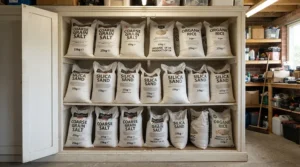
Dishwasher salt for softener systems can mean two different things, so let’s separate them. Inside your dishwasher is a small ion-exchange softener that needs coarse salt to regenerate. In some homes there’s also a plumbed-in softener on the mains, which uses its own salt, typically granules or tablets.
The overlap is real but not total. A granular salt sold for water treatment can complying with BS EN 973, the recognised specification for salt used in water treatment, and some are marketed for both dishwashers and softeners. The Olympia GG178 Dishwasher Salt 25kg listings, for example, describe suitability for built-in dishwasher softeners. Whether a given sack suits your plumbed unit is a manual question, not a marketing one.
Practical rules:
- Always check the dishwasher manual first, especially for premium machines needing reactivation salt.
- Check the plumbed softener’s manual for tablet versus granule requirements.
- Never assume tablets suit a dishwasher reservoir.
- Prioritise purity, because impurities cause the clogging that softeners hate.
If you run both systems, dishwasher salt for softener systems becomes a sensible bulk buying case. Just verify compatibility, then store the sack dry.
Water Softener Units vs Dishwasher Salt: Which Costs Less?
Water softener units treat water for the whole house, while dishwasher salt treats it only inside one appliance. That difference drives the whole cost argument.
| Option | Upfront Cost | Running Cost | Protects | Best For |
|---|---|---|---|---|
| Dishwasher salt (built-in softener) | Very low | A few pounds per refill | Dishwasher only | Most hard-water households |
| Plumbed water softener units | Often several hundred pounds or more | Salt plus servicing | Whole house | Very hard areas, large homes |
| Descaler cleaner only | Low | Periodic purchase | Treats existing scale | Occasional deep-cleans |
| No salt (soft-water area) | None | None | Minimal need | Soft-water postcodes |
Water softener units are the heavyweight solution. They protect kettles, boilers and showers, but they cost far more upfront and need maintenance. For a household whose only pain point is the dishwasher, RealHomes reports that using salt in the appliance is much cheaper than installing a softener.
My analysis: if limescale is wrecking your whole house, water softener units deserve a quote. If it’s mainly cloudy glasses, a tub of salt such as the HSD Dishwasher Salt 5kg delivers most of the benefit for pennies per wash. And if you already have water softener units, you can still use a dishwasher’s built-in softener, so check the hardness setting to avoid double-treating.
Limescale Prevention: What Dishwasher Salt Does (and Doesn’t) Do
Limescale prevention is the headline benefit, but it helps to understand the mechanism. Hard water carries dissolved calcium and magnesium. Your dishwasher’s resin softener swaps those ions for sodium as water passes through, and salt regenerates the resin so it can keep doing that. No salt means the resin runs out, and the minerals pass straight onto your plates.
Here is what salt won’t do. It doesn’t dissolve scale that has already formed. If you notice white crust on the tub or door, Bosch’s guidance points to a dedicated descaler for that job. Salt is preventive medicine, not a cure.
A simple limescale prevention routine:
- Keep the reservoir topped up with coarse, pure salt.
- Set the hardness dial to match your water.
- Add rinse aid, which lowers surface tension so droplets sheet off.
- Run a descaler periodically if you see existing buildup.
The cheapest limescale prevention is consistency. A £2 box that’s always topped up beats a premium bag that sits empty for three weeks. Choose a pack size you’ll actually refill on time, and the value takes care of itself.
Dishwasher Longevity: Long-Term Cost and Maintenance
Dishwasher longevity is where small habits compound. Limescale on heating elements and in spray arms forces the machine to work harder and can degrade performance. Mumsnet’s editors note that salt can help protect arms, spray heads and awkward internal spots, and prolong lifespan in hard-water areas.
I won’t invent lifespan figures, because they depend on water hardness, usage and machine quality. But here’s illustrative arithmetic. Suppose you spend around £20-£30 a year on salt. A single repair visit and part for a scale-related fault can easily run into the low hundreds. Even if salt only reduces your odds of that bill, the maths leans in its favour.
A long-term maintenance rhythm:
- Weekly: glance at the low-salt indicator.
- Monthly: clean the filter and check spray arms for blockages.
- Quarterly: run a dishwasher cleaner or descaler cycle.
- Annually: review your salt purchase, because usage patterns change.
For dishwasher longevity, the best salt is the one that never runs out. The HSD Dishwasher Salt 5kg and Olympia GG178 Dishwasher Salt 25kg keep supply steady, while the Finish Dishwasher Salt 4kg adds brand reassurance. Pair any of them with a good filter-cleaning habit and your machine has a fighting chance of outlasting the warranty.
Common Mistakes When Buying Dishwasher Salt
Most dishwasher salt regrets come from a handful of avoidable errors.
Buying by headline price. A £2 box is not cheaper than a sub-£10 bag if you’re buying five boxes a year. Always work out cost per kilo.
Using table salt. Table salt is finely ground and can clog the system. Dishwasher salt uses coarse granules for a reason.
Overfilling or mismeasuring. RealHomes quotes Finish UK’s brand manager advising people to check the packaging for how much to use. Over-salting is linked to drainage problems, odours and filling issues, so don’t empty the whole bag in.
Ignoring the hardness setting. The best salt in the world can’t help a machine set to “soft” in a very hard area.
Assuming tablets cover everything. All-in-one tablets contain only a little salt, so hard-water homes still benefit from separate salt.
Buying bulk without storage. A 25kg sack in a damp shed will clump. Decant it and keep it dry.
Skipping the manual. Premium machines may specify reactivation salt, so check before swapping brands.

Frequently Asked Questions
❓ Is Finish dishwasher salt worth the extra money?
❓ How often should I buy dishwasher salt in a hard-water area?
❓ Can I use water softener tablets in my dishwasher?
❓ Does dishwasher salt go off or expire?
❓ Do I need dishwasher salt if my machine has no salt compartment?
Conclusion
Dishwasher salt value comes down to three questions. How hard is your water, how fast do you use salt, and how much storage do you have? Answer those honestly and the choice gets easy.
For most UK households, the HSD Dishwasher Salt 5kg is the best overall dishwasher salt value. It offers pure coarse grains at a low cost per kilo without the weight of a trade sack. The Finish Dishwasher Salt 4kg is the brand-first pick, ideal if manufacturer recommendation matters to you. The Sainsbury’s Dishwasher Salt Granules 1kg and Finish Dishwasher Salt 2kg suit small cupboards and low-commitment starters. Somat Dishwasher Salt and the Miele Dishwasher Salt 1.5kg serve premium-machine owners, with Somat Dishwasher Salt the likelier money-saver. For heavy users, the Olympia GG178 Dishwasher Salt 25kg is the cost-per-kilo champion, provided you can lift and store it.
Whichever you pick, remember the habits that protect your investment: test your water, set the hardness dial, use a funnel and keep salt dry. Limescale prevention is cheap when it’s consistent and expensive when it isn’t.
Recommended for You
- Dishwasher Rinse Aid: 7 Best UK Picks For Spotless Glasses (2026)
- Dishwasher Tablets For Hard Water: 7 Proven Picks (2026)
- Dishwasher Tablets: 7 Best Picks For Sparkling Glasses (2026)
Disclaimer: This article contains affiliate links. As an Amazon Associate, I earn from qualifying purchases. If you purchase products through these links, we may earn a small commission at no additional cost to you.
✨ Found this helpful? Share it with your friends! 💬🤗
