
In This Article
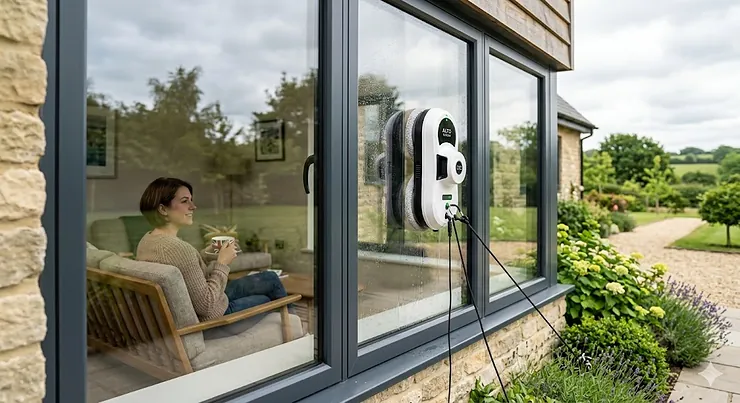
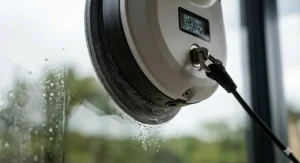
A smart window cleaning robot is a battery- or mains-powered device that uses vacuum suction to grip glass, then navigates the surface using sensors and pre-set or AI-driven paths while a wet pad wipes away grime. Most spray water automatically, detect edges to avoid falling, and can be paused mid-clean from an app or remote.
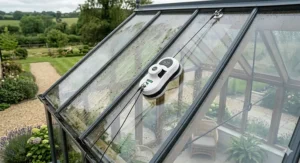
That’s the textbook answer. Here’s the honest one: it’s the gadget that finally ends the Sunday-morning ritual of teetering on a kitchen chair with a roll of paper towel, swearing at a smear that simply will not budge. I’ve spent years half-heartedly attacking my own windows with vinegar solutions and a squeegee that’s older than my houseplants, so when these things started turning up reliably on Amazon.co.uk rather than as dodgy AliExpress gambles, I paid attention. They won’t replace a proper spring clean of mud-caked exterior glass. But for the fortnightly maintenance most of us never actually do? They’re rather good.
Quick Comparison Table
| Robot | Best For | Suction | Price Range (£) |
|---|---|---|---|
| CHOVERY CL.1 | First-time buyers, small flats | 5,600Pa | Under £100 |
| Mamibot iGLASSBOT W120-T | Tight budgets | 3,000Pa | £170–£190 |
| HUTT W8 | Self-adjusting clean, mid-range | 1,800–3,800Pa | £150–£200 |
| HOBOT 388 | Best value, near-flagship results | Manual spray | £240–£260 |
| HOBOT 2S | Most UK homes | Ultrasonic auto-spray | £300–£350 |
| HOBOT S7 Pro | Static-prone, smeary glass | 4,800Pa dual mop | £350–£420 |
| ECOVACS WINBOT W2 Pro Omni | Large/frameless glass | Wide-angle triple spray | £400–£500 |
Worth reading before you scroll past it: the cheapest robot here, the Mamibot, needs you to spray the glass yourself first, which sounds trivial until you’re doing it on the eighth window of the morning. The HOBOT 2S earns its £50–£100 premium over budget models largely through that one auto-spray feature alone, and for most semis and terraces with a dozen or so panes, that’s the difference between a chore and an afterthought.
💬 Just one click — help others make better buying decisions too! 😊
✨ Don’t Miss These Exclusive Deals!
🔍 Fancy never balancing on a windowsill again? Click through to check live pricing and availability on Amazon.co.uk for any of the robots below.
Top 7 Smart Window Cleaning Robots: Expert Analysis
1. HOBOT 2S
The standout feature here is the dual ultrasonic spray — instead of a regular jet, two nozzles atomise water into a fine mist, which means no more pre-wetting the glass with a separate spray bottle like a Victorian housemaid.
In practice, that ultrasonic mist combined with AI route planning is what earns the HOBOT 2S its reputation as the safe default pick for UK households. The edge-leakage sensors detect the moment a seal lifts slightly — handy on older timber-framed sash windows, where the glass isn’t always perfectly flush. Should the power cut out mid-clean (not unheard of during a winter storm), the built-in battery holds it to the glass for around 20 minutes, plenty of time to notice and rescue it.
UK buyers report it handles double glazing confidently but struggles once the cleaning pad gets properly grubby — swap pads every few windows rather than persevering with one all morning. This is the model I’d point a first-time buyer towards: not the cheapest, not the flashiest, just dependable.
✅ Pros: auto-spray saves real time · edge sensors suit older frames · genuine UPS backup
❌ Cons: struggles on heavily soiled glass · pads need frequent swapping
Price: around £300–£350. Best for: anyone wanting a “set it and mostly forget it” experience without paying premium-tier money.
2. ECOVACS WINBOT W2 Pro Omni
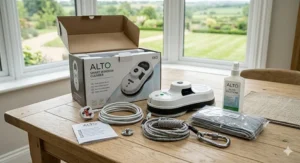
What sets this apart is the 6-in-1 Omni Station, a portable dock that turns the robot cordless for up to 110 minutes — genuinely useful if your conservatory or bay window sits nowhere near a socket.
The triple-nozzle wide-angle spray and WIN-SLAM 4.0 path planning are the bits ECOVACS shouts about, and fair enough: the brushless motor reportedly improves cleaning efficiency by around 30% over the previous generation, and the 12-stage fall-protection system is the most thorough of anything on this list. For Victorian bay windows or the floor-to-ceiling glass increasingly common in new-build flats, that flexibility between battery and plugged-in mode matters more than it sounds.
Reviewers on Amazon.co.uk are largely glowing, though a recurring theme is worth flagging honestly: streaking shows up once direct sunlight hits the glass, almost always traced back to a saturated or overdue cleaning pad rather than a faulty unit. Budget for spare pads and extra solution from day one.
✅ Pros: cordless flexibility · strongest safety system here · excellent on large/frameless glass
❌ Cons: priciest pick · streaking if pads aren’t rotated promptly
Price: typically £400–£500. Best for: bay windows, conservatories, and anyone with glass too large for budget models to cover confidently.
3. Mamibot iGLASSBOT W120-T
The honest sell here is value: at the bottom of the price ladder, the Mamibot W120-T still manages 3,000Pa suction and three AI cleaning patterns (Z, N, and a hybrid of the two).
There’s no auto-spray, so you’ll be misting the glass yourself before each pass — a minor inconvenience that becomes a genuine one once you’ve got fifteen windows to get through on a Saturday. What you do get is a 20-minute UPS battery backup and reasonably capable edge detection for the price, which is more than budget rivals typically offer. At 1.35kg it’s also among the lighter robots here, so lifting it window to window doesn’t become its own workout.
UK reviewers describe it as a “safeguard as much as a cleaner” on high-rise glass — it won’t leave a showroom finish, but it removes the fall risk of leaning out with a squeegee, and that alone justifies it for plenty of buyers.
✅ Pros: cheapest reliable pick here · light and easy to handle · solid UPS backup
❌ Cons: manual pre-wetting required · struggles with dried-on grime
Price: around £170–£190. Best for: students, renters, or anyone testing whether a window robot suits their routine before spending more.
4. HOBOT 388
This is the HOBOT 2S’s quieter sibling: drop the ultrasonic auto-spray and you drop roughly £80–£100 off the price, while keeping most of the cleaning performance.
Independent UK testing puts it at roughly 85% of the 2S’s results for about 70% of the cost — a trade that makes sense if you don’t mind a quick spritz with a spray bottle first. The lighter 0.98kg body is easier to manoeuvre one-handed than most rivals, genuinely useful when you’re balancing it against a window frame with your other hand free for the lead.
The honest verdict from UK reviewers: it’s the value pick once you’ve decided auto-spray isn’t a dealbreaker, and HOBOT’s reputation for parts availability (replacement pads run roughly £12–£15 for a six-pack on Amazon.co.uk) means you’re not stuck if something wears out.
✅ Pros: near-flagship cleaning at a lower price · lightest robot on this list · easy pad replacement
❌ Cons: manual pre-wetting · fewer smart features than the 2S
Price: around £240–£260. Best for: budget-conscious buyers who still want a recognised, well-supported brand.
5. HUTT W8
The HUTThink algorithm is the clever bit: it reads how dirty the glass is and self-adjusts suction between roughly 1,800Pa and 3,800Pa, rather than running at maximum power (and maximum noise) regardless of need.
Laser-based edge detection rather than the simpler optical sensors found on cheaper rivals means the W8 reacts faster to frames and obstacles, and the 80ml tank covers a genuinely useful amount of glass before needing a refill. One real-world UK buyer flagged something worth knowing before you order, though: imported listings don’t always ship with a UK three-pin plug, so it’s worth checking the specific listing confirms a Type G plug rather than assuming an adapter is included.
That’s a small but properly British gripe, and exactly the kind of detail Amazon’s spec sheet won’t volunteer. Once wired up correctly, the dual-nozzle spray and voice prompts make it a capable mid-ranger that quietly undercuts the bigger brand names.
✅ Pros: self-adjusting suction is genuinely clever · large water tank · laser edge detection
❌ Cons: confirm UK plug before ordering · voice prompts can’t always be disabled
Price: typically £150–£200, though always check the live listing — confirm current price on Amazon.co.uk. Best for: buyers who want laser-grade tech without flagship pricing.
6. CHOVERY CL.1
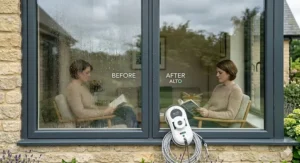
This is the entry point for anyone who isn’t sure a window robot is worth the fuss yet: 5,600Pa suction at a price that undercuts almost everything else here.
The double-spiral cleaning head and AI V2.0 route calculation are surprisingly capable for the price bracket, and the 3-year warranty offered by the seller is longer than most premium brands provide. The catch, flagged consistently in UK reviews, is the circular cleaning disc — it physically can’t reach into square corners the way a HOBOT or ECOVACS pad can, so you’ll likely still need a quick manual wipe of the corners afterwards.
Think of it less as a full replacement for cleaning and more as doing 80–90% of the work for a fraction of the outlay. For a lot of UK renters with a handful of standard double-glazed windows, that’s a perfectly sensible trade.
✅ Pros: cheapest robot on this list · strong suction for the price · long warranty
❌ Cons: round disc misses corners · noticeably noisier indoors
Price: generally well under £100, among the cheapest genuinely usable options on Amazon.co.uk. Best for: first-time buyers and small flats with standard rectangular windows.
7. HOBOT S7 Pro
The flagship of the range, and the one to consider if static and dust are a recurring battle rather than an occasional one: dual mop pads oscillate 600 times per minute, which doubles as a static-neutralising action most rivals simply don’t attempt.
Paired with the same 15µm ultrasonic mist as the 2S but stepped up to 4,800Pa suction, the S7 Pro is built for glass that picks up dust fast — think homes near a busy A-road or a building site. The Edge-Leakage-Bumper Sensors are a refinement on the standard HOBOT edge sensors, reacting that bit quicker to subtle air leaks around frameless or poorly sealed glass.
It’s reviewed favourably by UK tech outlets, with TechRadar’s hands-on testing of the model rating it among the stronger performers in the category. You’re paying a premium for marginal gains over the 2S, so this one’s really for buyers who’ve already decided a budget model won’t cut it.
✅ Pros: best static/dust performance here · highest suction on this list · refined edge sensors
❌ Cons: premium pricing for incremental gains over the 2S
Price: roughly £350–£420. Best for: homes near busy roads, building work, or anyone who’s outgrown a budget model.
✨ Don’t Miss These Exclusive Deals!
🔍 Take your window cleaning routine up a notch — click through to compare current pricing on any of these models via Amazon.co.uk.
Practical Usage Guide: Setting Up Your Robot for British Homes
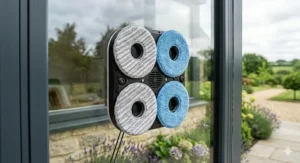
First clean of any new robot should be a dry pass — most manufacturers, HOBOT and HUTT included, recommend removing surface dust before introducing water, since wet grit is what actually scratches glass, not the robot’s pads.
For UK conditions specifically: British weather means more condensation and grime build-up on north-facing glass than manufacturers (mostly testing in drier climates) account for. Wring cleaning pads out properly before fitting them — a too-damp pad is the single most common cause of slipping reported in UK reviews, more so than any fault with the suction motor itself. If you’re in a flat or terraced house with limited storage, most of these robots pack down small enough for an under-stairs cupboard; the charging dock for the ECOVACS Omni Station is the bulkiest accessory here, so factor that in before buying the premium option.
Replace pads roughly every 15–20 cleans, sooner if you’re tackling pollen season or a recent building project nearby. Store the unit somewhere dry between uses — a damp utility room invites exactly the kind of limescale build-up in the water tank that British hard-water areas are famous for.
Real-World Scenarios: Matching the Robot to Your Home
A first-floor flat in a converted terrace, Bristol. Standard double-glazed sash windows, no balcony access, six panes total. A Mamibot W120-T or HOBOT 388 covers this comfortably — manual pre-wetting isn’t a hardship across six windows, and the lighter bodies suit a tenant who’d rather not invest in a flagship model for a rented property.
A semi-detached family home, Sheffield suburbs. Twelve to fifteen windows, a couple of larger bay frontages, kids tracking mud everywhere. The HOBOT 2S earns its keep here — auto-spray genuinely matters once you’re past ten windows, and the edge sensors cope well with older bay-window frames that aren’t perfectly square.
A new-build flat with floor-to-ceiling glass, Manchester city centre. Large frameless panels and limited socket access near the glass itself. This is exactly the brief the ECOVACS WINBOT W2 Pro Omni was built for — the Omni Station’s 110 minutes of cordless running time solves the socket problem outright.
How to Choose a Smart Window Cleaning Robot in the UK
- Count your windows honestly. Under eight, a budget model like the CHOVERY or Mamibot will do; beyond fifteen, auto-spray stops being a luxury and starts saving real time.
- Check your frame type. Older timber sash windows and uneven Victorian frames benefit from stronger edge-leakage sensors (HOBOT’s speciality); modern uPVC double glazing is more forgiving across the board.
- Think about socket access. No power point near your largest window? Prioritise battery/cordless models like the ECOVACS Omni range over mains-only budget options.
- Decide if static dust is a problem. Homes near main roads or building sites benefit from the HOBOT S7 Pro’s oscillating mop action.
- Factor in storage. Flats and terraces with limited cupboard space should weigh the bulkier docking stations against simpler corded models.
- Budget for consumables. Replacement pads and solution add £20–£40 a year regardless of which model you pick — build that into the real cost, not just the sticker price.
- Confirm the UK plug. As the HUTT W8 example shows, some imported listings arrive without a Type G plug fitted — check before you buy, not after.
Features That Actually Matter (And Which Are Just Marketing)
High Pascal (Pa) suction numbers get plastered across every listing, but past roughly 3,000Pa, the difference is marginal on standard double glazing — it matters far more on heavier patio doors or oversized panels. Auto-spray, by contrast, is the feature that actually changes your Saturday morning: it’s the one upgrade every UK reviewer mentions noticing in daily use, not just on a spec sheet.
Voice prompts and app connectivity are pleasant but skippable — handy for troubleshooting, irrelevant to cleaning quality. Edge-leakage sensors, on the other hand, genuinely matter if your home has older or slightly uneven frames, which describes a large share of UK housing stock built before uPVC became standard.
Common Mistakes When Buying a Window Cleaning Robot
A frequent and entirely avoidable error: ordering a budget import without checking it ships with a UK three-pin plug, then discovering an adapter wasn’t included — exactly the issue one HUTT W8 buyer flagged in their Amazon.co.uk review.
Another common misstep is assuming a robot will tackle months of accumulated grime in one pass. Every model on this list performs best as routine maintenance on glass that’s already reasonably clean — a first deep clean by hand (or a professional) sets the robot up to actually succeed afterwards. Buyers also frequently underestimate ongoing costs: pads and cleaning solution are consumables, not one-off purchases, so factor in roughly £20–£40 a year. Finally, skipping the safety tether because “it probably won’t fall” is the single most regretted shortcut in user reviews — five minutes connecting a £4 cord is considerably cheaper than a cracked window ledge.
Smart Window Cleaning Robots vs Traditional Window Cleaning
| Robot | Hand-Cleaning (DIY) | Professional Cleaner | |
|---|---|---|---|
| Time per session | 5–8 min/window | 10–15 min/window | N/A (outsourced) |
| Ongoing cost | Pads/solution, ~£20–40/yr | Cloths/solution, low | £25–£40/hour typically |
| Physical risk | Low (tethered) | Ladder/reach risk | Minimal (trained) |
| Best for | Routine maintenance | Occasional touch-ups | Deep cleans, hard-to-reach glass |
A robot wins decisively on time and physical safety for routine upkeep, but it isn’t pretending to replace a professional for the heavy stuff — caked-on render dust after building work, or genuinely hard-to-reach upper-storey exteriors on a tall Victorian terrace, still call for a ladder and a trained pair of hands (or a one-off professional booking). Where the robot earns its keep is in the gap between those two extremes: the fortnightly maintenance clean that, realistically, most of us simply skip when it requires getting a ladder out.
What to Expect: Real-World Performance in British Conditions
Set realistic expectations and these robots genuinely deliver; expect a flawless finish on every pass and you’ll be disappointed. UK testers who’ve spent real time with this category — TechRadar’s hands-on look at robotic window cleaners among them — note that the cleaning action is notably drier than manual methods, since the units need to maintain suction on a surface that isn’t soaking wet, which suits our damper climate better than you’d expect.
British weather brings its own quirks: condensation on north-facing glass in winter can interfere with suction grip if you clean immediately after a cold snap, so let the glass reach room temperature first. Shorter winter daylight isn’t a practical issue since these units don’t rely on cameras or ambient light to navigate. The bigger seasonal factor is pollen in spring and early summer, which clogs pads faster than any other UK condition — budget for more frequent pad swaps between April and June.
Long-Term Cost & Maintenance in the UK
| Cost Item | Typical UK Price | Frequency |
|---|---|---|
| Replacement pads (6-pack) | £12–£18 | Every 2–3 months with weekly use |
| Cleaning solution | £8–£15 | Every 1–2 months |
| Robot itself (amortised) | £170–£500 | One-off, lasts several years with care |
Run the numbers over a year and even the priciest robot here works out cheaper than a handful of professional call-outs, given UK professional window cleaning typically runs £25–£40 an hour. The genuine long-term cost isn’t the robot — it’s the consumables, which is exactly the bit Amazon’s product page won’t spell out for you. Budget roughly £40–£70 a year in pads and solution regardless of which model you choose, and the headline price starts to look a lot more reasonable.
UK Regulations, Safety Standards & Buying Online
Electrical goods sold in Great Britain need to meet UK product safety requirements, historically signposted by the UKCA marking. Helpfully for buyers, the government has confirmed CE-marked electrical goods continue to be recognised indefinitely across England, Wales and Scotland too, so don’t be put off a listing simply because it shows a CE rather than UKCA mark — both are currently valid routes to market.
Buying online also means you’re protected by the Consumer Contracts Regulations, which guarantee a minimum 14-day cooling-off period on most goods bought at a distance — explained clearly by Which?’s consumer rights team if you want the full detail on how and when that clock starts. In practice, that means if a robot arrives and the suction underwhelms, you’ve a genuine legal window to send it back, separate from whatever return policy the individual seller advertises. Worth knowing before you click buy, not after.
FAQ
❓ Do smart window cleaning robots work on UK double glazing?
❓ Are window cleaning robots legal/safe to use without supervision?
❓ What plug does a window cleaning robot use in the UK?
❓ Can I return a window cleaning robot if it doesn't work well?
❓ How much does a smart window cleaning robot cost in the UK?
Conclusion
If you only take one thing from all this: the auto-spray feature is the line that separates “nice gadget” from “actually changes my Saturday.” Budget models like the Mamibot or CHOVERY are a sensible toe in the water, especially for smaller flats. But once you’re cleaning more than ten panes regularly, the HOBOT 2S earns back its higher price in saved time within the first month.
For larger or trickier glass — bay windows, frameless panels, anything without a nearby socket — the ECOVACS WINBOT W2 Pro Omni is worth the extra outlay. And if static dust near a busy road is your specific nemesis, the HOBOT S7 Pro’s oscillating mop action is built precisely for that fight. Whichever you choose, budget a little extra for pads and solution, double-check the plug, and let the robot handle the maintenance clean while you keep the ladder for the jobs that actually deserve it.
Recommended for You
- Best Window Cleaning Robot UK 2026: 7 Picks That Actually Work
- Best Rechargeable Window Vacuum UK 2026: 7 Expert Picks
- Best Cordless Window Vacuum UK 2026: 7 Picks Worth Buying
Disclaimer: This article contains affiliate links. As an Amazon Associate, I earn from qualifying purchases. If you purchase products through these links, we may earn a small commission at no additional cost to you.
✨ Found this helpful? Share it with your mates! 💬🤗
