
In This Article
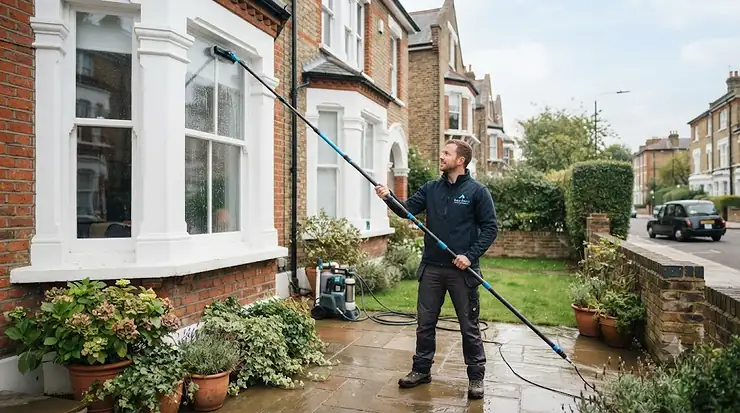
There’s a very specific kind of dread that sets in when you look up at your bedroom window, see six months of pollen and pigeon-related unpleasantness smeared across the glass, and then look down at your ladder leaning against the wall like it’s silently judging you. A telescopic pole for window cleaning exists to make that entire scene disappear — no ladder, no wobbling on the second rung while your neighbour pretends not to watch, just a lightweight rod that extends up to wherever the grime is and lets you scrub, rinse, and squeegee from two safe feet planted on solid ground.
In one sentence, a telescopic pole for window cleaning is an extendable, section-locking rod — usually aluminium or carbon fibre — that fits a brush, squeegee, or water-fed head on the end so you can clean upper-storey glass without leaving the ground. That’s the whole concept, really, and it’s a good one: the Health and Safety Executive is blunt about the fact that ladders should be a last resort rather than a first instinct for exactly this kind of job, precisely because so many “quick jobs” end with someone at A&E explaining how a five-minute task turned into six weeks in a cast.
The trouble is that not all poles are created equal, and the differences matter more than you’d think from a quick scroll through Amazon listings. A pole that’s too heavy turns “quick window clean” into “shoulder workout you didn’t sign up for.” A pole with wobbly locking sections will flex and twist the moment you press against the glass, which does nothing for your streak-free finish and everything for your blood pressure. Below, we’ve researched seven real, currently available telescopic poles for the UK market — from full aluminium workhorses to featherweight carbon fibre poles that professional window cleaners genuinely swear by — so you can pick the one that suits your house, your budget, and your patience levels.
This post contains affiliate links. As an Amazon Associate, I earn from qualifying purchases — see the disclaimer at the end for full details.
Quick Comparison Table
| Pole | Material | Max Reach | Best For | Price Range |
|---|---|---|---|---|
| Gardiner SLX-25 | 100% carbon fibre | ~7.6m (25ft) | Professionals, multi-storey work | £250-£400 |
| Unger Ninja ErgoTec Carbon | Carbon fibre | ~1.2m per section, modular | Anti-twist precision work | £40-£80 per section |
| Unger OptiLoc 3-Section | Anodised aluminium | Up to 5.5m | Reliable mid-range reach | £30-£70 |
| Ettore Pro Series | Fluted anodised aluminium | Up to 3.7m | Everyday domestic and light trade use | £25-£55 |
| IGADPole Water-Fed Kit | Aluminium/carbon composite | Up to 9m | Home use on conservatories, upper floors | £60-£150 |
| Beldray Telescopic Window Cleaner (5-piece) | Aluminium | Up to 1.3m | Budget indoor and ground-floor cleaning | £10-£18 |
| Amazon Basics Extendable Window Squeegee | Aluminium/plastic | Up to 0.97m | Occasional light domestic use | £10-£15 |
Notice the enormous spread in that “Max Reach” column — we’ve got everything from a pole that barely clears a metre to a genuine 25-footer built for scaling the side of a townhouse. That’s deliberate, because “best telescopic pole” genuinely depends on what you’re pointing it at: a first-floor semi and a three-storey Victorian terrace are two completely different jobs wearing the same trousers. Weight-to-reach ratio is the other thing worth studying here — the carbon fibre options manage far greater length without a corresponding jump in arm-punishing heft, which is exactly why professionals pay a premium for them.
💬 Just one click — help others make better buying decisions too!😊
Top 7 Telescopic Poles for Window Cleaning: Expert Analysis
1. Gardiner SLX-25 — the carbon fibre pole professionals actually queue up for
There’s a reason window cleaning forums light up with genuine enthusiasm whenever someone mentions Gardiner poles — one seasoned trade cleaner online put it about as plainly as it can be put: you won’t easily find a better pole, and anyone telling you otherwise probably hasn’t used one. That’s not manufacturer copy; that’s the unfiltered opinion of people who use this thing eight hours a day.
The SLX-25 is a five-section, 100% carbon fibre pole extending to roughly 7.6 metres (25ft) and weighing just 1,340 grams — genuinely astonishing when you consider fibreglass poles of similar length can weigh two to three times as much. What most buyers overlook about carbon fibre poles generally is that the weight saving isn’t just about comfort; it’s about control. A lighter pole flexes less under your own arm strength, which means the brush head at the top stays steadier against the glass, and steadier pressure is what actually gets grime off rather than just moving it around. The Gardiner Smart Clamps are the other standout feature here — they auto-tighten around each section regardless of wear, which solves the maddening “spinning section” problem that plagues cheaper poles after a few months of use.
Who this suits: anyone doing genuine multi-storey work, whether that’s a self-employed window cleaner building a round or a homeowner with a tall Victorian house where a domestic ladder simply won’t cut it safely. Aggregated trade feedback consistently praises the rigidity-to-weight ratio, with several long-term users noting they’ve upgraded from cheaper poles specifically because the SLX range doesn’t develop play in the joints after heavy use.
Pros:
- ✅ Exceptionally light for its 7.6m reach, at just 1,340g
- ✅ Smart Clamps prevent the spinning-section problem entirely
- ✅ Insulated base section adds a genuine safety margin near cables
Cons:
- ❌ Premium price puts it well beyond casual domestic buyers
- ❌ Designed around water-fed brush systems, so a squeegee setup needs extra parts
At £250-£400 depending on configuration, this is a considered investment rather than an impulse buy. Here’s what to weigh: for a professional cleaning dozens of properties a week, the cost-per-use maths resolves itself within a few months; for an occasional domestic user, it’s genuinely more pole than most houses need, and one of the lighter options further down this list will likely serve you just as well for far less outlay.

2. Unger Ninja ErgoTec Carbon Pole — the anti-twist specialist
Every window cleaner has a story about a cheap pole twisting mid-scrub, sending the brush skidding sideways across glass at precisely the wrong moment. The Unger Ninja was engineered specifically to end that story, and its triangular cross-section — rather than the traditional round tube most poles use — is the detail that makes the difference. A round pole wants to rotate under torque; a triangular one genuinely resists it, the same way a hex-shaft screwdriver bit grips a socket better than a round one.
Constructed from 100% carbon fibre, the Ninja pole ships in modular 1.2m sections that click together, and Unger’s one-handed clamp operation with a built-in pull-out stop means you can extend to your desired length without accidentally sliding a section clean off the end — a small mercy anyone who’s dropped a top section into a flowerbed will appreciate. On paper this means you’re buying flexibility as much as reach: rather than committing to one fixed maximum length, you buy sections as your jobs demand them, which suits anyone whose workload genuinely varies from single-storey cottages to taller properties.
This is the pole for buyers who prioritise precision and control over sheer maximum reach — detailers, people doing careful glass work close to frames and mullions, or anyone who’s been burned by a wobbly pole before and now reads spec sheets with genuine suspicion. Reviewers consistently highlight the ergonomic triangular grip as noticeably more comfortable over long sessions than a standard round handle, particularly for anyone with smaller hands who’s struggled to get a secure hold on bulkier aluminium poles.
Pros:
- ✅ Triangular design genuinely eliminates mid-clean twisting
- ✅ Modular sections let you buy only the reach you actually need
- ✅ Pull-out stop prevents accidental overextension
Cons:
- ❌ Modular buying means costs add up section by section
- ❌ Rubberised tip is designed for microfibre cloths, not heavier brush heads
Priced at roughly £40-£80 per section, building a full-length Ninja setup costs more overall than buying an equivalent fixed pole outright. What the spec sheet won’t tell you, but forum chatter consistently confirms, is that this modularity is precisely why tradespeople keep buying into the system — you’re not locked into one length for the rest of the pole’s working life.
3. Unger OptiLoc 3-Section Pole — the dependable aluminium all-rounder
Not every job needs carbon fibre, and the Unger OptiLoc is the poster child for “sensible aluminium done properly.” Constructed from anodised, extruded aluminium with 3.5-inch nylon locking collars, it’s available in lengths from 1.25m right up to 5m, which covers the overwhelming majority of two-storey UK homes without you needing to think too hard about which variant to buy.
The externally mounted locking collars are the genuinely clever bit here — because the twist-lock mechanism sits on the outside of the tube rather than inside it, it’s far less prone to seizing up from moisture or grit than internal locking systems, something anyone who’s fought with a corroded pole joint in February will appreciate immediately. Based on the spec comparison against pricier carbon options, the OptiLoc trades a bit of weight for a genuinely bombproof mechanism: at roughly 2-3.3lbs depending on length, it’s heavier than the carbon poles above, but the ErgoTec Locking Cone at the tip accepts a huge range of Unger and third-party tools without any fiddly adapters.
This suits homeowners and light-trade users who want one dependable pole rather than a modular system, particularly anyone whose windows sit at a fairly consistent height. Aggregated feedback repeatedly praises the anti-slip end cap, a detail that sounds trivial until you’ve had a pole skid out from under you while leaning it against a wall to grab your bucket.
Pros:
- ✅ External locking collars resist seizing in wet or gritty conditions
- ✅ Compatible with an unusually wide range of third-party tools
- ✅ Anti-slip end cap prevents embarrassing wall-slide incidents
Cons:
- ❌ Noticeably heavier in hand than the carbon fibre options above
- ❌ Made in Germany pricing runs slightly higher than generic aluminium rivals
At £30-£70 depending on length, the OptiLoc sits in accessible mid-range territory. Reviewers consistently note that the balance of weight and rigidity — described by Unger itself as engineered for exactly that trade-off — holds up well even after years of regular outdoor use, which for a pole living in a shed through British winters is no small praise.
4. Ettore Pro Series — the quietly excellent trade favourite
Ettore doesn’t shout about its extension poles the way some brands do, and that’s rather the point — one supplier description sums it up neatly by noting it’s still considered by many to be one of the best extension poles on the market, despite (or perhaps because of) not chasing flashy marketing. The Pro Series uses a fluted, anodised aluminium construction, and that fluting isn’t decorative: ridges running the length of the tube add rigidity without adding material, the same engineering logic behind corrugated cardboard being stronger than a flat sheet of the same weight.
What most buyers overlook about fluted poles specifically is that the extra surface area also improves grip when your hands are wet, which — window cleaning being what it is — is basically always. The smooth twist-locking clamps hold sections securely without the finger-pinching some cheaper clamp designs are prone to, and the ergonomic handle at the base is shaped to sit comfortably against the palm during extended single-handed work, which matters more than it sounds once you’re twenty minutes into a job.
This is a strong pick for anyone doing regular domestic cleaning or light trade work who wants genuine reliability without paying carbon fibre prices. Aggregated review sentiment across cleaning supply retailers consistently describes the Pro Series as a dependable long-term purchase rather than an exciting one — which, for a tool you’re relying on above ground level, is precisely the compliment you want to hear.
Pros:
- ✅ Fluted construction adds rigidity and wet-hand grip simultaneously
- ✅ Smooth clamps avoid the pinch-point problem of cheaper locks
- ✅ Long-standing reputation for reliability over flashy features
Cons:
- ❌ Fewer length options than the modular Unger Ninja system
- ❌ Aluminium weight becomes noticeable at maximum extension
At around £25-£55, the Pro Series undercuts the premium carbon options considerably while still outperforming genuinely cheap aluminium poles on rigidity. Here’s what to weigh: if your windows are within a standard two-storey reach and you’re not chasing every last gram of weight saving, this represents some of the best value-for-rigidity on this entire list.
5. IGADPole Water-Fed Telescopic Kit — the home-user’s route into professional-style cleaning
Water-fed pole systems used to be strictly the domain of vans with tanks and hoses, but kits like the IGADPole range have brought the same core idea within reach of ordinary UK households: a telescopic pole with a brush head that delivers filtered water directly to the bristles, so you scrub and rinse in one motion and simply let the glass air-dry streak-free, without ever touching a squeegee.
The kit combines an aluminium and carbon composite pole construction extending up to roughly 9 metres, connecting to a standard garden hose or filtered water tank rather than requiring the industrial-grade filtration vans use. What most buyers overlook about water-fed systems for home use is that the “leave it to dry” step genuinely does work, provided the water going through the system is properly filtered — pure water leaves no mineral deposits behind, which is precisely why professional cleaners switched to this method decades ago rather than sticking with soap and squeegee.
This suits homeowners with conservatories, dormer windows, or upper-storey glass that’s awkward to reach with a standard pole-and-squeegee combination, and particularly anyone who finds the drying-and-buffing stage of traditional window cleaning the most tedious part of the job. Real UK customer feedback highlights how well the system handles solar panels and conservatory roofs alongside standard windows — a genuine bonus for anyone with all three needing attention on the same weekend.
Pros:
- ✅ No squeegee stage — brush, rinse, and walk away
- ✅ 9m reach comfortably covers most UK domestic properties
- ✅ Doubles up for solar panels and conservatory roofs
Cons:
- ❌ Requires a water source and ideally a filter for genuinely spot-free results
- ❌ Bulkier to store than a simple squeegee pole when not in use
Priced around £60-£150 depending on kit configuration, this sits comfortably in the middle of our range. On paper this means a meaningfully higher upfront cost than a basic pole-and-squeegee setup, but for anyone who dreads the streak-chasing final stage of a traditional clean, the value case is less about pounds spent and more about a Saturday morning reclaimed.
6. Beldray Telescopic Window Cleaner (5-Piece Kit) — proof that budget doesn’t mean useless
Not everyone needs a nine-metre reach or a carbon fibre triangular cross-section — sometimes you just need to reach the top of a kitchen window without standing on a wobbly stool, and the Beldray five-piece kit does exactly that for less than the cost of a takeaway. The aluminium pole extends to 130cm, and the kit bundles a squeegee head and microfibre wipers, giving you a complete streak-free cleaning setup rather than just a bare pole you’ll need to accessorise separately.
The genuinely useful detail here is the “lock in dirt and dust” microfibre design, which traps debris rather than smearing it around the glass — a small thing that matters enormously on a budget kit, since cheap microfibre is often the actual weak point rather than the pole itself. Reviewers consistently note that assembly is straightforward and the whole kit works well for indoor glass, mirrors, and ground-to-first-floor windows, which covers the majority of cleaning most households actually need to do on a regular basis.
This is the pick for renters, students, or anyone testing whether a telescopic pole genuinely makes window cleaning easier before committing to a pricier trade-grade option. Aggregated feedback repeatedly frames it as solid value for occasional use, with the honest caveat that it’s not built for daily professional punishment — which, at this price, is an entirely fair trade.
Pros:
- ✅ Complete kit — pole, squeegee, and microfibre heads included
- ✅ 130cm extension covers most first-floor and indoor reach needs
- ✅ Genuinely low price for a full streak-free setup
Cons:
- ❌ Not built to withstand daily heavy trade use
- ❌ Maximum reach won’t cover taller two-storey properties
At £10-£18, this is the clearest budget pick on the list. Reviewers consistently note that for the price, the combination of pole plus proper microfibre heads beats buying a squeegee and a separate cheap extension pole and hoping they play nicely together.
7. Amazon Basics Extendable Window Squeegee — the no-fuss starter option
Sometimes the least glamorous option on the list is exactly the right one, and the Amazon Basics extendable squeegee earns its spot here purely on straightforward usefulness. The 180-degree rotating head is the standout feature — rather than a fixed squeegee angle, it pivots to match whatever angle you’re working at, which genuinely matters when you’re reaching up and slightly sideways at an awkward first-floor window rather than working on a perfectly flat, eye-level pane.
Extending from 66cm to 96.5cm, this is a shorter-reach option than everything else on this list, and that’s the honest trade-off: it’s built for mirrors, tiles, low windows, and conservatory panels rather than scaling the side of a house. What most buyers overlook about shorter poles specifically is that for a huge amount of genuinely common cleaning — bathroom mirrors, patio doors, ground-floor glass — a shorter, lighter pole is actually easier to control than an oversized one you’re only using at a fraction of its extension.
This suits anyone whose cleaning needs are mostly at or just above eye level, or who wants a genuinely inexpensive first pole to establish whether they’ll actually use one regularly before spending more. Aggregated customer sentiment consistently praises the rotating head specifically, with several buyers noting it handles awkward corner angles noticeably better than fixed-head alternatives at a similar price.
Pros:
- ✅ 180-degree rotating head handles awkward angles well
- ✅ Genuinely low price for a recognisable, dependable brand
- ✅ Lightweight and easy to store in a small cupboard
Cons:
- ❌ Limited maximum reach compared to every other pole here
- ❌ Not suitable for anything beyond ground-floor or near-eye-level glass
At around £10-£15, this is squarely an entry-level buy, and the honest verdict is that it does its intended job — low windows, mirrors, patio doors — genuinely well, without pretending to be something it isn’t.
Practical Usage Guide: Setting Up and Using Your Pole Safely
Getting a new telescopic pole out of the box for the first time, resist the urge to extend it to full length immediately — start at roughly half extension, get a feel for how the sections lock and how much flex the pole has under light pressure, and work your way up. Always fully extend and re-lock each section individually rather than trying to yank the whole pole to length in one go; uneven extension is the single most common cause of a section slipping mid-clean.
In your first month of use, the most frequent mistake is applying too much downward or lateral pressure at full extension, which is exactly when a pole is at its weakest and most likely to flex or bow. A rule of thumb worth adopting: the taller you extend, the lighter your touch should become, letting the brush or squeegee’s own weight and a gentle sweeping motion do the work rather than muscling it. Clean your pole’s locking mechanism every few months — grit and dried soap residue are the main causes of collars seizing, and a quick wipe with a damp cloth before storage prevents the “why won’t this twist-lock budge” frustration entirely.
For anyone working near overhead cables or aerials, always check the area above and around the window before extending — even non-conductive poles shouldn’t be treated as entirely risk-free near power lines, and a quick visual scan takes seconds compared with the alternative. Store your pole horizontally rather than resting it upright against a wall for months at a time; sustained upright storage under its own weight can, over years, encourage a very slight permanent bow in cheaper aluminium poles, which then affects how evenly it extends.
Real-World Scenarios: Matching the Pole to the House
Dave, 52, has a three-storey Victorian terrace and cleans his own windows every six weeks. His upper-floor sash windows sit well beyond anything a domestic ladder should reach safely. The Gardiner SLX-25’s genuine 7.6m reach and featherweight carbon build mean he can work from the pavement rather than risking a ladder against an uneven Victorian frontage — precisely the scenario the pole was engineered for.
Priya, 29, rents a first-floor flat and just wants her windows properly clean without bothering the landlord about access equipment. She doesn’t need nine metres of reach or a water-fed system — she needs something cheap, easy to store in a flat with limited cupboard space, and simple to use solo. The Beldray five-piece kit covers exactly that brief without her spending more than the cost of a decent takeaway.
Marcus, 41, runs a small two-person window cleaning round covering mostly semi-detached houses. He needs something that survives being used dozens of times a week without developing play in the joints, but doesn’t need the absolute top-end carbon fibre pricing of a solo Gardiner setup for every pole in the van. The Unger OptiLoc’s bombproof external locking collars and wide tool compatibility make it the practical trade choice for daily, repeated use.

How to Choose a Telescopic Window Cleaning Pole
- Measure your actual maximum reach need before shopping, not your aspirational one. A pole that comfortably clears your highest window with a foot to spare beats one that’s technically “longer” on the box but overkill for your house.
- Weigh material against budget honestly. Carbon fibre genuinely reduces fatigue over long sessions, but aluminium is entirely capable for occasional domestic use — the premium only pays off with frequent, extended use.
- Check the locking mechanism type, not just the number of sections. External twist-locks generally resist seizing better than internal clamps exposed to grit and moisture.
- Confirm tool compatibility before buying an accessory-free pole. Some poles use proprietary tip shapes; check that your preferred brush, squeegee, or water-fed head will actually fit.
- Consider whether you want a squeegee system or a water-fed brush system. Squeegees are cheaper and familiar; water-fed systems remove the drying stage entirely but need a hose or tank connection.
- Factor in storage length, not just extended length. A pole that collapses to 1.5m is far more practical for a small shed or flat than one that only shrinks to 2.5m.
- Read aggregated review sentiment for your specific use case — daily trade use, occasional domestic cleaning, or awkward angles — since a pole can be excellent overall while being the wrong tool for your particular job.
Telescopic Poles vs Ladders: The Honest Comparison
A stepladder feels familiar and immediate — you climb, you clean, you climb back down — and for genuinely low-level jobs, the Health and Safety Executive itself acknowledges ladders remain a perfectly sensible option. But the moment a job stretches beyond ground-floor reach, the calculation shifts considerably. RoSPA’s accident data consistently identifies falls as the single leading cause of accidental death in the UK, with the majority happening at home rather than at work, and ladder-related DIY incidents feature heavily within that picture.
A telescopic pole sidesteps that risk category entirely by keeping both feet on the ground throughout the job, which is the fundamental appeal regardless of which specific pole you choose. The trade-off is control: a ladder puts your eyes and hands directly at the glass, while a pole requires you to judge pressure and coverage from a distance, which takes a session or two to get genuinely comfortable with. For windows within safe, low-level ladder reach, either tool does the job; for anything above that, a pole removes a risk that simply isn’t worth taking for a task that used to require climbing.
Aluminium vs Carbon Fibre Poles: What the Material Actually Changes
Aluminium poles are the sensible default for most households — durable, widely available, and considerably cheaper than carbon fibre for equivalent length. The trade-off is weight: aluminium is a denser material, so a longer aluminium pole starts to genuinely tire your arm and shoulder well before an equivalent carbon fibre pole would, particularly at or near full extension where leverage works against you.
Carbon fibre reinforced polymer combines a very high strength-to-weight ratio with genuine stiffness, which is precisely why it dominates the professional end of the window cleaning pole market despite costing considerably more to manufacture. In practice, this means a carbon fibre pole at a given length will typically weigh roughly half what an equivalent aluminium pole weighs, while flexing noticeably less under the same working pressure — both qualities that translate directly into a steadier brush head against the glass and a less fatigued arm at the end of a session.
The honest verdict: if you’re cleaning windows a handful of times a year, aluminium represents entirely sensible value, and the weight difference won’t meaningfully affect you over a single session. If you’re doing this weekly, professionally, or on a genuinely tall property where every extra section adds noticeable strain, the carbon fibre premium pays for itself in comfort alone within the first few months of regular use.
Adjustable Sections and Locking Mechanisms: The Detail Everyone Underestimates
It’s tempting to treat “number of sections” as a simple spec to compare, but the locking mechanism holding those sections in place matters considerably more than the count itself. Twist-lock collars — the most common design — rely on an internal cam that expands against the inner tube wall when twisted; cheap versions of this mechanism wear unevenly and develop the dreaded “spinning section” problem within months, while better designs like Gardiner’s Smart Clamps auto-adjust their grip regardless of wear.
Button-lock and clip-lock mechanisms, more common on cheaper consumer kits, are quicker to operate but generally offer a less secure hold under lateral pressure — fine for a lightweight squeegee at moderate extension, less reassuring on a longer pole under real working load. If you’re buying a pole specifically because a previous one developed play in its joints, prioritise checking the locking mechanism type in the listing description over almost any other spec, since this is the single component most likely to determine whether your pole still feels solid in two years’ time or has started twisting in your hands after two months.
Long-Term Cost and Maintenance
A cheap pole isn’t automatically a false economy, but the total cost of ownership looks rather different once you factor in replacement cycles. A £15 pole that develops a spinning joint after a season, replaced by another £15 pole with the same fate a year later, adds up to more than a single £50 pole built with a genuinely durable locking mechanism from the outset — before you even count the wasted mornings re-doing a job because the brush wouldn’t sit steady against the glass.
Maintenance itself is straightforward regardless of which pole you choose: rinse off soap residue and grit after each use, particularly around the locking collars, dry the pole before extended storage to avoid any corrosion at the joints, and periodically check the tool-attachment tip for wear if you’re swapping heads regularly. Carbon fibre poles generally need less maintenance over their working life since the material itself doesn’t corrode the way untreated aluminium can, though anodised aluminium (used in most of the poles above) is considerably more resistant to this than bare metal.
Features That Actually Matter (And Those That Don’t)
Genuinely worth prioritising: locking mechanism quality, weight-to-reach ratio, and tool-tip compatibility with the brush or squeegee you already own or plan to buy. These three factors do the heavy lifting for how a pole actually feels and performs during real use, session after session.
Largely marketing noise for most domestic buyers: maximum theoretical section count beyond what your house actually needs, and branding around “professional grade” on kits that don’t specify their actual locking mechanism or material composition. An 8-section pole that reaches further than your house requires isn’t a bonus — it’s extra weight, extra joints to maintain, and extra cost for reach you’ll never use.
Safety Considerations Before You Start
Before extending any pole near a building, scan upward for overhead cables, satellite dishes, or aerials — even non-conductive carbon fibre and aluminium poles shouldn’t be treated as entirely risk-free near overhead power lines, and a five-second visual check costs nothing. The HSE’s broader guidance on safe work at height makes a point worth carrying over to pole work too: plan the task, check your footing and stance on the ground before you extend, and never work in a way that requires you to overreach or stretch beyond a comfortable, balanced stance, since a pole doesn’t remove risk entirely — it simply changes what the risk looks like.
FAQ
❓ How long should a telescopic pole for window cleaning be for a two-storey house?
❓ Is carbon fibre really worth the extra cost over aluminium?
❓ Can I use a telescopic pole with my existing squeegee?
❓ What's the difference between a squeegee pole and a water-fed pole?
❓ How much should I expect to pay for a decent telescopic window cleaning pole in the UK?
Conclusion
Cleaning windows shouldn’t feel like an extreme sport, and the right telescopic pole is genuinely the difference between dreading that job and just quietly getting it done on a Saturday morning without a second thought. Whether that’s the featherweight, professional-grade reach of the Gardiner SLX-25, the dependable mid-range sensibility of the Unger OptiLoc, or a humble £12 Beldray kit that does exactly what your first-floor windows actually need — the seven poles covered here represent honest, currently available options across every budget and every level of ambition.
If there’s one thing worth taking away, it’s this: match the pole to the job you actually have, not the job you imagine you might have someday. Buy for your real windows, your real storage space, and your real frequency of use, and a decent telescopic pole will quietly outlast several ladders’ worth of near-misses — which, frankly, is the whole point.
Recommended for You
- Professional Window Cleaning Kit: 7 Best Picks for 2026
- Traditional Window Cleaning Kit: 7 Best Picks Tested for 2026
- Best Shower Squeegee UK 2026: 7 Top Picks for Streak-Free Glass
Disclaimer: This article contains affiliate links. As an Amazon Associate, I earn from qualifying purchases. If you purchase products through these links, we may earn a small commission at no additional cost to you.
✨ Found this helpful? Share it with your friends! 💬🤗
