In This Article
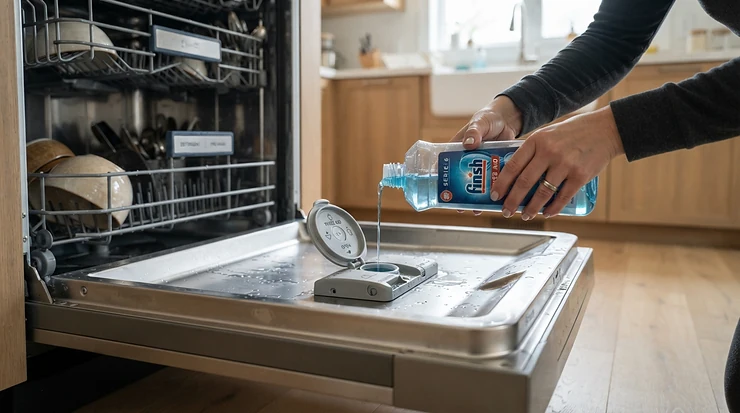
What is dishwasher rinse aid? It’s a liquid your machine releases automatically during the final rinse. It lowers the surface tension of water, so water sheets off plates and glasses instead of clinging in droplets. That cuts water spots, protects glass shine and improves dishwasher drying performance, especially in hard water.

You’ve loaded the machine with care, chosen a decent tablet and run the long cycle. Yet your wine glasses come out looking as if a dragon with a limescale habit has breathed on them. 🐉 Cue the tea towel.
The culprit is usually the water itself. Hard water forms when water passes through limestone, chalk or gypsum and picks up calcium and magnesium. Commonly cited figures suggest more than half of UK homes sit in a hard water area, with the South East and East Anglia hit hardest. When those mineral-laden droplets dry on your crockery, they leave a chalky signature behind.
This guide compares seven real products, from supermarket-style staples to plant-based and refillable options. It covers rinse aid for hard water areas, fragrance-free rinse aid and rinse aid for spotless glasses. One honest note up front: this is analysis built from specifications, label information and aggregated review sentiment, not hands-on testing. Prices and availability on amazon.co.uk move constantly, so always check the current listing.
Quick Comparison: 7 Dishwasher Rinse Aid Options at a Glance
| Product | Size | Fragrance | Typical Price Range | Best For |
|---|---|---|---|---|
| Finish Rinse & Shine Aid (Original) | 400ml | Original scent | £3-£5 | First-time buyers, all-round use |
| Finish Rinse & Shine Aid 0% | 400ml | Fragrance-free (per listings) | £4-£6 | Scent-sensitive households |
| Bio-D Dishwasher Rinse Aid | 750ml | Fragrance-free | £3-£5 | Allergy-conscious, hard water |
| Ecover Rinse Aid | 450-500ml | Listings differ, check label | £4-£6 | Plant-based shoppers |
| Miniml Dishwasher Rinse Aid Unscented | 400ml | Fragrance-free | £3-£4 | Refill fans, soft-to-medium water |
| Finish Rinse & Shine Aid Lemon | 400ml | Lemon | £3-£5 | Fresh-scent lovers |
| Dri Pak Dishwasher Rinse Aid | 500ml | Not stated, check label | £2-£3 | Tight budgets |
Looking at the comparison above, Finish Original is the safest mainstream starting point. The fragrance-free rinse aid contenders (Finish 0%, Bio-D and Miniml) split on price and eco credentials rather than on basic function. Budget buyers should note that Dri Pak is the cheapest here, but its evidence base is the thinnest.
💬 Just one click — help others make better buying decisions too!😊
Top 7 Dishwasher Rinse Aid Products: Expert Analysis
1. Finish Rinse & Shine Aid (Original) — the benchmark all-rounder
Every rinse aid review needs a yardstick, and this is it.
The 400ml bottle is dosed at roughly 4.5ml per wash, which the brand says stretches to around 80 washes. That means a couple of months of near-daily cycles, and pennies per load once you spread the price below across the bottle. The formula is conventional and surfactant-led. The brand’s own retail listings name big appliance makers as recommending it, which makes it the lowest-risk first purchase if you’re unsure what your machine tolerates.
The catch is that it’s scented. That’s fine for most households, but if you want a fragrance-free rinse aid, jump to the 0% version below. Reviewer sentiment looks solid. One UK grocer’s page showed 4.3 out of 5 from around 60 reviews at the time of research. I couldn’t verify review-by-review themes on Amazon itself, so treat that as a broad signal.
Pros:
- ✅ Familiar, widely stocked formula
- ✅ Long-lasting 80-wash bottle claim
- ✅ Low cost per wash
Cons:
- ❌ Scented, not ideal for sensitive noses
- ❌ No plant-based or refill credentials
Price: around £3-£5 for 400ml (check current price). Excellent value per wash.

2. Finish Rinse & Shine Aid 0% — best mainstream fragrance-free rinse aid
Want big-brand familiarity without the perfume? This is the obvious route. 🌿
Retailer listings describe it as free from perfume and dyes, and some trade listings add preservatives to that list. It comes in a 400ml bottle and is topped up in the same dispenser as any other rinse aid. On paper, you’re getting the same job (sheeting water off glassware and speeding drying) with fewer additives.
Here’s what to weigh. “Fragrance-free” is not the same as “hypoallergenic”, and nothing here makes a medical claim. If you have genuine skin concerns, a GP or pharmacist is the right call. For everyone else who simply dislikes a perfumed machine, this is a low-drama switch. I couldn’t find enough verified UK review data specifically for the 0% version, so I won’t invent a rating. The standard Finish Original score is the nearest proxy, and the brand describes the two as sister products.
Pros:
- ✅ Perfume- and dye-free per listings
- ✅ Familiar mainstream performance profile
- ✅ Same easy dispenser top-up
Cons:
- ❌ Costs more per bottle than own-brand options
- ❌ Not marketed as plant-based
Price: around £4-£6 for 400ml. Fair value if scent is your priority.
3. Bio-D Dishwasher Rinse Aid — Allergy UK-approved and fragrance-free
This is the pick for households that read labels. 🏷️
The bottle holds 750ml, which is nearly double the mainstream 400ml size. It’s UK-made, vegan, fragrance-free, septic-safe and approved by Allergy UK. The ingredient list is short: under 5% ethanol, citric acid, two surfactants and sodium chloride. A UK retailer positions it for hard water areas where extra rinse aid is always needed.
Reviewer sentiment is positive but not unanimous. On one ethical retailer’s page (37 reviews), several buyers praised results in very hard water. One detailed critic reported white film and struggled to drain the reservoir after switching. The takeaway is to start on a lower dial setting and know how to empty your dispenser. Another marketplace showed 12 ratings, all five-star.
Pros:
- ✅ Allergy UK-approved, fragrance-free
- ✅ Large 750ml bottle, fewer repurchases
- ✅ Vegan, UK-made, septic-safe
Cons:
- ❌ Mixed reports of film if overdosed
- ❌ Dispenser may need flushing when switching brands
Price: around £3-£5 for 750ml. Strong value for the volume.
4. Ecover Rinse Aid — plant-based with 98% bio-based ingredients
For the shopper who wants the eco angle without leaving the high street brands. ♻️
The brand claims 98% bio-based ingredients. The UK ingredient list features citric acid, a rapeseed oil and glucose ferment, a glucoside surfactant and alcohols. It’s vegan, and one retailer lists the bottle as made from recycled plastic. Pack sizes appear as 450ml or 500ml depending on the seller, so check the listing.
Fragrance details conflict. One UK trade listing calls it fragranced, while another retailer describes it as free from artificial fragrances. If scent matters, read the label on the bottle you actually receive. Analytically, plant-derived formulas can be perfectly capable, but the brand’s “no residue” claim deserves a sanity check in very hard water. I couldn’t verify Amazon review themes, so there’s no rating here.
Pros:
- ✅ High bio-based content, vegan
- ✅ Recycled plastic bottle per one listing
- ✅ Well-known eco brand
Cons:
- ❌ Fragrance status unclear across listings
- ❌ Costs a little more per wash than mainstream
Price: around £4-£6. Reasonable if sustainability drives your choice.
5. Miniml Dishwasher Rinse Aid Unscented — refillable and fragrance-free
Zero-waste credentials are its headline trick. 🔄
The 400ml bottle is biodegradable, low-foaming and free from VOCs, chlorine bleaches, sulphates and phosphates. Empty packaging can be posted back free for cleaning and refilling. The brand says it works equally well in hard and soft water. That’s the claim I’d treat most carefully.
Reviewer data is thin and mixed. One ethical retailer showed 3.6 out of 5 from only seven ratings. Two buyers (one in a hard water area) reported streaks or a white coating, while others reported good results, including in a Bosch slimline machine. With a sample that small, it’s a caution rather than a verdict. Based on that spread, it looks best suited to soft or moderate water and to people who value refills.
Pros:
- ✅ Genuine free packaging return scheme
- ✅ Fragrance-free, low-foaming formula
- ✅ Low typical price
Cons:
- ❌ Mixed hard-water feedback from reviewers
- ❌ Very small review pool
Price: around £3-£4 for 400ml. Good value, with hard-water caveats.
6. Finish Rinse & Shine Aid Lemon — scented variant for fresh-smelling kitchens
Same family as the Original, with a citrus twist. 🍋
Listings show the 400ml bottle at the same dosing as its sibling (about 4.5ml per wash, roughly 80 washes), and larger 800ml bottles appear at some sellers. The functional difference is the scent, so choose it for preference or availability rather than performance.
Frankly, scent in a rinse aid mostly shows up when you open the door. If you’re prone to headaches from fragranced products, Finish 0% is the more sensible choice. I found no verified reviews specifically for this variant, so the Original’s rating is the closest guide.
Pros:
- ✅ Established brand, wide retail presence
- ✅ Same 80-wash dosing claim
- ✅ Pleasant fresh scent for those who want it
Cons:
- ❌ No performance edge over the Original
- ❌ Unsuitable for fragrance-sensitive users
Price: around £3-£5 for 400ml (check current price). Decent value.
7. Dri Pak Dishwasher Rinse Aid — budget UK-made option
The lowest-risk way to trial a rinse aid. 💷
The 500ml bottle is UK-made and positioned for all water hardness levels and many dishwasher brands. It’s designed to stop water beading, so dishes dry faster. Don’t expect bells and whistles. The listing I found publishes no fragrance or ingredient detail, so check the label.
Evidence is the weak point. One retailer showed a single five-star rating, which proves nothing. Treat it as a cheap experiment: if your glassware looks better after a month, you’ve saved money. If it doesn’t, you’re not out much. Hard-water households should still watch for film.
Pros:
- ✅ Lowest typical price in this lineup
- ✅ Generous 500ml bottle
- ✅ UK-made
Cons:
- ❌ Almost no verified reviews
- ❌ Limited ingredient and fragrance detail
Price: around £2-£3 for 500ml. Great for low-stakes trials.
Top 7 Comparison: Real Review Signals and Value
| Product | Type | Typical Price Range | Verified Review Signal | Best For |
|---|---|---|---|---|
| Finish Original | Conventional, scented | £3-£5 | 4.3/5, about 60 reviews (one UK grocer) | Everyday reliability |
| Finish 0% | Conventional, fragrance-free | £4-£6 | Not verified | Scent-sensitive homes |
| Bio-D | Plant-based, fragrance-free | £3-£5 | Mixed-positive, 37 reviews (ethical retailer) | Allergy-conscious, hard water |
| Ecover | Plant-based | £4-£6 | Not verified | Eco shoppers |
| Miniml | Refillable, fragrance-free | £3-£4 | 3.6/5, 7 ratings (ethical retailer) | Soft-to-medium water |
| Finish Lemon | Conventional, scented | £3-£5 | Not verified | Scent fans |
| Dri Pak | Budget | £2-£3 | One five-star rating only | Cheap trial |
The honest reading here is that only Finish Original and Bio-D have meaningful review volumes. Everything else rests on formulation and brand claims, so keep expectations measured. If you want proof before you buy, those two are your best-documented options.
Practical Usage Guide: Your First 30 Days With Dishwasher Rinse Aid
Buying the bottle is the easy bit. These steps help you get the best from it.
- Check your water hardness. Your supplier publishes figures, and tools like Thames Water’s water quality pages let you check by postcode.
- Find the dispenser. It sits beside the detergent drawer, usually with a screw cap and a level indicator.
- Fill slowly to the marker. Don’t overfill, and wipe any spill, since excess can cause streaking.
- Set the dial mid-range. Many machines have an adjustable setting, so check your manual for the scale.
- Run a normal cycle and inspect the glasses. Droplets mean turn it up. Streaks or a bluish film mean turn it down.
- Top up monthly. Monthly is the usual rhythm, though a lower-use household can go longer.
- Clean the filter fortnightly. A clogged filter ruins results no matter which bottle you buy.
The classic first-month mistakes are overfilling, ignoring the dial, and switching brands mid-bottle without flushing. In a hard water area, pair your rinse aid with dishwasher salt, because the two do different jobs.

Real-World Scenarios: Which Rinse Aid Suits Your Home?
The family of four in Kent (very hard water, daily cycles). Hard water is the main enemy here. Bio-D is marketed for exactly this and has some very-hard-water praise, though watch the dial for film. Finish Original is the conventional alternative. Budget about £3-£5 per bottle, and add dishwasher salt.
The renter in Glasgow (soft water, three cycles a week). Soft water means mineral spotting is less of a worry. Miniml suits here, since its hard-water complaints matter less, and its refill scheme cuts waste. Dri Pak is the cheap alternative if you simply want drier dishes.
The parent avoiding fragrance (moderately hard Midlands water). A fragrance-free rinse aid is the priority. Finish 0% offers mainstream familiarity, while Bio-D adds Allergy UK approval. This isn’t medical advice, but both remove perfume from the equation.
Problem → Solution Guide: Fixing Common Rinse Aid Headaches
Problem 1: Cloudy film on glasses. Reduce the dial setting by one notch, then check your filter. If hard water is the cause, add salt.
Problem 2: Persistent water spots. Increase the dose gradually, or switch to a formula with stronger reviews in hard water, such as Finish Original or Bio-D.
Problem 3: Plastic stays wet. Plastics hold less heat and keep droplets. Open the door slightly after the cycle and let steam escape.
Problem 4: Streaks after switching brands. Residual product in the dispenser may be mixing with the new one. Run a hot, empty cycle and restart at a lower setting. One Bio-D reviewer described precisely this struggle.
Problem 5: Perfume smell you can’t stand. Move to Finish 0%, Bio-D or Miniml.
How to Choose Dishwasher Rinse Aid: 7 Steps That Actually Matter
- Know your water. Hard water demands a stronger formula and possibly salt, so look up your supplier’s figure.
- Check your manual. Some machines specify a rinse aid type or dose.
- Decide on fragrance. Scent-sensitive? Go fragrance-free.
- Match bottle size to usage. A big bottle suits daily cycles, while a small one suits occasional use.
- Read reviews from your water type. A rave from a soft-water postcode tells you little about Kent.
- Weigh eco claims honestly. Bio-based and refillable options reduce waste, but check hard-water reviews first.
- Start low on the dial. It’s easier to add rinse aid than to remove film.
Rinse Aid for Hard Water Areas: What Actually Works
The best rinse aid for hard water areas is one that sheets water away quickly enough that minerals don’t have time to settle. The South East, East Anglia and parts of the East Midlands face the toughest conditions. Scotland, Wales and the North West are mostly softer, which changes the equation.
Brand guidance suggests that even with all-in-one tablets, very hard water benefits from separate salt and rinse aid. Salt softens the water going into the wash, while rinse aid improves how it leaves the dishes. Both do separate jobs, and skipping either tends to show.
On the product side, Bio-D is positioned for hard water and has reviewer praise from very hard water postcodes, alongside one cautionary tale. Finish Original is the mainstream choice with a large review base. Miniml has drawn the most hard-water criticism, so I’d approach it carefully in these areas. Long term, a whole-home water softener addresses the root cause, but a bottle of rinse aid for hard water areas remains the cheapest first move.
✨ Ready to Upgrade Your Rinse Routine?
🔍 Take your dishwasher drying performance to the next level with these carefully researched picks. Click any highlighted product to check current pricing and availability. A few millilitres per wash could be all it takes to put the tea towel away for good!
Fragrance-Free Rinse Aid: Who Genuinely Needs One?
Rinse aid is heavily diluted and rinsed off, so does fragrance matter? For many households, no. But for anyone who notices perfume lingering inside the machine, or who buys unscented products across the house, a fragrance-free rinse aid is a simple switch.
Your main options here are Finish 0%, Bio-D and Miniml. Ecover is plant-based, but its fragrance status varies by listing, so read the label. Finish 0% is the most familiar formula, Bio-D adds Allergy UK approval, and Miniml adds refills.
It’s worth knowing what “fragrance-free” doesn’t promise. It doesn’t guarantee suitability for eczema or allergies, and it doesn’t guarantee better results on glassware. If you’re using a fragrance-free rinse aid because of a medical concern, a GP or pharmacist can advise properly. For everyone else, the practical benefit is simply a neutral-smelling kitchen and fewer irritants in the mix.
Rinse Aid for Spotless Glasses: Beating Water Spots and Restoring Glass Shine
Glasses are the toughest test, because every droplet shows. Rinse aid for spotless glasses works by lowering surface tension, so water forms a thin sheet that drains away rather than beading. If it sits, it evaporates and leaves calcium behind: those familiar water spots.
Glass shine depends on a residue-free final rinse. Too little rinse aid leaves droplets, while too much can leave a filmy, rainbow-ish coating. That’s why dosing matters as much as product choice, and why a mid-range dial is the sensible starting point.
To diagnose a problem, wipe one glass with a vinegar-dampened cloth. If it clears, you’re dealing with removable mineral film, so adjust the dose or add salt. If it doesn’t, you may be seeing etching, which is permanent surface damage that no rinse aid can reverse.
For loading, angle glasses so water can run off, avoid overcrowding, and keep the filter clean. For spotless glasses in hard water, Bio-D and Finish Original are the best-documented bets. Keeping water spots at bay is as much about habit as about the bottle.
Dishwasher Drying Performance: What to Expect in Real Life
Realistic dishwasher drying performance means drier glass and ceramics, not a bone-dry plastic tub. Rinse aid helps water drain, but plastics hold less heat and tend to keep droplets regardless of brand.
Brands claim sizeable drying gains when rinse aid is added to tablets alone. Treat those figures as marketing claims measured under the brand’s own test conditions. Your results depend on your machine, your water and your programme. Eco and short cycles use lower final-rinse temperatures, which can leave more moisture behind.
If drying is still weak, three things usually help. First, nudge the dial up one notch. Second, check the dispenser is actually full, since an empty one is the commonest culprit. Third, crack the door open after the cycle to release steam. Improving your dishwasher drying performance rarely needs a fancier product, just correct use of the one you have.
Dishwasher Rinse Aid vs White Vinegar and All-in-One Tablets
| Option | Water Spots Control | Drying | Machine Note | Cost | Best For |
|---|---|---|---|---|---|
| Dedicated rinse aid | Strong | Strong | Made for the dispenser | Low per wash | Finish Original, Bio-D users |
| White vinegar | Moderate | Moderate | Advice is mixed, check your manual | Very low | Emergency stopgap |
| All-in-one tablets alone | Moderate | Moderate | Brand guidance suggests extra products in very hard water | Medium | Soft-to-medium water |
| Salt or water softener | Addresses cause | Indirect | Essential upkeep in hard areas | Medium-high | Very hard water |
These ratings are my editorial assessment, not lab results. The takeaway is that dedicated rinse aid remains the most targeted fix for spotting and drying, while vinegar is a cheaper but contested substitute. Some online advice says it’s fine, while other users warn it can harm seals, so check your appliance manual before trying it.
All-in-one tablets include some rinse aid action, and your machine will keep working when the light comes on. Even so, a separate bottle tends to give a visible boost on glassware in hard water areas.
Long-Term Cost & Maintenance: What You’ll Really Spend
Rinse aid is one of the cheapest upgrades in the kitchen. Which? notes that rinse aid is key for drying but less fundamental than salt for machine upkeep, and that entry-level bottles have started from under £2 for 400ml.
| Product | Typical Price Range | Cost Tier | Value Verdict |
|---|---|---|---|
| Dri Pak | £2-£3 | Budget | Cheap trial, thin evidence |
| Miniml | £3-£4 | Budget | Great if soft water |
| Finish Original | £3-£5 | Mid | Best documented value |
| Bio-D | £3-£5 | Mid | Big bottle, strong hard-water fit |
| Finish Lemon | £3-£5 | Mid | Same value, scented |
| Finish 0% | £4-£6 | Mid-premium | Fair for fragrance-free |
| Ecover | £4-£6 | Premium | Pay for eco credentials |
The per-wash differences are tiny. At roughly 4.5ml per wash, a 400ml bottle covers up to 80 cycles per the brand. So choosing the right formula for your water matters far more than saving a pound on the bottle.
On maintenance, top up monthly, clean the filter fortnightly, wipe spills and keep the spray arms clear. Those habits protect results more than any product swap.
FAQ
❓ Do I still need dishwasher rinse aid if my tablets say all-in-one?
❓ How much dishwasher rinse aid is released per wash?
❓ Can fragrance-free rinse aid still give brilliant glass shine?
❓ Where can I buy dishwasher rinse aid in the UK?
❓ Why are my glasses still cloudy after using rinse aid?
Conclusion
The bottom line is that the best dishwasher rinse aid is the one that fits your water, your household and your dispenser. For most people, Finish Original is the safest, best-documented choice. If you want a fragrance-free rinse aid from a familiar brand, Finish 0% is the logical switch. For hard water and allergy-conscious homes, Bio-D has the strongest credentials, provided you start on a modest dial setting.
Eco-minded shoppers can look at Ecover or Miniml, bearing in mind Miniml‘s mixed hard-water feedback. Finish Lemon is a pleasant scented option, and Dri Pak is a cheap trial if you just want to see whether rinse aid helps your machine.
Remember the unglamorous bits too: correct dosing, a clean filter, and salt if your water is hard. Get those right and water spots, cloudy glass shine and damp crockery become far less of a daily annoyance. Check current prices and availability on amazon.co.uk before buying, since both change often.
Recommended for You
- Dishwasher Tablets For Hard Water: 7 Proven Picks (2026)
- Dishwasher Tablets: 7 Best Picks For Sparkling Glasses (2026)
- Refillable Washing-Up Liquid: 7 Best Picks For UK Homes (2026)
Disclaimer: This article contains affiliate links. As an Amazon Associate, I earn from qualifying purchases. If you purchase products through these links, we may earn a small commission at no additional cost to you.
✨ Found this helpful? Share it with your friends! 💬🤗
