
In This Article
Picture the scene: it’s a Saturday morning in late October. The sun — a rare and suspicious visitor at this time of year — cuts through your living room at a low, accusatory angle, illuminating every smear, every dried raindrop, every ghost of a fingerprint your windows have been quietly accumulating since March. You grab a cloth. You squint at the upstairs bay. You think, not today, and put the kettle on instead.
Sound familiar? You’re in excellent company.
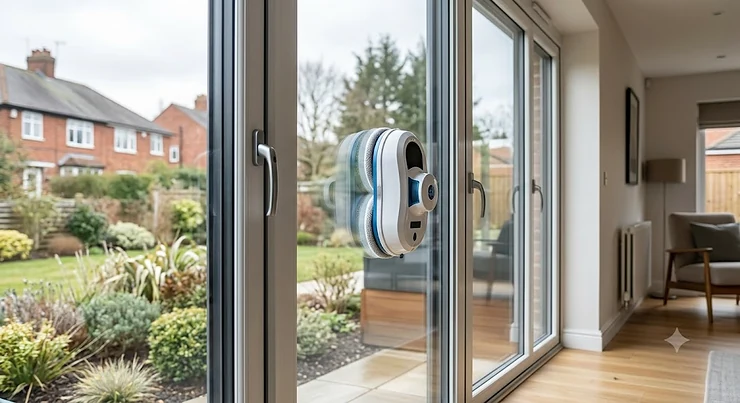
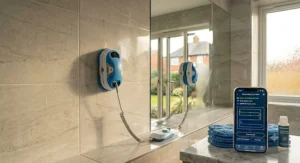
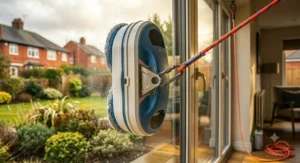
An automatic window cleaner (also called a window cleaning robot or hands-free window cleaning device) is a small robotic device that attaches to your glass via vacuum suction and scrubs its way systematically across the pane — no ladders, no squeegees, no aching shoulders. You place it on the glass, press a button, and get on with something more interesting. Most models clean a standard UK double-glazed window in five to eight minutes, covering a square metre in roughly two to three minutes, spraying water automatically as they go.
And the safety case is compelling. According to the Health and Safety Executive (HSE), falls from height remain the leading type of fatal workplace accident in Great Britain — and RoSPA estimates around 6,000 people are hospitalised annually in the UK from domestic ladder accidents. Even a first-floor sill is an unnecessary gamble when a robot costs less than £400.
This guide covers seven real products available on Amazon.co.uk, with honest analysis of what each one actually does in British conditions — damp winters, double glazing, Victorian sashes and all.
Quick Comparison: 7 Best Automatic Window Cleaners at a Glance
| Product | Suction | Auto Spray | Navigation | Price Range (GBP) | Best For |
|---|---|---|---|---|---|
| Ecovacs WINBOT W2 Pro Omni | 5,500Pa | ✅ Triple nozzle | WIN-SLAM 4.0 | £450–£520 | Premium, cordless freedom |
| Ecovacs WINBOT W2 Omni | 5,500Pa | ✅ Triple nozzle | WIN-SLAM 4.0 | £370–£410 | Large windows, frameless glass |
| Hobot S7 Pro | 4,800Pa | ✅ Ultrasonic mist | Dual-mop AI | £300–£340 | Corner cleaning, framed windows |
| Ecovacs WINBOT Mini | 3,500Pa | ✅ Ultrasonic | WIN-SLAM 3.0 | £270–£310 | Small or narrow windows |
| HOBOT 388 | 3,800Pa | ✅ Ultrasonic | Zigzag + AI | £230–£270 | Value, general use |
| Tosima W3 | 3,800Pa | ✅ Dual-direction | Smart Nav | £150–£200 | Budget-conscious buyers |
| Mamibot W120-T | 3,000Pa | ❌ Manual spray | Z/N paths | £160–£200 | Entry-level, occasional use |
What the data tells us: The £370–£520 tier (Ecovacs WINBOT W2 family) dominates on technology, but the gap between them and the mid-range HOBOT options narrows considerably in real-world use on standard UK double glazing. If you live in a Victorian terrace with smallish sash windows, spending an extra £200 on the Pro Omni’s cordless station is arguably a waste of money. On the other hand, if you’re tackling floor-to-ceiling glass in a new-build or a conservatory full of frameless panels, the premium navigation earns its keep.
💬 Just one click — help others make better buying decisions too! 😊
✨ Don’t Miss These Exclusive Deals!
🔍 Click on any highlighted product name to check current pricing and availability on Amazon.co.uk. Prices fluctuate — always worth a quick check before you buy.
Top 7 Automatic Window Cleaners: Expert Analysis
1. Ecovacs WINBOT W2 Pro Omni — Best Overall
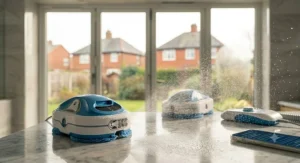
The W2 Pro Omni is the automatic window cleaner that most people will be glad they bought — and a few will find mildly over-engineered for their actual needs. Its party trick is the six-in-one portable station: a chunky dock that holds the robot, coils the cable automatically, and runs on an internal battery for up to 110 minutes. That last point matters enormously if your home is arranged the way most UK homes are — plugs nowhere near the windows you most want to clean.
The 5,500Pa suction and WIN-SLAM 4.0 path planning deliver 30% better cleaning efficiency than the previous generation, per Ecovacs, and TechRadar’s hands-on test found it tackled “frankly filthy windows” with a single pass. The triple-nozzle spray atomises water evenly, which means less streaking on the kind of lightly grime-coated glass British weather specialises in producing. UK plug type G, 230V compatible, available on Amazon.co.uk with Prime delivery.
This is the one for homeowners with large, hard-to-reach windows, conservatories, or balconies without nearby sockets. It isn’t cheap — expect to pay in the £450–£520 range — but the convenience of true cordless operation on exterior glass is something cheaper models simply cannot offer. UK reviewers consistently praise the ease of setup and the fact that pads are machine-washable.
✅ True cordless operation — no socket hunting
✅ Excellent on frameless glass and balcony panels
✅ Auto cable management — no tangled mess in storage
❌ Station adds bulk; not ideal for compact flats with limited cupboard space
❌ Premium price that won’t suit every budget
2. Ecovacs WINBOT W2 Omni — Best for Large Windows
The W2 Omni shares most of the W2 Pro Omni’s DNA — same WIN-SLAM 4.0 navigation, same 5,500Pa suction, same 12-tier safety system — but connects to the mains rather than offering full battery-powered operation. What this costs you in flexibility, it gives back in price: expect to pay roughly £50–£100 less than the Pro variant, settling comfortably in the £370–£410 range.
In practice, for most UK homes, the difference is minimal. If your windows are on ground and first floor, with a socket within a few metres, the W2 Omni does everything the Pro version does. The WIN-SLAM 4.0 navigation is genuinely clever: it maps the window edges before committing to a cleaning path, which means it covers corners more precisely than older zigzag-pattern robots. British conservatories — those long-suffering panels that face every conceivable weather event — are well within its abilities.
UK customers on Amazon.co.uk report excellent results on double glazing and note that the machine-washable pads mean ongoing running costs are minimal. Edge cleaning improves by 65% over the W1 generation, which is noticeable on taller panes where earlier robots would leave a dusty border near the frame.
✅ Top-tier navigation at a lower price than Pro Omni
✅ Handles floor-to-ceiling glass with ease
✅ 12-tier safety system — genuinely reassuring on high windows
❌ Mains-powered only — extension lead required for exterior use
❌ Heavy station (5.2kg) makes it less nimble for quick single-window jobs
3. Hobot S7 Pro — Best for Corner Cleaning
Here’s something no round-bodied robot will ever admit: circles cannot reach 90-degree corners. The geometry simply doesn’t work. The Hobot S7 Pro is square. Its dual reciprocating mop pads — oscillating at 600 strokes per minute — reach all the way into the corners of framed windows, leaving behind results that most competitors physically cannot match in those tight edges.
The 4,800Pa suction is the highest published figure in this category (Ecovacs doesn’t quote a suction number for the W2 family), and the 15nm ultrasonic spray atomises water into a fine mist that cleans gently without soaking your frames — a genuine consideration for older UK homes with painted timber window surrounds. Featured at the Ideal Home Show 2026 at London’s Olympia, it’s now available on Amazon.co.uk in the £300–£340 range.
TechRadar’s reviewer found it performed excellently on lightly soiled indoor glass, with accurate navigation and no missed spots. On heavier outdoor grime — the kind that accumulates on south-facing bay windows after a British winter — it occasionally needed a second pass. The UPS backup keeps the robot safely attached for 30 minutes in a power cut, and the 230kgf safety tether is the strongest in its class. App control is available via the Hobot Legee app (note: not the standard Hobot app — an important distinction several Amazon reviewers learned the hard way).
✅ Best-in-class corner coverage — unmatched by round-pad robots
✅ Ultrasonic mist gentle on painted timber and UPVC frames
✅ Excellent for framed and frameless vertical glass
❌ Large footprint — won’t fit windows narrower than approximately 32cm
❌ Mains-powered only; exterior use requires cable management
4. Ecovacs WINBOT Mini — Best for Narrow Windows
Most window robots have a minimum viable window size of around 40cm × 40cm. That’s fine for modern double-glazed units, but the UK’s housing stock is famously varied — Victorian properties, cottage casements, and narrow bathroom obscure glass exist in vast numbers, and standard robots simply won’t operate on them.
The WINBOT Mini was designed precisely for this gap. Its compact oval form factor lets it clean windows less than 25cm wide — something neither the W2 Omni nor the S7 Pro can manage. The nine-stage protection system includes both hardware fall prevention and a UPS backup, and the WIN-SLAM 3.0 navigation achieves a claimed 99.5% surface coverage on panels where the robot can physically manoeuvre.
For homeowners in older UK properties — terraced houses, converted flats, Edwardian semis with their small divided-light casements — the Mini fills a niche that everything else in this list ignores. Priced in the £270–£310 range on Amazon.co.uk, it’s not cheap relative to its size, but there’s genuinely no direct competitor for narrow-format windows at this quality level. The ultrasonic dual-nozzle spray keeps moisture minimal, which matters on older window seals.
✅ The only quality option for windows under 30cm wide
✅ Compact storage — fits comfortably in a kitchen drawer
✅ Quiet motor — noticeably less disruptive than larger models
❌ Smaller cleaning surface means more moves between panes on a full house
❌ Less suitable for very large windows where bigger robots are faster
5. HOBOT 388 — Best Mid-Range Value
The HOBOT 388 — also sold as the HOBOT 388 Ultrasonic on Amazon.co.uk — occupies that pleasing sweet spot where you’re getting serious capability without paying flagship prices. At around £230–£270, it delivers what independent testing describes as approximately 85% of the HOBOT 2S’s cleaning performance at notably less cost.
The ultrasonic spray system is its standout feature at this price. Ultrasonic atomisation produces a far finer mist than standard spray nozzles, which means glass dries with fewer streaks — a meaningful advantage in British conditions, where windows face months of damp, diesel particles, and intermittent bird activity. The zigzag-then-vertical cleaning path isn’t as sophisticated as WIN-SLAM navigation, but for a standard rectangular UK window it’s perfectly adequate.
The 3,800Pa suction holds the robot firmly on glass during wet-wipe cycles, and the UPS backup keeps it attached for 20 minutes if the power goes. Replacement microfibre pads are available on Amazon.co.uk and wash at 30°C in a standard machine. HOBOT has been making window robots since 2010 — one of the longest track records in the category — and that experience shows in build quality that punches above this price point.
✅ Ultrasonic spray at a mid-range price — rare combination
✅ Reliable brand with a decade-long track record in the UK market
✅ Good availability of replacement pads on Amazon.co.uk
❌ Navigation less precise than premium models — occasional edge misses on larger panes
❌ No cordless option
6. Tosima W3 — Best Budget Pick
The Tosima W3 is the most affordable properly-featured autonomous window cleaner on Amazon.co.uk worth recommending without reservation. “Budget” can be a euphemism for “you get what you pay for,” but the W3 — with its dual-direction auto-spray, NIDEC brushless motor, and 3,800Pa variable-frequency suction — is built on components that wouldn’t embarrass models costing twice as much.
What it lacks compared to HOBOT or Ecovacs is navigation sophistication. The W3’s smart navigation is competent rather than clever: it detects edges and avoids falls reliably, but the path it takes across a large window is less efficient than AI-optimised routing. For a standard-sized UK window — say, 90cm × 120cm — this matters very little. For a 2m floor-to-ceiling glass panel, you may want to intervene with the remote.
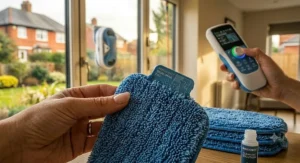
In the £150–£200 range with Prime delivery available, it’s an excellent entry point for anyone testing whether a window robot fits their lifestyle before committing to a premium model. The twelve included cleaning rags (six pairs) mean you won’t need to buy accessories immediately. UK customers note it handles double glazing and bathroom tiles with equal ease.
✅ Best price-to-performance ratio in this roundup
✅ Generous accessory bundle — 12 microfibre rags included
✅ Dual-direction spray covers glass more evenly than single-direction models
❌ Navigation efficiency drops on large, non-standard window shapes
❌ Less polished app integration than Ecovacs or HOBOT equivalents
7. Mamibot W120-T — Best Entry-Level Option
The Mamibot W120-T is the one to buy if you want to spend the least amount of money while still getting a genuine automatic window cleaner — and you’re prepared to do one small thing manually: pre-spray the cleaning cloth yourself before attaching it to the robot.
That single compromise aside, the W120-T delivers three AI cleaning modes (Z-pattern, N-pattern, and Z-to-N), 3,000Pa suction with edge detection, a 600mAh UPS backup battery, and app/remote control. Awarded best smart device at IFA 2018, it’s been a staple of the UK market for several years, which means replacement pads are reliably available on Amazon.co.uk.
For occasional use — monthly cleaning of a few key windows rather than the whole house fortnightly — it’s a perfectly sensible investment in the £160–£200 range. It won’t challenge the HOBOT or Ecovacs models on large panes or frameless glass, and it’s not the robot for a glazed extension. But for a standard UK semi-detached with UPVC frames and moderately-sized windows, it does the job.
✅ Lowest price point for a genuinely functional robot cleaner
✅ App control (iOS and Android) included
✅ Compact and lightweight at 1.35kg — easy to handle
❌ No auto-spray — manual pre-wetting required
❌ 3,000Pa suction is adequate but not impressive on very large vertical panes
How to Get the Best Results: A Practical UK Setup Guide
First Use: Setting the Robot Up for British Glass
Double-glazed UPVC windows — the dominant window type in UK homes built after the 1980s — are ideal for all seven robots in this list. The smooth, non-porous glass surface provides excellent suction adhesion. Older single-glazed timber-frame windows work too, but wipe a small clean patch first (about 10cm × 10cm) so the robot has a suction point to start from.
For the first clean, do a dry pass before a wet one. British windows that haven’t been properly cleaned in months will have a layer of dried pollution and mineral deposits that can smear if you go straight in with water. Run the robot dry with a clean pad, then follow immediately with a damp pad. The difference is noticeable.
Safety Setup: The Bit Everyone Skips
Every robot in this roundup comes with a safety tether cord. Clip it. Always. Attach it to the window handle, a robust hook screwed into the frame, or an anchor point above the window. The UPS backup battery will hold the robot for 15–30 minutes in a power cut, but the tether is your last line of defence if something goes wrong. In a typical UK first-floor window, a fall means a broken robot at minimum, and potentially a broken person standing below it.
Maintenance Tips for Damp British Conditions
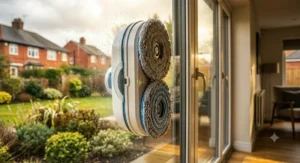
After each use, remove the cleaning pads and rinse them immediately — especially in autumn and winter when windows accumulate more organic matter (algae, leaf residue, traffic film from narrower British roads). Washing at 30°C is fine; tumble drying is not recommended. Store the robot inside, away from a damp garage or shed — the suction seal and motor housing don’t enjoy prolonged exposure to cold, humid air. Most manufacturers recommend a light wipe of the suction ring with a dry cloth every five or six uses.
Which Robot Suits Which UK Buyer? Three Real Scenarios
Scenario 1 — The London Flat Dweller Emma lives in a second-floor conversion in Hackney. She has eight windows, all standard double-glazed UPVC, no awkward angles. Her main concern is the street-facing front windows that face a busy bus route and accumulate diesel grime fast. Budget: under £300. Best pick: HOBOT 388. The ultrasonic spray handles traffic-film residue better than standard nozzles, and the 3,800Pa suction is more than adequate for vertical residential glass. She doesn’t need cordless operation — all her windows are within cable reach of a socket.
Scenario 2 — The Suburban Conservatory Owner David and his wife have a 1990s detached in the Midlands with a lean-to conservatory comprising eight glass panels, plus French doors and a bay window. Several conservatory panels are effectively frameless. Budget: up to £450. Best pick: Ecovacs WINBOT W2 Omni. The WIN-SLAM 4.0 navigation and dual edge sensors handle frameless glass that would baffle mid-range robots, and the 5,500Pa suction copes with the slightly angled conservatory panels without hesitation.
Scenario 3 — The Victorian Terrace Homeowner Priya lives in an Edwardian terrace in Bristol with a mix of original single-glazed sash windows in the bedrooms (narrow, divided-light panes) and replacement double-glazed units elsewhere. Budget: flexible. Best pick: ECOVACS WINBOT Mini for the narrow sashes; Tosima W3 for the standard units. Yes, this means buying two robots — but a robot that won’t physically fit on a narrow pane is no help at all, and the Tosima W3 at sub-£200 is an economical companion for the standard windows.
How to Choose an Automatic Window Cleaner in the UK: 6 Key Criteria
Choosing the right hands-free window cleaning device comes down to a handful of factors that the marketing materials consistently underplay.
1. Glass type first. Frameless glass (glass balconies, shower screens, conservatory panels) demands premium navigation — WIN-SLAM 4.0 or Hobot’s Edge-Less-Border (ELB) technology. Framed UPVC or timber windows are far less demanding.
2. Window size matters more than suction figures. A 5,000Pa robot on a standard 90cm × 60cm window is overkill. Where suction numbers matter is on very large, very tall panes where the robot’s weight is a real consideration.
3. Cordless vs mains. For interior windows only: any model works. For exterior glass where you can’t thread a cable through the window frame, only the Ecovacs WINBOT W2 Pro Omni offers genuine battery-powered operation.
4. UK plug and voltage. All seven products reviewed here come with UK Type G plugs and operate on 230V/50Hz. If you’re tempted by a grey-import listing, check this explicitly — running a 110V North American product on UK mains will destroy it promptly.
5. Minimum window width. Standard models require approximately 40cm. The Ecovacs WINBOT Mini is the only option for windows narrower than 30cm. This matters more in UK housing than manufacturers based elsewhere might appreciate.
6. Replacement pad availability. A robot whose pads you can’t replace within a week from Amazon.co.uk is a liability. Check the accessories page before buying.
Common Mistakes UK Buyers Make (And How to Avoid Them)
Ignoring minimum window size. The single most common return reason on Amazon.co.uk for window robots. Measure your narrowest window before ordering.
Skipping the safety tether. The rope feels like a formality until it isn’t. On a first-floor window, the robot would fall onto a path, a parked car, or — at worst — a person. Clip the tether every single time.
Using tap water. UK tap water is relatively hard in many regions — the South East and Midlands in particular. Hard water leaves calcium deposits on glass even after cleaning. Use distilled or de-mineralised water in the robot’s tank, or add a capful of the manufacturer’s cleaning solution, which typically contains descaling agents. According to Which?, streak-free glass is one of the most common complaints about window cleaning robots, and water quality is usually the culprit.
Buying US-voltage models. Several otherwise excellent robots — the HOBOT 298, some early Ecovacs WINBOT versions — are sold in both 110V and 230V configurations with different model numbers. A US-configuration model listed cheaply on a marketplace is a 110V product that needs a step-down transformer to run in the UK. More hassle than it’s worth.
Expecting miracles on heavily soiled glass. A window robot is a maintenance tool, not a restoration tool. The first time you deploy it on glass that hasn’t been properly cleaned in years, do a manual clean first. Window robots shine at keeping clean glass clean — not at undoing months of neglect in one pass.
Real-World Performance in British Conditions: What the Spec Sheet Won’t Tell You
British weather does three specific things to windows that manufacturers based in sunnier climates don’t fully account for.
Persistent fine rain. The UK’s mild, damp climate means windows don’t get the occasional dramatic downpour that rinses them clean — they get a constant, gentle misting that deposits thin layers of mineral film and airborne particulate. Standard spray mechanisms struggle with this because the water evaporates before the pad makes contact. Ultrasonic spray systems (HOBOT S7 Pro, HOBOT 388, ECOVACS WINBOT Mini) atomise water far more finely, making contact with the glass before evaporation occurs. On a damp October morning in Manchester, this difference is palpable.
Condensation. UK winters bring considerable inside-surface condensation on older windows, and the resulting mould and lime deposits around the glass edges are thicker than anything the spec sheet’s “cleaning speed” figures account for. Budget models with lower suction may slip on condensation-damp glass. The 4,800Pa–5,500Pa machines in the upper half of this list maintain adhesion; the 3,000Pa Mamibot W120-T can occasionally slip in very damp conditions.
Narrow gaps and bay windows. The classic UK bay window — a standard feature in millions of Victorian and Edwardian terraces — creates an angle that defeats taller robots that can’t operate below standing height. The HOBOT 388 and Tosima W3, both relatively compact, handle bay window angles better than the bulkier WINBOT W2 Pro Omni station.
Long-Term Cost & Maintenance: What Does a Window Robot Actually Cost Per Year?
The purchase price tells only half the story. The total cost of owning an automatic window cleaner includes:
Replacement pads: £8–£20 for a four-to-six pack, depending on brand. Most pads last 80–120 cleaning cycles before performance drops noticeably. Cleaning fortnightly, you’d replace them roughly annually. Amazon.co.uk stocks replacements for all seven robots in this guide.
Cleaning solution: £10–£15 for a litre. Diluted generously, this lasts six to twelve months depending on frequency of use.
Electricity: Negligible. A 35W–50W window robot running 90 minutes a fortnight costs under £5 per year at current UK electricity rates.
Professional window cleaner comparison: A professional window cleaning service for a typical three-bedroom semi costs £20–£40 per visit. Quarterly — which is the minimum most professionals recommend — that’s £80–£160 per year. Your robot pays for itself within two to four years against this baseline, and produces results on-demand rather than on someone else’s schedule.
Which? magazine’s broader home technology testing framework consistently emphasises total cost of ownership over purchase price — and on that measure, mid-range window robots like the HOBOT 388 represent genuinely good value for households that would otherwise pay a professional regularly.
Frequently Asked Questions
❓ Do automatic window cleaners work on double-glazed UPVC windows?
❓ Can a window cleaning robot clean the outside of windows?
❓ Are automatic window cleaners safe on windows above the ground floor?
❓ Do window cleaning robots work on tinted or frosted glass?
❓ What's the best automatic window cleaner for a UK conservatory?
Conclusion: Stop Procrastinating, Start Delegating
The British relationship with window cleaning sits somewhere between denial and resignation. We notice the grime, we plan to deal with it, and then we don’t — because it’s awkward, time-consuming, and mildly dangerous on anything above ground floor.
The best automatic window cleaner doesn’t need to be perfect. It needs to be good enough to mean you actually use it, regularly, without organising an expedition. The Ecovacs WINBOT W2 Pro Omni is the most capable product in this category for UK homes with large or frameless glass — but the HOBOT S7 Pro’s corner-cleaning ability makes it the smarter choice for anyone with standard framed windows, and the Tosima W3 makes the whole category accessible for under £200.
Whatever your budget, there’s a robot here that’s better than the ladder in your shed, better than the squeegee that always leaves a streak, and infinitely better than leaving it until next weekend. Again.
✨ Don’t Miss These Exclusive Deals!
🔍 Check current pricing and availability on Amazon.co.uk — Prime members get free next-day delivery, and prices move frequently. Click any highlighted product name to see today’s price.
Recommended for You
- 7 Best Smart Window Cleaning Robots UK Buyers Trust in 2026
- Best Window Cleaning Robot UK 2026: 7 Picks That Actually Work
- Best Rechargeable Window Vacuum UK 2026: 7 Expert Picks
Disclaimer: This article contains affiliate links. As an Amazon Associate, I earn from qualifying purchases. If you purchase products through these links, we may earn a small commission at no additional cost to you.
✨ Found this helpful? Share it with your mates! 💬🤗
